Lock the front wheel when you run, jog, or push over uneven ground. Unlock it for slow walks, tight turns, and crowded spaces. A locked wheel keeps the stroller moving in a straight line. A swivel wheel makes the stroller easier to turn.
Before each outing, stop the stroller, set the parking brake, and check the owner’s manual. Some models use a front-wheel lever. Others use a pin, slider, or twist lock. Never try to lock or unlock the wheel while the stroller is moving.
Introduction
For families in the United States, a jogging stroller is more than a daily stroller. It may roll over sidewalks, park paths, gravel, grass, and paved trails. The front-wheel setting helps match the stroller to each surface.
The basic rule is simple: lock the front wheel before jogging or running; leave it unlocked for normal walking and sharp turns. The right setting improves control, but it does not replace the parking brake, a wrist strap, or safe speed.
This guide explains when to use each setting, how to check that the lock works, and what to do if the stroller pulls to one side.

What Does the Front-Wheel Lock Do?
The front-wheel lock stops the front wheel from swiveling from side to side. With the lock on, the wheel points forward and tracks in a straighter path. This reduces sudden turns when the wheel meets a crack, stone, or uneven patch.
With the lock off, the front wheel can swivel. That makes the stroller easier to turn around tables, store aisles, sidewalks, and narrow paths. It also helps when you need to change direction at a slow walking pace.
The front-wheel lock is not the same as the parking brake. The parking brake holds the stroller when you stop. The front-wheel lock controls how the stroller tracks while it moves.
Most jogging strollers have one of these designs:
- Fixed front wheel: The wheel stays straight and does not swivel.
- Lockable swivel wheel: The wheel swivels when unlocked and points straight when locked.
- Adjustable tracking wheel: Some models let you correct a slight pull to the left or right.
Read the manual for your exact stroller. A “locked” setting may mean the wheel is fixed straight. It does not always mean that the wheel can lock at any angle.
When Should You Lock the Front Wheel?
Lock the front wheel before jogging, running, or moving at a faster pace. A fixed wheel gives you more predictable steering and helps prevent a sudden sideways turn.
Use the locked position for:
- Jogging on paved roads or sidewalks
- Running on smooth park paths
- Firm dirt trails
- Grass with small bumps
- Gravel paths, if the stroller manual allows them
- Downhill sections where a swivel wheel may wander
- Any route where the front wheel may strike cracks or small objects
A locked wheel does not make every surface safe. Deep sand, mud, roots, large rocks, steep hills, and icy paths may be unsafe even when the wheel is locked. Follow the stroller maker’s terrain limits and avoid running where you cannot keep firm control.
When to leave the wheel unlocked
leave the front wheel unlocked for slow walking and tight turns. A swivel wheel works best when you need to steer around people or objects.
Use the unlocked position for:
- Shopping or indoor use
- Crowded sidewalks
- Turning in small spaces
- Walking through a neighborhood
- Maneuvering around benches, tables, or doorways
- Slow walks on smooth, level ground
If you begin walking after a run, stop first and change the setting. Do not reach down to adjust the wheel while the stroller is rolling.
Quick Decision Table
The table below gives a practical starting point. The owner’s manual always takes priority.
| Activity or surface | Front-wheel setting | Why |
|---|---|---|
| Running or jogging | Locked | Keeps the stroller tracking straight |
| Fast walking | Usually locked | Adds stability as speed rises |
| Smooth sidewalk stroll | Unlocked | Allows easier turns |
| Crowded public area | Unlocked | Improves maneuverability |
| Firm gravel path | Usually locked | Reduces side-to-side wandering |
| Uneven grass | Locked | Helps prevent sudden swivels |
| Deep sand or mud | Avoid unless approved | The wheel may sink or stop |
| Steep downhill path | Locked, with caution | A swivel wheel may turn unexpectedly |
| Stopped at a curb or bench | Parking brake on | The wheel lock does not hold the stroller still |
The key factor is not only the surface. Speed matters too. A swivel wheel may feel fine at walking speed but become hard to control when you run.
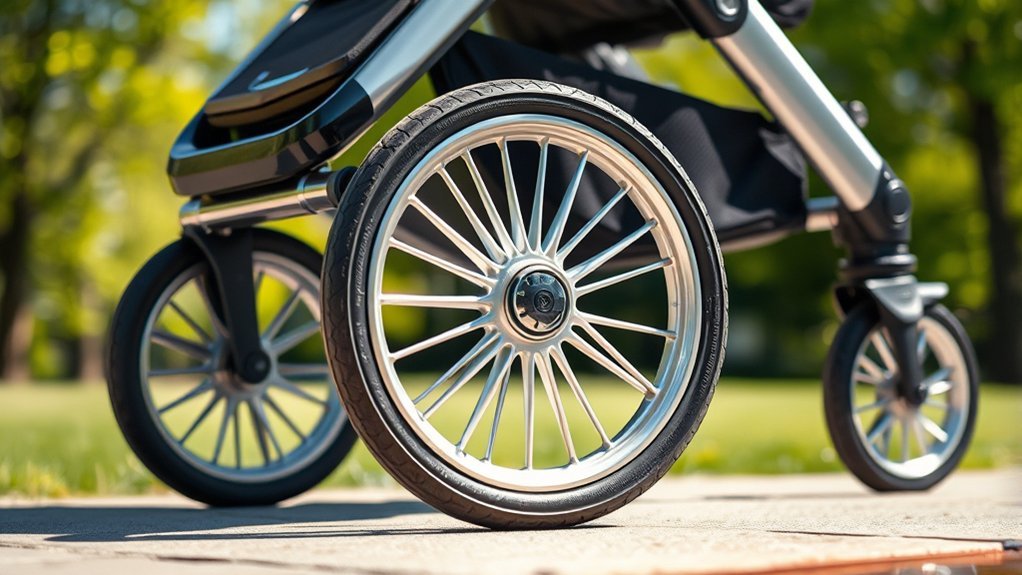
How to Lock the Front Wheel Correctly
Use this sequence each time you change the wheel position.
- Stop the stroller. Keep both hands on the handle if the stroller is on a slope.
- Set the parking brake. This prevents the stroller from rolling while you adjust it.
- Find the front-wheel control. Look near the wheel fork or front frame.
- Point the wheel straight ahead. Some locks will not engage unless the wheel is aligned.
- Move the lever, pin, or slider to the locked position.
- Test the wheel by hand. Push the stroller slightly while holding the handle. The wheel should stay aligned and should not swivel freely.
- Release the parking brake before moving.
- Attach the wrist strap before jogging. Keep it on your wrist whenever the stroller is moving at speed.
If the lock will not engage, do not run with the stroller. Check whether dirt, gravel, or fabric is blocking the mechanism. Never force the lever. A bent part or damaged wheel needs inspection or repair.
Signs that the lock is working
A working front-wheel lock should:
- Engage with a clear click or firm stop
- Keep the wheel aligned with the stroller
- Resist side-to-side swiveling
- Stay engaged as you push over a smooth surface
- Release without excessive force
Test the stroller without your child inside after any repair, folding, wheel removal, or adjustment. If the wheel shakes, sticks, or turns despite the lock, stop using the stroller for jogging until the issue is fixed.
Why Locking the Wheel Helps While Running
A swivel wheel can rotate when it meets an angled crack or small object. At slow speed, you can usually correct the direction. At running speed, the same movement may pull the stroller off line.
Locking the wheel limits that side movement. It does not steer the stroller by itself, and it does not prevent a crash. You still need to keep both hands available, watch the path, slow down near hazards, and use the wrist strap.
A fixed wheel can make tight turns harder. That is a useful trade-off: the locked setting improves straight-line control but reduces turning ability. Plan wider turns and slow down before corners.
The American Academy of Pediatrics advises parents to use jogging strollers as directed and to follow the manufacturer’s age and use guidance. The U.S. Consumer Product Safety Commission also provides product-safety information and recall notices. Check both the manual and current recall information for your model.
Common Mistakes to Avoid
Using the unlocked setting while running
An unlocked wheel may swivel when it hits a crack, rock, or curb edge. Lock it before increasing your pace.
Treating the wheel lock as a brake
The front-wheel lock does not keep a parked stroller from rolling. Use the parking brake every time you stop, even for a short moment.
Adjusting the wheel while moving
Stop first. Reaching toward the front wheel while the stroller rolls can cause you to lose control.
Running with a child who is too young
Jogging strollers differ. Some are approved only for children who can sit upright without support. Others allow an approved infant car-seat setup for walking but not for running. Follow the exact age, weight, and activity rules in the manual.
Running on unsuitable terrain
A locked wheel cannot overcome deep sand, large roots, loose rocks, ice, or a steep slope. Choose a safer route or walk the stroller.
Ignoring a pulling stroller
A stroller that pulls to one side may have low tire pressure, uneven tire wear, a misaligned wheel, or a tracking adjustment problem. Do not assume the front-wheel lock will solve it.
What to Do If the Stroller Pulls to One Side
First, stop using the stroller for running until you find the cause. Then check the likely problems in a safe order:
- Check tire pressure. Unequal pressure can make the stroller drift.
- Inspect the front wheel. Look for dirt, hair, stones, or damage around the axle.
- Confirm the wheel is fully locked. A partly engaged lock may allow movement.
- Check the rear wheels. A loose or damaged rear wheel can affect tracking.
- Look for a tracking adjustment. Some jogging strollers include a small adjustment near the front fork.
- Test the stroller without the child. Use a flat, open area at walking speed.
- Contact the manufacturer or a qualified repair center if the stroller still pulls, shakes, or makes unusual sounds.
Do not add homemade spacers, tape, lubricant, or replacement parts that the manufacturer does not approve. A temporary fix may affect the lock or wheel assembly.

Front-Wheel Lock vs. Parking Brake
These controls serve different purposes:
- Front-wheel lock: Helps the stroller travel straight while moving.
- Parking brake: Stops the wheels from rolling when the stroller is parked.
- Wrist strap: Helps keep the stroller attached to you if you lose your grip.
- Hand brake: Found on some jogging strollers; helps control speed on slopes but does not replace the parking brake.
Use all controls as intended. On a hill, keep the wrist strap on and maintain a firm grip. If you need to stop, use the parking brake and never leave the stroller unattended.
Does the Front Wheel Need to Be Locked on a Sidewalk?
Not always. For a slow walk on a smooth, level sidewalk, an unlocked wheel usually gives easier steering. If you are walking quickly, crossing rough pavement, or pushing over cracks and uneven areas, locking the wheel may provide better control.
The practical test is simple: if the wheel wanders, shakes, or swivels when the pace rises, stop and lock it before continuing. Do not wait until the stroller feels unstable.
Can You Jog With the Front Wheel Unlocked?
You should not jog with the front wheel unlocked unless the stroller manufacturer specifically says that configuration is safe. Most jogging strollers are designed to use a fixed or locked front wheel for running.
Even if the stroller feels stable on a smooth path, a small object can turn a swivel wheel. The risk increases with speed, uneven ground, downhill travel, and sharp changes in direction.
Can You Lock the Wheel on a Regular Stroller?
A regular stroller may have a front-wheel swivel lock, but that does not make it a jogging stroller. A jogging stroller is designed for faster movement and may include a fixed or lockable wheel, larger wheels, a longer frame, a wrist strap, and other features.
Use only the activities approved in the manual. Do not run with a standard stroller simply because its front wheel can lock.
What If the Front-Wheel Lock Is Stuck?
Stop using the stroller for running. Set the parking brake and inspect the mechanism for dirt or a small object. Check the manual for cleaning instructions, then try the control gently.
If the lever remains stuck, the wheel will not lock, or the mechanism feels loose, contact the manufacturer. Do not force the part or continue jogging with a wheel that cannot stay straight.
Key Takeaways
- Lock the front wheel before jogging or running.
- Unlock it for slow walks, tight turns, and crowded areas.
- Stop and set the parking brake before changing the wheel setting.
- The front-wheel lock is not a substitute for the parking brake.
- Use the wrist strap whenever you jog.
- Follow the stroller manual for child age, weight, terrain, and speed limits.
- Do not run if the wheel will not lock, shakes, or pulls to one side.
Conclusion
The safest general rule is easy to remember: locked for running, unlocked for slow maneuvering. A locked front wheel helps the stroller track straight, while an unlocked wheel makes turns easier.
Before every run, check the wheel, tires, brake, wrist strap, and route. If any part does not work as intended, walk only if the manual allows it—or stop using the stroller until it is repaired.
Sources and Further Reading
- American Academy of Pediatrics: Jogging Strollers
- U.S. Consumer Product Safety Commission
- Your stroller’s official owner’s manual and safety notices