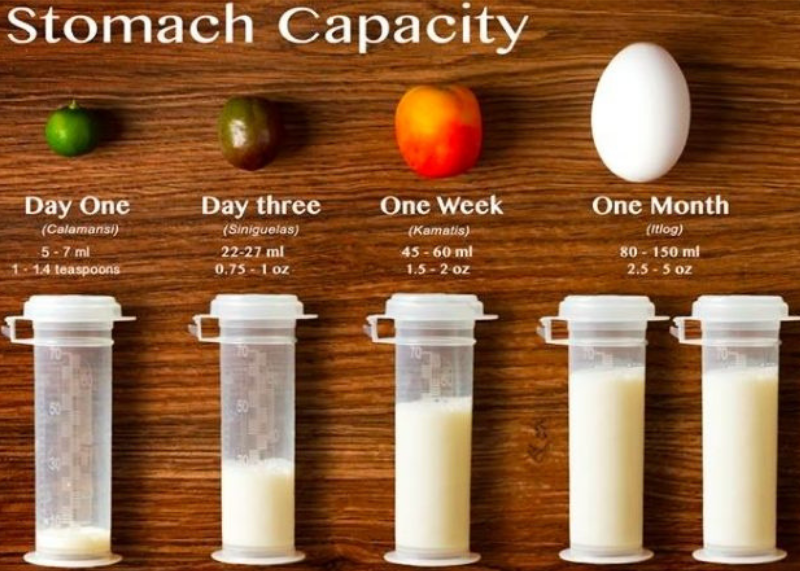
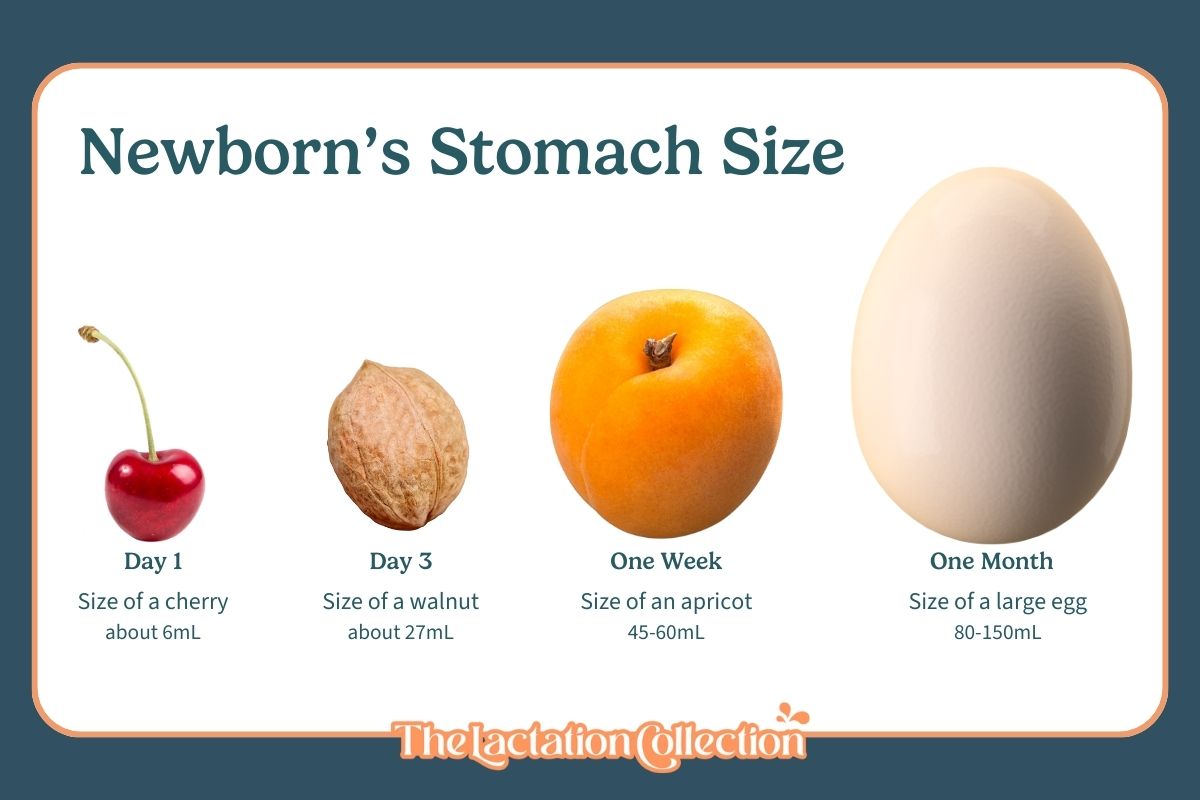
A newborn’s stomach can hold only a small amount at first—about 1 to 2 teaspoons (5 to 10 mL) during the first 24 hours. It grows quickly. By about 3 days, it may hold ¾ to 1 ounce (22 to 30 mL). By the end of the first week, many newborns can take about 1½ to 2 ounces (45 to 60 mL) at a feeding.
These are general estimates, not strict limits. A baby’s age, birth weight, gestational age, health, and feeding method all affect how much they can take. In the United States, your baby’s pediatrician should guide feeding if your newborn was premature, has a medical condition, or is not gaining weight well.

Newborn stomach capacity by age
A newborn’s stomach expands over the first several days. It does not grow from a teaspoon to a full bottle overnight.
| Baby’s age | Approximate stomach capacity | Common feeding amount |
|---|---|---|
| First 24 hours | 5–10 mL, or 1–2 teaspoons | Small, frequent feeds |
| Around day 3 | 22–30 mL, or ¾–1 ounce | About ½–1 ounce per feed |
| Around day 7 | 45–60 mL, or 1½–2 ounces | About 1–2 ounces per feed |
| Around 1 month | 80–150 mL, or 2½–5 ounces | Often 2–4 ounces per feed |
The ranges above come from newborn feeding guidance and clinical education materials, including information from Stanford Medicine’s Newborn Nursery and the American Academy of Pediatrics.
Capacity and intake are not the same thing. A baby may be able to hold a certain amount but take less at one feed. Newborns often eat small amounts many times each day.
A breastfed baby may also take a different amount at each feeding. With bottle-feeding, parents can measure the volume more easily, but the number on the bottle is not a target that every baby must finish.
How much should a newborn eat at one feeding?
Most healthy full-term newborns take about ½ to 1 ounce in the first few days. By the end of the first week, many take 1 to 2 ounces per feeding. By about 1 month, many babies take 2 to 4 ounces, although some take more or less.
The best guide is not one single volume. Look at several signs together:
- Your baby shows feeding cues.
- Your baby feeds actively.
- Your baby seems relaxed after many feeds.
- Wet diapers increase each day during the first week.
- Your baby has regular weight checks.
- Your baby’s weight starts to recover after the normal early loss.
For breastfeeding, it can be hard to know how many ounces your baby drank. A newborn may nurse for 10 minutes at one feed and 30 minutes at another. Time at the breast does not give a precise volume.
For formula-fed babies, the American Academy of Pediatrics advises parents to follow hunger and fullness cues rather than force a set amount. A newborn may feed about 8 to 12 times in 24 hours, but patterns vary.
Do not make a newborn finish a bottle. Stop when the baby shows signs of fullness, such as turning away, relaxing the hands, slowing the sucking, or falling asleep.

Why can a newborn stomach hold so little?
A newborn’s stomach is small because the baby has just moved from constant nutrient delivery through the placenta to separate feeds. The stomach and gut are still developing.
Early milk, called colostrum, is thick and made in small amounts. It is rich in nutrients and immune factors. Small amounts match the early size of the stomach and the baby’s early needs.
Newborns also digest milk quickly. That is one reason they may feed often, including during the night. Frequent feeding does not always mean that something is wrong.
The stomach is flexible, too. Capacity changes with the baby’s age and the amount taken over time. This is why a number such as “one ounce” should be treated as a guide, not a hard limit.
A common mistake is to compare a newborn’s feed with the amount an older infant drinks. A 2-month-old may take much more at once than a baby on the first day of life.

How often should a newborn feed?
Most newborns feed 8 to 12 times in 24 hours, whether they breastfeed or take formula. Some feed more often for short periods. This can happen during a growth spurt or during cluster feeding.
Feed when your baby shows early hunger cues, such as:
- Stirring or waking
- Turning the head toward touch
- Opening the mouth
- Bringing hands to the mouth
- Licking or sucking
- Making soft sounds
Crying is a late hunger cue. A crying baby may have more trouble latching or pacing a bottle.
In the first days, a sleepy newborn may not wake often enough to feed. Ask your baby’s health care professional how often to wake the baby, especially if the baby was premature, had a low birth weight, has jaundice, or has lost more weight than expected.
The Centers for Disease Control and Prevention recommends working with a health care professional when you have concerns about breastfeeding, milk supply, or your baby’s intake.
How do you know whether your newborn is getting enough?
Diapers, feeding behavior, and weight checks give a better answer than stomach size alone.
Wet diapers
A general pattern during the first week is:
- Day 1: At least 1 wet diaper
- Day 2: At least 2 wet diapers
- Day 3: At least 3 wet diapers
- Day 4: At least 4 wet diapers
- Day 5 and after: About 5 to 6 or more wet diapers each day
This pattern is a guide. Your baby’s clinician may give different instructions based on the baby’s health.
Stool patterns also change. Early stools are dark and sticky. They usually become lighter and looser over the first several days.
Weight
Newborns often lose some weight after birth. The amount and timing matter. Most babies begin to regain weight after the first few days and return to birth weight by about 10 to 14 days, though some take longer.
A weight check is more useful than trying to estimate stomach volume at home. Your pediatrician or lactation professional can check feeding, milk transfer, and growth.
Feeding behavior
A baby who feeds well often has steady sucking and swallowing, then relaxes or releases the breast or bottle. A baby who remains very sleepy, has weak sucking, or cannot stay awake for feeds may need prompt evaluation.

Does breastfeeding change how much a newborn can hold?
No. Breastfeeding and bottle-feeding do not create different stomach sizes. The main difference is that breast milk intake is harder to measure.
A breastfed newborn may take small amounts often. Milk production usually increases over the first several days after birth. Colostrum is present in small amounts, but that does not mean it lacks value.
Look for swallowing during feeds. You may also notice softer breasts after feeding and a baby who seems calmer or more relaxed. These signs are useful but do not replace weight checks when intake is uncertain.
If breastfeeding is painful, the baby cannot latch, or the baby feeds for long periods without swallowing, contact a lactation professional or pediatric clinician. Early help can prevent dehydration and help protect milk supply.
Do not give water, juice, cereal, or other drinks to a newborn unless a qualified clinician specifically tells you to do so. Babies under about 6 months generally need breast milk or iron-fortified infant formula as their main source of nutrition. The American Academy of Pediatrics explains why water can be unsafe for young babies.

Does formula change the amount a newborn can hold?
Formula does not change the basic stomach capacity, but bottle-feeding can make it easy to offer more than a baby wants.
Use the formula amount and mixing directions on the product label. Measure water and powder carefully. Do not dilute formula, add extra powder, or use homemade formula. The CDC’s infant formula guidance covers safe preparation and storage in the United States.
Use paced bottle-feeding:
- Hold your baby in a semi-upright position.
- Keep the bottle more level than vertical.
- Let the baby pause during the feed.
- Watch for fullness cues.
- Stop when the baby turns away, slows down, or relaxes.
Never prop a bottle or leave a newborn alone with a bottle. Bottle propping can increase the risk of choking, ear infections, and overfeeding.
A larger feed may not help a newborn sleep longer. It can instead lead to spit-up, discomfort, or overfeeding.
Can a newborn’s stomach be stretched by overfeeding?
A single larger feed does not usually cause permanent stretching. However, repeatedly urging a baby to finish a bottle can override the baby’s normal hunger and fullness signals.
Newborns have limited control over bottle flow. Milk may come out faster than the baby can comfortably manage. This can look like gulping, coughing, leaking milk, pulling away, or becoming upset.
If this happens, pause the feed. Check the bottle nipple flow and use a slower, paced method. Ask a pediatric clinician or feeding specialist for help if coughing or choking happens often.
Spit-up is common because the muscle between the esophagus and stomach is still developing. Small spit-ups after feeding may be normal. Call the baby’s clinician for forceful vomiting, green vomit, blood, poor feeding, unusual sleepiness, or signs of dehydration.
When should you call a pediatrician?
Contact your baby’s pediatrician promptly if your newborn:
- Has fewer wet diapers than expected
- Is difficult to wake for feeds
- Refuses several feeds
- Has weak sucking or cannot stay latched
- Has repeated vomiting
- Has a dry mouth or very dark urine
- Seems unusually limp, pale, or unwell
- Is not gaining weight as expected
Seek urgent medical care for trouble breathing, blue or gray skin, severe choking, or a newborn with a temperature of 100.4°F (38°C) or higher. The American Academy of Pediatrics advises immediate medical evaluation for a baby younger than 3 months with this fever level.
Premature babies, babies with low blood sugar, and babies with jaundice may need a specific feeding plan. Do not rely on a general stomach-capacity chart for these infants.

Common mistakes about newborn stomach capacity
Mistake 1: Treating the estimate as a required amount
A stomach-capacity estimate is not a feeding prescription. Babies vary. The care team may recommend a different amount based on weight, health, and growth.
Mistake 2: Feeding by the clock alone
A schedule can help organize feeds, but hunger and fullness cues still matter. Some newborns need to feed more often than a printed schedule suggests.
Mistake 3: Assuming crying always means hunger
Crying may signal hunger, but it can also mean discomfort, fatigue, a wet diaper, temperature issues, or the need to burp.
Mistake 4: Using water to settle a baby
Water can upset a young baby’s electrolyte balance and reduce needed milk intake. Ask a clinician before giving anything other than breast milk or formula.
Mistake 5: Measuring breastfeeding success by minutes
A long feed does not always mean a large feed. A short, active feed may transfer more milk than a long, sleepy one. Diapers, swallowing, and weight provide better clues.
Mistake 6: Making a bottle larger to improve sleep
A larger bottle is not a safe sleep treatment. Follow responsive feeding practices and discuss sleep concerns with your pediatrician.

Quick reference: newborn stomach capacity
For a healthy, full-term newborn, a practical estimate is:
- First day: 5–10 mL, or 1–2 teaspoons
- Third day: 22–30 mL, or about ¾–1 ounce
- End of first week: 45–60 mL, or 1½–2 ounces
- Around 1 month: 60–120 mL is common, though some babies take up to about 150 mL
These numbers describe approximate capacity and common intake ranges. They do not tell you exactly how much your baby should drink at every feed.
The safest next step is to track feeding cues, wet diapers, and scheduled weight checks. If those signs do not match, contact your baby’s pediatrician rather than trying to solve the problem by offering a much larger feed.

FAQs
Can a newborn drink 2 ounces at once?
Some newborns can drink 2 ounces, especially near the end of the first week or later. A younger baby may take less. Do not force the bottle to reach 2 ounces, and watch for fullness cues.
How many milliliters should a newborn drink per feed?
Many newborns take about 15–30 mL per feed in the first few days. By the end of the first week, 45–60 mL may be common. Your baby’s clinician may set a different amount.
Can a newborn’s stomach hold more than 1 ounce?
Yes. Stomach capacity increases quickly. Around day 3, many babies can take close to 1 ounce. By the end of the first week, many can take 1½ to 2 ounces.
Should I wake my newborn to feed?
Many newborns need regular feeds and may need to be awakened if they sleep too long. The right timing depends on age, weight, jaundice, birth history, and feeding progress. Ask your pediatrician for a plan.
Is spit-up a sign that my newborn ate too much?
Not always. Small spit-ups are common in young babies. Frequent, forceful, green, bloody, or distressing vomiting needs medical advice.
Key takeaways
- A newborn’s stomach holds about 5–10 mL on the first day.
- Capacity often reaches 22–30 mL by day 3 and 45–60 mL by the end of the first week.
- Feeding amounts vary, so do not treat these numbers as strict targets.
- Hunger cues, fullness cues, wet diapers, and weight gain matter more than one feed.
- Do not give water or dilute infant formula.
- Call a pediatrician if your newborn feeds poorly, has too few wet diapers, vomits repeatedly, or is hard to wake.
Conclusion
A newborn stomach starts very small, but it grows fast. Think of the early days as many small refills rather than three large meals. Offer breast milk or properly prepared infant formula when your baby shows hunger cues, pause when your baby shows fullness, and use diaper counts and weight checks to judge overall intake.
If your baby seems too sleepy to feed, has fewer wet diapers, or is not gaining weight, contact the pediatrician. A feeding professional can also watch a feed and help you make a safe plan.