A healthy full-term newborn’s stomach can hold only a small amount at first—about 1 to 2 teaspoons (5 to 10 mL) during the first day. By the end of the first week, many newborns can take about 1 to 2 ounces (30 to 60 mL) per feeding.
These are general ranges, not strict limits. A baby’s stomach grows quickly, and feeding needs vary by age, birth size, feeding method, and health.
Introduction
New parents often worry that a newborn is not getting enough milk because the baby drinks only a small amount. In the first days after birth, small feeds are normal. Colostrum, the first breast milk, is thick and rich, and newborns need only small amounts at each feed.
The key is to look at the full picture: feeding frequency, wet diapers, stool changes, weight, and the baby’s behavior. A single feeding does not show whether a newborn is getting enough.
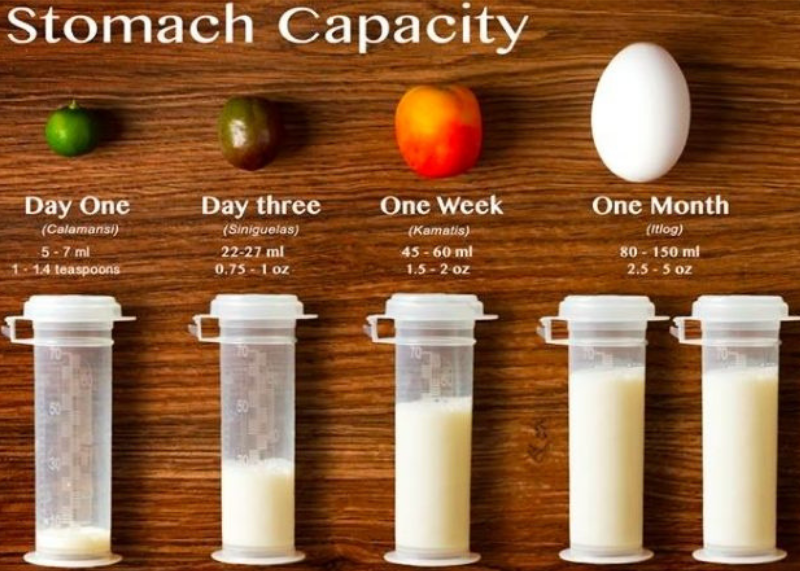
Newborn stomach capacity by age
A newborn’s stomach expands fast during the first week. The following table gives useful estimates for a healthy, full-term baby:
| Baby’s age | Approximate amount per feeding | Helpful comparison |
|---|---|---|
| First 24 hours | 5–10 mL | 1–2 teaspoons |
| Day 2 | 5–15 mL | 1–3 teaspoons |
| Days 3–4 | 15–30 mL | ½–1 ounce |
| By the end of week 1 | 30–60 mL | 1–2 ounces |
| Around 1 month | 60–120 mL | 2–4 ounces |
These amounts are estimates, not medical targets. Some babies take less but feed more often. Others take more at some feeds and less at others.
The American Academy of Pediatrics notes that formula-fed newborns often begin with about 1 to 2 ounces per feeding in the first days, then gradually increase intake. Breastfed babies may take smaller amounts more often, especially while the parent’s milk supply is increasing. See the AAP guidance on how often and how much babies should eat.
A newborn’s stomach is not a fixed container. Its capacity changes from feed to feed. A baby may also stop before the stomach is full because of sleepiness, a pause in milk flow, or the need to burp.
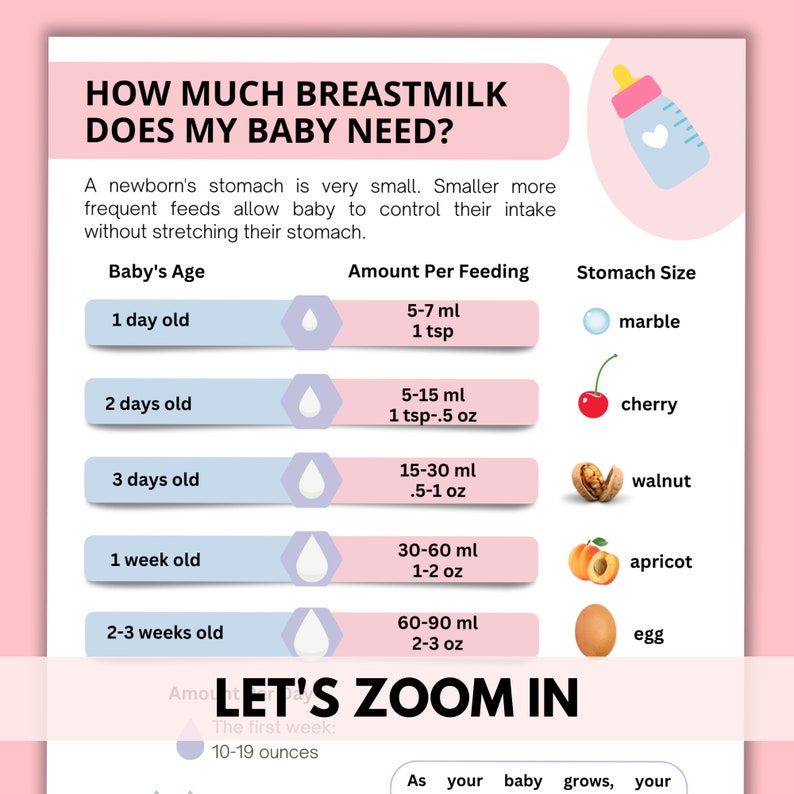
Why newborns need small, frequent feeds
Newborns have small stomachs and high energy needs. They also digest human milk and infant formula over time, so they usually need to feed many times in 24 hours.
Most breastfed newborns feed about 8 to 12 times in 24 hours. Some feed more often. Formula-fed newborns commonly eat every 2 to 3 hours, though schedules can vary. The Centers for Disease Control and Prevention recommends watching the baby’s hunger and fullness cues rather than forcing a fixed amount.
Colostrum also affects the first feeds. It is made in small amounts, but it contains concentrated nutrients and immune factors. A newborn may nurse for a short time, pause, and then ask to feed again soon.
Frequent feeding also helps signal the breasts to make more milk. This is one reason strict attempts to stretch the time between feeds can cause problems in the early days.
Typical hunger cues
early hunger signs include:
- Moving the hands toward the mouth
- Turning the head toward a breast or bottle
- Opening the mouth
- Licking or smacking the lips
- Becoming more alert
- Making soft sounds
Crying is a late hunger sign. A very upset baby may have a harder time latching or taking a bottle.

How much milk should a newborn drink?
The right amount depends on whether the baby breastfeeds, drinks expressed milk, or takes formula. It also depends on the baby’s age and health.
Breastfed newborns
You usually cannot measure the exact amount a breastfed baby drinks at the breast. Instead, track signs that milk is moving well:
- The baby has a deep latch.
- You can hear or see swallowing.
- The baby’s hands and body relax during the feed.
- The baby seems satisfied after some feeds.
- Wet diapers increase over the first several days.
- The baby receives regular weight checks.
A newborn may nurse on one or both breasts. Feed length can differ from one session to the next. The goal is not to make every feed last the same amount of time.
Expressed breast milk
When giving expressed breast milk, offer a small amount first. You can provide more if the baby still shows hunger cues.
A slow-flow nipple and paced bottle-feeding can help the baby control the pace. Hold the bottle mostly level, allow pauses, and avoid pushing the nipple into the baby’s mouth. This can reduce the chance of overfeeding.
Infant formula
Many newborns start with about 1 to 2 ounces per feeding, often every 2 to 3 hours. The amount often rises during the first weeks.
Always mix powdered or concentrated formula exactly as the label says. Do not add extra water, extra powder, cereal, or other ingredients. Incorrect mixing can cause serious problems with fluid and nutrient balance.
Never force a baby to finish a bottle. Turned-away eyes, relaxed hands, a slower suck, or pushing the bottle away can signal fullness.

How to tell whether a newborn is getting enough
Diapers and weight trends are more useful than trying to calculate stomach size.
A general diaper pattern is:
- Day 1: At least 1 wet diaper may be expected.
- Day 2: At least 2 wet diapers may be expected.
- Day 3: At least 3 wet diapers may be expected.
- By days 4 to 5: Many babies have about 5 to 6 or more wet diapers each day.
Stool color also changes. Early stools are dark and sticky. They usually become lighter and looser over the first several days.
These are broad guides. A pediatrician or lactation professional may set different goals based on birth weight, jaundice, dehydration risk, or medical needs.
Weight is one of the best measures of intake. Some weight loss after birth is common, but the amount and recovery need professional review. The American Academy of Pediatrics recommends an early newborn follow-up visit after leaving the hospital, often within a few days.
Call the baby’s healthcare professional if the newborn:
- Has too few wet diapers
- Is hard to wake for feeds
- Feeds very poorly
- Has a weak suck
- Vomits green fluid or repeatedly vomits forcefully
- Has a dry mouth or seems unusually limp
- Looks increasingly yellow
- Has a fever of 100.4°F (38°C) or higher if younger than 3 months
For urgent symptoms, seek emergency care. Do not wait for the next routine visit.

Can a newborn’s stomach stretch from eating too much?
A newborn’s stomach can expand during a feed, but it does not mean that every baby should take a larger bottle. Overfeeding is more likely with a bottle because milk can flow faster than the baby can control.
Signs of possible overfeeding include:
- Frequent spit-up
- Gulping or coughing during feeds
- Choking or pulling away
- A tense, uncomfortable belly
- Fussiness after feeding
- Taking very large amounts and then going a long time without feeding
Spit-up by itself is common. Many healthy babies spit up small amounts because the muscle between the esophagus and stomach is still developing.
To reduce overfeeding:
- Start with a small amount.
- Feed slowly.
- Pause for burping.
- Watch for fullness cues.
- Stop when the baby turns away or relaxes.
- Do not pressure the baby to finish the bottle.
Do not use stomach capacity charts to make a baby wait when the baby shows clear hunger cues. Likewise, do not use crying alone as proof that the baby needs more milk. A diaper change, burping, warmth, or comfort may solve the problem.

Newborn stomach size: common mistakes to avoid
The most common mistake is treating an estimate as a rule. A chart may show a typical range, but it cannot measure what one specific baby needs at one feed.
Avoid these practices:
- Delaying feeds to “fill the stomach.” Newborns often need frequent feeds.
- Making a breastfed baby take a set bottle amount. Intake at the breast is not easy to measure.
- Forcing a bottle to be finished. Babies can show fullness before the bottle is empty.
- Adding cereal to a bottle. This can create choking and feeding risks and should not be done unless specifically directed by a clinician.
- Diluting formula. Extra water lowers the nutrient content and can be dangerous.
- Comparing a newborn with an older infant. Feeding amounts rise quickly during the first months.
- Using wet diapers as the only measure. Weight checks and clinical exams also matter.
If feeding seems difficult, ask for help early. A pediatrician, registered nurse, or International Board Certified Lactation Consultant can assess the latch, milk transfer, bottle technique, and the baby’s growth.
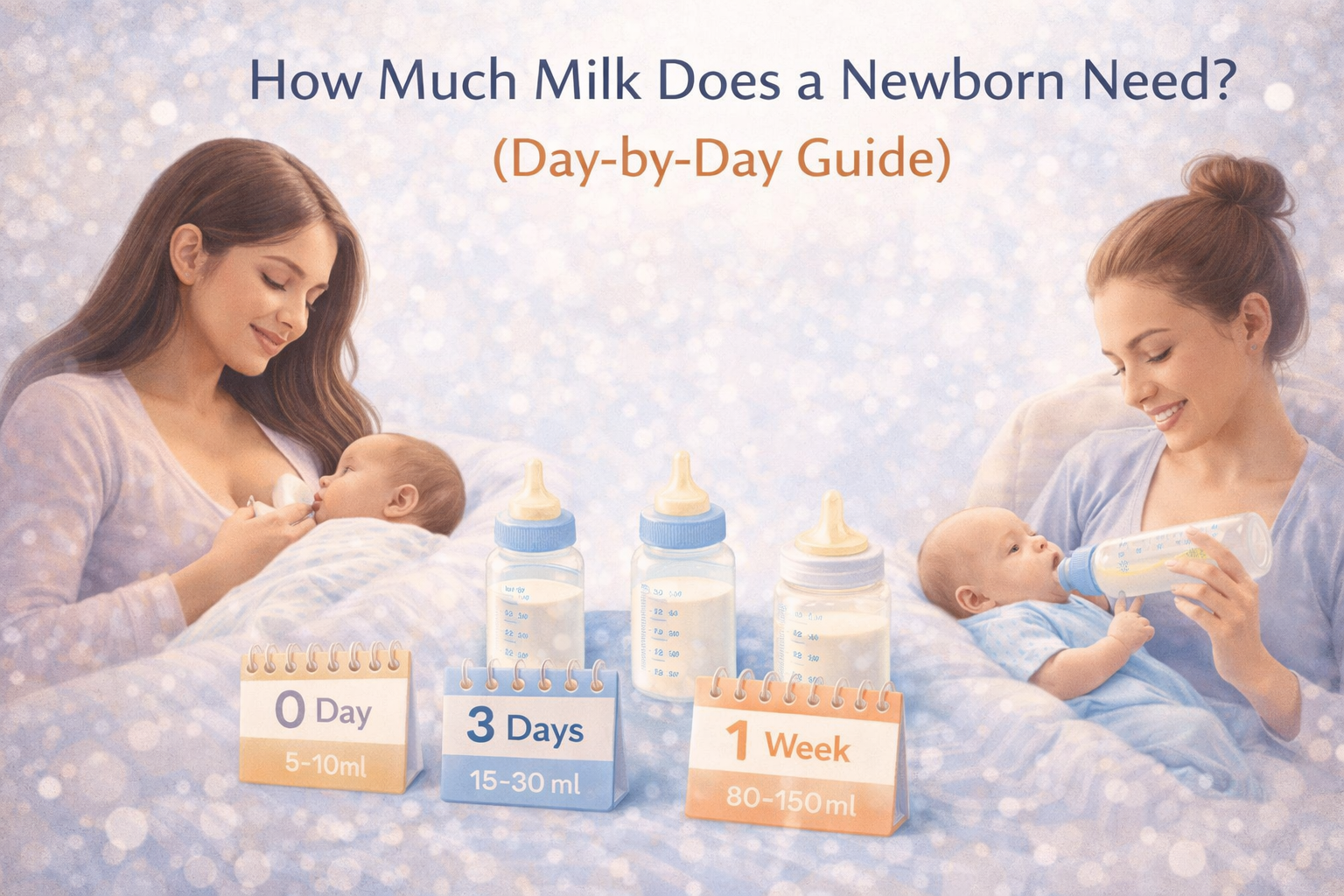
Breast milk versus formula: does stomach capacity differ?
The physical stomach capacity is not divided into separate “breast milk” and “formula” sizes. However, feeding patterns can differ.
Breast milk may be offered more often, and a breastfed baby may take different amounts at different feeds. Formula-fed babies may follow a more measurable bottle pattern, but they still need to eat according to hunger and fullness cues.
Formula is not “heavier” in a way that makes a newborn’s stomach larger. It may take longer to digest for some babies, but parents should not use this idea to delay feeds or make a baby wait.
For either feeding method, growth, diaper output, alertness, and clinical checks matter more than a single volume.

When to call the pediatrician
Contact the baby’s healthcare professional if you are unsure whether the newborn is eating enough. It is especially important to call when the baby has poor diaper output, continues to lose weight, is difficult to wake, or cannot stay latched or suck well.
Seek prompt medical advice for signs of dehydration, worsening jaundice, repeated vomiting, or a baby who appears weak. For a newborn under 3 months, a rectal temperature of 100.4°F (38°C) or higher needs immediate medical guidance.
If breastfeeding hurts, the baby makes clicking sounds, or feeds take much longer than expected, request a feeding assessment. A small change in positioning or latch can sometimes improve milk transfer.

Key takeaways
- A newborn’s stomach holds about 5–10 mL in the first 24 hours.
- By the end of the first week, many newborns take about 30–60 mL per feeding.
- These are estimates, not fixed limits.
- Newborns often feed 8–12 times per day, especially when breastfeeding.
- Diapers, swallowing, behavior, and weight gain help show whether intake is adequate.
- Feed slowly and stop when a bottle-fed baby shows fullness cues.
- Call a pediatrician for poor feeding, too few wet diapers, unusual sleepiness, repeated vomiting, worsening jaundice, or fever.
Frequently asked questions
Can a newborn drink 2 ounces at once?
Some newborns can drink 2 ounces, especially near the end of the first week or during a growth spurt. Others may need less and feed more often. Do not force a baby to take 2 ounces if the baby shows fullness.
How often should a newborn eat?
Many newborns eat 8 to 12 times in 24 hours when breastfeeding. Formula-fed newborns often eat every 2 to 3 hours. Feeding frequency can vary, so follow hunger cues and the plan from the baby’s healthcare professional.
Is it normal for a newborn to want to eat every hour?
It can be normal, especially during cluster feeding or a growth spurt. However, very frequent feeds with poor swallowing, few wet diapers, or poor weight gain may signal a feeding problem. Ask the pediatrician or a lactation professional to check milk transfer.
How do I know if my newborn is full?
A full newborn may slow down, stop sucking, turn away, relax the hands, close the mouth, or fall asleep calmly. Do not rely only on an empty bottle as proof that the baby needs more.
What if my newborn will not finish a bottle?
Stop when the baby shows fullness cues. A newborn does not need to finish every bottle. If the baby repeatedly takes very little, is hard to wake, vomits often, or has too few wet diapers, contact the pediatrician.
Conclusion
A newborn’s stomach is small, but it grows quickly. In the first day, a baby may take only teaspoons at a time. By the end of the first week, many babies take 1 to 2 ounces per feed.
Use stomach size as a helpful guide, not a feeding rule. Offer milk when the baby shows hunger cues, watch for signs of fullness, and track diapers and weight. When feeding does not seem to be going well, contact the baby’s healthcare professional rather than trying to increase or limit the amount on your own.
Sources
- American Academy of Pediatrics: How Often and How Much Should Your Baby Eat?
- Centers for Disease Control and Prevention: How Much and How Often to Feed Infant Formula
- Centers for Disease Control and Prevention: How Much and How Often to Breastfeed
- American Academy of Pediatrics: Newborn and Infant Breastfeeding