
Most babies say a meaningful first word around 12 months, though normal timing can range from 9 to 15 months.
Wondering when do babies say first word is a common part of early parenthood. Language grows step by step, from cries and coos to babbling, gestures, and clear words. Knowing what to expect can help you support your baby without turning normal development into a race.
When Do Babies Say Their First Word?
Most babies say their first meaningful word near their first birthday. Some say a word as early as 9 months, while others need more time and begin closer to 15 or 18 months.
A first word is more than a random sound. It usually has meaning and repeats in the right setting. For example, a baby who says “ba” whenever they see a ball may be using an early word, even if the sound is not yet clear.
Common first words include:
• Mama
• Dada
• Bye-bye
• Hi
• Ball
• Dog
• More
• Up
• No
• Milk
When asking when do babies say first word, remember that speech skills develop at different speeds. One baby may speak early, while another may understand many words but stay quiet for longer.
The Centers for Disease Control and Prevention notes that many 15-month-old children try to say one or two words besides “mama” or “dada.” These milestones describe what most children can do, not a strict deadline for every child.

What Counts as a Baby’s First Word?
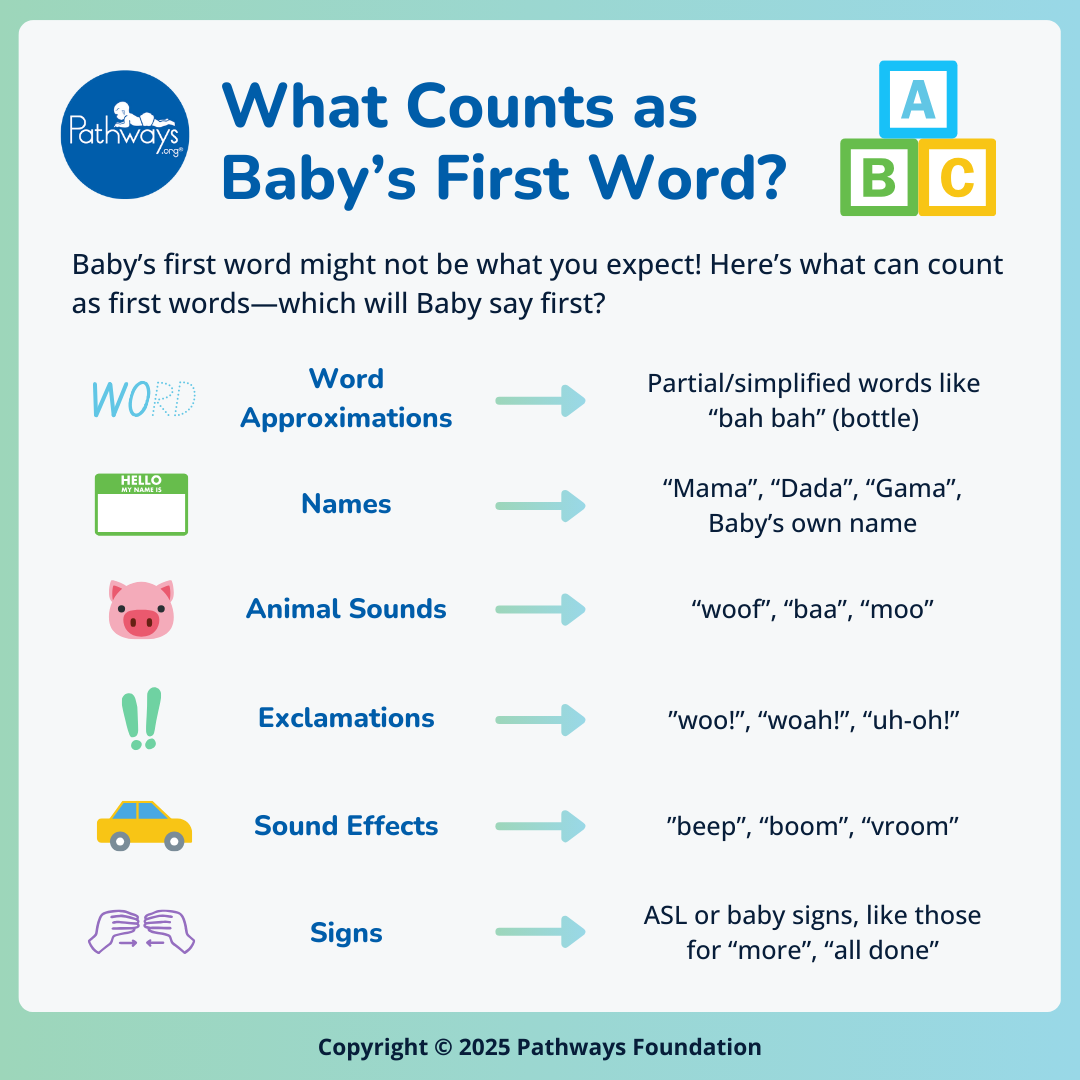
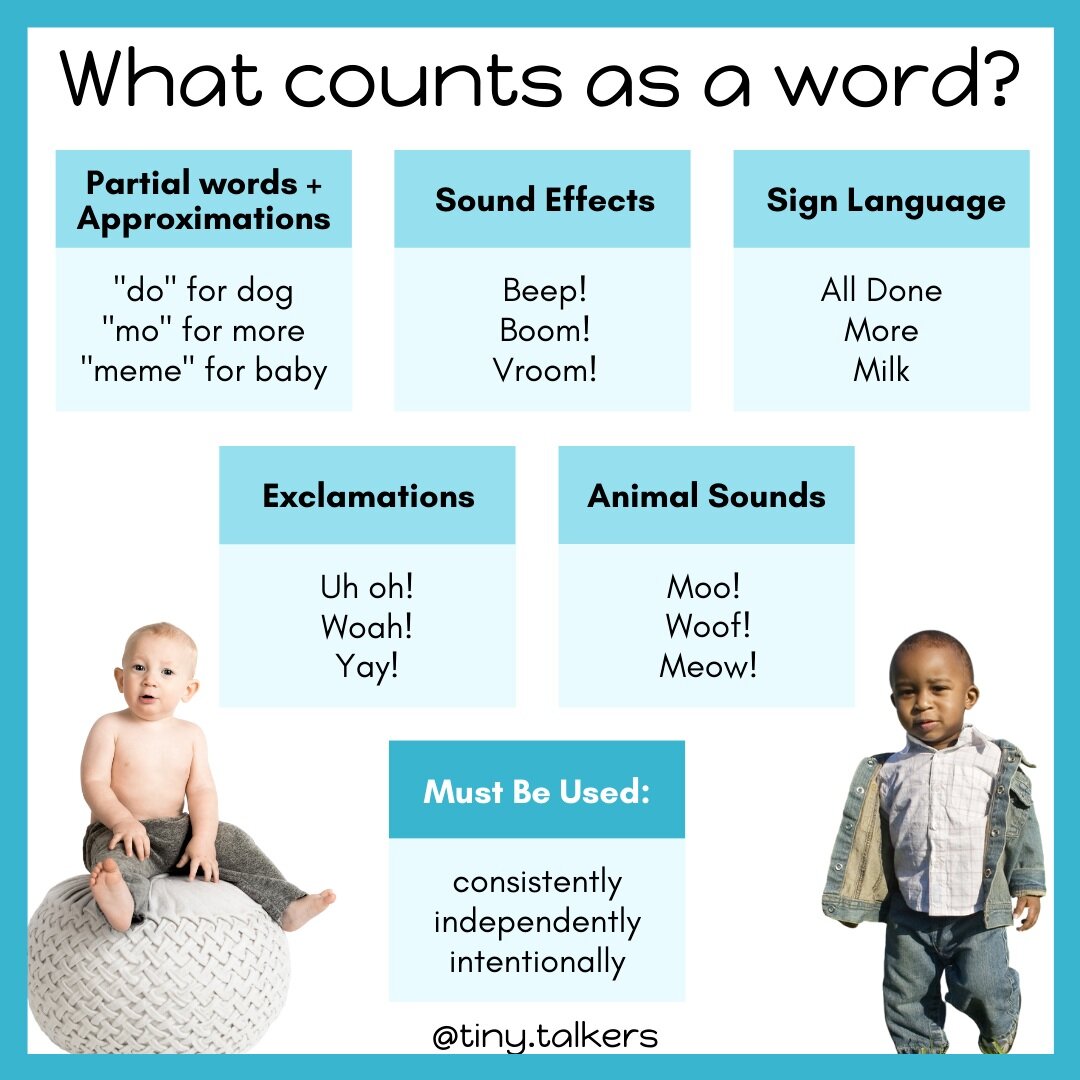
A first word should be used consistently and with purpose. It does not need to sound perfect. Babies often leave out sounds or shorten words while learning to control their lips, tongue, and voice.
For example, these may count as early words:
• “Ba” for ball
• “Da” for dog
• “Ju” for juice
• “Uh” for up
• “Mi” for milk
• “Nana” for banana
A sound counts more strongly as a word when your baby uses it in the same way several times. If “ba” happens only during random babbling, it may not yet have a clear meaning.
Understanding often comes before speaking. Your baby may know what “shoe,” “bottle,” or “come here” means before saying any of those words. This gap is normal because understanding language is usually easier than producing it.
When do babies say first word can also depend on how adults define “word.” Some parents count a repeated sound with meaning. Others wait for a clearer adult-like word. Both views can be useful when tracking progress.
Baby Language Milestones by Age
Language development is gradual. Each stage prepares the brain and mouth for the next one.
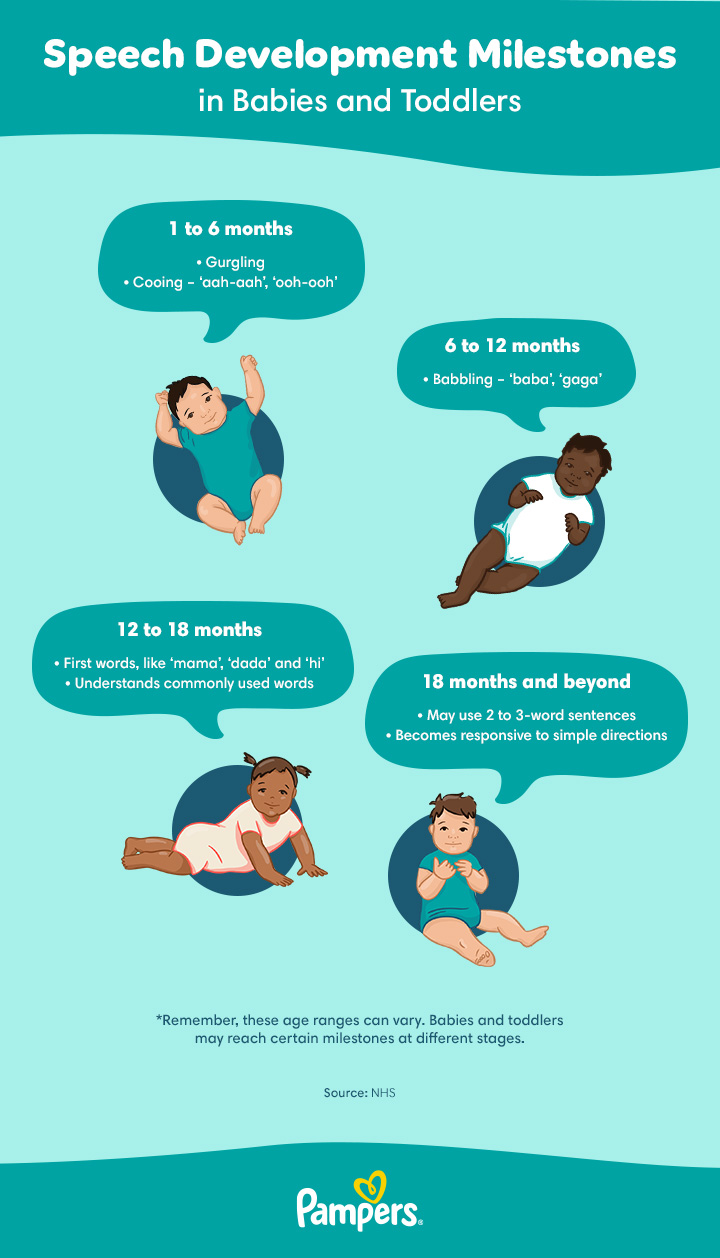
Birth to 3 months
Newborns mainly communicate through crying, facial expressions, and body movements. By about 2 months, many babies begin cooing and making soft vowel sounds.
They also learn the rhythm of familiar voices. Smiling, looking toward sound, and calming when spoken to are early communication skills.
4 to 6 months
Babies often laugh, squeal, and make a wider range of sounds. They may respond to changes in your voice and turn toward sounds.
Some babies begin early babbling during this stage. They may repeat sounds such as “ba,” “ga,” or “ma,” though these sounds may not have meaning yet.
7 to 9 months
Babbling becomes more varied. Your baby may say strings such as “bababa” or “mamama.” They may also copy sounds, watch your mouth, and respond to their name.
Gestures become important at this age. Reaching, pointing, waving, and lifting the arms to be picked up all support language growth.
10 to 12 months
Many babies understand simple words and phrases. They may follow a basic request, such as “come here,” especially when you use a gesture.
This is also the stage when some babies say their first meaningful word. If you are asking when do babies say first word, the answer for many families is between 10 and 14 months.
13 to 18 months
Vocabulary often grows slowly at first and then speeds up. A toddler may add several new words, use gestures with speech, and point to familiar people or objects.
By 18 months, many children use at least a few words beyond “mama” and “dada.” Some children have many words, while others are still building their first small vocabulary.
19 to 24 months
Many toddlers begin combining two words, such as “more juice,” “go outside,” or “mommy up.” They may understand far more words than they can say.
Speech may still be hard for strangers to understand. That is usually expected at this age because clear pronunciation develops over time.
Why Do Babies Start Talking at Different Ages?
Several factors can affect when babies say their first word. These factors do not always predict exactly when speech will begin.
Brain and motor development
Speaking requires careful teamwork between the brain, lips, tongue, jaw, and breathing muscles. Babies must learn to hear sounds, remember them, and produce them.
This process takes time. A baby may understand a word but lack the motor control needed to say it clearly.
Hearing
Hearing plays a major role in speech development. Even mild hearing loss from repeated ear infections can make it harder for a child to hear speech sounds.
A baby who does not respond to voices or sounds should receive a hearing check. Hearing tests are safe and can help identify support needs early.
Personality and communication style
Some babies are social and vocal from the start. Others communicate more through pointing, eye contact, facial expressions, and movement.
A quiet baby is not always a delayed speaker. Look at the full picture, including understanding, gestures, social interest, and response to sound.
Birth history
Babies born early may reach language milestones later when measured by their actual birth date. Health professionals may use corrected age during the first two years.
Your pediatrician can explain how prematurity, early medical problems, or time in the neonatal intensive care unit may affect development.
Family patterns
Speech timing can sometimes run in families. A parent may remember speaking late as a child, and the same pattern may appear in the next generation.
Family history is helpful information, but it should not replace developmental screening when concerns arise.
Home language environment
Babies learn through warm, repeated interaction. Talking, singing, reading, and responding to sounds give the brain many chances to connect words with meaning.
Growing up with two or more languages does not cause a speech disorder. A multilingual child may divide words across languages, so caregivers should count the child’s total vocabulary in all languages.
How to Encourage Your Baby’s First Words
You do not need expensive toys or special lessons to support speech. Everyday routines offer some of the best learning moments.
Talk during daily care
Describe what you are doing in short phrases:
• “Wash hands.”
• “Here is your cup.”
• “Socks on.”
• “Open the door.”
• “Time for a bath.”
Use simple words and repeat them often. Repetition helps your baby connect a sound with an action or object.
Follow your baby’s interests
If your baby points to a dog, talk about the dog. Say, “Dog! The dog is running.” Following their attention makes language more meaningful.
Avoid testing too often. Asking “What is that?” again and again can feel like pressure. It is usually better to comment, pause, and give your baby a chance to respond.
Read picture books
You do not need to read every word on every page. Point to pictures and name them. Ask simple questions, then wait several seconds for your baby to react.
Books with clear pictures, repeated phrases, and animal sounds can be especially engaging. The goal is shared attention, not finishing the story.
Use gestures with words
Pairing a word with an action can make meaning easier to understand. Wave while saying “bye-bye,” point while saying “there,” and lift your arms while saying “up.”
Gestures are not a replacement for speech. They are a bridge that often helps babies understand and later use words.
Copy and expand sounds
If your baby says “ba,” you might respond, “Ball! Red ball.” This shows that you heard the attempt and gives them a slightly richer model.
Try not to correct every sound. Clear, friendly models work better than repeated demands to say a word perfectly.
Limit background screen noise
Babies learn language best through back-and-forth interaction. Television or videos playing in the background can reduce the amount of direct talking and shared attention.
The American Academy of Pediatrics recommends focusing on real-world interaction for infants. When screens are used, shared viewing with an adult is more helpful than leaving a baby alone with a device.

Signs Your Baby May Need Extra Speech Support
Parents often ask when do babies say first word because they worry about delay. A single late word does not always signal a problem, but patterns matter.
Talk with your child’s pediatrician if your baby:
• Does not respond to loud sounds or familiar voices
• Rarely makes sounds by 7 months
• Does not babble by around 9 months
• Does not use gestures, such as pointing or waving, by about 12 months
• Does not try to say words by 15 months
• Loses words or social skills they previously had
• Seems unable to understand simple language
• Shows little interest in people or shared interaction
Loss of skills deserves prompt attention. Do not wait to see whether the problem disappears.
The American Academy of Pediatrics recommends regular developmental screening. A doctor may suggest a hearing test, speech-language evaluation, or early intervention referral.
Early intervention does not label a child or predict their future. It provides practical support during a period when the developing brain is highly responsive to learning.

Common Mistakes Parents Should Avoid
It is easy to feel pressure when another baby says a first word early. Comparing children can create worry without giving useful information.
Try to avoid these common mistakes:
• Expecting clear adult speech from a young baby
• Counting every babble as a word
• Treating speech like a contest
• Correcting pronunciation too often
• Using long, complex sentences all day
• Ignoring hearing concerns
• Waiting too long after skills are lost
• Assuming bilingual exposure causes delay
A helpful approach is to track progress over time. Write down new sounds, gestures, words, and ways your baby understands you. This record can help your pediatrician see the bigger picture.
One lesson many parents learn is that communication is broader than speech. A baby who points to a cup, looks at you, and makes a sound is already building the skills needed for spoken language.

When Do Babies Say First Word: Practical Ways to Track Progress
If you want a simple way to monitor language growth, keep a monthly note. Record what your baby says, understands, points to, and imitates.
You can track:
• New sounds
• Repeated sound patterns
• Meaningful words
• Gestures
• Response to their name
• Understanding of simple requests
• Interest in books and people
• Any lost skills
Count a word when your child uses the sound with a stable meaning. For example, “ba” may count if your baby uses it each time they want a ball.
Do not focus only on the number of words. A child’s ability to share attention, understand language, use gestures, and interact socially also matters.
If you are unsure when do babies say first word for your child’s age or situation, bring your notes to a health visit. Specific examples are more useful than saying, “My baby is not talking yet.”
Frequently Asked Questions
When do babies say their first word?
Many babies say a meaningful first word around 12 months. Some begin between 9 and 15 months, while others may need more time.
Is “mama” usually a baby’s first word?
“Mama” is a common early word, but it may begin as repeated babbling before it has meaning. It counts as a word when your baby uses it consistently to refer to a person.
Do babbling sounds count as words?
Babbling does not usually count as a word unless the sound has a clear, repeated meaning. For example, “ba” can count if your baby uses it each time they want a ball.
What if my 12-month-old is not saying words?
Some 12-month-old babies understand language and use gestures before they speak. Mention your concerns at a checkup, especially if your baby is not babbling, pointing, responding to sound, or interacting with others.
When should I worry about a late talker?
Contact your child’s pediatrician if your baby is not trying to say words by about 15 months, has trouble responding to sound, or loses skills. A hearing check and developmental evaluation can provide helpful answers.
Can babies learn two languages at once?
Yes. Learning two languages does not cause a speech delay. Count words across both languages, and keep speaking the languages that feel natural to your family.
Do boys say their first words later than girls?
Some studies find small average differences, but individual variation is much larger. A child’s communication skills should be viewed as a whole rather than judged by sex-based expectations.
Conclusion
Most babies say a meaningful first word around 12 months, but the normal range is wide. Babbling, gestures, eye contact, understanding, and shared attention all prepare the way for speech.
Support your baby with simple talk, songs, books, pauses, and warm responses. If your baby misses several milestones, loses skills, or does not respond to sound, contact a pediatrician rather than waiting. Track your child’s progress, trust your concerns, and explore local early intervention resources or share your experience in the comments.