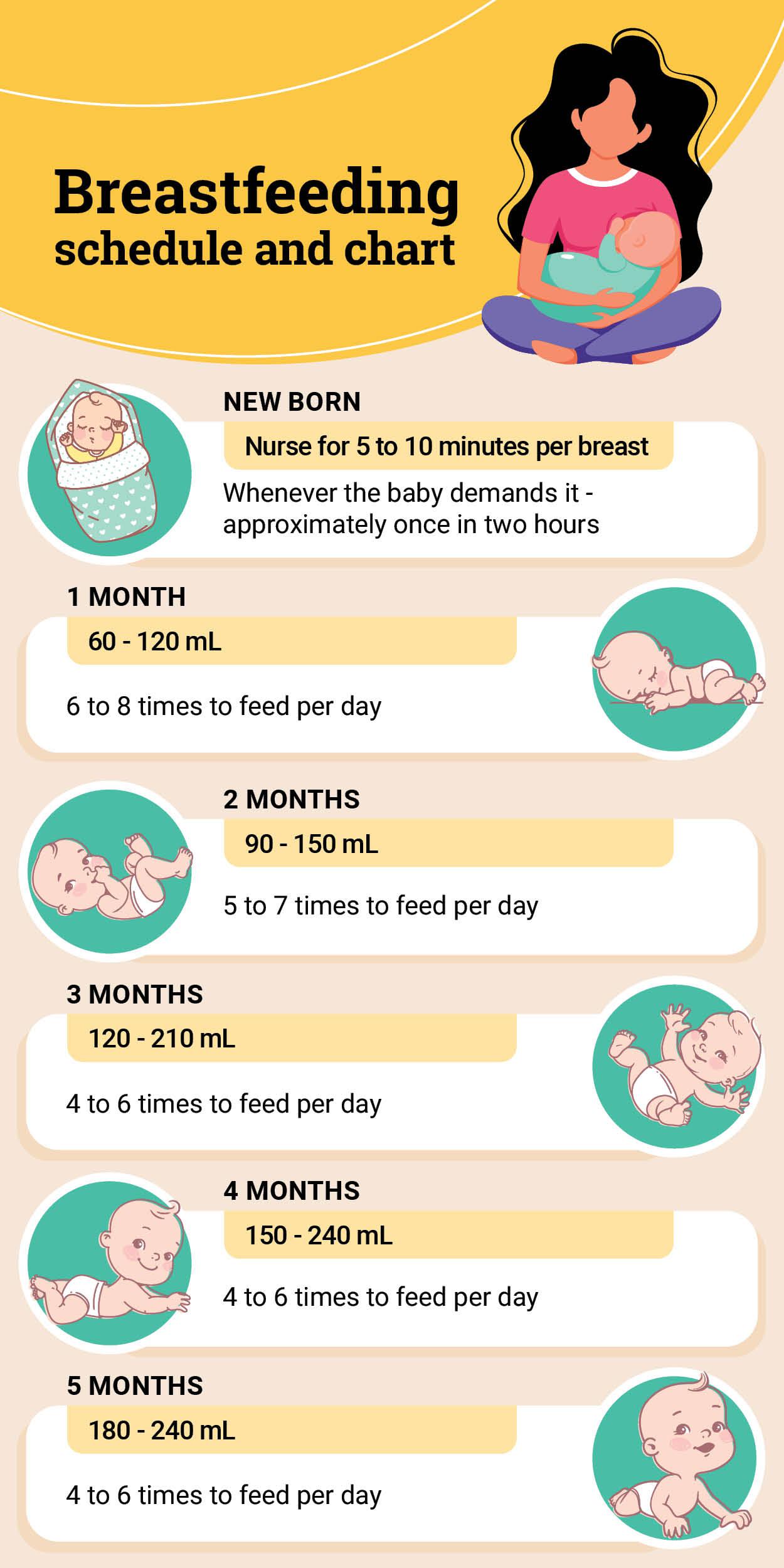
A 5-week-old baby will usually breastfeed 8 to 12 times in 24 hours. Some babies feed more often, especially during a growth spurt or in the evening. Others may have one longer sleep period at night.
In the United States, the American Academy of Pediatrics and the CDC recommend feeding breastfed babies when they show hunger cues, rather than following a strict clock. Your baby’s wet diapers, weight gain, and behavior after feeds are better signs of enough milk than the exact number of minutes spent nursing.

How often should a 5-week-old breastfeed?
Most 5-week-old babies nurse every 2 to 3 hours, counting from the start of one feeding to the start of the next. This can lead to 8 to 12 feedings each day.
A normal pattern may look like this:
- A few feeds close together in the evening
- A longer sleep stretch at night
- Short feeds during some parts of the day
- Longer feeds during growth spurts
- Different feeding times from one day to the next
Some babies feed 12 to 14 times in a day. This may still be normal if the baby has good diaper output, seems alert when awake, and is gaining weight.
Do not try to make every feeding fit a fixed schedule. Breast milk digests quickly, and babies often nurse for comfort as well as food.
A simple feeding range
| Feeding pattern | What it may mean |
|---|---|
| 8–12 feeds in 24 hours | Common for this age |
| More than 12 feeds | May occur during cluster feeding or a growth spurt |
| Fewer than 8 feeds | May be too few, especially with poor diaper output or sleepiness |
| Feeding every 2–3 hours | A common daytime pattern |
| One longer night stretch | May be fine if weight gain and diaper output are good |
The number alone does not diagnose a feeding problem. Your baby’s health history, birth weight, current weight, and feeding quality also matter.

Should you feed a 5-week-old on a schedule or on demand?
Feed your 5-week-old on demand. This means offering the breast when your baby shows early hunger cues.
Early hunger cues include:
- Stirring or waking
- Moving the arms or legs
- Turning the head from side to side
- Opening the mouth
- Bringing hands to the mouth
- Making sucking sounds
- Licking the lips
Crying is a late hunger cue. A crying baby may have more trouble latching, so try to feed when you notice the earlier signs.
A flexible routine can still help. You might offer feeds during the day every 2 to 3 hours, then respond to your baby’s cues between feeds. A strict schedule is less useful because babies do not take the same amount at every feeding.
When should you wake a 5-week-old to breastfeed?
If your baby has not yet regained birth weight, was born premature, has jaundice, is ill, or has slow weight gain, wake the baby to feed as directed by the baby’s doctor.
Many healthy, full-term babies who have regained birth weight and are gaining well can sleep for one longer stretch at night. Even then, many 5-week-olds still wake to feed every few hours.
Ask your pediatrician how long your baby may sleep at night if you are unsure. Do not let a very sleepy baby miss several feeds without medical advice.
How long should each breastfeeding session last?
There is no required length for a breastfeeding session. Many babies nurse for 10 to 30 minutes, but some finish sooner and others take longer.
Let your baby guide the feed. A baby may slow down or release the breast when satisfied. You can then offer the other breast. Some babies take both breasts at each feed, while others prefer one breast at a time.
Signs of active milk transfer include:
- Slow, deep sucks
- Regular swallowing
- Relaxed hands and body
- Breast softening during the feed
- The baby releasing the breast or appearing satisfied
Do not judge milk intake by nursing time alone. A 10-minute feed with good swallowing may provide more milk than a 30-minute feed with weak sucking.
If your baby stays latched for a long time but rarely swallows, falls asleep at once, or seems hungry after nearly every feed, ask a lactation professional to watch a feeding.

How do you know your 5-week-old is getting enough breast milk?
The best signs are steady weight gain, regular wet diapers, and effective feeding.
By about 5 weeks, many breastfed babies have at least six wet diapers per day. Urine should usually be pale yellow. Stool patterns can vary. Some breastfed babies still have several yellow stools each day, while others begin to stool less often after the first month.
A baby who is getting enough milk may also:
- Wake for feeds
- Swallow during nursing
- Relax after feeding
- Have periods of calm alertness
- Have moist lips and mouth
- Gain weight at checkups
Diaper counts are helpful, but they do not replace weight checks. If you are worried about milk supply, arrange a weight check with the baby’s pediatrician or a lactation consultant.
Signs that may suggest a feeding problem
Call your baby’s doctor if your 5-week-old:
- Has fewer than six wet diapers in 24 hours
- Is difficult to wake for feeds
- Does not swallow during most feeds
- Keeps losing weight or is not gaining as expected
- Has a dry mouth or very dark urine
- Seems hungry after nearly every feed
- Has painful or worsening jaundice
- Vomits forcefully or repeatedly
Seek urgent medical care if your baby is very hard to wake, has trouble breathing, has signs of severe dehydration, or has a rectal temperature of 100.4°F (38°C) or higher. Any baby younger than 3 months with this temperature needs prompt medical assessment.

Why does a 5-week-old want to breastfeed constantly?
Frequent feeding is often normal. Babies commonly have periods of cluster feeding, when they nurse many times over several hours. This often happens in the late afternoon or evening.
A growth spurt around 6 weeks is also common. Your baby may nurse more often for a few days. Frequent nursing can signal your body to make more milk.
Cluster feeding does not automatically mean you have low milk supply. Look at the full picture:
- Is your baby swallowing?
- Are there enough wet diapers?
- Is your baby gaining weight?
- Does your baby sometimes relax after feeding?
- Does your breast feel softer after nursing?
Frequent feeds may also occur because of a shallow latch, poor milk transfer, illness, or discomfort. If feeding is painful or your baby never seems satisfied, get help instead of assuming the problem is normal cluster feeding.
What can make a baby feed more often?
Common reasons include:
- Normal growth and development
- Evening cluster feeding
- A growth spurt
- Comfort sucking
- A shallow latch
- Sleepiness during feeds
- Low milk transfer
- Reflux or another health concern
An International Board Certified Lactation Consultant, or IBCLC, can check the latch and observe milk transfer. Your pediatrician can assess weight, hydration, jaundice, and illness.

What should you do if your 5-week-old sleeps through a feeding?
First, consider your baby’s health and weight history. A healthy baby who has regained birth weight and is gaining well may occasionally sleep longer than usual.
If your baby is not gaining well, was premature, or your doctor told you to wake for feeds, wake the baby according to that plan. You can try:
- Changing the diaper.
- Removing a layer of clothing.
- Holding your baby skin to skin.
- Gently rubbing the back, hands, or feet.
- Offering the breast when the baby is calm and awake.
Do not shake, force-feed, or prop a bottle. If your baby is unusually hard to wake or misses several feeds, contact the pediatrician promptly.
One missed feeding is not usually an emergency in an otherwise well baby. Repeated missed feeds, poor diaper output, or unusual sleepiness needs medical attention.
How many wet diapers should a 5-week-old have?
A 5-week-old usually has at least six wet diapers in 24 hours. This is a general guide for a baby who is breastfeeding effectively.
The diaper may not feel very heavy if it contains only urine, so focus on the total number over the full day. Some disposable diapers also hide moisture well.
Stool patterns are less predictable at this age. A breastfed baby may poop several times a day or go several days between stools. The stool is often yellow and soft. Contact your pediatrician if stools are hard, bloody, white, or black after the early newborn period.
Call the baby’s doctor if wet diapers drop, urine becomes very dark, or your baby has a dry mouth and unusual sleepiness.

What if breastfeeding hurts at 5 weeks?
Breastfeeding may feel strong or tender at first, but ongoing pain is not something you must simply tolerate. The most common cause is a shallow latch.
Try these steps:
- Bring your baby close, with the nose near the nipple.
- Wait for a wide-open mouth.
- Bring the baby to the breast, rather than leaning the breast toward the baby.
- Aim the nipple toward the roof of the mouth.
- Check that more of the areola is in the baby’s mouth below the nipple than above it.
Signs of a deeper latch include rounded cheeks, rhythmic swallowing, and less nipple pain. The nipple should not look pinched or flattened after the feed.
Get help for cracked or bleeding nipples, severe pain, a hot red area on the breast, fever, or flu-like symptoms. These may signal infection or another problem that needs care.

Can you breastfeed too often?
You generally cannot breastfeed a healthy baby too often when you respond to hunger cues. Babies may nurse for food, comfort, closeness, or help settling to sleep.
Frequent feeding becomes a concern when it is paired with signs of poor milk transfer or illness. Examples include no swallowing, very few wet diapers, continued weight loss, or a baby who is always too sleepy to feed well.
Do not limit feeds just to make the baby follow a schedule. Instead, check latch, swallowing, diaper output, and weight gain.
If you are worried about oversupply, speak with a lactation consultant before trying to reduce feeds. Sudden changes can cause breast fullness, blocked ducts, or mastitis.

A practical 24-hour breastfeeding plan
Use this as a flexible guide, not a rule:
- Offer the breast when your baby wakes or shows hunger cues.
- Aim for about 8 to 12 feeds in 24 hours unless your clinician gives a different plan.
- Offer the second breast after the first, if your baby still shows hunger cues.
- Track wet diapers during the day.
- Notice swallowing and your baby’s behavior after feeds.
- Keep scheduled pediatric appointments for weight checks.
- Ask for help early if feeds hurt or your baby is hard to wake.
For example, a baby might feed at 6 a.m., 8:30 a.m., 11 a.m., 1:30 p.m., 4 p.m., 6 p.m., 7:30 p.m., 10 p.m., 1 a.m., and 4 a.m. Another healthy baby may feed at different times and cluster several feeds together. Both patterns can be normal.
Key takeaways
- Most 5-week-old babies breastfeed 8 to 12 times in 24 hours.
- Feed by hunger cues instead of using a strict clock.
- Cluster feeding and a longer night stretch can both be normal.
- At least six wet diapers per day is a useful general guide.
- Weight gain and effective swallowing matter more than feeding length.
- Wake your baby to feed if your clinician recommends it.
- Get medical help for poor feeding, dehydration signs, unusual sleepiness, or a rectal temperature of 100.4°F (38°C) or higher.
Frequently asked questions
Is it normal for a 5-week-old to breastfeed every hour?
It can be normal for short periods, especially during cluster feeding or a growth spurt. If your baby feeds every hour all day, rarely swallows, seems unsatisfied, or has poor diaper output, have a pediatrician or lactation consultant assess the feeding.
How long can a 5-week-old sleep at night without feeding?
The safe interval depends on weight gain, birth history, health, and your clinician’s advice. A healthy baby who has regained birth weight may have one longer sleep period, but many 5-week-olds still wake several times to eat.
Should I offer both breasts at every feeding?
Offer the first breast and let your baby nurse while actively sucking and swallowing. Then offer the second breast. Your baby may take both breasts or may be satisfied after one.
Does frequent breastfeeding mean I do not have enough milk?
Not always. Frequent nursing is common at this age. Check wet diapers, swallowing, comfort after feeds, and weight gain. A weight check is the most useful way to assess milk intake.
When should I call a lactation consultant?
Call if breastfeeding hurts, your baby has trouble latching, feeds last a very long time without much swallowing, your nipples are damaged, or your baby is not gaining well. Early support can often prevent a small feeding issue from becoming a larger one.
Trusted U.S. guidance
This article follows general guidance from U.S. health organizations, including:
- American Academy of Pediatrics: Breastfeeding and Infant Nutrition
- CDC: Breastfeeding
- Office on Women’s Health: Breastfeeding
- American College of Obstetricians and Gynecologists: Breastfeeding Challenges

Conclusion
A 5-week-old usually breastfeeds 8 to 12 times each day, but normal patterns vary. Follow hunger cues, watch wet diapers and swallowing, and use weight gain as the clearest measure of adequate intake.
If your baby is hard to wake, feeds poorly, has too few wet diapers, or has a fever of 100.4°F (38°C) or higher, contact a health care professional promptly.