
At 2 months, most babies see best from about 8 to 18 inches away, while distant objects remain blurry.
Understanding how far can a baby see at 2 months can make daily moments feel much easier to understand. At this age, your baby is learning to focus, track movement, notice faces, and respond to bright colors. Vision is still developing, so short periods of eye wandering or mild blur can be normal.
How far can a baby see at 2 months?
Most 2-month-old babies see most clearly at a distance of about 8 to 18 inches. This is roughly the space between your face and your baby’s face during feeding, cuddling, or talking.
A baby may notice objects farther away, but those objects may look soft or unclear. Your baby might see light, movement, strong color, and large shapes before recognizing small details.
At 2 months, vision is not yet sharp like adult vision. Think of it as a camera that is slowly coming into focus. Your baby’s eyes are learning how to work together, and the brain is learning how to understand the images they receive.

What can a 2-month-old baby see?
A 2-month-old can usually see more than a newborn, although vision is still limited. When considering how far can a baby see at 2 months, clarity matters as much as distance.
Your baby may be able to:
• Look at your face during feeding
• Follow a slow-moving toy for a short distance
• Watch you walk across a nearby room
• Notice bright lights and bold colors
• Study large patterns
• Look toward a familiar voice
• Smile at a familiar face
Babies often prefer faces over other objects. Your face has strong contrast between the eyes, nose, mouth, and skin. It also moves and makes sounds, which makes it especially interesting to your baby.
A baby may not seem to “see” a toy across the room. However, the baby may notice its movement or bright color. This does not always mean your baby can identify the toy clearly.

How baby vision changes from birth to 2 months
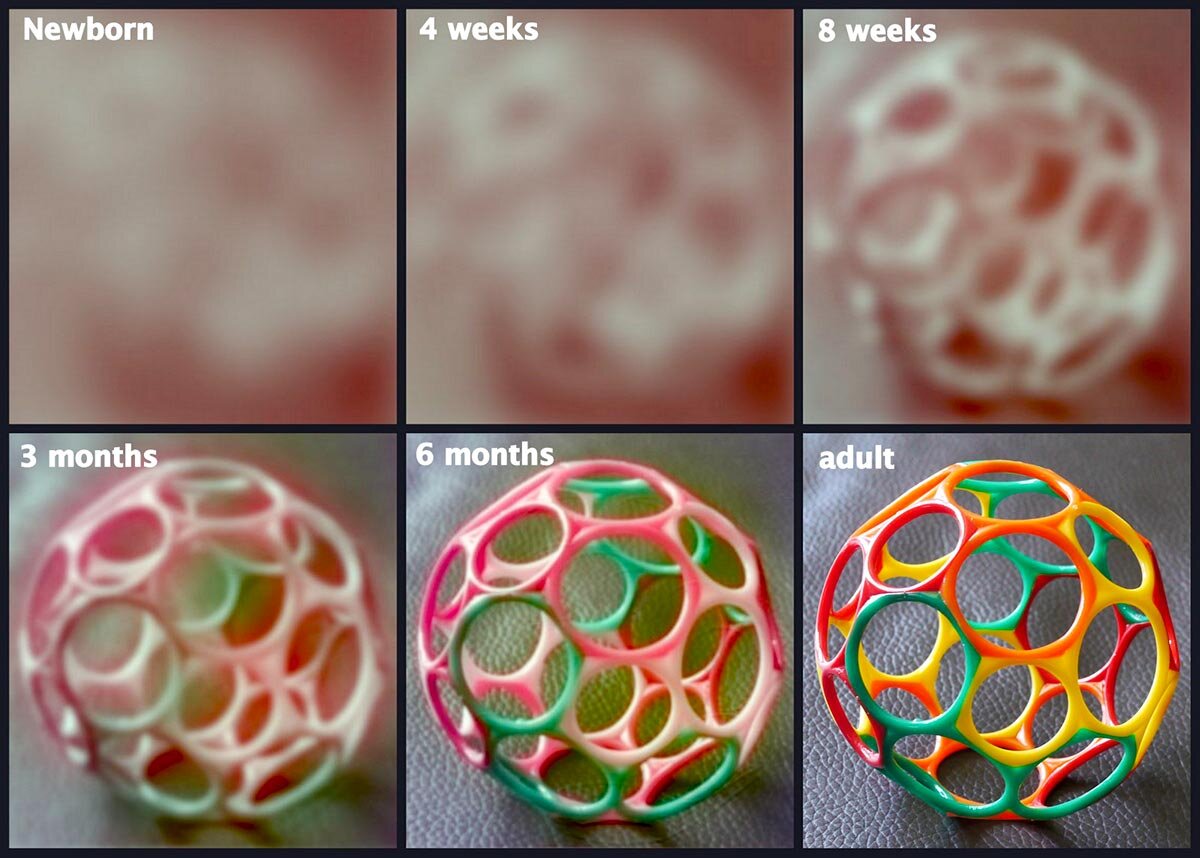
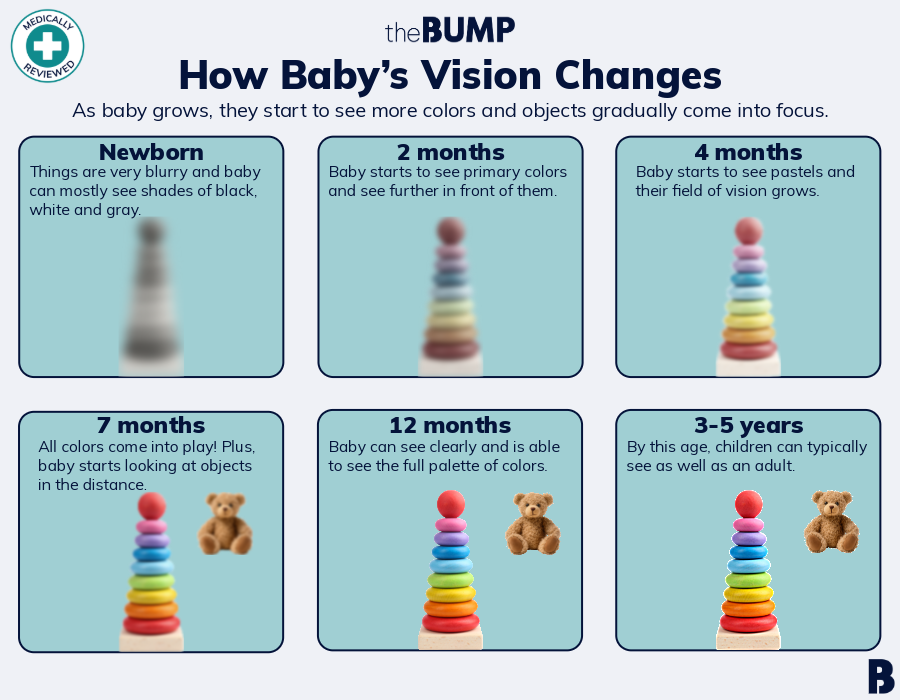
Newborn vision is quite blurry. Most newborns see best at about 8 to 12 inches, which matches the distance to a parent’s face during feeding.
By 2 months, many babies can focus for longer periods. They may also begin to follow a face or toy from side to side. These changes happen as the eyes, brain, and eye muscles develop together.
Here is a simple view of early vision:
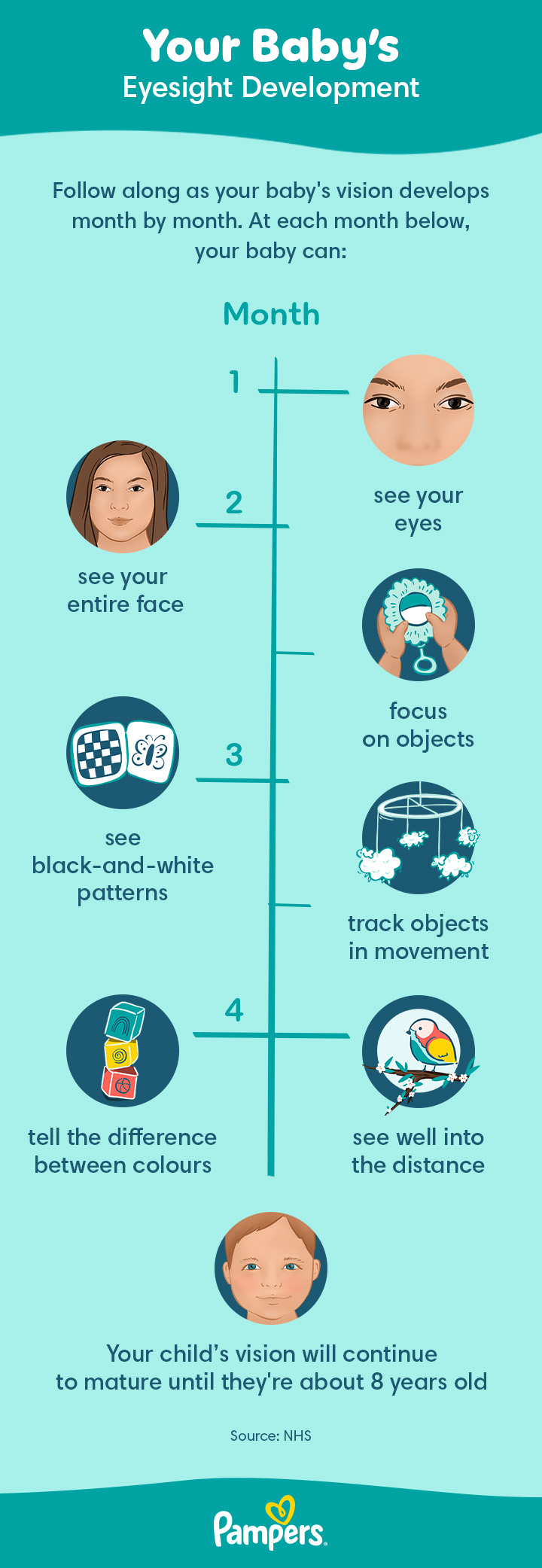
• At birth: A baby sees light, movement, faces, and bold shapes at close range.
• Around 1 month: A baby may briefly focus on faces and track slow movement.
• Around 2 months: A baby may follow a person or toy and look at faces for longer.
• Around 3 to 4 months: A baby often tracks objects more smoothly and reaches toward them.
Development does not happen on a strict schedule. Some babies show strong visual tracking at 2 months, while others take a little longer. A small difference does not always signal a problem.
Can a 2-month-old see across the room?
A 2-month-old may notice movement across a room, but clear vision at that distance is unlikely. When parents ask how far can a baby see at 2 months, they often mean whether the baby can recognize them from several feet away.
Your baby may turn toward you because of a mix of visual and sound clues. Your voice, smell, movement, and face can all help your baby know that you are nearby.
For example, your baby may look toward you when you enter the room. The baby may see your outline or movement, but may not see the fine details of your face. A baby may also respond more strongly when you speak.
Try this simple observation:
Hold your baby safely in your arms.
Stand about 12 inches away.
Smile and speak softly.
Move your face slowly from one side to the other.
Watch whether your baby looks at you or follows your face.
Do not move too fast. A young baby needs time to shift focus. Bright light, tiredness, hunger, and noise can also affect the response.

What colors can a 2-month-old see?
A 2-month-old can usually see color, but color vision is still developing. Many babies notice bright colors and strong contrasts more easily than pale or closely matched shades.
Black and white patterns, red objects, and bold designs may attract your baby’s attention. A toy with clear edges may be easier to see than a small gray toy against a gray wall.
Good choices for visual play include:
• Large black and white cards
• Bright red, blue, or yellow toys
• High-contrast picture books
• Simple face drawings
• Toys with clear shapes
• A colorful mobile placed at a safe distance
You do not need to fill your baby’s room with toys. One simple object is often enough. Too many colors, sounds, and movements can overwhelm a young baby.
How to help your baby’s vision develop
You can support early visual development through simple daily activities. You do not need special equipment or expensive learning products.
Try these activities:
• Hold your face about 8 to 18 inches from your baby.
• Talk and smile during diaper changes and feedings.
• Move a toy slowly from one side to the other.
• Use soft, natural light when possible.
• Offer short periods of tummy time while your baby is awake and watched.
• Place a bold picture near, but not directly beside, your baby.
• Give your baby quiet breaks when signs of tiredness appear.
During tummy time, your baby may lift the head and look around. This helps build neck and upper-body strength, which supports later visual exploration.
One practical lesson many new parents learn is that slower is better. Moving a toy quickly across a baby’s face may cause the baby to lose track of it. Slow, gentle movement gives the eyes and brain time to work together.
Avoid shining bright lights into your baby’s eyes. Never use a laser pointer or leave a mobile, cord, or small toy within reach.

Signs your baby is seeing normally at 2 months
Every baby develops at a different pace, but several common signs suggest that vision is progressing.
Your baby may:
• Look at your face
• Make eye contact for a few seconds
• Watch a moving person or object
• Blink at bright light
• Turn toward a light source
• Show interest in bold patterns
• Begin to follow objects from side to side
Eye movements may still look uneven at times. Brief periods of crossed or wandering eyes can occur in young babies. However, these movements should become less common as the baby grows.
It is also normal for a baby to lose interest when tired or overstimulated. A baby who turns away may need a break, not more stimulation.
When to call a pediatrician about baby vision
Knowing how far can a baby see at 2 months is helpful, but watching how your baby uses vision is even more important. Contact your pediatrician if you notice a concern or if your baby is not showing expected visual responses.
Ask for medical advice if your baby:
• Does not seem to look at faces
• Does not react to bright light
• Does not follow a nearby moving object at all
• Has an eye that always turns inward or outward
• Has a pupil that looks white in photos or normal light
• Has repeated jerky eye movements
• Has persistent redness, swelling, discharge, or pain
• Keeps one eye closed
A white-looking pupil can have several causes and needs prompt medical assessment. It should not be ignored.
The American Academy of Pediatrics recommends routine health visits that include developmental checks. Your child’s doctor can assess eye alignment, responses to light, and overall development. If needed, the doctor may refer your baby to a pediatric eye specialist.
Do not compare your baby with a cousin, friend’s child, or social media post. Photos and videos can make normal differences look like problems, while some real concerns may be hard to notice at home.

Common factors that affect what a baby can see
A baby’s visual response can change from one moment to the next. This does not always reflect a change in eyesight.
Common factors include:
• Sleepiness
• Hunger
• Crying
• Bright sunlight
• Dim lighting
• Illness
• A busy room
• Distance from the object
• The object’s color and contrast
A baby may track a toy well in the morning but ignore it after a long day. This is often related to attention and energy.
Premature babies may follow a different developmental timeline. Doctors often consider corrected age when assessing development. Corrected age accounts for how early the baby was born and can give a fairer picture of progress.
Family eye conditions also matter. Tell your pediatrician if close relatives have childhood eye disease, severe vision problems, lazy eye, or crossed eyes.

How parents can test visual tracking safely
Parents can observe vision at home, but home checks do not replace a professional eye exam. The goal is to notice patterns, not to “pass” or “fail” your baby.
Try this gentle check:
Choose a calm time when your baby is awake.
Hold a large, colorful object about 12 inches away.
Let your baby look at it without rushing.
Move it slowly from the center toward one side.
Repeat on the other side.
Stop if your baby looks away, fusses, or becomes tired.
Your baby may not follow the object all the way. A short glance or partial follow can still be normal at 2 months.
Avoid testing in bright sunlight or using tiny objects. Never place an object close enough for your baby to grab if it could become a choking hazard.
Frequently Asked Questions About How Far Can a Baby See at 2 Months
How far can a baby see at 2 months clearly?
Most babies see clearest at about 8 to 18 inches. They may notice movement farther away, but distant details usually remain blurry.
Can a 2-month-old recognize their parents?
A 2-month-old may recognize a parent’s face, voice, smell, and movement. Recognition often comes from all these signals working together, rather than vision alone.
Can a 2-month-old see color?
Yes, most 2-month-old babies can see color. Bright colors and strong contrast are often easier to notice than soft or similar shades.
Should a 2-month-old track objects?
Many babies begin tracking slow-moving faces or objects by 2 months. Short or uneven tracking can still be normal, especially when the baby is tired or hungry.
Can a 2-month-old see across the room?
A baby may notice light, movement, or a large shape across the room. Clear details and facial features are usually easier to see at close range.
When should I worry about my baby’s eyesight?
Talk with your pediatrician if your baby never looks at faces, does not respond to light, has constant eye misalignment, or shows unusual eye movements. A doctor can decide whether a formal eye evaluation is needed.
Do babies with blue eyes see better than babies with brown eyes?
Eye color does not determine how clearly a baby sees. Vision depends on the health and development of the eyes, visual nerves, and brain.
Conclusion
At 2 months, a baby usually sees best from about 8 to 18 inches away. Your baby may notice movement and bright shapes from farther away, but fine details across the room will likely look blurry.
Support healthy vision with face-to-face time, slow tracking games, safe tummy time, and calm visual play. Keep routine pediatric visits, trust your observations, and ask for help if your baby does not respond to faces, light, or movement. Share this guide with another new parent or leave a comment about what your baby enjoys watching.