
To attach a Lascal BuggyBoard, fit its two universal connectors around the stroller’s lower frame, adjust the connector width and height, then click the board into place. The board should sit level, move freely, and stay clear of the stroller wheels and brake.
Introduction
A Lascal BuggyBoard gives an older child a place to stand behind a stroller. It can help on walks in U.S. neighborhoods, parks, stores, and busy sidewalks when a child gets tired but you still need to push a younger child.
The exact fit depends on your stroller frame and the BuggyBoard model. Lascal sells several versions, including the BuggyBoard Mini and Maxi. The basic fitting process is similar, but the connector shape, board size, and stroller clearance may differ.
Always check the instruction sheet that came with your board. If the stroller has a narrow, curved, folding, or unusual frame, confirm compatibility before use.


What You Need Before Attaching the BuggyBoard
You usually do not need tools to install a Lascal BuggyBoard. The package normally includes the board, two frame connectors, and the parts used to secure and adjust those connectors.
Before you begin, check the following:
- The BuggyBoard model matches your stroller’s size and frame.
- Both connectors are present and free from cracks.
- The stroller frame is clean and dry.
- The stroller is on a flat surface.
- The stroller is empty and its brakes are locked.
- The board will not cover the brake pedal or touch the rear wheels.
- Your child can stand safely and hold the stroller handle.
Do not attach the board to a loose, damaged, or bent frame. A connector needs a firm section of tubing to grip. It should not sit on a folding joint, a brake cable, a thin plastic cover, or a removable part.
Mini or Maxi?
The BuggyBoard Mini is generally intended for smaller, lighter strollers. The Maxi is designed for a larger standing platform and may suit some wider or heavier stroller frames.
That does not mean every Mini fits every small stroller or every Maxi fits every large stroller. Frame shape and clearance matter more than the stroller’s marketing label. Use Lascal’s current compatibility information and the manual for your exact board.
How to Attach a Lascal BuggyBoard
Follow these steps with the stroller parked, empty, and braked.
1. Find the best mounting points
Stand behind the stroller and look at the lower rear frame. Choose two frame sections at about the same height, one on the left and one on the right.
The mounting points should:
- Be strong and rigid.
- Face the same general direction.
- Leave enough room for both connectors.
- Sit above or near the rear axle area without touching the wheels.
- Keep the board centered behind the stroller.
- Avoid hinges, cables, brake parts, and folding locks.
Do not mount the connectors only to a fabric seat base or soft storage basket. The connectors must grip the stroller’s structural frame.
2. Open or position the two connectors
Place one connector on each side of the stroller frame. Depending on the version, the connector may wrap around the tube and close with a locking part or strap.


Do not fully tighten either side at first. Leave enough room to slide the connectors into the correct position. This makes it easier to center the board and keep both sides level.
If your package includes different connector parts or inserts, use only the parts listed for your stroller and BuggyBoard model. Do not substitute screws, straps, or clamps from another product.
3. Set the connector width
Adjust the left and right connectors so the board sits directly behind the stroller. The board should not angle sharply to one side.
A useful check is to look down from above:
- The center of the board should line up with the center of the stroller.
- The board should not sit so close that it hits the rear wheels.
- The board should not sit so far back that it makes the stroller hard to steer.
- Both connectors should carry the frame evenly.
Tighten each connector a little at a time. Alternate between the left and right sides instead of tightening one side fully first.
4. Set the height and angle
Adjust the connectors so the platform is level, or close to level, when the stroller is standing normally. A small change in connector height can affect whether the board drags, tilts, or touches the wheels.
The standing surface should:
- Stay above the ground.
- Clear the stroller’s rear wheels.
- Avoid the brake pedal.
- Remain stable when you press down lightly with your hand.
- Leave enough space for the pushing adult’s feet.
If the board slopes too much, move both connectors to matching positions and check the angle again. Do not force the board into place by bending the stroller frame.
5. Attach the board to the connectors
With the connectors fitted, line up the BuggyBoard’s attachment points with the connector fittings. Push or click the board into place according to your model’s instructions.
You should hear or feel a clear lock. If one side clicks but the other does not, remove the board and realign it. Do not use the board with only one side attached.
Some Lascal BuggyBoard versions allow the board to swing or lift when not in use. Test that movement only after both connectors are secure. The board must return to its proper position without catching on the stroller.
6. Check the release or suspension parts
Many BuggyBoard models use a cord, strap, or lift system that lets the platform move when it is not carrying a child. Make sure the cord is routed as shown in the manual.
Keep the cord away from:
- The stroller wheels.
- The brake mechanism.
- Folding joints.
- The child’s feet.
- Loose bags or other accessories.
A loose cord can catch during a turn or fold. If the cord seems too short, too loose, or damaged, stop and check the model-specific instructions.


7. Perform a hands-on safety check
Before placing a child on the board, test it without a load.
Push down on the center of the platform with one hand. Then pull it gently from side to side. It should not detach, twist, or slide along the stroller frame.
Next, roll the empty stroller slowly:
- Release the stroller brake.
- Walk in a straight line.
- Make a wide turn in both directions.
- Apply the brake.
- Check that the board does not strike the wheels or brake.
If you hear clicking, scraping, or movement at either connector, stop and adjust the installation.
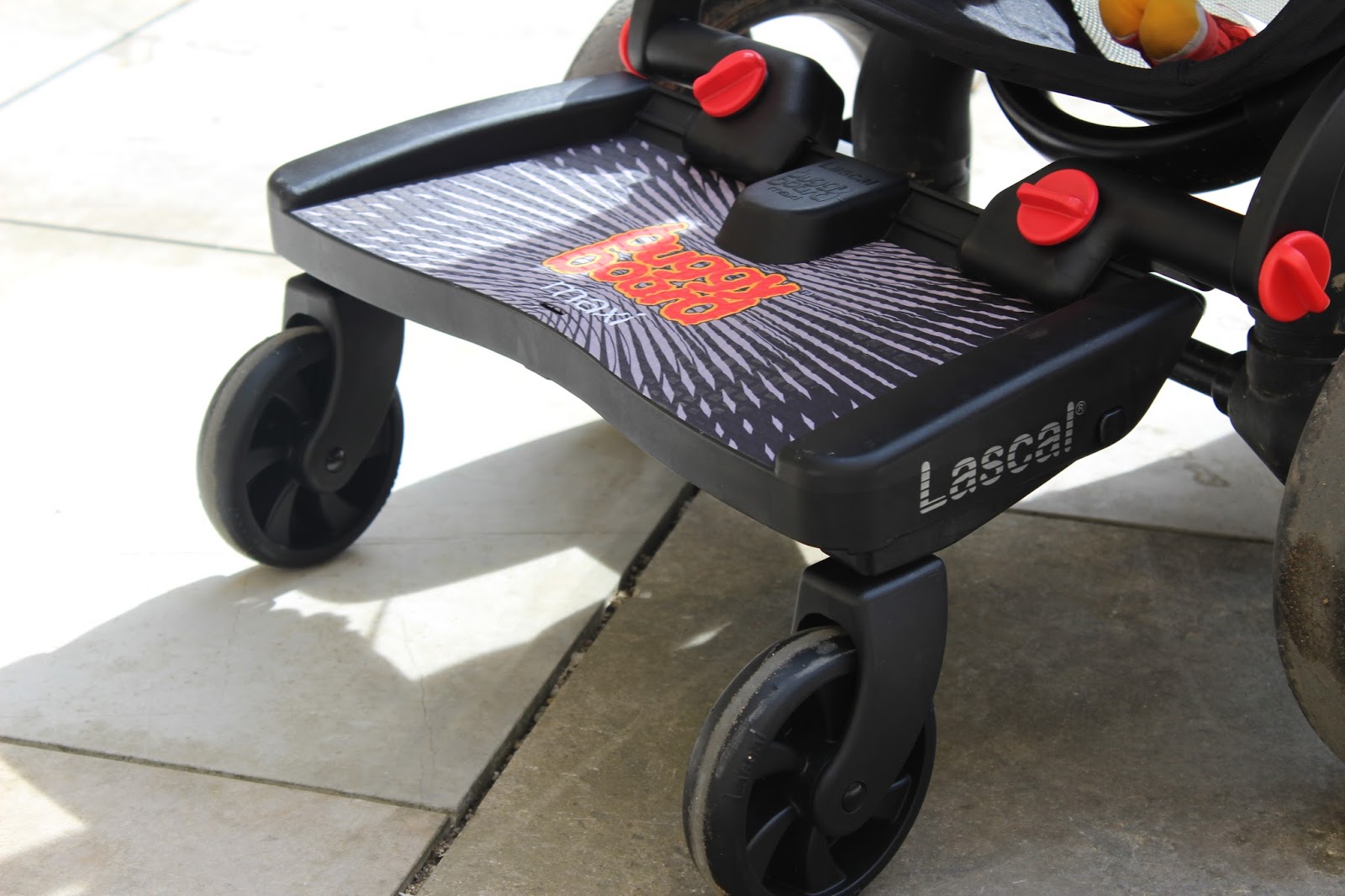
How to Know the BuggyBoard Is Attached Correctly
A properly attached Lascal BuggyBoard should remain centered and stable during normal walking. The platform should not drag on the ground or swing into the stroller wheels.
Use this quick check before each walk:
| Check | What you should see |
|---|---|
| Connector fit | Both connectors grip firm frame sections |
| Board position | The platform is centered behind the stroller |
| Level | The standing surface is level or stable |
| Wheel clearance | The board does not touch either rear wheel |
| Brake access | You can set and release the stroller brake |
| Lock | Both attachment points are fully engaged |
| Movement | The stroller turns without scraping or binding |
| Folding | The stroller folds only as allowed by the manual |
The most important test is not whether the board looks straight while parked. It is whether the board stays clear of the wheels, brake, and adult’s feet while the stroller moves.
Have your child step on only after you complete these checks. The child should stand in the center of the platform and hold the stroller handle. Follow the child-weight limit printed in the current Lascal instructions for your model.

What to Do If the BuggyBoard Does Not Fit
A board that does not fit is often facing a clearance or frame-shape problem, not an installation mistake. Check the simplest causes first.
The connectors are too wide or too narrow
Move both connectors inward or outward by the same amount. Keep the board centered. If one connector sits much farther from the stroller’s center than the other, the board may twist under load.
The board hits the rear wheels
Raise or reposition the connectors if the instructions allow it. Check whether the board is too close to the axle or whether the stroller frame curves toward the wheels.
Do not solve wheel contact by forcing the platform sideways. A board that touches a wheel can affect steering and braking.
The board sits too low
Confirm that both connectors are at matching heights. Inspect the adjustment setting and make sure the connectors are fully seated.
If the platform still sits too low, the stroller frame may not provide enough clearance for that BuggyBoard model. Use the manufacturer’s compatibility guidance rather than adding homemade spacers.


The stroller brake is blocked
Move the connectors only if the model instructions show that the position can change safely. Some stroller frames place the brake directly where an accessory connector needs to go.
Never remove, tie back, or disable the stroller brake to make room for the board.
One side will not click into place
Remove the board and check for:
- Dirt in the connector.
- A connector that is not aligned.
- A damaged locking part.
- A cord or strap caught in the fitting.
- A board that is being pushed in at an angle.
If the lock still does not engage, do not use the board. Contact the retailer or Lascal for model-specific support.
The stroller folds poorly after installation
Some strollers cannot fold with a BuggyBoard attached. Remove the board or follow the folding method in the instructions.
Do not force the stroller closed. A forced fold can damage the stroller, board, or connector.

Common Mistakes to Avoid
The most common mistake is tightening the connectors before checking the board’s center line. This can leave the platform crooked or too close to one wheel. Fit both sides loosely, center the board, and then tighten them evenly.
Other mistakes include:
- Mounting a connector on a folding hinge.
- Attaching the connector to fabric instead of the frame.
- Using only one connector.
- Ignoring a missing click or lock.
- Letting the board block the brake.
- Carrying a child who is above the model’s stated limit.
- Allowing a child to sit on a standing board.
- Hanging a heavy bag from the board or handle.
- Leaving the board attached while folding a stroller that is not designed to fold with it.
- Adding homemade brackets, bolts, tape, or spacers.
The BuggyBoard changes the weight and length of the stroller. Turn slowly, use extra care on ramps and uneven ground, and avoid curbs that could cause the board to strike the ground.

Cleaning and Maintenance
Check the connectors and platform before each use. Remove sand, mud, and small stones from moving parts. Wipe the board with a damp cloth and let it dry before storage.
Look for:
- Cracks in the platform.
- Frayed straps or cords.
- Loose connector parts.
- A lock that no longer clicks.
- Excessive side-to-side movement.
- Bent mounting hardware.
- Missing screws or covers.
Do not use oil or grease unless the product instructions call for it. Lubricant can attract grit and may affect a locking part.
If any structural part is damaged, stop using the board until Lascal or an authorized service source confirms that it is safe to repair. Keep the original instructions with the product so you can identify the exact model and replacement parts.

Frequently Asked Questions
Can I attach a Lascal BuggyBoard to any stroller?
No. Lascal BuggyBoard connectors are made for many stroller frames, but not every stroller is compatible. Frame shape, tube diameter, brake position, wheel clearance, and folding design all affect fit.


Does the BuggyBoard need tools?
Many installations use hand-adjusted connectors and do not need tools. Some stroller or adapter combinations may have different requirements. Use only the hardware and tools listed in the instructions for your model.
Can my child sit on the BuggyBoard?
A BuggyBoard is a standing platform. Do not let a child sit on it or use it as a seat unless the product is specifically designed and approved for that purpose. Follow the age, height, and weight guidance supplied with the exact model.
Can I leave the BuggyBoard attached when I fold the stroller?
Only if the stroller and BuggyBoard instructions clearly allow it. Many stroller frames need the board removed or lifted before folding. Never force the fold.
Why does my BuggyBoard swing from side to side?
Some movement may be part of the board’s design, but excessive movement can indicate loose connectors, poor alignment, a damaged lock, or an unsuitable frame. Remove the board, inspect both connectors, and refit it. If movement continues, stop using it until you receive model-specific support.
Conclusion
Attaching a Lascal BuggyBoard starts with choosing firm, matching frame points above the rear wheels. Fit both connectors loosely, center the board, set the height and angle, secure the locking points, and test wheel and brake clearance before use.
The final step is a safety check with the stroller empty. If the board scrapes, blocks the brake, will not lock, or does not fit the frame without force, do not use it. Check the exact Lascal manual or contact the manufacturer with your stroller and BuggyBoard model numbers.
