
A buggy board, also called a stroller board, ride-on board, or glider board, usually costs $50 to $150 in the United States. Basic universal models often sell for $50 to $90, while premium boards made for a specific stroller brand often cost $100 to $180 or more.
You may also pay for shipping, sales tax, an adapter, or replacement parts. A used buggy board can cost about $20 to $75, depending on its condition and whether it fits your stroller.
What Is a Buggy Board?
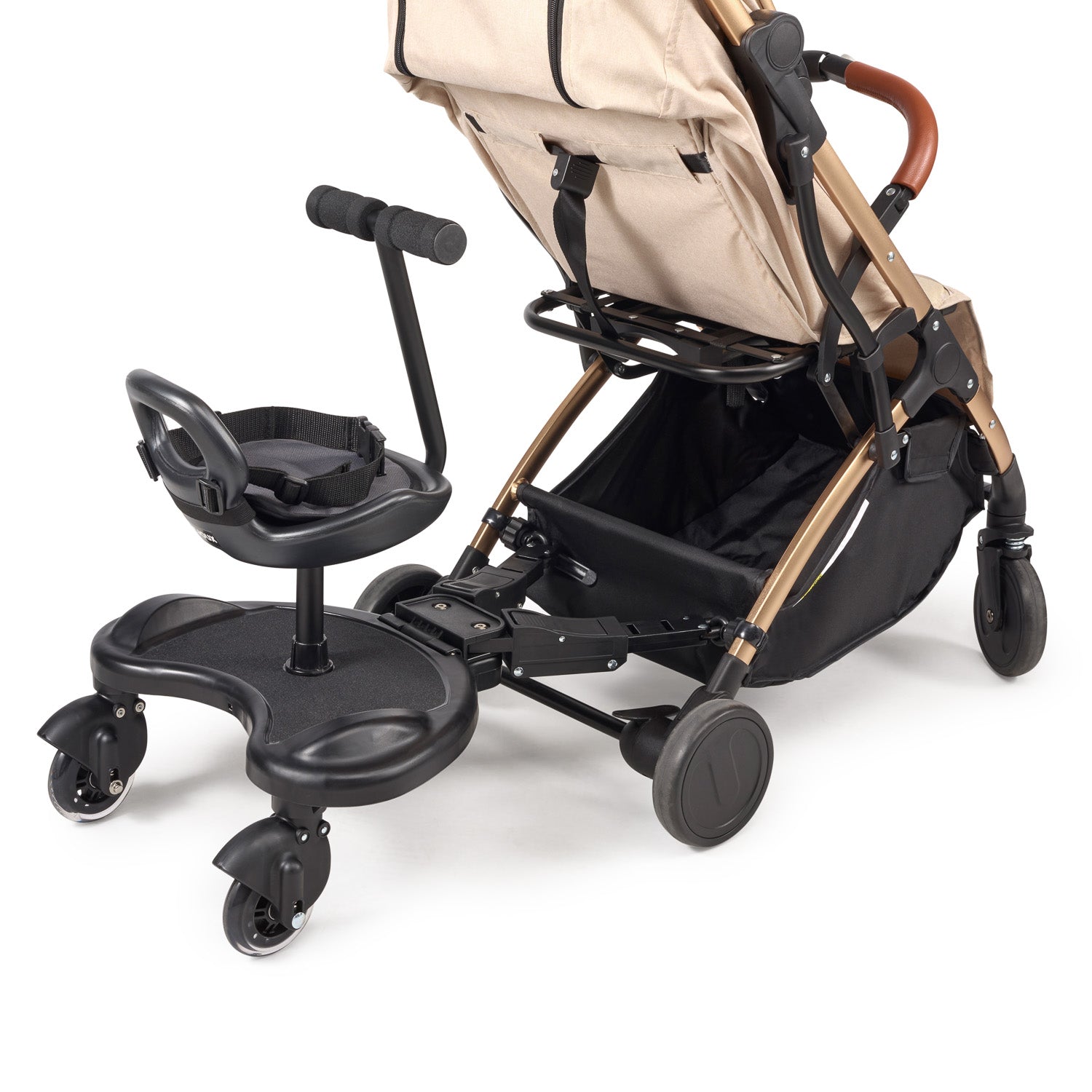
A buggy board is a small platform that attaches to the back of a stroller. An older child can stand on it while a parent pushes the stroller.
Most boards use a pair of wheels, a standing platform, and adjustable connectors. Some models fold upward when not in use. Others have a seat, a handle, or a small saddle for children who cannot stand for long.


In the US, retailers may use several names for the same type of product:
- Stroller board
- Ride-on board
- Glider board
- Toddler board
- Standing platform
- Universal stroller board
A buggy board is not the same as a stroller wagon, a standing stroller, or a scooter. It is an accessory that depends on another stroller for support.
Age and weight limits vary by model. Many boards suit toddlers and preschoolers, but you should follow the exact limit in the product manual. A board that fits your stroller may still be unsuitable for your child’s age, height, or weight.
Buggy Board Price Ranges in the US
The price depends mainly on the board’s design, materials, brand, and stroller compatibility.
| Buggy board type | Typical US price | Best fit |
|---|---|---|
| Basic universal board | $50–$80 | Occasional use and simple stroller setups |
| Better-built universal board | $80–$120 | Frequent use and mixed stroller brands |
| Brand-specific board | $90–$160 | Families who want a close fit and easy attachment |
| Premium board with a seat | $120–$200+ | Longer walks or children who tire quickly |
| Used buggy board | $20–$75 | Budget buyers who can check condition carefully |
| Replacement connectors or parts | $15–$60 | Repairing or adapting an existing board |
These are practical retail ranges, not fixed prices. US prices change with sales, stock, shipping, and model updates. A board listed at $79 may cost closer to $90 after shipping and sales tax.
A low price does not always mean poor quality. It may mean the board has a smaller platform, fewer adjustment options, or a simpler folding system. A higher price may reflect better materials, a seat, improved suspension, or a connector made for one stroller family.

What Changes the Price of a Buggy Board?
The main price difference comes from compatibility. A universal board must fit many stroller shapes, so it often uses adjustable straps, clamps, or arms. A brand-specific board may cost more because its connector is made for a particular stroller frame.
Other cost factors include:
- Weight capacity: Boards with stronger frames may cost more.
- Platform size: A larger standing area gives a child more room.
- Wheels: Larger or swivel wheels may handle uneven pavement better.
- Folding design: A board that folds or lifts when empty can be easier to use.
- Seat options: A removable seat or saddle usually raises the price.
- Suspension: Shock absorption can improve comfort on rough sidewalks.
- Materials: Metal frames and thick plastic platforms may cost more than lighter parts.
- Brand support: Established brands may offer replacement connectors or clearer fit guides.
- Stroller adapters: Some stroller systems need a separate adapter.
A universal board may look like the cheaper choice, but check the full cost. If it needs a $30 adapter, the final price can be close to a model designed for your stroller.
How Much Should You Budget?
For most families, a sensible budget is $80 to $130 before tax.


That range often includes a reasonably durable board with adjustable connectors. It may work well for daily trips, school drop-off, shopping, and short walks.
Use this simple budget guide:
- Under $60: Look for a basic board or a good used model. Check the fit and wheel condition closely.
- $60–$100: This is the common range for simple universal boards.
- $100–$150: Expect better adjustment, a stronger frame, or a board made for a named stroller.
- Over $150: Look for a clear reason, such as a seat, special adapter system, suspension, or a premium stroller ecosystem.
If you expect to use the board every day, paying more for a secure fit may be worthwhile. If you need it for a two-week vacation or occasional errands, a basic or used board may make more financial sense.
Example total-cost calculation
Imagine a board priced at $89:
- Board: $89
- Adapter: $25
- Shipping: $10
- Sales tax: about $10, depending on the state
Estimated total: $134
This is why the product price alone may not show the real cost. Always check whether the package includes the connectors required for your stroller.

Universal vs. Stroller-Specific Buggy Boards
A universal board is designed to attach to several stroller types. It may cost less and can be useful if you change strollers often.
A stroller-specific board is made for one brand or a limited set of models. It may attach more neatly and leave more room for the parent’s feet. It can also be easier to install because the manufacturer has already defined the correct connection points.
| Feature | Universal board | Stroller-specific board |
|---|---|---|
| Upfront price | Often lower | Often higher |
| Stroller choice | More flexible | Limited to listed models |
| Fit | Depends on frame shape | Usually more predictable |
| Adapter need | Possible | May be included or built in |
| Resale value | Depends on demand | Strong if the stroller is popular |
| Best for | Families with changing strollers | Owners keeping one stroller system |
Do not assume that “universal” means “fits every stroller.” Some stroller frames have rear brakes, storage baskets, narrow bars, or unusual shapes that prevent a safe attachment.
Before buying, check:
- The exact stroller brand and model.
- The stroller’s production year, if the board maker lists one.
- The required connector or adapter.
- The child’s age and weight limits.
- Whether the board affects folding or braking.
- Whether the parent has enough walking space behind the stroller.
A product page that says “fits most strollers” is not proof that it fits yours. The manufacturer’s compatibility chart is the better source.

Is a Buggy Board Worth the Cost?
A buggy board can be worth the cost when a child is too old for a stroller seat but still tires during longer walks.
It can help with:
- School runs
- Zoo visits
- Theme parks
- Airport trips
- Shopping centers
- Neighborhood walks
- Moving two young children with one stroller
The value depends on how often you will use it. A $100 board used 100 times costs about $1 per use before tax. A $100 board used five times costs $20 per use.
A board may not be worth buying if your child prefers to walk, your stroller has little rear clearance, or you often use rough paths. It can also be a poor fit if the board makes the stroller hard to push or blocks the parent’s stride.


For children who need to sit during long outings, a board with a seat may offer more value than a standing-only model. It will usually cost more and may be heavier, so compare that benefit with the added size.

What to Check Before Buying a Buggy Board
Start with compatibility, not price. A cheap board that does not fit your stroller is not a bargain.
Check the stroller frame
Look at the rear frame, brake bar, basket, and wheels. The connectors need a firm attachment point. Avoid models that require a loose connection around a moving or flexible part of the frame.
Check the weight limit
Use the board only within the maker’s stated child weight limit. Do not add a seat or extra load unless the manufacturer allows it.
Check your stride
Stand behind the stroller and imagine walking with the board attached. Some boards force the parent to stand farther back or walk with shorter steps.
Check folding
Some boards must be removed before the stroller folds. Others lift into a storage position. A board that blocks folding may become annoying during car trips.
Check brakes and storage
Confirm that you can reach the brake. Make sure the board does not press against the brake cable, block the basket, or interfere with the stroller’s rear wheels.
Check the return policy
A board can look compatible online but feel awkward in real use. A return policy matters if you cannot test the fit before buying.
New or Used: Which Costs Less?
A used buggy board often saves 30% to 60% compared with a similar new model. It can be a good choice because these accessories have a simple design and may last through more than one child.
Inspect a used board before use:
- Look for cracks in the platform or frame.
- Check that both wheels turn freely.
- Test every connector and locking point.
- Look for missing screws, straps, pins, or adapters.
- Check that the board stays level when attached.
- Confirm that the model has not been recalled.
- Ask for the manual if the seller has it.
Do not buy a used board with a cracked frame, damaged connector, missing safety part, or unknown modification. A lower price is not worth a loose attachment.
When buying through a marketplace, compare the model number with the manufacturer’s current instructions. Similar-looking versions may use different connectors.

Safe Use of a Buggy Board
Read the manual before the first trip. The board should attach firmly, stay level, and leave the stroller’s brake usable.
Follow these basic safety steps:
- Attach the board according to the manufacturer’s instructions.
- Test the connection before placing a child on it.
- Keep the child within the stated age and weight range.
- Use the board on surfaces suitable for that model.
- Slow down near curbs, ramps, doors, and uneven ground.
- Keep both hands on the stroller when moving.
- Apply the stroller brake before the child gets on or off.
- Do not let the child sit or stand on the handlebar.
- Stop using the board if it cracks, loosens, or behaves differently.
- Check screws and connectors from time to time.
A buggy board changes the stroller’s balance and turning behavior. It may be harder to push over curbs, stairs, gravel, or grass. Never carry the stroller with a child standing on the board.


A board is also not a substitute for supervision. The child should hold the stroller only where the manual permits, and the parent should stay close enough to control the stroller.
For product safety information, check the US Consumer Product Safety Commission and the manufacturer’s recall page. Rules and product notices can change, so check current information for the exact model.
Common Buggy Board Buying Mistakes
The most common mistake is buying a board based only on the advertised price.
Other mistakes include:
- Assuming universal means every stroller.
- Forgetting the cost of an adapter.
- Ignoring the parent’s foot space.
- Failing to check the child’s weight limit.
- Choosing a small wheel for rough sidewalks.
- Overlooking whether the stroller can still fold.
- Buying a used board without all connectors.
- Using a board with a seat that the maker does not approve.
- Ignoring a damaged frame because the board is inexpensive.
- Expecting a standing board to work well on stairs or steep hills.
Another mistake is choosing a board that is too wide for the usual walking route. Measure doorways, store aisles, and the space between the stroller and nearby objects if you often use narrow paths.

Quick Answer: How Much Is a Buggy Board?
Most buggy boards cost $50 to $150 in the US. A practical budget for a new, everyday board is $80 to $130 before tax and shipping. Premium seated or stroller-specific models may cost $150 to $200 or more, while used boards often cost $20 to $75.
The final price depends on compatibility, adapters, weight limit, wheel design, folding features, and whether the board includes a seat.
FAQs
Do buggy boards fit all strollers?
No. Universal boards fit many stroller frames, but none should be assumed to fit every stroller. Check the board maker’s compatibility list for your exact stroller model.
Can a newborn use a buggy board?
No. Buggy boards are designed for older children who can stand safely and follow instructions. Use the age and weight limits supplied with the specific product.
Are stroller boards safe?
They can be used safely when correctly fitted and used within the manufacturer’s limits. They can change the stroller’s balance and handling, so use extra care near curbs, slopes, and uneven surfaces.
Is a buggy board better than a double stroller?
It depends on the children and the trip. A board is usually lighter and less expensive than a double stroller, but the child must stand and may have less support. A double stroller may be better for long outings or children who need to sit.
Can I use a buggy board on rough ground?
Some boards handle uneven sidewalks better than others. Larger wheels and suspension may help, but follow the product instructions. A board is usually less suitable for stairs, deep gravel, sand, or steep paths.
Do buggy boards work with travel systems?
Some do, but compatibility varies by stroller frame and car-seat system. Check the exact stroller model, not just the travel-system name.
Key Takeaways
- Expect to pay $50 to $150 for most new buggy boards in the US.
- Budget about $80 to $130 for a practical everyday model.
- Premium seated or brand-specific models may cost $150 to $200 or more.
- Used boards often cost $20 to $75.
- Include adapters, shipping, and tax in the total cost.
- Confirm compatibility before buying.
- Check the weight limit, folding function, brake access, and parent foot space.
- Inspect used boards for cracks, loose parts, and missing connectors.
Conclusion
A buggy board is usually a mid-priced stroller accessory, not a major baby-gear purchase. For most US families, $80 to $130 before tax is a realistic starting budget.


The best value comes from a board that fits your stroller securely and suits your child’s age, size, and walking habits. Before paying, confirm the exact model, required adapter, safety limit, and return policy. That short check can prevent the most expensive mistake: buying a board you cannot safely use.
