
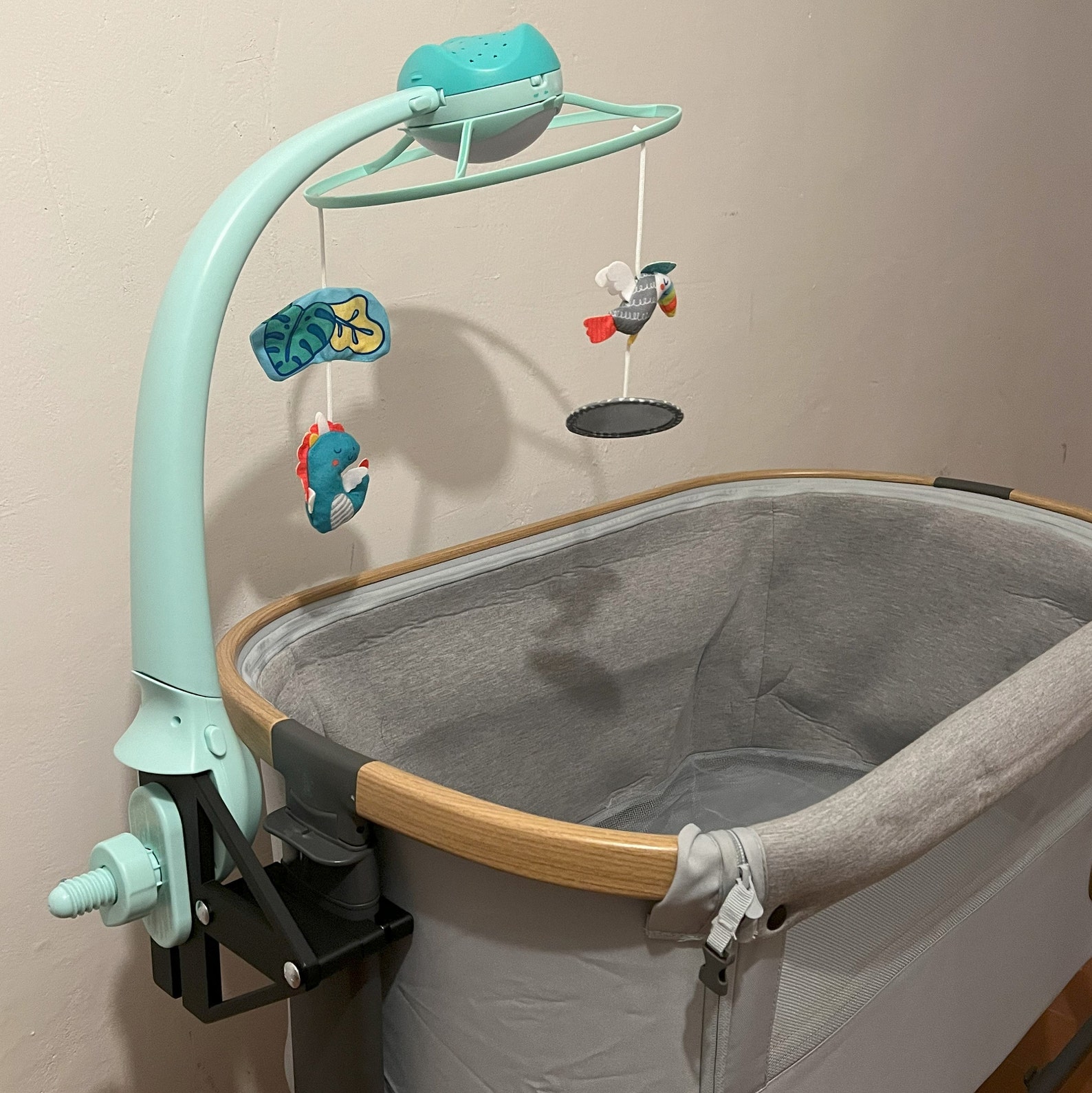
To attach a mobile to a bassinet in the United States, use only the bassinet’s approved mobile mount or a mobile made for that exact model. Follow the bassinet and mobile manuals, keep every part out of your baby’s reach, and remove the mobile as soon as your baby can push up on their hands and knees or around 5 months, whichever comes first.
A mobile should never hang inside the sleep space. It must stay securely above the bassinet, with no loose cord, strap, hook, or small part that your baby could grab, pull, or swallow.

Before You Attach the Bassinet Mobile
Check the bassinet manual first. Bassinets differ in shape, frame design, side height, and approved accessories. Some have a built-in mobile socket. Others allow only a brand-specific attachment. Some do not support a mobile at all.


You will usually need:
- The mobile and all parts listed in its manual
- The bassinet’s approved mobile arm or adapter
- A clean, dry work area
- The bassinet instruction manual
- A screwdriver only if the manual calls for one
Do not use a mobile arm from another brand unless the bassinet maker states that it is compatible. A part may seem to fit but still fail under movement or weight.
Check the parts
Lay out the parts before assembly. Look for:
- Cracks in plastic parts
- Bent metal
- Missing screws or caps
- Frayed cords
- Loose knots
- Broken hanging toys
- Sharp edges
- Parts that do not lock in place
Do not attach a damaged mobile. Contact the maker for a replacement part instead.
Check the bassinet frame
Inspect the place where the mobile will attach. The frame should be firm and free from damage. Do not attach the mobile to:
- A folding hinge
- A removable fabric panel
- A loose canopy
- A storage pocket
- A mattress support
- A handle that moves during use
- A rail that the manufacturer does not list as an attachment point
The attachment point must remain stable when the bassinet is moved, if the bassinet is designed to move.
Read the age and use limits
A mobile may be intended for visual play while your baby is awake, not for use during sleep. Check whether the manual gives limits for:
- Baby age
- Baby weight
- Bassinet model
- Maximum mobile weight
- Maximum cord length
- Use during sleep
- Use while the bassinet is being moved
If the manuals conflict, follow the stricter instruction or contact the manufacturer before use.


How to Attach a Mobile to a Bassinet
The exact steps vary by model, but the safe process is similar. Keep the bassinet empty while you install and test the mobile.
1. Place the bassinet on a stable surface
Set the bassinet on the floor or another firm surface while you work. Lock the wheels or movement system if the model has one.
Do not assemble the mobile while holding the bassinet, while the bassinet is on a bed, or while your baby is inside it.
2. Find the approved mounting point
Look for a marked socket, clamp area, threaded opening, or other attachment point described in the manual.
If you cannot find an approved point, stop. Do not guess where to place the mobile. The manual may explain that the model is not designed to hold one.
3. Attach the mobile arm or base
Insert the mobile arm into the correct socket or place the approved clamp on the stated frame section. Tighten it by hand first.
If the instructions call for a screw, tighten the screw until the part is secure. Do not force it. Over-tightening can damage plastic or deform the frame.
The base should not:
- Slide along the rail
- Tilt toward the mattress
- Twist when touched lightly
- Lift away from the frame
- Block a folding or locking part
4. Lock the arm in place
Many mobile arms use a snap button, locking tab, threaded collar, or clamp. Make sure the lock is fully engaged.
A click alone does not always prove that the part is secure. Check that the button or tab has returned to its locked position and that no gap remains where the manual shows a closed joint.
5. Attach the hanging mobile
Connect the mobile body, toy bar, or hanging toys as the instructions show. Keep cords and strings in their intended channels.
Do not add:
- Extra toys
- Beads
- Ribbons
- Pacifiers
- Teething rings
- Homemade decorations
- Longer strings
- Clips or key rings
Extra weight can change the balance of the mobile. Added cords can also create a strangulation or entanglement hazard.
6. Position it above the bassinet
The mobile should sit above the baby, not beside the baby’s face and not within the baby’s grasp.
Keep it away from:
- The mattress surface
- The bassinet edge
- The fitted sheet
- The baby’s hands and feet
- Any canopy or fabric that could catch on it


Use the distance stated by the manufacturer. If the manual does not give a distance, the safest choice is to keep the mobile clearly out of reach and remove it when your baby becomes mobile.
Never lower the mobile just because your baby cannot reach it yet. Babies gain new skills quickly, and a mobile that is safe one week may be reachable the next.
7. Test it before use
Apply gentle pressure to the mobile arm from several directions. It should stay attached and return to its normal position.
Check that:
- The base does not shift
- The arm does not bend toward the mattress
- The toys do not detach
- The cord stays tight and out of reach
- The mobile does not touch the bassinet wall
- The bassinet still folds or locks as intended
- The mobile does not block access to the baby
If the mobile moves more than the manual allows, remove it and inspect the attachment.

How to Tell Whether the Mobile Is Secure
A properly attached mobile stays in place during normal use. It should not swing into the bassinet, lean over the mattress, or loosen when the frame is gently touched.
Use this quick check:
| Check | What you should see |
|---|---|
| Base | Fully seated or clamped at the approved point |
| Lock | Snap, screw, or collar fully engaged |
| Arm | Firm, with no unexpected tilt |
| Toys | Connected as shown in the manual |
| Cord | Short, tight, and out of reach |
| Bassinet | Still stable and fully locked |
| Mattress | Flat and clear of mobile parts |
| Movement | No mobile contact with the baby or sleep surface |
A mobile that passes this check still needs regular inspection. Vibration, moving the bassinet, and repeated use can loosen parts.
Check the attachment:
- Before each use
- After moving the bassinet
- After folding or unfolding the bassinet
- After cleaning
- Whenever the mobile has been pulled
- Whenever you hear a rattle or notice a change in position
If any part becomes loose, stop using the mobile until you repair or replace it according to the manufacturer’s instructions.
Bassinet Mobile Safety Rules for U.S. Families
The American Academy of Pediatrics recommends keeping hanging objects, including mobiles, out of a baby’s reach. The AAP also advises removing mobiles when a baby begins to push up on their hands and knees or reaches about 5 months of age, whichever comes first.
The U.S. Consumer Product Safety Commission warns caregivers to follow product instructions and keep cords, straps, and other hazards away from sleeping infants. A mobile is not a sleep aid that makes an unsafe sleep space safe.
Always place your baby:
- On their back for every sleep
- On a firm, flat, non-inclined mattress
- In a bassinet, crib, or play yard approved for sleep
- With only a fitted sheet
- Without pillows, blankets, bumpers, stuffed toys, or loose items
Do not attach a mobile to the inside of the bassinet. Do not let the cord hang over the side. Do not use a mobile as a substitute for supervision during awake play.
Remove the mobile when your baby can reach it
Remove the mobile right away if your baby:
- Pushes up on their hands and knees
- Pulls up on the bassinet side
- Rolls close enough to grab it
- Sits or leans toward it
- Pulls at the toys or cord
- Moves the bassinet during play


You do not need to wait until the mobile appears unsafe. Early removal is better than trying to raise it higher or extend the bassinet’s use.
Stop using it after a recall or damage
Check the manufacturer’s recall page and the CPSC recall database if you hear about a problem with your mobile or bassinet. Stop using a recalled product until the maker provides an approved remedy.
Do not repair a broken mobile with tape, glue, wire, string, or a homemade bracket. Those fixes may hide damage without restoring the strength of the original design.
What to Do If the Mobile Will Not Fit
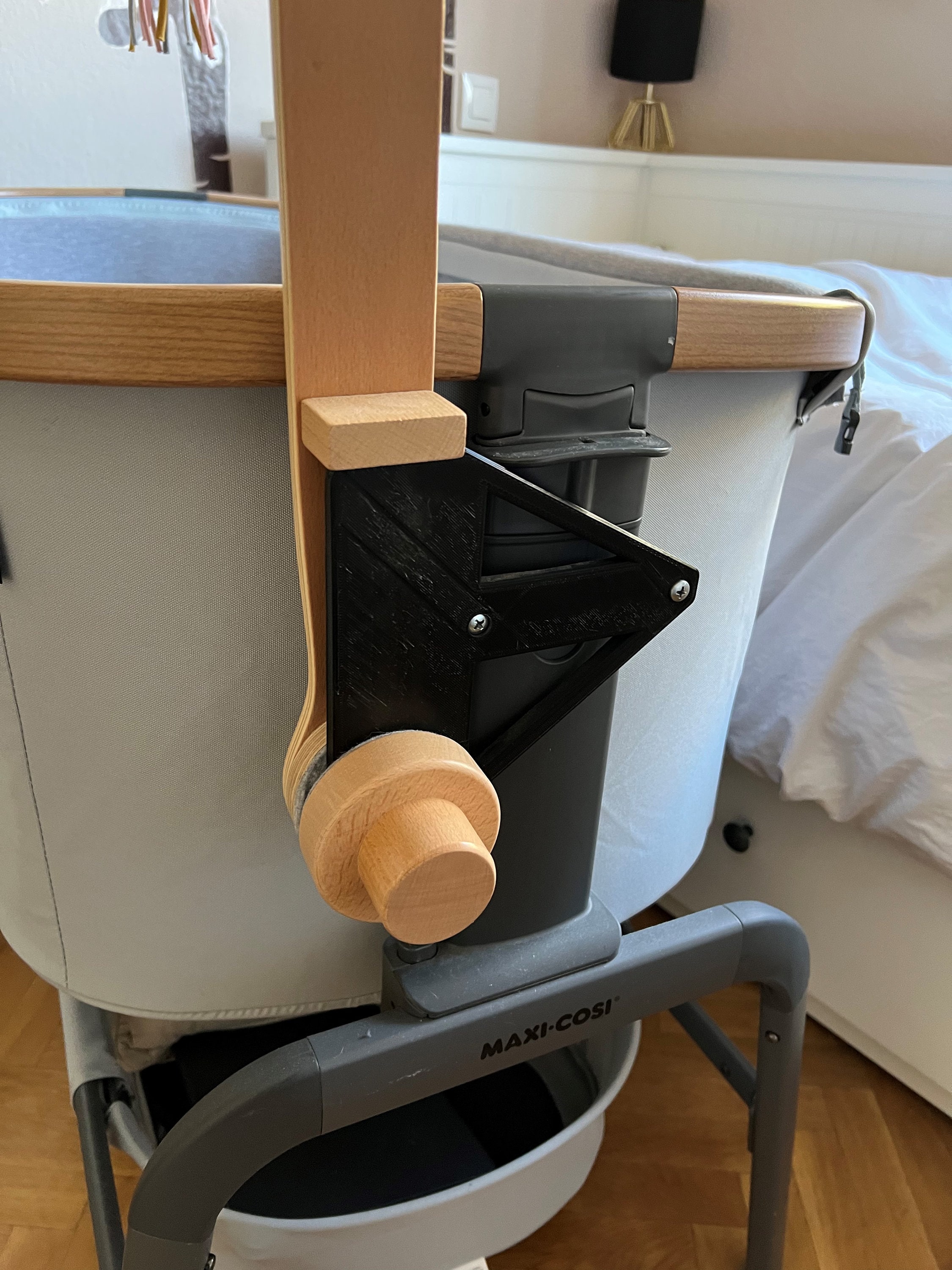
If the mobile does not fit, do not force it or modify the bassinet. A poor fit can place pressure on the frame or leave the mobile unstable.
Try these steps:
- Confirm the bassinet model and version.
- Check that you have every adapter and screw.
- Compare each part with the manual.
- Make sure the attachment point is not covered by fabric.
- Check whether the mobile is made for that exact bassinet.
- Contact the manufacturer with the model number and photos if needed.
Avoid universal clamps unless both the bassinet maker and mobile maker approve them. A universal product may fit many frames but still lack approval for your bassinet.
Common fit problems
The clamp keeps sliding.
The frame may be too narrow, too smooth, or outside the clamp’s approved size. Do not add rubber, cloth, cardboard, or tape unless the manual specifically requires that part.
The arm leans into the bassinet.
The base may be in the wrong position, a joint may be incomplete, or the frame may be bent. Remove it and check the assembly order.
The mobile touches the side.
The arm may be reversed or the mobile may not be compatible. Do not stretch or bend the arm to change its reach.
The screw will not tighten.
The screw may be cross-threaded, missing a washer, or not the correct part. Stop using the mobile and request the proper hardware.
The bassinet no longer folds.
Remove the mobile before folding unless the manual says it can stay attached. Never force the frame closed around an accessory.

Can You Attach a Mobile to a Moses Basket or Portable Bassinet?
Only attach a mobile if the product instructions specifically allow it. Moses baskets, bedside bassinets, travel bassinets, and portable sleep products may have flexible sides or handles that cannot safely support a mobile.
Do not clamp a mobile to:
- A woven basket edge
- A fabric wall
- A carrying handle
- A travel bag
- A removable cover
- A bedside sleeper rail not listed for accessories
For a portable bassinet, remove the mobile before carrying or moving the product unless the manual clearly permits transport with the mobile attached.
A mobile that is safe on a rigid, approved frame may be unsafe on a soft or flexible one. The key issue is not whether the clamp appears tight. It is whether the entire product was designed and tested for that attachment.


Should You Use a DIY Bassinet Mobile?
No. Avoid homemade mobiles and improvised attachment systems over a sleeping baby.
A safe mobile needs more than a balanced toy bar. Its mount, joints, cords, weight, and break points must remain stable during normal use. A homemade hook, ceiling cord, zip tie, or adhesive strip may fail without warning.
If you want visual stimulation during awake time, place an age-appropriate toy where your baby cannot pull it into the sleep space. Use it only while you are watching your baby, then remove it before sleep.
A wall-mounted or ceiling-mounted decoration should also stay outside the bassinet area and away from any place your baby could reach. Decorations are not a replacement for an approved bassinet mobile.

Key Takeaways
- Use only the mobile mount approved for your bassinet.
- Read both product manuals before installation.
- Keep the mobile above the bassinet and out of reach.
- Never add cords, toys, ribbons, or homemade parts.
- Test the mount gently before placing your baby nearby.
- Inspect it after each move and before use.
- Remove it when your baby can push up, reach it, or is about 5 months old.
- Keep the sleep space bare, firm, flat, and free of loose items.
Frequently Asked Questions
Can a mobile hang inside a bassinet?
No. A mobile should remain above the bassinet and out of your baby’s reach. Do not place its arm, toys, cord, or base inside the sleep area.
How high should a mobile be above a bassinet?
Use the height stated in the mobile’s instructions. If no height is listed, position it clearly out of reach and remove it when your baby begins to push up or can reach it. Do not use a general height as a substitute for the product’s instructions.
Can I use a crib mobile on a bassinet?
Only if the manufacturer confirms that the mobile and its mounting system are compatible with that bassinet. A crib mobile may be too heavy, too large, or designed for a different frame.
Is it safe to leave a mobile on during sleep?
A properly mounted mobile still does not belong within a baby’s reach during sleep. Follow the product instructions and remove the mobile when your baby becomes more mobile. Keep the bassinet’s sleep surface free of toys and loose objects.
What should I do if my baby pulls on the mobile?
Remove your baby from the area, take off the mobile, and inspect the bassinet for damage. Do not simply raise the mobile or tighten the clamp if your baby can still reach it.
Can I attach a mobile to a bedside bassinet?
Only when the bedside bassinet manual provides an approved attachment point or accessory. Never attach a mobile to the adult bed, a bedside rail, a fabric side, or a part that could affect the bassinet’s stability.
Final Recommendation
Attach a mobile to a bassinet only through the mounting system approved for that exact model. Keep it out of reach, inspect it often, and remove it at the first sign that your baby can grab or pull it. If the fit, instructions, or safety limits are unclear, contact the manufacturer rather than improvising.
For current U.S. safe-sleep guidance, consult the American Academy of Pediatrics safe sleep recommendations and check the U.S. Consumer Product Safety Commission recall database.
