
Most babies start walking between 9 and 18 months. Many take their first steps around their first birthday, but a baby who walks earlier or later can still be developing normally.
In the United States, the CDC lists walking without holding on as an 18-month developmental milestone. Babies develop at different rates, so the timing of first steps matters less than steady progress in movement and skills. If your baby is not walking by 18 months, has lost a skill, or seems unusually stiff or floppy, contact their pediatrician.
What age do babies usually start walking?
Babies usually begin walking between 9 and 18 months. First steps often come after months of practice with rolling, sitting, crawling, pulling up, and cruising along furniture.
Some babies skip crawling and move from scooting or rolling to standing and walking. Others crawl for many months before taking their first steps. Both patterns can be normal.


Walking skill develops in stages:
- Around 6 to 10 months: Sitting, reaching, rolling, and moving on the floor become more steady.
- Around 8 to 12 months: Many babies pull up to stand.
- Around 9 to 15 months: Babies may cruise while holding furniture.
- Around 10 to 18 months: Many babies take independent steps.
- By 18 months: Most babies can walk without holding on, according to the CDC’s developmental milestones.
These ranges are guides, not deadlines. A baby may be advanced in one area and slower in another. For example, a baby who talks early may walk later, while another baby may walk early but use fewer words.

Signs your baby may be ready to walk
A baby may be getting ready to walk when they can stand, shift their weight, and move from one support to another. These signs often appear before independent steps.
Look for:
- Pulling up to stand on sturdy furniture
- Standing briefly without support
- Lowering from standing with control
- Cruising sideways while holding a couch or table
- Bending down to pick up a toy while holding on
- Pushing a stable object
- Moving between nearby adults or pieces of furniture
- Taking one or two steps before sitting down
- Squatting, standing, and rising again during play
Early steps may look unsteady. Your baby may stand with feet far apart, hold their arms out, or take a few stiff steps. This helps them balance while their brain and muscles learn to work together.
A baby does not need to walk in a straight line at first. Turning, stopping, falling onto the bottom, and trying again are all common parts of learning.

How to help your baby learn to walk safely
The best way to support walking is to give your baby regular chances to move on the floor in a safe space. Babies learn balance through active play, not by being placed in a device that moves them for them.
Try these steps:
- Create a clear floor area. Remove sharp objects, small items, cords, unstable furniture, and breakable items.
- Offer floor play each day. Let your baby crawl, roll, squat, reach, and move between toys.
- Place toys just out of reach. Use a sturdy object nearby so your baby can pull up and move toward it.
- Practice standing during normal play. Put favorite toys on a low, stable surface.
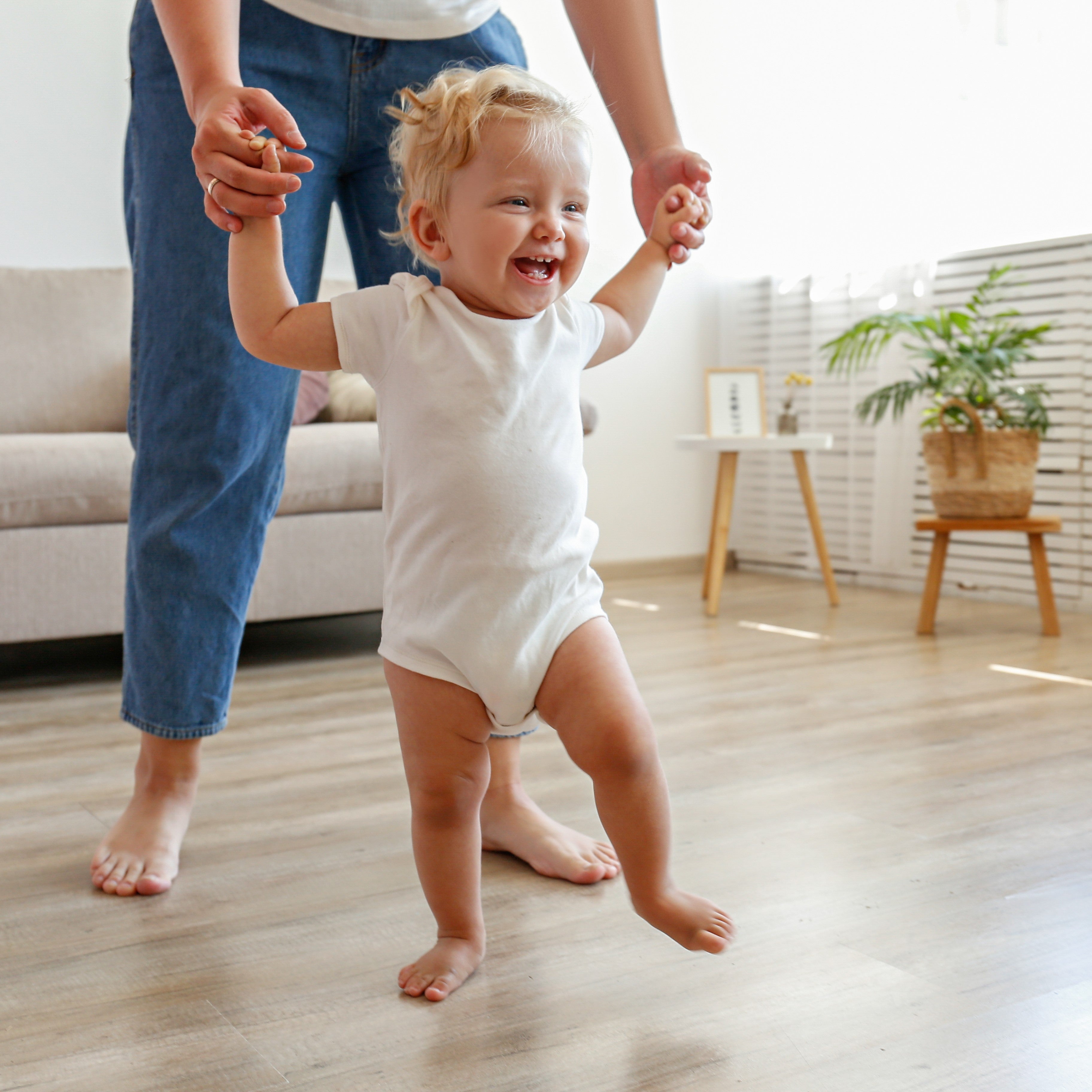
- Offer your hands for balance. Let your baby hold your fingers rather than pulling them forward.
- Use stable push toys only with supervision. The toy should not roll away easily or tip when your baby leans on it.
- Allow safe barefoot time indoors. Bare feet can help babies feel the floor and adjust their balance.
- Let your baby set the pace. Stop when your baby is tired, upset, or losing control.
The American Academy of Pediatrics advises against wheeled baby walkers. They can move quickly, tip, and give babies access to stairs, hot surfaces, and other hazards. The AAP recommends safer alternatives, such as supervised floor play and stationary activity centers without wheels. See the AAP guidance on baby walkers.


Do babies need shoes to learn to walk?
No. Babies usually do not need shoes indoors while learning to walk. Bare feet or socks with grips may help them feel the ground.
Use shoes outdoors or when a baby needs protection from hot, cold, rough, or sharp surfaces. Choose flexible shoes with enough room for the toes. Avoid stiff, tight, heavy, or pointed shoes.
Shoes do not make a baby walk sooner. Their main job is to protect the feet.

Why some babies walk earlier or later
Walking age can vary because babies differ in muscle strength, balance, body size, temperament, practice, and earlier development. A cautious baby may stand and cruise for weeks before trying an unsupported step. A bold baby may take steps sooner but fall more often.
Premature babies may also follow a different timeline. Pediatricians often consider adjusted age during the first two years. To estimate it, subtract the number of weeks a baby was born early from their actual age.
For example, if a baby is 12 months old but was born eight weeks early, their adjusted age is about 10 months. Ask your child’s pediatrician how adjusted age applies to your baby, especially if your baby was very premature or had medical complications.
Other factors that may affect walking include:
- Limited opportunities for floor movement
- A recent illness or injury
- Differences in muscle tone
- Vision or balance problems
- Hip, leg, or foot concerns
- Neurologic or developmental conditions
- A family pattern of later walking
A later first step does not automatically mean there is a problem. The pattern of progress matters. A baby who gains new skills over time may simply need more time, while a baby who stops progressing needs prompt medical attention.

When should you call the pediatrician?
Call your child’s pediatrician if your baby is not walking independently by 18 months, or sooner if you have concerns. The CDC recommends discussing missed milestones with a health care provider rather than waiting.
Contact the pediatrician promptly if your baby:
- Loses a skill they previously had
- Does not bear weight on their legs
- Uses one side of the body much more than the other
- Drags one leg
- Has very stiff or very floppy muscles
- Cannot sit independently by about 9 months
- Cannot pull up to stand by about 12 months
- Does not move around in any way
- Falls constantly without improving
- Seems to have pain when standing or walking
- Walks only on their toes for long periods
- Shows delays in several areas, such as movement, speech, play, or social interaction
These signs do not diagnose a condition. They simply show when an evaluation may help. A pediatrician may check your baby’s muscles, joints, reflexes, balance, vision, and overall development. They may also recommend early intervention services or a physical therapist.
If your baby loses a skill suddenly, has severe pain, cannot use a limb, or becomes weak after an injury, seek urgent medical care.


Common concerns about baby walking
Is it normal for a baby to walk at 8 months?
It can be. Some babies take early steps before their first birthday. Early walking does not reliably predict higher intelligence, strength, or later athletic ability.
If an 8-month-old is walking, make the home safer because they may reach stairs, cords, tables, and hot items sooner than expected.
Is it normal for a 15-month-old not to walk?
It may be normal, especially if the child pulls up, cruises, stands, and continues to gain movement skills. Still, share your concerns at the 15-month visit and keep monitoring progress.
If the child is not walking by 18 months, contact the pediatrician for a developmental evaluation.
Should I worry if my baby skips crawling?
Not necessarily. Some babies crawl on hands and knees. Others scoot, roll, crawl backward, or move in another way. Crawling style alone is usually less important than whether your baby can move, use both sides of the body, and keep gaining skills.
Tell the pediatrician if your baby does not move at all, strongly favors one side, or seems weak or unusually stiff.
Are baby walkers safe?
Wheeled baby walkers are not recommended by the American Academy of Pediatrics. They can increase the risk of falls and injuries and do not teach babies to walk safely.
Use supervised floor play, stable furniture, and stationary activity centers instead. Never place a baby in a walker near stairs, pools, heaters, ovens, or other hazards.
How long after standing will a baby walk?
There is no fixed timeline. Some babies walk within days of standing alone. Others spend several weeks or months pulling up, cruising, and practicing balance before taking steps.
Progress is more useful than a specific number of days. Look for stronger standing, better control, and movement between supports.
Key takeaways
- Most babies start walking between 9 and 18 months.
- First steps near 12 months are common, but earlier and later walking can also be normal.
- Babies often progress from pulling up to cruising, standing, and then walking.
- Floor play and safe practice help more than equipment.
- Avoid wheeled baby walkers.
- Bare feet indoors can help with balance; shoes are mainly for protection.
- Ask the pediatrician about missed milestones, loss of skills, pain, stiffness, floppiness, or one-sided movement.
- If a baby is not walking independently by 18 months, arrange a developmental check.
What to do next
Give your baby daily opportunities to move on a safe floor. Watch for gradual progress rather than comparing their first steps with another child’s.
At the next well-child visit, tell the pediatrician when your baby began pulling up, cruising, standing, and taking steps. If your baby is 18 months or older and is not walking independently, schedule an evaluation rather than waiting for walking to happen on its own.
