
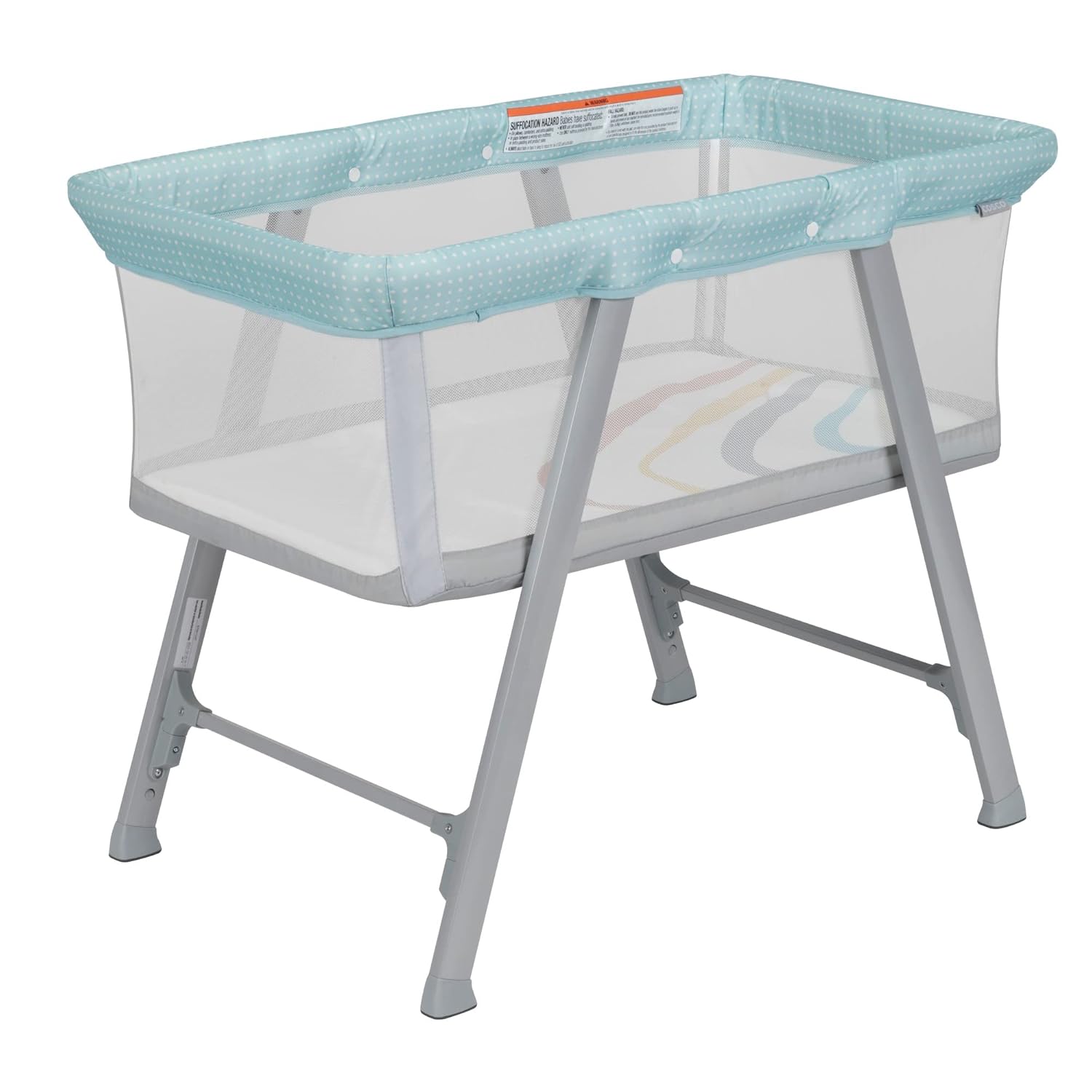
No. A bassinet does not have to have mesh sides to be safe or legal in the United States. U.S. rules focus on the bassinet’s overall design, stability, side height, mattress, openings, and other safety features—not on making every side from mesh.
Still, mesh sides can be useful. They may improve airflow and let you see your baby more easily. The key is that the bassinet must meet current U.S. safety rules and provide a firm, flat, level sleep surface with no loose or padded items.
The American Academy of Pediatrics (AAP) recommends that babies sleep on their backs in a crib, bassinet, portable crib, or play yard that meets U.S. Consumer Product Safety Commission (CPSC) standards. The sleep space should contain only a fitted sheet.

What U.S. safety rules say about bassinet sides
Federal safety rules do not require every bassinet to use mesh sides. The CPSC rules for bassinets and cradles address hazards such as:


- Structural failure
- Entrapment
- Dangerous gaps and openings
- Instability or tipping
- Side height
- Mattress fit
- Hardware failure
- Protruding parts
- Folding and locking problems
- Suffocation and fall hazards
A bassinet may use fabric, wood, plastic, metal, or mesh. The material alone does not determine whether the product is safe.
The product must be designed and tested to meet the applicable U.S. standard. For many traditional bassinets and cradles, that includes 16 CFR Part 1218, which incorporates the relevant ASTM safety standard. Bedside sleepers have separate federal requirements under 16 CFR Part 1222.
A product listing that says “breathable” or “mesh-sided” is not, by itself, proof of safety. Check the product label, instructions, manufacturer details, and recall history.
What matters more than mesh
A safe bassinet should have:
A firm, flat, level mattress.
Your baby’s head should not sink into the surface.A correctly fitted mattress and sheet.
There should be no gap where a baby could become trapped.Strong, secure sides.
The sides should not collapse, bow inward, or detach during normal use.A stable base.
The bassinet should not rock, tip, or move when used as directed.No added padding.
Do not add bumpers, pillows, positioners, blankets, or extra mattresses.A clear sleep area.
Keep toys, stuffed animals, wedges, and nursing pillows out of the bassinet.
Mesh can support visibility and airflow, but it cannot correct a soft mattress, a loose sheet, a damaged frame, or an unsafe incline.

Why parents often prefer mesh bassinet sides
Mesh sides can offer practical benefits, especially during the first months when parents keep the bassinet near their bed.
Better visibility
A clear mesh panel may make it easier to check your baby without leaning over the bassinet. This can be helpful during nighttime care.
Visibility is not the same as supervision, though. A mesh wall does not prevent every sleep hazard, and it does not make it safe to leave a baby in an unsafe position.


Airflow
Mesh may allow more air to move around the bassinet than a solid fabric panel. That can feel reassuring, but airflow claims should not replace safe-sleep practices.
There is no safe reason to add loose mesh, a homemade panel, or an aftermarket liner to improve airflow. An added item can loosen, cover the baby’s face, or create an entrapment risk.
Less temptation to add bumpers
Some parents choose mesh because they worry about a baby’s arms or legs touching the sides. A properly designed bassinet should not need a bumper. The safest approach is to use the product as made and keep the sleep space bare.
Easier monitoring of movement
Mesh may help you see whether your baby has shifted. However, you should still place your baby on their back for every sleep. If your baby moves into another position on their own, follow your pediatrician’s advice and keep the sleep space free of objects.
Mesh is a convenience feature. It is not a substitute for a compliant product or a safe sleep setup.

How to tell whether a bassinet is safe without mesh
If a bassinet has solid sides, inspect the product as a whole. Use this checklist before placing your baby in it.
1. Confirm that the product is meant for infant sleep
Some products look like bassinets but are not intended for unsupervised sleep. Examples can include:
- Moses baskets without a proper stand
- Portable loungers
- Infant nests
- Dock-style cushions
- Rocking products
- Nursing pods
- Changing stations
- Strollers used outside their approved sleep mode
Read the manual. Look for the manufacturer’s stated use, age range, weight limit, and sleep instructions.
2. Check the mattress
The mattress should be firm and should fit the bassinet exactly. You should not be able to slide more than a very small amount of space between the mattress and the frame.
Do not replace the original mattress with a softer or thicker one unless the manufacturer specifically approves that replacement. A thicker mattress can reduce side height and create gaps.
3. Test the sides and frame
Before use, check for:
- Loose fabric
- Torn seams
- Bent supports
- Broken fasteners
- Unlocked folding joints
- Gaps that were not present during assembly
- Side panels that sag or fold
- Sharp edges or exposed hardware
Stop using the bassinet if any part is damaged. Do not repair a structural part with tape, cord, glue, or a homemade panel.
4. Check the base and incline
The sleep surface should be level unless the manufacturer’s instructions clearly describe a permitted position. Avoid products that place a baby on a steep or unstable incline.


A baby’s head can fall forward on an inclined surface. That position may interfere with breathing, even when the product has mesh sides.
5. Read the warning labels
The warning label should state key limits, such as:
- Maximum baby weight
- Maximum age or developmental stage
- When to stop use
- Whether the product can be folded
- Whether rocking or movement is allowed
- Whether the bassinet is designed for bedside use
Many bassinets should no longer be used once a baby can push up, roll, sit, or reach the product’s stated limit. Follow the earliest limit listed in the manual.
6. Search for recalls
Search the product name, model number, and manufacturer on the CPSC recall website. A used bassinet may be missing its original labels or instructions, so ask the seller for clear photos before buying.
A product that was legal when sold may later be recalled. Recalls can involve frames, mattresses, folding parts, accessories, or sleep-position risks—not just mesh.

Mesh sides versus solid sides: Which is better?
Neither material is automatically safer. The better choice is the product that meets current U.S. requirements and stays safe during daily use.
| Feature | Mesh sides | Solid sides |
|---|---|---|
| Visibility | Usually easier to see through | May make checking the baby harder |
| Air movement | May allow more airflow | Depends on vents and overall design |
| Cleaning | Can be harder if fabric traps spills | May be easier to wipe |
| Durability | Can tear or pull away from the frame | Can crack, split, or loosen |
| Safety | Safe only when properly designed and attached | Safe only when properly designed and attached |
| Main concern | Tears, loose fabric, and added liners | Gaps, poor ventilation, and unstable panels |
The material should not drive the decision by itself. Focus on the mattress, frame, side strength, product instructions, and current safety status.
A solid-sided bassinet can be a safe choice when it is made for infant sleep and used as directed. A mesh-sided bassinet can still be unsafe if it has a soft mattress, an incline, a loose side, or an unapproved accessory.

Are breathable mesh liners or aftermarket panels safe?
Do not add an aftermarket mesh liner, bumper, net, or fabric panel unless the bassinet manufacturer specifically made and approved it for that exact model.
The word breathable does not make an accessory safe. A loose product can:
- Cover a baby’s nose or mouth
- Detach from the frame
- Create a loop or entrapment point
- Reduce the available sleep space
- Change the product’s tested design
- Hide damage or gaps
The same caution applies to replacement mattresses, mattress pads, wedges, and positioners. Use only parts listed in the manufacturer’s instructions.
If a bassinet has a tear or loose side, remove it from use. Replacing the whole product is usually safer than trying to sew, tie, or glue the side back into place.

Does a bedside bassinet need mesh sides?
A bedside bassinet does not necessarily need mesh sides, either. However, bedside sleepers have special design and attachment issues because they sit next to an adult bed.


Before using one, confirm that:
- The product is approved for bedside use.
- The attachment system is installed exactly as directed.
- The product is secured to the adult bed.
- There is no gap between the sleeper and the bed.
- The adult mattress height falls within the stated range.
- The side can be lowered only in the approved way.
- The sleep surface remains firm, flat, and clear.
Never assume that lowering one side makes an ordinary bassinet safe for bed sharing. A product must be designed and tested for bedside use.
Mesh may make it easier to see the baby from bed, but it does not remove the risk of gaps, loose attachments, or unsafe positioning.

Common mistakes to avoid
The most common bassinet mistakes involve the sleep surface and accessories, not the absence of mesh.
Adding a padded bumper
A bumper can make the space look cozy, but it adds material near the baby’s face. A baby does not need a bumper to sleep safely in a compliant bassinet.
Using a loose blanket
Dress your baby in clothing suitable for the room instead of adding a loose blanket. If a blanket is used under a pediatrician’s guidance, keep it light, secured below the chest, and away from the face. Many families use a properly fitted wearable blanket instead.
Reusing an unknown secondhand bassinet
A secondhand product may have missing parts, outdated instructions, hidden damage, or a recall history. If you cannot identify the model and confirm its condition, do not use it for sleep.
Using a stroller bassinet without checking the manual
Some stroller attachments are approved for sleep in certain conditions. Others are not. Do not assume that a flat-looking stroller insert is a bassinet.
Letting a baby sleep in a rocking or vibrating product
Movement can soothe a baby, but a product designed for soothing may not be approved for routine sleep. Follow the manual and move the baby to a firm, flat sleep surface when needed.
Treating “breathable” as a safety rating
“Breathable” is often a marketing term. It does not prove compliance with federal rules, and it does not make an inclined or cluttered sleep space safe.
When should you stop using a bassinet?
Stop using the bassinet when the manufacturer says to stop or when your baby reaches the product’s developmental limit—whichever comes first.
Common stop-use signs include:
- Your baby reaches the stated weight limit.
- Your baby can roll.
- Your baby can push up on their hands or knees.
- Your baby can sit up.
- Your baby can pull on or climb over the side.
- The bassinet no longer remains stable.
- The mattress, fabric, frame, or hardware is damaged.
Do not wait for a baby to climb out. A low side can become a fall risk once a baby gains new skills.
Move your baby to a compliant crib, portable crib, or play yard with a firm, flat mattress and a fitted sheet. If you are unsure about timing, ask your child’s pediatrician and check the bassinet manual.

Quick decision guide
Use this simple guide when choosing or checking a bassinet:


- Does it have mesh sides? That is optional.
- Does it meet current U.S. safety requirements? This is essential.
- Is the mattress firm, flat, and fitted? This is essential.
- Is the sleep space empty except for the fitted sheet? This is essential.
- Is the frame stable and undamaged? This is essential.
- Is it used within the age, weight, and development limits? This is essential.
- Are all accessories approved for that model? This is essential.
- Can you confirm the product is not recalled? Check before use.
If the answer to any essential question is no or unknown, do not use the bassinet for sleep until you resolve the problem.

Frequently asked questions
Can a newborn sleep in a bassinet with solid sides?
Yes. Solid sides are not automatically unsafe. The bassinet must be made for infant sleep, meet applicable U.S. safety requirements, have a firm and level sleep surface, and remain free of loose items.
Does mesh prevent Sudden Infant Death Syndrome (SIDS)?
No. Mesh sides have not been shown to prevent SIDS. Follow safe-sleep guidance: place the baby on their back, use a firm and flat sleep surface, keep the sleep area bare, and share a room without sharing a bed.
Can I cover solid bassinet sides with breathable fabric?
No. Do not add fabric or mesh unless the manufacturer approves that exact accessory for that exact model. Added material can create suffocation and entrapment hazards.
Is a bassinet safer than a crib?
Not by default. Both can be safe when they meet current requirements and are used correctly. A bassinet is smaller and often useful for the early months, but it has a shorter use period.
What should I do if my baby rolls in the bassinet?
Stop using the bassinet if its instructions say to stop when rolling begins. Move your baby to a suitable crib, portable crib, or play yard. Ask your pediatrician if you are unsure how to handle the transition.
Conclusion
A bassinet does not need mesh sides in the United States. Mesh can improve visibility and may support airflow, but it is only one design feature.
Choose a bassinet with a firm, flat mattress, secure sides, a stable frame, a proper fit, clear instructions, and no unapproved accessories. Before use, check the model for recalls and stop using it when your baby reaches the product’s stated limit or developmental milestone.
The safest next step is simple: read the manual, inspect the bassinet, confirm its U.S. safety status, and keep the sleep space bare.
