
Shopping with a stroller in a U.S. grocery store, pharmacy, mall, or big-box store takes a little planning. The goal is to keep your child secure, leave enough room to move, and carry only what the stroller is built to hold.
The easiest method is to use the stroller for your child and a basket, reusable bag, or store cart for your purchases. Do not overload the stroller, hang heavy bags from the handle, or place a child in a shopping cart unless the cart has a safe, built-in child seat and you follow its instructions.

What You Need Before Shopping With a Stroller
You need a stroller that fits your child, has a working brake, and allows your child to sit or recline as the manufacturer permits. You also need a simple plan for carrying your items.
Most shopping trips work best with:


- A stroller with a five-point harness
- A working parking brake
- A small diaper bag or personal bag
- Reusable shopping bags
- A short shopping list
- A way to pay without holding many loose items
- A backup plan if the store is crowded or the stroller will not fit
A stroller basket is meant for light items. Check the stroller manual for its exact basket and handle limits. Do not assume that a strong-looking handle can hold a heavy bag.
A stroller is not a shopping cart. It may tip if weight hangs from the handle or sits high above the child. The U.S. Consumer Product Safety Commission advises caregivers to use stroller restraints and set the brakes when stopped.
Choose the right shopping setup
Your setup depends on the child’s age, the store, and the size of the trip.
| Shopping trip | Practical setup |
|---|---|
| A few small items | Stroller basket or a small hand basket |
| A full grocery trip | Stroller plus a store cart, or shop with another adult |
| A mall or pharmacy visit | Stroller basket and a small personal bag |
| A warehouse-store trip | Use a cart and keep the child in the stroller |
| A crowded store | Use a compact stroller and avoid peak hours |
| A store with narrow aisles | Use a small stroller and carry fewer items |
If you shop alone, a stroller and a shopping cart can be difficult to control at the same time. Consider a pickup order for a large trip. In the U.S., many grocery chains and retailers offer curbside pickup, which can reduce the need to push both.

How to Prepare Before You Leave Home
Prepare the stroller and the shopping plan before entering the store. A few minutes of preparation can prevent a rushed decision in a crowded aisle.
1. Check the stroller
Before leaving, confirm that:
- The harness buckles and adjusts correctly.
- The wheels move freely.
- The brakes hold the stroller in place.
- The stroller opens fully and locks.
- The basket is not torn or loose.
- No strap or blanket can reach the wheels.
- The child is within the stroller’s stated weight and height limits.
Never use a stroller with a loose wheel, broken brake, damaged frame, or faulty harness. Check the model for recalls through the CPSC recall database.
2. Pack light
Bring only what you need for the trip. A heavy diaper bag can make the stroller harder to steer and may add weight above the stroller’s center of gravity.
Keep heavy items low and centered. Good examples include a small package of wipes or a few canned goods in the basket. Avoid placing large, heavy items on the handle.


3. Plan your list by store section
Group your list into sections such as:
- Produce
- Dry goods
- Refrigerated food
- Frozen food
- Household items
- Checkout
This reduces backtracking. It also helps you leave if your child becomes tired or upset.
4. Check the store layout
Look for:
- Elevator access
- Wide entrances
- Family restrooms
- Accessible checkout lanes
- Customer service desks
- Pickup or delivery options
Many U.S. stores have accessible routes, but displays, carts, boxes, and seasonal items may narrow the path. If you cannot find a clear route, ask an employee for help.

How to Shop With a Stroller Step by Step
The safest approach is to keep your child in the stroller and use a separate method for your purchases.
Step 1: Secure your child
Place your child in the seat approved for their age, size, and development. Fasten the harness snugly. The straps should hold the child without pinching.
Do not let a child stand in the stroller. Do not leave the stroller unattended, even if the brake is set.
If your child is asleep, keep the stroller in the position allowed by the manual. A stroller seat is not automatically a safe sleep space. The American Academy of Pediatrics recommends moving a sleeping infant from a sitting device to a firm, flat sleep surface when practical.
Step 2: Use the entrance with the most room
Choose an entrance that gives you space to turn. Automatic doors and accessible entrances are often easier than narrow doors with a sharp threshold.
Keep the stroller away from closing doors. Enter slowly, especially when another shopper is behind you.
Step 3: Pick a basket or cart
For a short trip, use a hand basket if you can carry it safely. For more items, use a store cart and keep the child in the stroller.
If you push both, place the cart in front and guide the stroller behind only when you have enough room. This can be hard to control. A safer choice is to shop with another adult: one person pushes the stroller while the other handles the cart.
Do not place the stroller inside a shopping cart. Do not put a child carrier or car seat on top of a cart. The cart can become top-heavy and tip.
Step 4: Keep the stroller close
Keep one hand on the stroller when stopped. Set the parking brake if you need both hands.


Avoid leaving the stroller at the end of an aisle while you reach for an item. A child can roll into another shopper’s path, and an unattended stroller can be struck by a cart.
Step 5: Keep items low
Place purchases in the cart or a basket. If the stroller basket is your only option:
- Put heavier items at the bottom.
- Keep weight near the center.
- Leave room for your child’s feet.
- Keep items away from the wheels.
- Do not cover the child with bags.
- Stop if the stroller becomes hard to steer.
Never hang a heavy tote from the handle. If the handle pulls backward when you remove your hands, the stroller may be at risk of tipping.
Step 6: Turn with extra space
A stroller’s front wheels may swing wider than you expect. Slow down near:
- End caps
- Clothing racks
- Refrigerated cases
- Checkout lines
- Elevator doors
- Displays placed in the middle of aisles
Look behind you before backing up. Say “excuse me” rather than forcing through a tight gap.
Step 7: Check out safely
Use a checkout lane with enough space for the stroller. Keep the stroller beside you, not in the path of the conveyor belt or bagging area.
If you use a self-checkout lane, avoid balancing items on the stroller while scanning. Keep the stroller brake set when you pay. If the lane is too narrow, ask an employee to help or choose a staffed lane.

How to Shop With a Stroller and a Shopping Cart
Using a stroller and a cart at the same time is possible, but it requires more room and attention.
The safest options are:
- Shop with another adult.
- Use a cart with a designated child seat only if your child is safely seated there instead of in the stroller.
- Use a hand basket for a small list.
- Use delivery or curbside pickup for a large order.
Do not connect a stroller to a shopping cart with a strap, hook, or improvised device. Unless both products are specifically designed and approved to connect, the setup may affect balance, steering, and stopping.
If you use a cart with a child seat, follow the cart’s warning label. The CPSC warns that children can fall from shopping carts and that carts can tip. Keep the child seated, use the built-in restraint, and never allow the child to stand or climb.
A cart is often better than a stroller for a large grocery order because it holds more weight lower to the ground. However, it does not replace supervision.

Tips for Different U.S. Stores
The best stroller strategy changes by store type.


Grocery stores
Use a small list and shop around the store’s edge first if you need fresh foods. Keep cold food together and finish with frozen items when possible.
A full grocery trip may be difficult with one adult, one stroller, and one cart. Consider a second adult, pickup, or delivery for heavy items such as cases of water, pet food, and large detergent containers.
Pharmacies and convenience stores
These stores often have narrow aisles. Use the smallest safe stroller setup and avoid leaving the stroller in front of the entrance, pharmacy counter, or checkout.
Malls and department stores
Elevators may be easier than escalators. Never take a stroller onto an escalator unless the facility gives specific guidance and the stroller can be safely managed. In most cases, use an elevator instead.
Watch for clothing racks and changing displays. They can create narrow paths that are hard to see from the stroller.
Warehouse clubs
Warehouse stores have wide aisles but heavy, tall products. Keep large boxes and bulk packages in the cart, not on the stroller handle.
If the store requires a large cart for your purchase, shopping with another adult or using pickup may be safer and easier.
Outdoor markets and farmers markets
Uneven pavement, gravel, and crowded walkways can make a stroller harder to control. Use the brake on slopes, slow down over rough ground, and keep bags low.
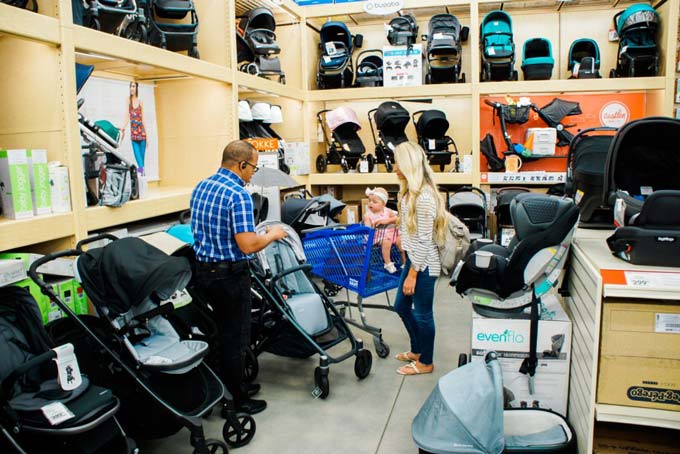
Stroller Shopping Safety Rules
The main safety rule is simple: keep the child secured, keep weight low, and keep the stroller under control.
Follow these practices:
- Use the harness every time.
- Set the brake whenever you stop.
- Keep one hand on the stroller when near stairs, ramps, or curbs.
- Do not hang heavy bags from the handle.
- Do not place a child in a stroller basket.
- Do not leave a child alone in a stroller.
- Do not let an older child push a stroller in a store.
- Do not use a phone while moving through crowded areas.
- Keep hot drinks away from the child and stroller.
- Keep cords, straps, and bag handles away from wheels.
- Do not cover the stroller with a blanket to block sun or heat.
A stroller fan can help with airflow, but it does not make a hot car or warm store safe. Watch for signs of overheating, such as flushed skin, unusual sleepiness, weakness, or rapid breathing. Leave the store and seek medical help if symptoms are severe or do not improve.

What to Do When Shopping With a Stroller Goes Wrong
Most problems have a simple fix. Stop moving first, then solve the problem.
The stroller will not fit through an aisle
Do not force it. Back out slowly, ask nearby shoppers to give you space, or ask an employee for another route.
The stroller feels heavy or unstable
Remove items from the handle and top area. Move heavy goods to a cart or ask for help. If steering remains difficult, stop the trip.
Your child becomes upset
Move to the side of the store or a quiet area. Offer a drink or snack if appropriate, check the harness and temperature, and shorten the trip if needed.


You need to use the restroom
Ask an employee where a family or accessible restroom is located. Never leave a child alone with the stroller outside the restroom.
The store is too crowded
Leave the main aisle and wait in a safe, open area. If the store remains difficult to navigate, use pickup or return at a less busy time.
The stroller brake does not work
Do not use the stroller on a slope or leave it standing unattended. If the brake fails during the trip, keep hold of the stroller and leave the store safely. Stop using the stroller until it is repaired or replaced.

Common Mistakes to Avoid
Small shortcuts can create large risks in a busy store.
Hanging bags from the handle
This is one of the most common ways to make a stroller unstable. Use the basket or a separate cart instead.
Covering the stroller with shopping bags
Bags can fall, block airflow, or reach the child. Keep them in the basket or cart.
Leaving the stroller at the end of an aisle
The stroller can roll, block traffic, or be hit by another cart. Keep it beside you.
Using a phone while pushing
A phone reduces your awareness of people, shelves, doors, and uneven flooring. Stop the stroller before using it.
Treating a stroller board as a seat
A ride-on board may be approved only for standing and only within a certain weight limit. Check the manufacturer’s instructions. Do not allow a child to sit on a board unless it is designed for sitting.
Assuming all store carts work with all car seats
Car seats and shopping carts are separate products. A car seat that clicks into a stroller frame is not necessarily safe on a shopping cart. Follow the car seat and cart instructions, and avoid placing the carrier on top of the cart.
Quick Shopping Checklist
Before leaving home:
- The child fits the stroller’s limits.
- The harness works.
- The brakes work.
- The basket is not damaged.
- Heavy items will go in a cart or reusable bag.
- The shopping list is short and organized.
- You know where the accessible entrance or elevator is.
- You have a backup plan for a crowded store.
At the store:
- Secure the child.
- Choose a basket or cart.
- Keep the stroller close.
- Set the brake when stopped.
- Keep weight low.
- Slow down at turns and doors.
- Check the path before backing up.
FAQs About Shopping With a Stroller
Can I put groceries in the stroller basket?
Yes, if the items stay within the basket’s weight limit and do not affect steering or balance. Keep heavy items low and centered. Never use the basket as a seat for a child.
Can I put my baby’s car seat on a shopping cart?
Generally, no. A car seat may fit on top of a cart, but that does not make the combination stable or approved. Keep the car seat attached to its approved stroller base or carry it as directed by the manufacturer.
Is it safe to push a stroller and a shopping cart together?
It can be difficult and may reduce control. Shopping with another adult, using a hand basket, or choosing pickup is usually easier for a large trip. Never attach the stroller to the cart with an improvised strap or hook.
How can I shop with a stroller in a small store?
Use a compact stroller, carry a small basket, and shop during a quiet period when possible. Keep the stroller beside you and ask an employee for help if an aisle is blocked.
What should I do if my stroller tips or a wheel breaks in the store?
Hold the stroller if you can do so safely, move the child to a safe place, and ask an employee for help. Do not continue using a stroller with a broken wheel, frame, harness, or brake until it has been checked.
Conclusion
Shopping with a stroller is safest when the stroller carries the child and a cart or basket carries the purchases. Secure the harness, use the brake when stopped, keep heavy items low, and avoid hanging bags from the handle.
For a small trip, a stroller basket may be enough. For a full grocery run, use a separate cart, bring another adult, or choose curbside pickup. When the stroller becomes hard to steer or the store becomes too crowded, stop and change the plan rather than pushing through.
