
Introduction
To put a rain cover on a stroller, first park the stroller on level ground and set the brake. Place the cover over the stroller canopy, pull it down over the seat or bassinet, and fasten each strap or elastic edge. Check that the cover fits snugly, has clear air vents, and does not touch your child’s face.
Rain covers help block rain and wind during short trips. They do not replace adult supervision. The stroller manual always comes first because covers differ by stroller type, seat shape, and brand.
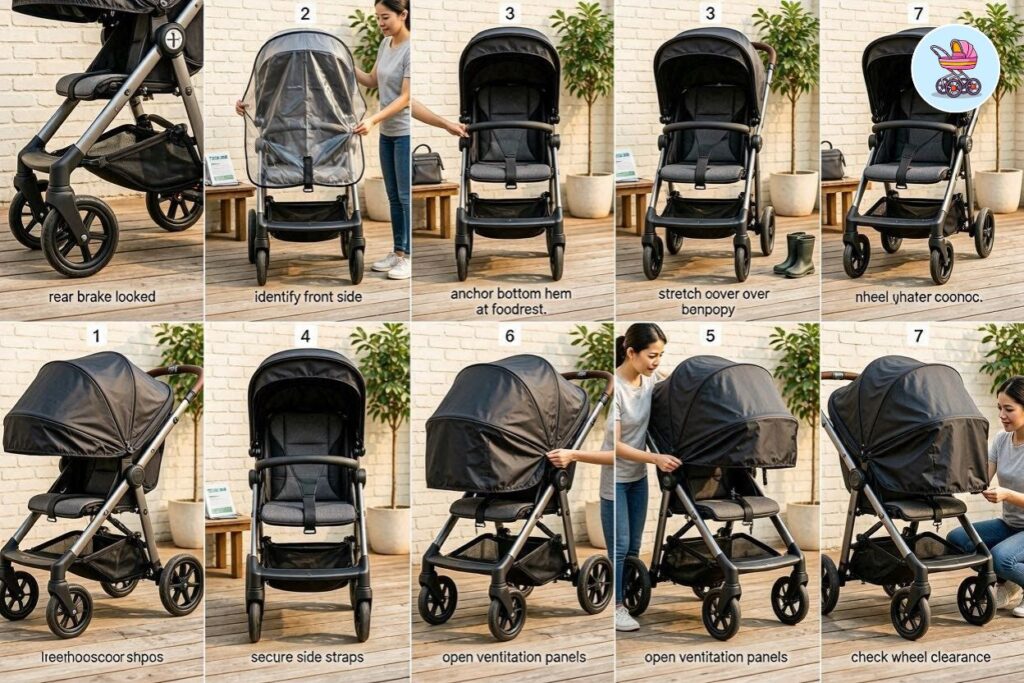
What You Need Before You Start
You usually need only the stroller and its matching rain cover. A clean, dry cloth can help if the cover or stroller is wet and slippery.
Before you fit the cover, check these points:


- Use the correct cover. A custom cover should match the stroller model. A universal cover must fit the stroller’s size and shape.
- Inspect the cover. Look for tears, loose seams, sharp parts, cloudy plastic, or blocked vents.
- Check the stroller position. A cover may fit a stroller in the upright position but not when the seat is fully reclined.
- Remove loose items. Take off bags, blankets, toys, and other items that could block air vents.
- Read the manual. Look for instructions under “rain cover,” “weather shield,” or “stroller accessories.”
- Check the weather. A rain shield is for brief protection from rain and wind. It is not a safe enclosure for hot weather.
A rain cover is often made from clear plastic or coated fabric. Its job is to keep water out while allowing air to enter through built-in vents. Never create a cover from a plastic bag, shower curtain, blanket, or other household material.
How to Put a Rain Cover on a Stroller
Follow these steps for most standard stroller rain covers. If your cover has a different design, use the same basic order but follow the maker’s instructions.
1. Park the stroller safely
Move the stroller to a level spot away from traffic, stairs, and puddles. Set the parking brake. If possible, fit the cover before placing your child in the stroller.
A locked stroller is easier to handle. It also reduces the chance that the stroller will roll while you pull the cover into place.
2. Open the stroller canopy
Pull the stroller canopy forward. The rain cover usually sits over the canopy and follows its shape.
If the cover has a top opening, align it with the canopy. Some covers attach to the canopy with hook-and-loop tabs, snaps, or elastic. Leave these fasteners open for now.
3. Identify the front and back of the cover
The front usually has a larger clear panel. The back may have straps, elastic, or a smaller opening around the handle area.
Look for:
- A wider section for the child’s legs
- A top section that fits over the canopy
- Side vents
- Bottom elastic
- Straps or snaps near the frame
- An opening for the stroller handle
If the cover feels twisted, take it off and turn it around. Do not force a panel over the frame.
4. Place the cover over the canopy
hold the top of the cover over the stroller canopy. Pull it forward so the clear front panel sits in front of the child.


Keep the cover centered. The side seams should run down the sides of the stroller, not across the child’s face or chest.
For a stroller with a reversible seat, check that the cover is designed for the seat’s current direction. A cover made for forward-facing use may not fit well when the seat faces the parent.
5. Pull the cover down over the seat
Gently pull the sides and bottom of the cover over the stroller seat, footrest, and lower frame. Work from one side to the other.
Do not stretch the cover so tightly that it pulls the canopy forward or presses against the child. The cover should leave enough space for normal movement and airflow.
If the stroller has a bassinet or carrycot, use a cover made for that bassinet. Do not assume a regular seat cover is safe or compatible.
6. Attach the fasteners
Secure each strap, snap, zipper, or hook-and-loop tab. Start at the top, then fasten the sides and bottom.
Fasteners should hold the cover in place without pulling the stroller out of shape. Keep all straps outside the child’s reach when possible. Do not leave loose straps inside the seating area.
If the cover uses elastic, make sure it sits around the stroller frame. Do not place elastic around the child’s body or neck.
7. Check the vents
Find every vent in the cover. Make sure no vent is folded shut, pressed against fabric, or covered by a bag.
Air vents must stay open. Do not add extra plastic, tape, blankets, or cloth over the cover. Those items can reduce airflow and trap heat.
8. Check the child’s space
Before you start walking, inspect the area around your child’s head and face. The cover should not rest against the child.
Check that:
- Your child can breathe freely.
- The child’s face is not near the plastic.
- The cover does not press on the child’s chest.
- The child’s hands are not caught in a strap or zipper.
- The harness remains correctly fastened.
- The child can sit or recline in the normal position.
The cover should protect the stroller, not act as a sealed bubble.
9. Test the stroller
Push the empty stroller a short distance. Watch for rubbing, flapping, or movement of the cover.
Then check the wheels, brake, handle, and folding parts. The rain cover must not touch the wheels or interfere with steering. Never fold the stroller while the cover is attached unless the manual specifically allows it.


How to Check That the Rain Cover Fits Correctly
A properly fitted cover stays in place and protects the child without blocking airflow.
Use this quick check:
| Check | What you should see |
|---|---|
| Canopy | The cover sits over the canopy without pulling it out of shape |
| Front panel | The clear panel hangs in front of the child |
| Side panels | The sides cover the seat without pressing inward |
| Bottom edge | The edge reaches the frame or footrest area |
| Vents | All vents are open and clear |
| Straps | Fasteners are secure and outside the seating space |
| Wheels | No cover material touches the wheels |
| Brake | The brake works as normal |
| Child’s face | The cover does not touch the face or mouth |
| Handle | The handle remains easy to hold |
A good fit is snug but not tight. There should be no large gap where rain can blow directly onto the child. There should also be no sealed space around the child’s head.
If the cover slips down, check whether the canopy is fully open. Then refasten the top and side points. If it still slips, the cover may not match the stroller.
Safety Rules for Using a Stroller Rain Cover
Use a rain cover only for its intended purpose and for short periods. Plastic and coated fabric can trap heat, even when the outdoor air feels mild.
Follow these rules:
- Never leave a child alone under a rain cover.
- Remove the cover indoors, in a car, or in a warm area.
- Keep all vents open.
- Do not cover the stroller with an extra blanket or sheet.
- Do not use a torn, cracked, or damaged cover.
- Do not let the cover touch the child’s face.
- Do not use the cover as a sleep enclosure.
- Do not place a bag over the handle if it can cover a vent or tip the stroller.
- Do not run or jog with a regular stroller unless it is designed for that use.
- Do not use the cover if it blocks the brake, wheels, handle, or folding system.
Watch the child often. Signs of overheating may include flushed skin, unusual sweating, hot skin, weakness, rapid breathing, or unusual sleepiness. Move the child to a cool place and remove the cover. Seek medical help if the child seems seriously unwell.
A rain cover also does not protect against lightning, flooding, or strong wind. Go indoors during severe weather.

What to Do If the Rain Cover Does Not Fit
A cover that does not fit can block airflow or interfere with safe stroller use. Do not solve the problem by stretching it, tying it to random parts of the stroller, or adding extra plastic.
Use this troubleshooting order:
The cover keeps slipping off
Possible causes include:
- The canopy is not fully open.
- The cover is upside down.
- The straps are not fastened in the correct order.
- The cover is too large for the stroller.
- The seat is in a position the cover does not support.
Take the cover off and identify the top, front, and back. Refit it with the canopy open. If it still slips, check the stroller manual or contact the manufacturer.
The cover is too tight
A tight cover may pull on the canopy or press against the child. Check whether the stroller is reclined or facing the wrong way.
If the cover still feels tight, stop using it. Choose a cover made for that stroller or seat position. Do not cut vents into the cover or alter the seams.
The cover touches the child
Remove it and check the size, seat position, and canopy angle. A cover should not rest on the child’s face, hands, or chest.


Some universal covers fit poorly on compact strollers, double strollers, and strollers with deep seats. A model-specific cover may work better.
Rain enters from the sides
Make sure the top is centered and the side edges reach the frame. Fasten every available tab.
A cover may still allow some water in during heavy rain or strong wind. Use a sheltered route and avoid standing water. If water enters during normal use, replace the cover if it has shrunk, warped, or lost its shape.
The cover fogs up
Fog can form when warm, moist air meets a cool plastic panel. First, check that all vents are open. Move to a dry or sheltered area and remove the cover when it is safe to do so.
Do not add a cloth inside the cover to wipe it while the child is seated. Remove the child or the cover before cleaning.
The stroller will not fold
Remove the rain cover unless the stroller manual says it can stay on during folding. Never force the folding mechanism.
Folded plastic can crease, crack, or become trapped in the frame. Store the cover separately when it is dry.

How to Clean and Store a Stroller Rain Cover
Clean the cover after muddy or salty rain. Wipe it with mild soap and lukewarm water, then rinse with clean water.
Avoid bleach, strong solvents, rough scrubbers, and high heat unless the manufacturer allows them. These can damage clear plastic or weaken seams.
To store the cover:
- Shake off water and dirt.
- Wipe it clean.
- Let it dry fully.
- Fold it loosely along its natural seams.
- Store it away from sharp objects and direct sunlight.
Do not pack a wet cover in a closed stroller basket or plastic bag. Moisture can cause mildew and a musty smell.
Inspect the cover before each use. Replace it if you find cracks, holes, cloudy sections that reduce visibility, broken snaps, loose elastic, or damaged vents.

Universal Versus Stroller-Specific Rain Covers
A stroller-specific cover usually provides the most predictable fit. It is made for the stroller’s canopy, seat, footrest, and frame.
A universal cover may cost less and can work across several stroller shapes. However, its fit can vary. Check the measurements and compare them with the stroller in both upright and reclined positions.
| Cover type | Main benefit | Main limitation |
|---|---|---|
| Stroller-specific cover | Better fit and simpler attachment | May fit only one model or small model range |
| Universal cover | Can work with different strollers | May slip, leave gaps, or block parts |
| Bassinet cover | Matches a bassinet or carrycot | Usually not suitable for a regular seat |
| Double-stroller cover | Covers two seats or a larger frame | Can be heavy and harder to ventilate |
| Jogging-stroller cover | May match a larger canopy and frame | Must not interfere with the jogging stroller’s safety features |
The deciding factor is not the label. It is the fit. A cover is suitable only when it stays secure, keeps vents open, and does not interfere with the child, wheels, brake, or handle.


Common Mistakes to Avoid
The most common mistake is treating a rain cover like a general stroller blanket. A rain cover must allow airflow and must not create a warm, sealed space.
Avoid these errors:
- Putting the cover on while it is inside out
- Covering the air vents with a bag
- Using a blanket over the rain cover
- Leaving the cover on in a warm room
- Using a cover made for a different stroller type
- Letting the cover hang near the wheels
- Folding the stroller with the cover attached
- Placing the child in the stroller before checking the fit
- Leaving the child unattended
- Using a damaged or homemade cover
If you are unsure, remove the cover and check the stroller manual. The safest choice is to pause the trip rather than use a cover that does not fit.

Frequently Asked Questions
Can I use a rain cover on any stroller?
No. A cover must fit the stroller’s size and design. Check the stroller manual and the cover’s compatibility list. A universal cover may fit many strollers, but it is not automatically safe for every model.
Can my baby sleep under a stroller rain cover?
A rain cover is not a sleep product. Do not use it to create a covered sleep space. If your child falls asleep during a walk, keep watching the child and follow the stroller and pediatric safety guidance for your situation.
Should stroller rain cover vents be open?
Yes. Keep all built-in vents open and clear. Vents help reduce heat and improve airflow. Never tape them shut or cover them with cloth.
Can I use a rain cover in hot weather?
Use caution. A clear cover can trap heat, even if it is raining. Remove it indoors and in warm areas. Do not use it as a sun shade unless the manufacturer specifically designed it for that purpose.
How do I keep a rain cover from fogging?
Keep the vents open and remove the cover when you reach a dry, safe place. Wipe the cover only after removing it or moving the child away from the cover. Persistent fogging may mean that the cover has poor ventilation or does not fit the stroller well.
Can I wash a stroller rain cover in a washing machine?
Only if the manufacturer says you can. Many clear plastic covers can warp or tear in a washer or dryer. Hand-washing with mild soap and air-drying is often the safer general method.
Conclusion
The safest way to put a rain cover on a stroller is to secure it over the open canopy, pull it evenly over the seat, fasten the straps, and check the vents and child’s breathing space. The cover must not touch the child’s face or interfere with the wheels, brake, handle, or folding system.
Use the cover for short trips, watch the child closely, and remove it in warm or enclosed spaces. If it slips, blocks airflow, or does not match the stroller, stop and use a compatible cover instead.
