
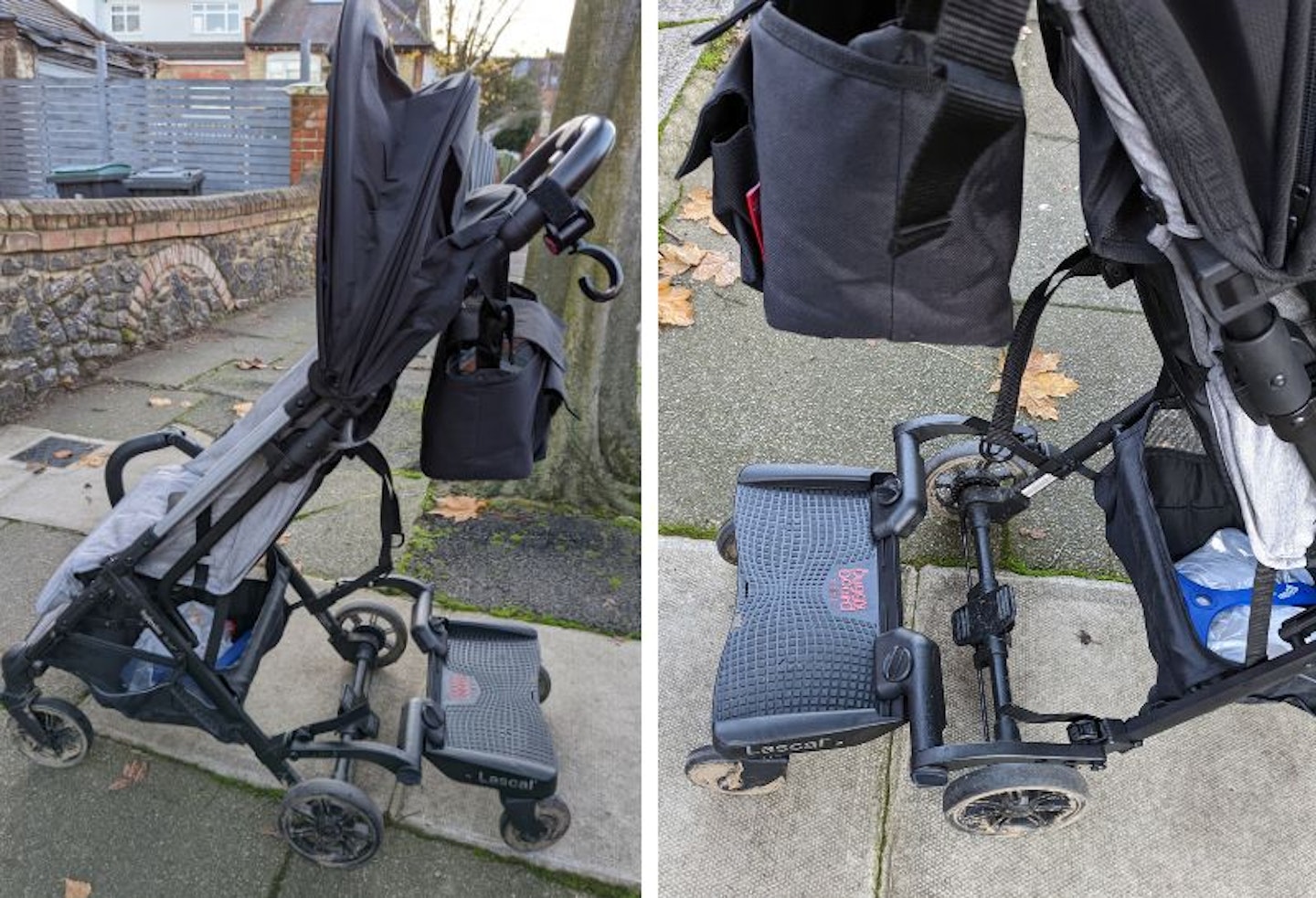
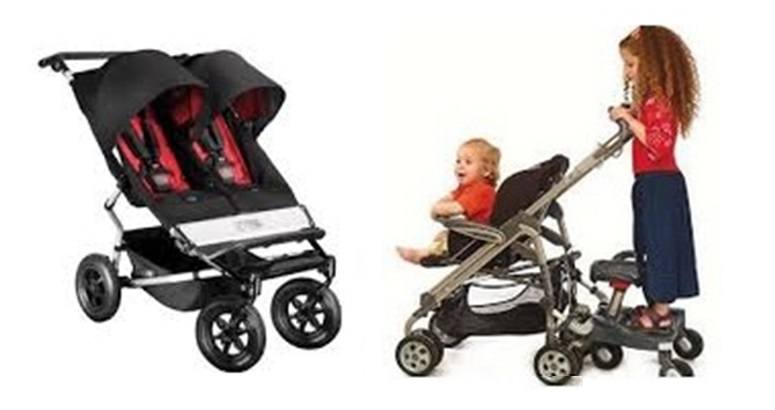
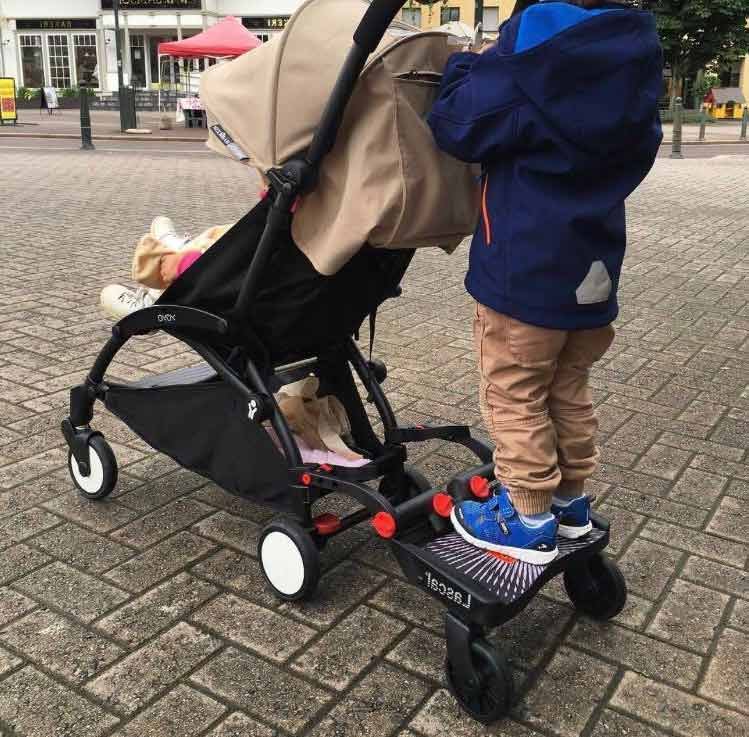
Usually, you should not put a standard buggy board on a double buggy unless the stroller manufacturer says that combination is approved. A buggy board, also called a ride-on board or stroller board in the United States, attaches to the rear of a stroller so an older child can stand while a younger child rides.
A double buggy, or double stroller, already carries extra weight and has a different balance point from a single stroller. Adding a board can make steering harder, block the brake, reduce space for the children, or increase the chance of tipping. The safest choice is a board made for your exact double-stroller model—or a double stroller with a manufacturer-approved standing board accessory.
The Short Answer: Sometimes, but Only With Model-Specific Approval
You can use a buggy board on some double strollers, but a board that fits physically is not automatically safe or approved.
Before using one, check all three of these points:


- The board must list your exact stroller model as compatible.
- The stroller and board must stay within their weight limits.
- The attachment must not affect the brake, folding system, steering, or child seats.
A universal board may attach to the stroller frame, but “universal” usually means it fits a range of frame shapes. It does not prove that it is safe for every double stroller.
Many double strollers have a wider frame, a lower rear basket, two seat backs, or a center bar that can interfere with a board. Tandem strollers and side-by-side strollers also behave differently when a child stands behind them.
If the manual does not mention a ride-on board, contact the manufacturer before use. If the company cannot confirm compatibility, choose a different setup.
Why a Buggy Board Can Be Risky on a Double Stroller
A ride-on board changes how the stroller carries weight. The older child stands behind the stroller, often over or beyond the rear wheels. That added weight can make the front wheels feel light and can place more force on the handle and frame.
This can lead to:
- Harder steering
- Reduced control on slopes or curbs
- A blocked or difficult-to-reach brake
- Less room for the adult to walk
- Contact between the board and the stroller basket
- Interference with a reclining seat
- A higher risk of tipping backward
- Damage to the frame or attachment points
The risk depends on the stroller design, the board position, the child’s weight, the combined load, and the ground surface. A setup that feels stable on a flat sidewalk may behave poorly on a curb or ramp.
Tandem double strollers
A tandem stroller has one seat behind the other. A board may fit behind the rear seat, but that area is often crowded. The standing child may bump the rear seat, the board may touch the basket, or the rear child’s feet may be near the board.
Some tandem strollers are built with a specific standing board accessory. That accessory is the better option because the manufacturer can account for the stroller’s frame, balance, and braking system.
Side-by-side double strollers
A side-by-side stroller is usually wider and may have no clear center point for a board. A board attached to one side can place uneven force on the frame and may make the stroller pull to one direction.
Even if the board attaches at two points, check whether it reduces walking space or strikes the adult’s legs. Do not use a board that forces you to push from the side or hold the stroller at an unusual angle.


How to Check if Your Double Buggy Supports a Buggy Board
Use the stroller manual and the manufacturer’s current accessory list as your main sources. Product listings from third-party sellers can be incomplete or may show a board that fits a similar model but not yours.
Follow this check before buying or attaching anything.
1. Find the exact stroller model and version
Look for the model name and version on:
- The stroller frame
- The seat label
- The original receipt
- The user manual
- The manufacturer’s registration record
A small model change can alter the frame or accessory connection. For example, a board made for one version of a stroller may not fit a later version, even if the name looks almost the same.
Write down the full model name, generation, and year if available.
2. Read the stroller manual
Search the manual for terms such as:
- Ride-on board
- Standing board
- Glider board
- PiggyBack
- Stroller board
- Accessory board
- Maximum load
- Approved accessories
Look for both compatibility information and warnings. Some manuals allow only accessories made for that stroller. Others may prohibit standing on the frame or using third-party attachments.
3. Check the board’s compatibility list
The board manual should identify compatible stroller models. Do not rely only on a photo or a claim such as “fits most strollers.”
Check whether the list includes:
- Your exact stroller name
- Your exact model version
- A double configuration, if the stroller converts between single and double modes
- The seat position you plan to use
- The required adapters or mounting parts
If the board is listed only for a single stroller, do not assume that it works on the brand’s double version.
4. Check the weight limits
A board may have its own maximum child weight. The stroller may also have a maximum total load or a separate limit for each seat and the basket.
Use the lower applicable limit. Do not add loads beyond the stroller’s stated capacity.
For a simple check, consider:
Child in seat 1 + child in seat 2 + child on board + diaper bag + other items
Compare that total with the stroller’s stated maximum load. Also check each seat’s individual limit. A stroller can remain under its total limit while one seat is overloaded.


Do not treat the basket as extra capacity unless the manual gives a separate basket limit.
5. Inspect the attachment area
Before placing a child on the board, confirm that:
- Both attachment points are fully secured
- The frame has no cracks or bends
- The board does not rest on the brake cable
- The brake remains easy to engage
- The board does not press against a wheel
- The rear seat can remain in its allowed position
- The board does not touch the basket when the stroller moves
- No strap hangs near a wheel
- The stroller can still fold as the manual describes
If the board needs improvised straps, drilling, clamps, or frame alterations, do not use it.

How to Install and Test a Compatible Board
If the manufacturer approves the board for your double stroller, install it with the stroller empty first. Keep the stroller on level ground during setup.
- Engage the stroller brake. Keep the stroller still while attaching the board.
- Follow the board’s manual. Use the supplied connectors and place them on the specified frame points.
- Tighten each connector evenly. Do not force a connector onto a tube that is too large or too small.
- Check the wheels and brake. Roll the empty stroller a short distance, then test the brake.
- Test the fold. Fold the stroller only if the instructions allow it with the board attached. Otherwise, remove the board before folding.
- Push the empty stroller over a flat surface. Check for pulling, scraping, or unusual noise.
- Add the seated children first. Confirm that their restraints are secure and that both seats work as expected.
- Add the standing child last. The child should stand in the marked area and hold the stroller handle if the board instructions require it.
- Test at walking speed. Start on a flat, smooth path away from traffic, stairs, and crowds.
- Recheck the attachment. Stop after a short distance and inspect the connectors.
A successful setup should roll straight, turn without unusual force, brake normally, and leave the adult with enough room to walk safely. The board should not wobble, scrape, detach, or make the stroller feel unstable.
When to stop using it
Stop immediately if:
- The front wheels lift during a turn
- The stroller tips backward or feels close to tipping
- The board swings from side to side
- The stroller pulls to one side
- The brake becomes hard to reach or does not hold
- The child’s feet touch a wheel
- The adult keeps hitting the board
- The frame bends, creaks, or shows new marks
- A connector loosens during use
Do not solve a fit problem with tape, extra straps, zip ties, or homemade spacers. A temporary fix can hide a serious load or frame problem.
What Type of Double Stroller Works Best With a Board?
The best option is not the board that attaches most easily. It is the setup that the stroller maker designed and tested for that frame.
| Double-stroller setup | Main concern | Safer approach |
|---|---|---|
| Tandem stroller | Rear seat, basket, or brake may block the board | Use the brand’s approved board, if available |
| Side-by-side stroller | Uneven force and reduced walking room | Use a model-specific center attachment or avoid a board |
| Convertible single-to-double stroller | Compatibility may change in double mode | Confirm the exact seat configuration |
| Jogging double stroller | Large wheels and different frame geometry | Use only an approved accessory; avoid generic boards |
| Lightweight double stroller | Extra rear weight may affect balance | Check total load and tipping warnings carefully |
| Sit-and-stand stroller | The rear platform may already be part of the design | Follow the stroller’s own age, weight, and standing rules |
A sit-and-stand stroller is not the same as a double stroller with a separate board. Its frame, foot platform, handhold, and braking system are designed around a standing child.
Buggy Board Alternatives for Families With Two Children
If your double stroller does not support a board, you still have several options.
Use a manufacturer-approved standing board
This is usually the simplest option when available. The manufacturer may specify the correct mounting points, weight range, and seat configuration.
Choose a sit-and-stand stroller
This type of stroller has a built-in rear platform or bench for an older child. It may work well when one child still needs a full seat and the other can stand or sit on a platform.


The trade-off is that the standing child may have less support and fewer position options than they would in a full seat.
Use a stroller wagon
A stroller wagon may offer more floor space for two children and gear. It is not automatically easier to steer or safer in every setting, so check its age, restraint, terrain, and load instructions.
Let the older child walk for part of the trip
For short trips, walking with a hand strap or holding the stroller handle may be practical. Use extra care near streets, parking lots, stairs, and crowded areas.
Use two separate strollers
This may help when two adults are present or when each child needs a different seat position. It is less convenient for one adult and may not work for travel.

Common Mistakes to Avoid
The most common mistake is treating a physical fit as proof of safe compatibility. A board can click onto a frame and still affect the stroller’s balance or braking.
Avoid these errors:
- Buying a board based only on stroller width
- Using a board approved for a single stroller on a double stroller
- Ignoring the exact model generation
- Exceeding the child or total load limit
- Carrying a heavy bag on the handle
- Letting a child sit on a board meant for standing
- Using the board on stairs, escalators, or rough terrain
- Pushing quickly over curbs
- Letting the child ride without the required handhold
- Leaving the board attached if it changes the fold
- Continuing to use the board after a fall or frame impact
- Relying on a retailer’s “universal” label instead of the manual
The handle is not a safe place for extra weight unless the stroller manual allows it. A heavy handle bag can also increase the chance that the stroller tips backward, especially when a child stands on the rear board.
Does a Buggy Board Work With a Double Stroller on Curbs and Slopes?
Even an approved board needs extra care on curbs and slopes. The standing child adds weight behind the rear axle, which can change how the front wheels meet an uneven surface.
At a curb:
- Stop and engage control of the stroller.
- Ask the child to step off if the board instructions require it.
- Lift or guide the stroller as described in the stroller manual.
- Keep both hands on the stroller.
- Never pull the stroller backward with the child standing on the board unless the instructions specifically allow it.
Avoid stairs and escalators with a child on the board. Use an elevator, ramp, or another route. Do not assume that large stroller wheels remove the risk of a tip.
On a slope, walk slowly and keep the stroller under control. If the stroller feels heavy, pulls, or rolls when you stop, move to level ground and remove the board from use.

How to Choose a Buggy Board for a Double Buggy
If your stroller maker confirms compatibility, compare boards using these practical points:
Exact compatibility
This matters more than a universal fit claim. The board should list the precise stroller model and configuration.
Weight range
Check both the minimum and maximum child weight. A very young or small child may not be ready to stand safely, even if the board attaches correctly.
Handhold and standing surface
The child should have a stable place to stand and a suitable handhold. A narrow or slippery surface can make balance harder.


Brake access
You should be able to engage and release the brake without stepping on the board or moving around the stroller.
Walking room
Stand behind the stroller and take several normal steps. If your feet hit the board, you may change your posture or push from the side.
Fold method
A board that must be removed for every fold may be inconvenient. That is not a safety problem by itself, but it increases the chance that the board will be left loose or incorrectly reattached.
Terrain limits
Some boards are intended for smooth paths. If your routine includes gravel, grass, snow, or uneven sidewalks, ask the manufacturer whether the board is suitable for that use.
Safety Guidance for the Child on the Board
A child should use a ride-on board only when they meet the board’s stated age, size, and ability requirements. Children vary in balance and judgment, so age alone is not enough.
Teach the child to:
- Stand in the marked area
- Hold the handhold as directed
- Keep hands away from wheels and connectors
- Keep feet away from the stroller frame
- Step off when told
- Never jump on or off while the stroller moves
Use the stroller’s child restraints for children in the seats. A board does not replace a seat or harness. Do not allow a child to sit on a standing board unless the manufacturer specifically designed it for sitting.
Check the board before each trip. Look for loose fasteners, cracks, worn wheels, bent connectors, or changes in the way the stroller steers.
What to Do If the Manufacturer Does Not List Your Model
If you cannot find your model in the board’s compatibility list, treat the answer as no for now.
Contact the manufacturer with:
- The exact stroller model and version
- A photo of the rear frame
- The board’s brand and model
- The child’s approximate weight
- The stroller’s current seat configuration
Ask whether the board is approved for that exact setup and whether using it changes the stroller’s warranty or safety instructions. Keep the reply for your records.
If the manufacturer gives no clear answer, do not use the board. A different stroller setup is safer than relying on a guess.
Frequently Asked Questions
Can I use a universal buggy board on any double stroller?
No. A universal board may fit several frame shapes, but that does not confirm safe use on every double stroller. Check the board’s model list and the stroller manual.
Is a buggy board safe for a tandem double stroller?
It can be safe when the stroller manufacturer approves that board for the exact tandem model and configuration. The rear seat, basket, brake, and folding system can make an otherwise suitable board unsafe.
Can a child sit on a buggy board?
Only if the board is designed and approved for sitting. A standing board should not be used as a seat, even for a short trip.
Can I leave the board attached when I fold the double stroller?
Only if the board and stroller instructions allow it. Some boards must be removed before folding. Never force the stroller closed around an attached board.
What is better: a buggy board or a sit-and-stand stroller?
A manufacturer-approved board may be useful when your younger child needs a full double-stroller seat and your older child only needs occasional rides. A sit-and-stand stroller may be better when the older child will stand often and the stroller is designed for that use.
Can I use a buggy board on a double jogging stroller?
Do not assume that you can. Jogging strollers have different wheel and frame designs. Use only an accessory that the jogging-stroller manufacturer approves for your exact model.
Bottom Line
You may be able to put a buggy board on a double buggy, but only when the board and stroller manufacturer approve the exact combination. A generic board that attaches to the frame is not enough proof of safe use.
Check the manual, confirm the model and weight limits, inspect the brake and wheels, and test the setup slowly on level ground. If the stroller maker does not confirm compatibility, choose a dedicated board, a sit-and-stand stroller, or another transport option instead.
