
Introduction
No. You should not prop up a bassinet mattress for routine infant sleep. A baby’s sleep surface should be flat, firm, level, and free of gaps, soft items, and added padding. Do not place a towel, pillow, wedge, folded blanket, book, or other object under the mattress.
This advice applies in the United States to newborns and young infants sleeping in a bassinet, bedside sleeper, portable crib, or crib. A raised surface may cause a baby to slide, curl forward, or turn into a position that blocks breathing. Babies may also become trapped between the mattress and the bassinet wall.
If your baby seems uncomfortable when lying flat, ask the child’s pediatrician for help. Do not change the bassinet’s angle on your own, even if your baby has spit-up, reflux, congestion, or trouble settling.


Why You Should Not Incline a Bassinet Mattress
An inclined mattress can place a baby’s head and neck in a poor position. A young baby may not have the strength to move their head or body if their chin drops toward their chest or their face turns into the side of the bassinet.
The main risks include:
- Airway blockage: The baby’s chin may fall toward the chest.
- Sliding: The baby may move toward the lower end of the bassinet.
- Rolling or tipping: A baby may shift into a side or stomach position.
- Entrapment: The mattress may no longer fit tightly against the bassinet walls.
- Soft-surface risk: A towel, blanket, or pillow used as a wedge may compress around the baby.
A slight incline may look harmless to an adult. For a small baby, it changes the way the body rests and moves. The bassinet’s side walls also may not be designed to contain a baby on a slope.
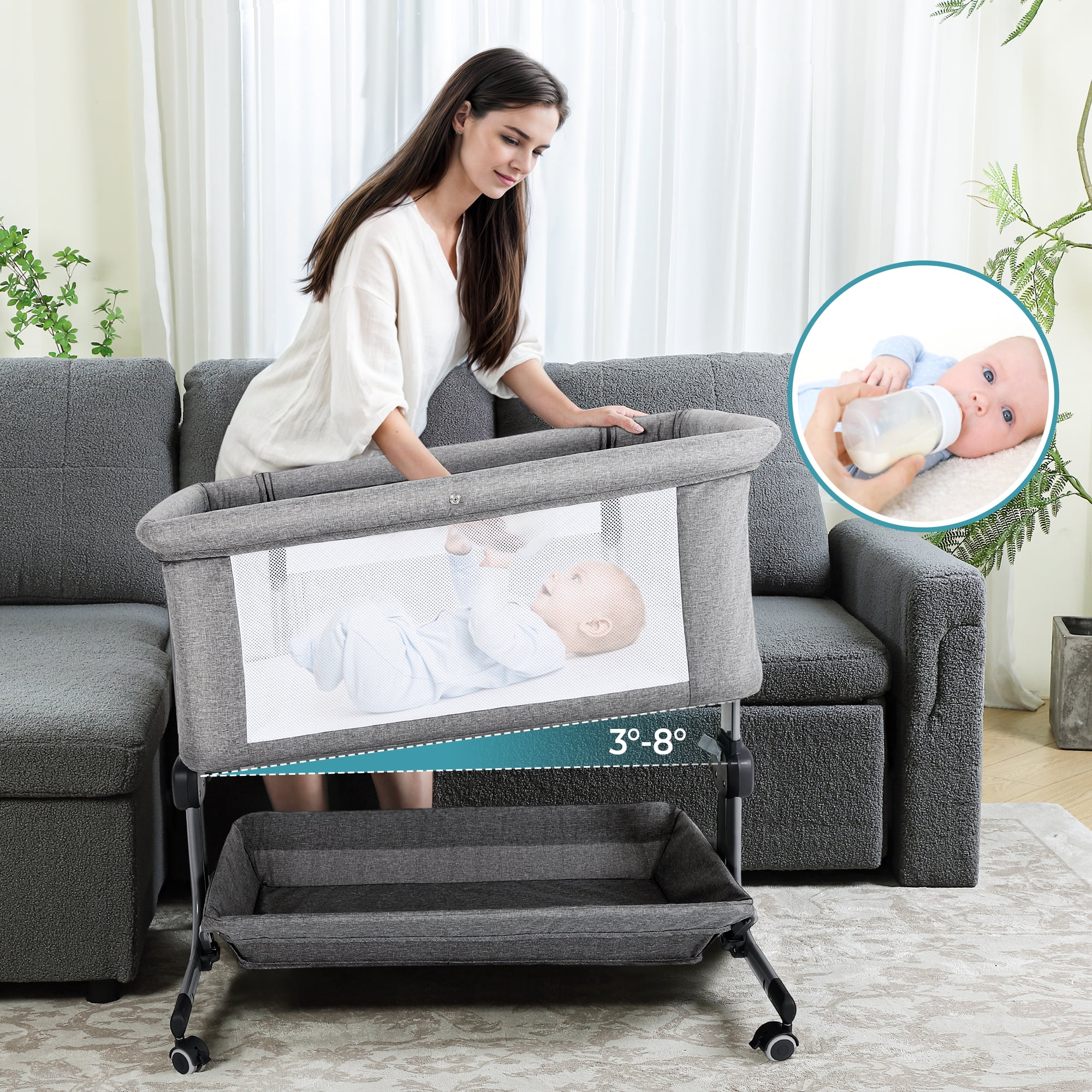
The U.S. Consumer Product Safety Commission (CPSC) warns against inclined sleep products with a sleep angle greater than 10 degrees. The federal Safe Sleep for Babies Act also prohibits the manufacture, sale, or distribution of inclined infant sleepers and certain crib bumpers in the United States. That law does not make every homemade bassinet incline safe. It reinforces the need to use a properly designed, approved sleep space.
The American Academy of Pediatrics (AAP) recommends a firm, flat, noninclined sleep surface for infants. A bassinet mattress should have only a fitted sheet made for that specific mattress.

What a Safe Bassinet Sleep Surface Looks Like
A safe bassinet setup has four basic features:
- Firm: The mattress does not sink deeply under the baby’s weight.
- Flat and level: The sleep surface has no raised head or foot.
- Bare: The bassinet contains only the baby and a tight fitted sheet.
- Properly fitted: The mattress sits tightly in the bassinet with no dangerous gaps.
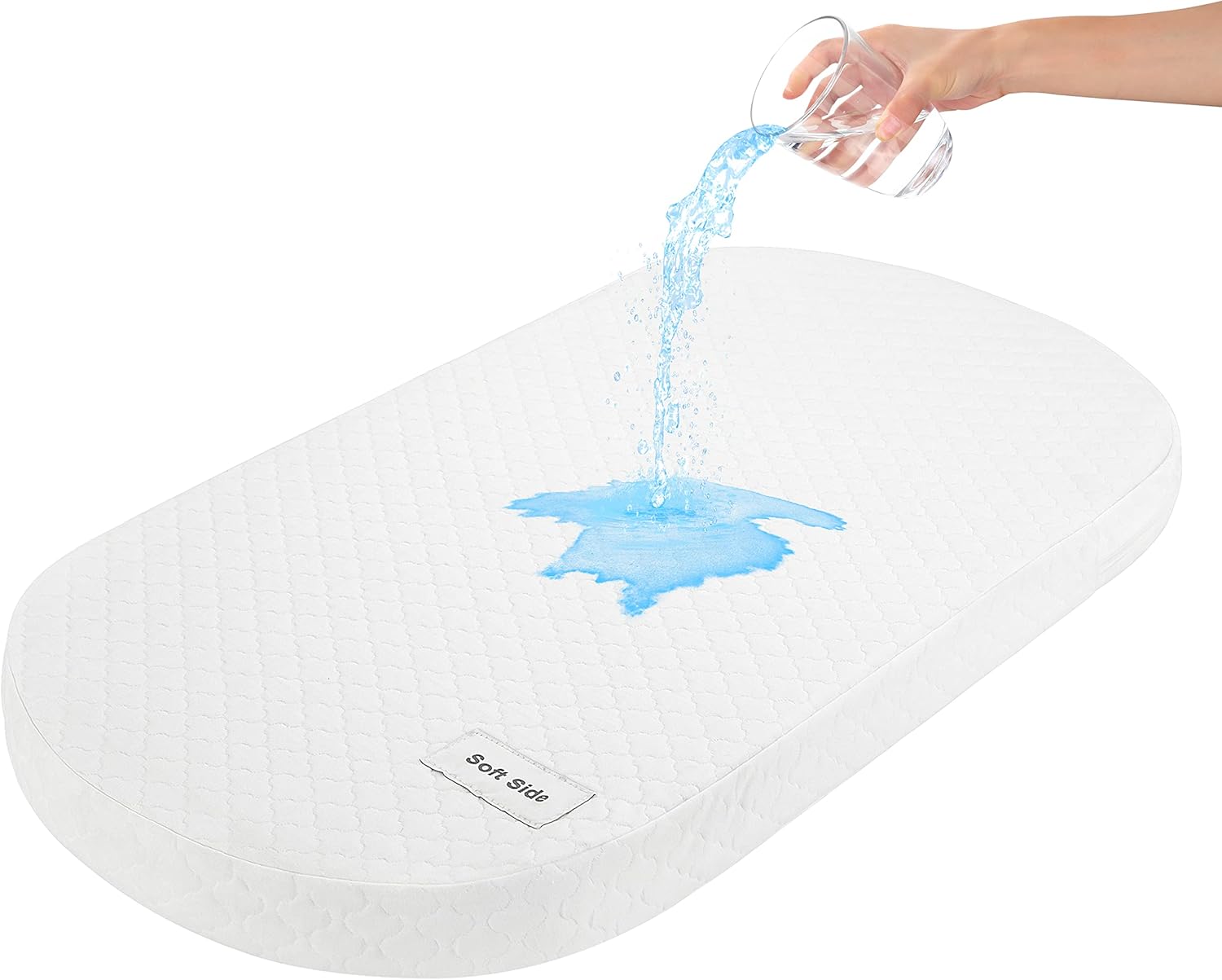
Use the mattress that came with the bassinet or a replacement listed by the manufacturer for that exact model. Do not substitute a crib mattress, play yard mattress, changing pad, couch cushion, foam topper, or homemade insert.
A safe sleep setup generally looks like this:
| Bassinet feature | What to check |
|---|---|
| Mattress | Firm, flat, and designed for the bassinet |
| Sheet | Tight fitted sheet made for that mattress |
| Sides | Secure, stable, and free from tears or loose fabric |
| Sleep space | Empty except for the baby |
| Position | Baby placed on their back for every sleep |
| Location | Bassinet placed on a stable, level floor or approved base |
A mattress can feel firm to an adult but still be too soft for an infant. Press the mattress only as a basic check; the manufacturer’s instructions and product design matter more than touch alone.


How to Handle Common Reasons Parents Want to Raise the Mattress
Parents often consider propping a bassinet mattress because a baby spits up, has reflux, sounds congested, or settles better when held upright. These concerns are common, but raising the sleep surface is not the safe solution.
Spit-up and reflux
Healthy babies often spit up. Sleeping on an incline does not reliably prevent reflux and may increase the chance of sliding or airway problems. Babies with reflux should still sleep flat on their backs unless a medical professional gives a specific, supervised plan.
Do not place a wedge under the mattress. Do not use a reflux pillow, positioner, nest, or rolled towel in the bassinet.
After a feed, keep the baby upright while awake and supervised if the pediatrician recommends it. Then place the baby flat on their back for sleep. Avoid letting the baby sleep in a car seat, swing, bouncer, or infant lounger after a ride or nap.
Nasal congestion
A congested baby may sound worse when lying flat. However, an inclined bassinet is not a safe way to open the airway.
Ask the baby’s health care provider about age-appropriate ways to ease congestion. A provider may discuss options such as saline drops and gentle suction. Never use adult cold medicine for an infant unless a qualified clinician specifically directs you to do so.
Trouble settling
Some babies settle more easily while held. That does not mean they need an inclined sleep surface. Hold and comfort the baby while you are awake and alert. If you feel sleepy, put the baby in their own bassinet or crib on a flat, bare surface.
A diagnosed medical condition
A medical condition may change feeding or comfort advice, but it does not justify a homemade sleep incline. Ask the pediatrician or specialist for written instructions that name the exact sleep product, position, and level of supervision.
If a clinician recommends a setup that differs from standard safe-sleep guidance, ask why, how long to use it, and what warning signs require a call. Follow the specific advice of the treating clinician rather than modifying the bassinet yourself.

How to Check Whether a Bassinet Is Safe to Use
Use this quick inspection before placing your baby in the bassinet.
1. Read the product manual
Find the manual for the exact bassinet model. Check the sections on:
- Mattress type and dimensions
- Approved replacement parts
- Maximum weight and age limits
- Assembly
- Mattress position
- Folding or transport
- Product recalls
If you cannot confirm that a replacement mattress or accessory is approved for the model, do not use it for sleep.
2. Remove every added item
Take out anything that did not come with the bassinet or is not specifically approved by its manufacturer. This includes:
- Mattress wedges
- Pillows
- Rolled towels
- Blankets under the baby
- Foam pads
- Mattress toppers
- Positioners
- Sleep nests
- Head-shaping pillows
- Stuffed toys


A fitted sheet is not a safe substitute for a loose cover. The sheet must fit tightly and must be made for that mattress.
3. Check the mattress fit
The mattress should lie flat and should not rock, fold, bow, or leave wide gaps along the sides. If the mattress shifts when you press near an edge, stop using the bassinet until you confirm the correct mattress and assembly.
Do not fix a gap by adding padding. Extra material can make the fit less predictable and may create an entrapment or suffocation hazard.
4. Check the base and floor
The bassinet should stand on a stable, level surface. Lock wheels or folding parts as directed. Do not place books, blocks, furniture risers, or other objects under the bassinet legs to create an incline.
If the bassinet rocks, leans, or has a damaged frame, remove it from use.
5. Check for recalls
Search the CPSC recall database for the brand and model. Also check the manufacturer’s safety notices. A recall may concern the frame, mattress, sidewall, folding parts, or another component.
A used bassinet needs extra care. Missing instructions, unknown repairs, damaged mesh, loose fasteners, or an unverified mattress are reasons to choose another sleep space.

What to Do If the Mattress Is Already Propped Up
Remove the prop and restore the bassinet to the manufacturer’s original, level setup before the next sleep. Check that the mattress is the correct model-specific mattress and that it fits tightly.
If the mattress remains sloped without a prop, look for one of these problems:
- The bassinet is on an uneven floor.
- The frame is not fully opened or locked.
- A support bar is assembled incorrectly.
- The mattress is upside down or folded.
- The mattress is damaged or warped.
- The product has a design fault or recall.
- An unapproved replacement mattress is installed.
Do not try to repair the slope with household objects. Contact the manufacturer with the model number and photos if needed. Stop using the bassinet until the company confirms the correct setup.
If the baby has been sleeping on an incline, do not panic. Move the baby to a flat, firm sleep surface and review the setup. Contact the pediatrician if you are worried about the baby’s breathing, movement, feeding, or any symptoms.
Call 911 immediately if a baby is struggling to breathe, turns blue or gray, cannot be awakened, or appears limp.

Can a Bassinet Have a Built-In Incline?
Some products may look angled because of their frame, fabric, rocking base, or marketing design. That does not mean the product is suitable for unsupervised sleep.
Use a bassinet only as the manufacturer describes it and only if it is intended for infant sleep. Check that:


- The sleep surface is flat and level.
- The product is marketed and labeled for infant sleep.
- The model is not an inclined sleeper.
- The product has not been recalled.
- The baby’s head and body remain on the designed sleep surface.
- The product meets applicable U.S. safety requirements.
A rocking bassinet may move while the baby rests on a flat surface. Rocking and inclining are not the same feature. Do not confuse a motion setting with permission to tilt the mattress.
If a product has an adjustable angle, read the manual carefully. For routine infant sleep, the safest choice is the manufacturer-approved flat setting. Do not rely on a seller’s online description, a social media tip, or a general claim that the incline helps reflux.
Bassinet Mattress Safety: Common Mistakes to Avoid
Mistake 1: Using a pillow under the baby’s head
A pillow can cover the face or push the neck forward. Infants do not need a pillow for safe sleep.
Mistake 2: Putting a towel under the mattress
A towel can compress, shift, and change the mattress angle. It may also create a gap between the mattress and the bassinet wall.
Mistake 3: Adding a “breathable” topper
The word breathable does not prove that a topper is safe for infant sleep. Extra layers can change firmness, fit, and heat buildup.
Mistake 4: Letting the baby sleep in a sitting device
Car seats, swings, bouncers, and loungers are not substitutes for a flat bassinet or crib. If a baby falls asleep in one, move the baby to a firm, flat sleep surface as soon as practical.
Mistake 5: Using a sleep positioner
Positioners may claim to keep a baby on their back. They can also restrict movement or cover the face. A baby should be placed on their back without a positioner.
Mistake 6: Assuming an old bassinet is safe because it worked for another baby
Safety rules, recalls, and product parts can change. Inspect the exact model and confirm that it is complete and undamaged.
Key Takeaways
- Do not prop up a bassinet mattress.
- Use a firm, flat, level mattress made for that bassinet.
- Place the baby on their back for every sleep.
- Keep the bassinet bare except for a tight fitted sheet.
- Do not use wedges, pillows, towels, positioners, or mattress toppers.
- Ask a pediatrician about reflux, congestion, or other medical concerns.
- Check the product manual and the CPSC recall database.
- Stop using any bassinet with a slope, gap, damaged frame, or uncertain mattress fit.
FAQs
Can I put a wedge under a bassinet mattress for reflux?
No. Do not use a wedge under a bassinet mattress unless a medical team gives you a specific plan for a medically supervised situation. For routine sleep, babies with reflux should sleep flat on their backs.
Can a newborn sleep at a slight incline?
A newborn should sleep on a firm, flat, noninclined surface. A slight incline can allow the baby to slide or place the head and neck in a position that affects breathing.
Can I raise one end of the bassinet legs?
No. Do not place objects under the legs or feet. This can make the bassinet unstable and may cause the baby to slide.
What if my bassinet mattress is naturally sloped?
Check the manual and contact the manufacturer. If the sleep surface is not flat, confirm whether the product is an approved infant sleep product and whether it has a recall. Do not use it for sleep until you resolve the concern.
Does keeping a baby upright after feeding reduce reflux?
Holding a baby upright while awake and supervised may be part of an individual feeding plan, but it does not make an inclined sleep surface safe. Once the baby sleeps, place them on their back on a flat, firm surface.


Conclusion
You should not prop up a bassinet mattress in the United States. The safer setup is simple: use the correct firm mattress, keep it flat and level, add only a tight fitted sheet, and place the baby on their back.
If reflux, congestion, or comfort is the reason you considered an incline, speak with the baby’s pediatrician instead of changing the bassinet. When the mattress does not lie flat or fit correctly, stop using the product until the manufacturer confirms the proper solution.
