
Yes, you can usually take a small stroller to a U.S. airport and check it at the gate. Some compact folding strollers may also be allowed inside the aircraft cabin if they fit the airline’s carry-on size limit and there is space in the overhead bin. However, a stroller cannot be used in the aircraft aisle or stored in front of an exit.
The airline—not the TSA—decides whether a stroller may go in the cabin, fit in the overhead bin, or must be gate-checked. Rules can also vary by aircraft, ticket type, and available storage space. Check your airline’s current stroller policy before you leave home.

Can a small stroller go in the airplane cabin?
A small stroller may go in the cabin only when it meets the airline’s carry-on rules and the crew confirms that cabin storage is available. Most airlines do not guarantee overhead-bin space for a stroller, even when the stroller is compact.


A stroller must usually meet all of these conditions:
- It folds fully.
- It fits within the airline’s stated carry-on size limit.
- It can be placed in an approved overhead bin or another designated storage area.
- It does not block the aisle, an exit, or emergency equipment.
- The flight crew accepts it for that aircraft.
A stroller that fits under the seat is more likely to be accepted in the cabin, but many small strollers still exceed under-seat dimensions. Measure the stroller when folded, including wheels, handles, and any attached accessories.
Overhead-bin storage is not guaranteed
Even a stroller advertised as “airplane cabin approved” may not fit every aircraft bin. Smaller regional jets often have less overhead space than larger mainline aircraft. A full flight may also leave no room for a stroller.
If the bin is full, the gate agent may tag the stroller and place it in the aircraft’s cargo hold. This is commonly called gate-checking.
Gate-checking a stroller
When you gate-check a stroller, you use it through the airport and usually leave it near the aircraft door before boarding. Airport staff then load it into the hold. After landing, the stroller may be returned at the aircraft door or sent to baggage claim, depending on the airline and airport.
Gate-check rules are not identical across U.S. airlines. For example:
- American Airlines generally allows passengers to check strollers at the gate or ticket counter, subject to its current size and weight rules.
- Delta Air Lines generally permits stroller gate-checking and may allow some small strollers in the cabin when space permits.
- Southwest Airlines generally allows strollers to be checked at the ticket counter or gate without counting them as regular baggage, subject to its policy.
- United Airlines generally allows stroller checking at the ticket counter or gate, while cabin storage depends on carry-on limits and available space.
These policies can change. Review the current stroller page for your airline before traveling.
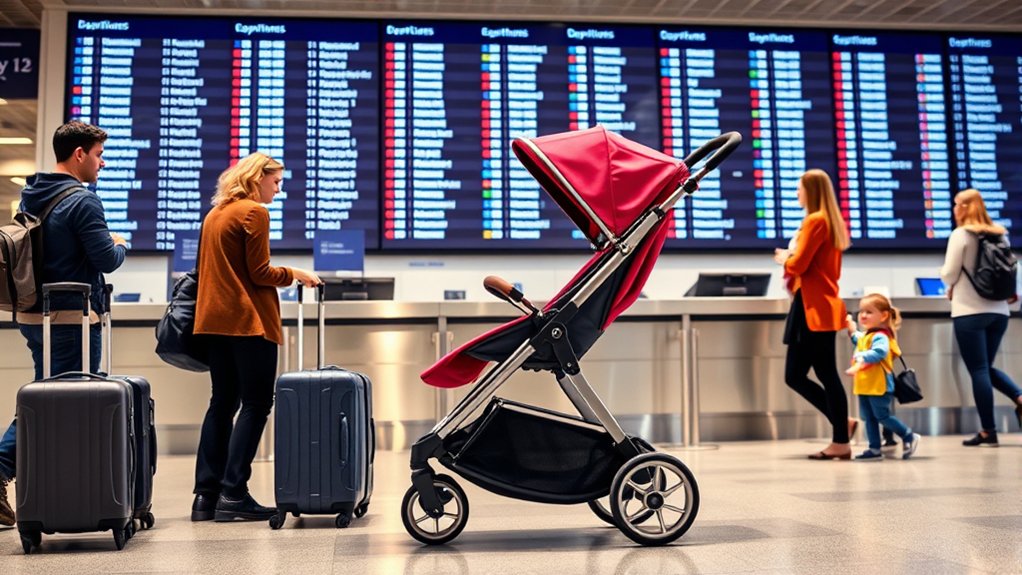
How to take a stroller through a U.S. airport
The easiest plan is to use the stroller through the airport and gate-check it unless your airline has confirmed that cabin storage is allowed.
1. Measure the stroller when folded
Write down the folded:


- Height
- Width
- Depth
- Weight
Compare these measurements with your airline’s carry-on limit. Do not rely only on the words “compact” or “travel stroller.” Different airlines use different limits, and a stroller’s wheels or handle may add several inches.
2. Check the airline’s stroller policy
Look on the airline’s official website for terms such as:
- Stroller
- Baby equipment
- Child equipment
- Gate check
- Carry-on stroller
Check both the general baggage rules and any rules for your ticket or aircraft. If the policy is unclear, contact the airline before your travel day.
3. Ask for a gate-check tag
At the check-in desk or gate, tell the agent that you want to gate-check the stroller. The agent will usually attach a tag to the stroller.
Keep the tag receipt. It may help staff locate the stroller if it does not appear at the aircraft door.
4. Use the stroller until boarding
Many airports let you use a stroller through security and up to the gate. At some airports, staff may ask you to leave it at a marked location before boarding.
Do not assume you can take the stroller onto the jet bridge. Ask the gate agent where to leave it.
5. Fold and prepare the stroller
Before handing it over:
- Remove toys, bags, cups, and loose items.
- Fold it fully.
- Lock the folding mechanism.
- Secure straps and accessories.
- Take a quick photo of its condition.
- Attach your name and phone number.
A lightweight stroller bag can reduce dirt and scratches, but some airlines may require staff to remove the bag before loading the stroller. Follow the gate agent’s instructions.
6. Collect it after landing
Ask the crew or ground staff where gate-checked items will be returned. It may be at the aircraft door, on the jet bridge, or at baggage claim.
If the stroller is damaged or missing, report it before leaving the airport. Keep the baggage tag and any photos.
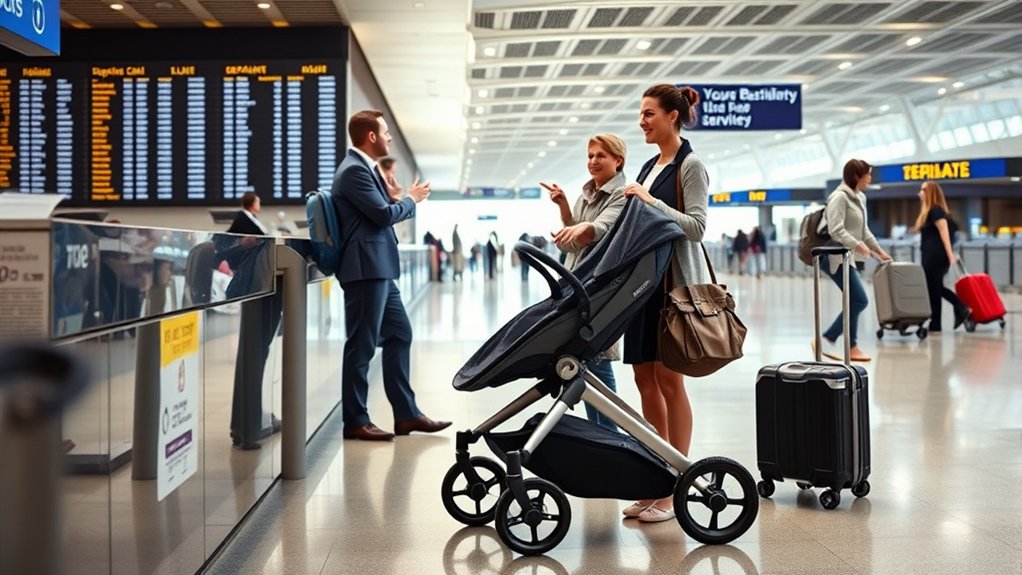
What is the best choice: cabin storage or gate check?
For most families, gate-checking is the more reliable option. It lets you use the stroller in the airport without depending on overhead-bin space.
| Option | Main benefit | Main limitation |
|---|---|---|
| Carry the stroller into the cabin | You keep it with you during the flight | It may not fit, and the crew can require gate-checking |
| Gate-check the stroller | You can use it through much of the airport | It may be exposed to handling and may not return at the aircraft door |
| Check it at the ticket counter | You do not carry it through the airport | You may need to carry your child and bags to the gate |
| Leave it at home | No airport handling or baggage concern | You lose a useful way to move your child and belongings |
A cabin stroller makes the most sense when it folds very small, the child can walk or be carried if needed, and the airline confirms that it may be stored onboard.


Gate-checking is often better when the stroller is larger, the airport is busy, the trip includes a long walk between gates, or you need the stroller before boarding.
Do you need a stroller bag?
A stroller bag is not always required, but it can help protect the stroller from dirt, rain, and rough handling. Use a bag that does not prevent staff from identifying the stroller or attaching the gate tag.
Do not place passports, medication, electronics, or other valuable items in the stroller bag. Gate-checked items are handled as baggage and should not contain valuables.
Can you take a stroller through TSA security?
In the United States, TSA generally allows travelers to bring a stroller to the security checkpoint. The stroller must be screened, and TSA may ask you to remove your child before the stroller goes through screening.
The exact process depends on the stroller’s size and the airport’s equipment:
- A small stroller may go through the X-ray machine.
- A larger stroller may need a separate inspection.
- TSA officers may swab or inspect parts of the stroller.
- The child may need to walk through the metal detector or be carried.
- Medical devices and other special circumstances may require additional screening.
TSA rules are separate from airline cabin rules. Passing through security does not mean the stroller is approved for the aircraft cabin.
Before security, remove items from the stroller basket and fold it if instructed. After screening, ask an officer for help if the stroller is difficult to reassemble or if you are traveling alone with a child.
For current screening instructions, use the official TSA traveling with children guidance.
Can a stroller replace a car seat on an airplane?
No. A stroller is not an approved aircraft seat or child restraint.
If your child will sit in a seat during the flight, you may use an approved child restraint system if the airline accepts it and the seat is labeled for aircraft use. The Federal Aviation Administration recommends using an approved child restraint for young children rather than holding a child on an adult’s lap, although airline rules determine what is permitted for each ticket and flight.
A stroller can carry a car seat through the airport, but that does not make the stroller or car seat automatically acceptable in the cabin. Check:
- Whether the car seat has an aircraft-use label.
- Whether the car seat fits the aircraft seat.
- Whether the child has a separate ticket.
- Whether the airline has special installation rules.
Do not place a child in a stroller while walking through the aircraft aisle or during takeoff and landing.
Read the FAA child safety restraint guidance and your airline’s current rules before flying.


Small stroller size: what measurements matter?
There is no single U.S. standard size for an airplane stroller. Airlines set their own carry-on measurements, and aircraft bins differ.
Measure the stroller in its fully folded travel form:
- Fold the stroller as you would at the airport.
- Include wheels, handles, bumper bars, and attached parts.
- Measure the longest side, widest side, and deepest side.
- Compare the result with the airline’s current carry-on limit.
- Check whether the stroller can fit inside an overhead bin without force.
A stroller that is only slightly larger than the stated limit may still be refused in the cabin. Do not remove wheels or parts at the gate unless the stroller’s instructions allow it and you can safely restore it.
Example
Suppose an airline permits a carry-on bag up to 22 × 14 × 9 inches, and your folded stroller measures 23 × 17 × 10 inches. The stroller is larger in every listed direction. Even if it looks small, it does not meet that example limit and should be planned for gate-checking.
This is only a sample calculation. Use the exact measurements and rules published by your airline.
What should you do if the airline refuses the stroller at the gate?
If the gate agent says the stroller cannot go into the cabin, ask whether you can gate-check it. This is the normal solution for many compact strollers.
If the stroller cannot be gate-checked, ask where it must be checked and whether you can use it to the aircraft door. Keep the tag receipt and remove all loose items.
If you believe the airline has applied its policy incorrectly:
- Stay calm and ask the agent to explain the rule.
- Show the stroller’s folded measurements if useful.
- Ask whether the rule is based on the airline, aircraft, or available bin space.
- Request help if you are traveling with a child and cannot safely carry everything.
- Contact the airline’s customer service team after the trip if needed.
The gate agent and flight crew control final onboard storage decisions. A manufacturer’s claim that a stroller is “cabin approved” does not override an airline or crew decision.
Common mistakes when flying with a small stroller
Avoid these problems before leaving for the airport:
- Assuming “umbrella stroller” means cabin-approved: The name describes a style, not a universal size.
- Measuring only the frame: Include wheels, handles, and accessories.
- Leaving items in the basket: Loose items can fall out or be removed during handling.
- Skipping the gate tag: An untagged stroller may be delayed or sent to the wrong location.
- Expecting guaranteed door delivery: Some airports return gate-checked items at baggage claim.
- Packing valuables in a stroller bag: Treat gate-checked items like checked baggage.
- Ignoring a connection: You may need to collect and re-check a stroller on some international or customs connections.
- Using the stroller on the plane: Strollers must be stored as directed and cannot block aisles or exits.
- Relying on an old airline policy: Baggage rules and aircraft layouts can change.
Frequently asked questions
Can I take a foldable stroller to the airplane gate?
Usually, yes. Many U.S. airlines allow passengers to use a foldable stroller through the airport and check it at the gate. You may need to leave it at the aircraft door or another marked location before boarding.


Can a small stroller go under the airplane seat?
Possibly, but only if the folded stroller fits the airline’s under-seat space and the crew permits it. Do not count on under-seat storage unless you have checked the stroller’s folded dimensions against the aircraft and airline rules.
Is a stroller free to check on U.S. airlines?
Many major U.S. airlines allow strollers to be checked without charging the standard checked-bag fee, but details can vary by airline, stroller type, size, and travel route. Confirm the current rule with your airline before departure.
Can I bring both a stroller and a car seat?
Often, yes. Many U.S. airlines have separate rules for strollers and child safety seats. You may be able to gate-check one or both, but the airline may apply different rules if you want to carry a car seat into the cabin.
What happens if my gate-checked stroller is damaged?
Report the damage to the airline before leaving the airport. Show the stroller, gate-check receipt, and photos if available. The airline will explain its claim process and any deadlines.
Final answer: should you bring a small stroller on the plane?
Yes—bring it if it will make the airport easier, but plan to gate-check it rather than depend on cabin storage. A very compact stroller may fit in the overhead bin, yet the airline and crew have the final say.
Before your trip, measure the folded stroller, review your airline’s current stroller policy, remove loose items, and ask the gate agent where to leave and collect it. That simple plan prevents most problems.
