
Introduction
Yes, stroller rain covers can be safe when they are made for the stroller, fit correctly, and are used for short periods with close supervision. They can help keep a child dry during rain, wind, or light snow.
They are not safe when they block air flow, trap heat, cover the stroller with extra blankets, or stay on while the child is unattended. U.S. safety guidance from the Consumer Product Safety Commission (CPSC) and the American Academy of Pediatrics (AAP) supports careful supervision and warns against overheating, suffocation risks, and unsafe coverings around babies.
The key rule is simple: a rain cover should shield a stroller from weather without turning it into a sealed space.

Are stroller rain covers safe for babies?
A rain cover is generally safe when it meets these conditions:


- It is designed for the specific stroller or approved for that stroller type.
- It has open vents or side gaps for air flow.
- It does not touch the child’s face.
- It does not cover the entire stroller in a way that traps heat.
- The child remains visible and supervised.
- The cover is removed as soon as the rain or wind passes.
- The child is not left sleeping in the stroller with the cover attached.
A rain cover does not make a stroller safe for all weather. It only reduces exposure to rain and wind. It cannot reliably control temperature inside the stroller, and it does not replace a safe sleep space.
Many covers are made from clear plastic. Clear plastic can allow you to see the child, but it may also hold warm air inside. Direct sun can raise the temperature under the cover even when the air outside feels mild.
The CPSC warns caregivers not to cover strollers or carriers with blankets or other materials because they can reduce air flow and cause overheating. A purpose-made rain cover is different from a loose blanket, but it still requires the same basic caution: never block ventilation or leave a child alone under a covering.
What are the main risks of stroller rain covers?
The main risks are overheating, poor air flow, suffocation, poor visibility, and improper fit. Most problems occur when caregivers treat the cover as a permanent shield instead of temporary weather gear.
Overheating
Overheating is the most important risk during warm or sunny weather. A clear plastic cover can act like a small greenhouse. Heat from the sun enters through the plastic and may not escape quickly.
A child may become too hot before the adult notices. Babies are especially vulnerable because they cannot remove clothing or move away from the heat.
Remove the cover when:
- The rain stops.
- The weather becomes warm or humid.
- The stroller moves indoors.
- The stroller enters a car, store, or other heated space.
- The child feels hot, sweaty, flushed, or unusually sleepy.
- The stroller sits in direct sun.
Do not rely only on the temperature shown by a weather app. The temperature inside a covered stroller can be higher than the outdoor reading.
Reduced air flow
A cover with small vents may still limit air exchange if it is pulled tightly around the stroller. Do not add another cover, blanket, towel, or plastic sheet over it.
Check that:
- Vent openings remain uncovered.
- The cover does not press against the child’s mouth or nose.
- The cover does not seal tightly around the frame.
- Wind has not pushed the plastic inward.
- The child’s face remains easy to see.


If the cover has no clear ventilation openings, do not use it over a child. A loose plastic sheet is not a safe substitute for a stroller rain shield.
Suffocation and entanglement
Loose plastic, straps, and poorly fitted covers can create hazards. A child may pull at the cover, place part of it near the face, or become caught in loose material.
Keep the cover attached only as the instructions show. Do not modify it with cuts, pins, clips, cords, or homemade straps. Do not use a cover that hangs inside the seating area.
The cover should stay outside the child’s reach as much as possible. If the child can grab it and pull it inward, check the fit or remove the cover.
Poor visibility
Rain covers can create glare, fog, or water drops that make it hard to see the child. Poor visibility can hide signs of distress, vomiting, sweating, or a change in position.
A covered stroller should stay within arm’s reach in crowded places, near traffic, and during windy weather. If you cannot clearly see the child, remove the cover or move to a safer, drier place.
Wind and tipping
A large cover can catch wind. A sudden gust may push the stroller, affect steering, or make it harder to control the stroller on a slope.
Use extra care near:
- Streets and parking lots
- Train platforms
- Curb edges
- Open fields
- Beaches
- Bridges
- Building entrances
- Hills and ramps
Always use the stroller’s parking brake when stopped. Do not hang heavy bags from the handle to counter wind. Extra weight can make the stroller unstable.
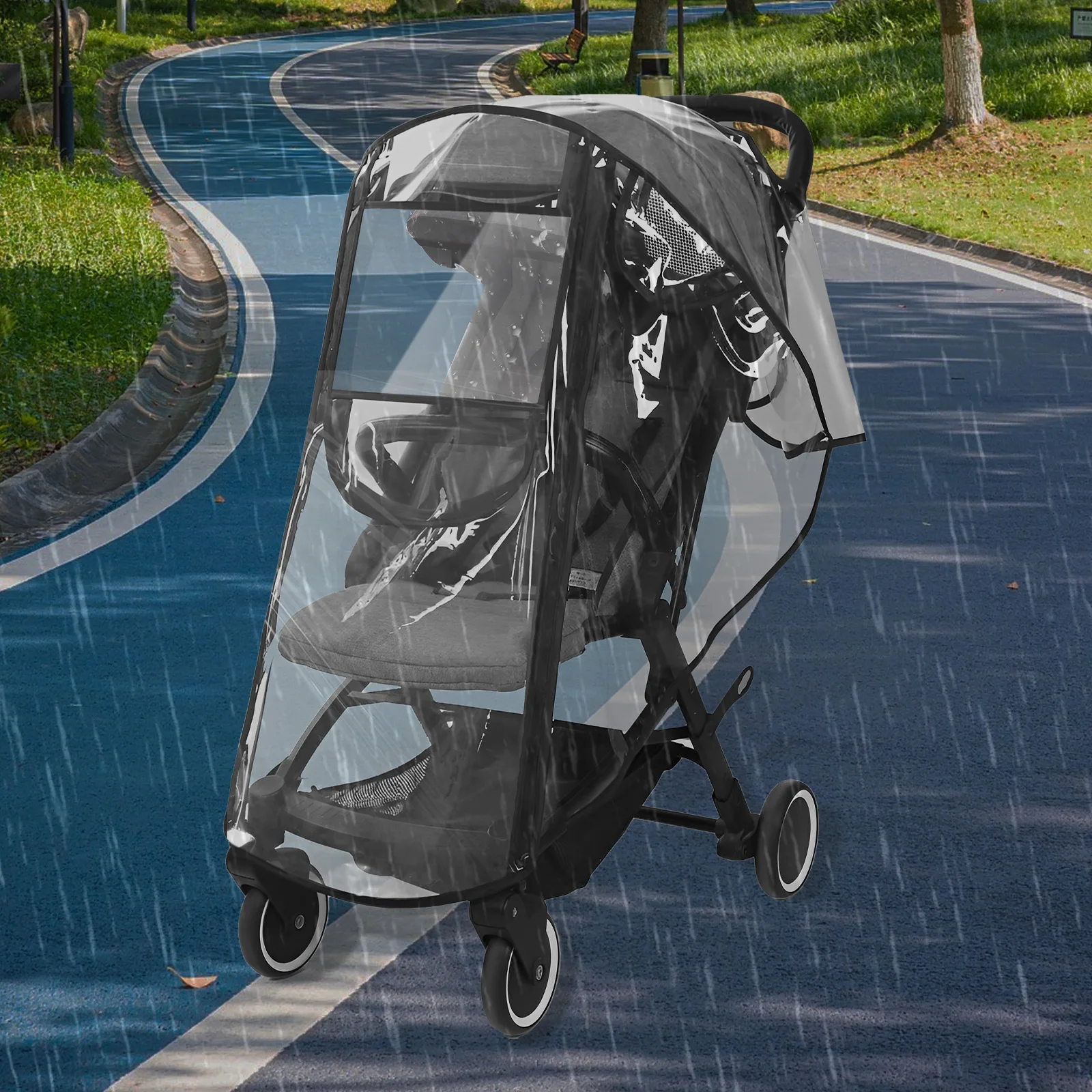
How to use a stroller rain cover safely
Use the cover as temporary weather protection, not as a way to create a closed sleeping space.
1. Check the stroller and cover
Before leaving, inspect the cover for:
- Tears
- Cloudy or brittle plastic
- Broken snaps
- Loose elastic
- Damaged seams
- Sharp edges
- Missing straps
- Blocked vents
Read both the stroller manual and the rain-cover instructions. Some covers fit only certain stroller frames, seats, or bassinet attachments.
Do not assume that a universal cover fits every stroller safely. “Universal” usually means the cover may fit several designs. It does not guarantee that it will provide proper ventilation or clearance on your stroller.
2. Fit the cover before placing the child inside
Attach the cover while the stroller is empty. Make sure it does not interfere with:


- The harness
- The stroller’s folding parts
- The wheels
- The brake
- The reclining mechanism
- The child’s head space
- The stroller’s handle
The cover should not touch the child’s face. It should also stay clear of the wheels and ground.
3. Secure the child correctly
Use the stroller harness according to the stroller manual. A rain cover does not replace a harness.
Keep the child’s head and face uncovered inside the seating area. Do not place pillows, thick blankets, stuffed toys, or loose items under the cover.
For infants, check that the child is positioned as the stroller maker directs. A rain cover must not push the infant into a slumped position or interfere with the stroller’s approved recline.
4. Keep watching the child
Check the child often. Look for:
- Sweating
- Warm or hot skin
- Red or flushed cheeks
- Damp hair
- Fast breathing
- Unusual fussiness
- Weakness
- Extreme sleepiness
- Pale or gray skin
- Trouble waking
Remove the cover and move the child to a cooler place if you see signs of overheating or distress. If the child has trouble breathing, is difficult to wake, or appears seriously ill, call 911.
5. Remove the cover when the weather changes
Take the cover off when rain stops or when you go inside. Do not leave it attached while the stroller sits in a warm car, lobby, store, or sunny room.
Dry the cover before storing it. Moisture left in folds can cause odors, mold, or material damage.
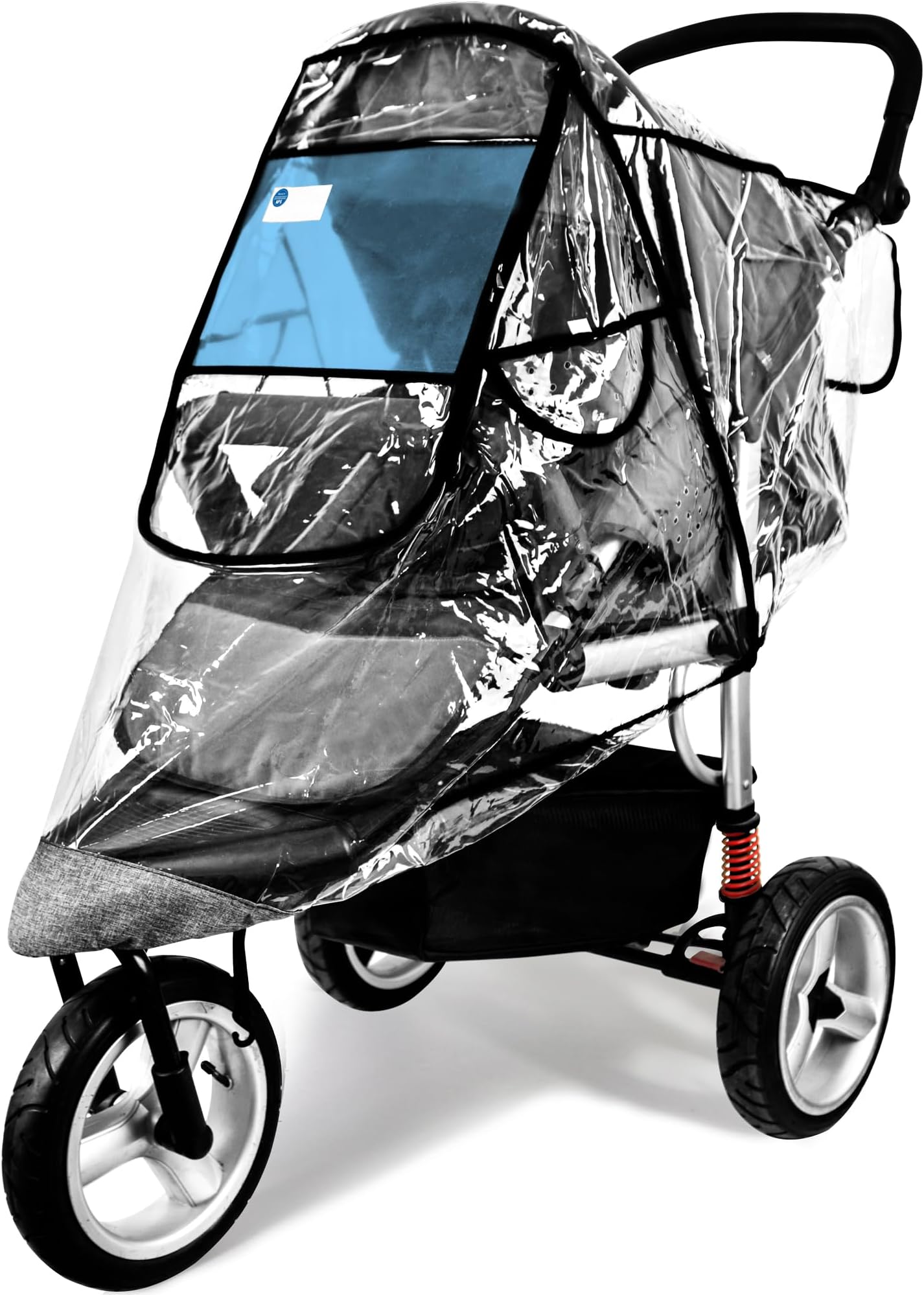
How to choose a safer stroller rain cover
The safest choice is usually the cover made or approved by the stroller manufacturer. It is more likely to match the stroller’s shape, attachment points, seat position, and ventilation design.
When comparing covers, look for these features:
| Feature | Why it matters |
|---|---|
| Model-specific fit | Reduces gaps, loose plastic, and interference with stroller parts |
| Clear viewing area | Helps you monitor the child |
| Large ventilation openings | Supports air flow |
| Secure attachment points | Helps prevent the cover from blowing inward or away |
| Space around the face | Keeps plastic away from the nose and mouth |
| No dangling cords | Reduces entanglement risk |
| Easy removal | Makes it more likely that you will remove it when conditions change |
| Clear care instructions | Helps prevent damage from heat, sunlight, and cleaning chemicals |
A cover should not have a strong chemical odor, sharp edges, exposed hardware, or plastic that cracks when gently flexed. If the material becomes brittle or cloudy, replace it.
Look for a product that provides clear instructions for your stroller model. Marketing terms such as “all-weather,” “breathable,” or “safe” are not enough by themselves. Check how the product creates ventilation and whether the instructions set limits for temperature, use, or stroller position.
Does an ASTM label prove that a rain cover is safe?
Not by itself. ASTM standards can cover specific products or product features, and the exact standard matters. The stroller standard ASTM F833, for example, addresses stroller and carriage safety.


A manufacturer’s statement may describe how a product was designed or tested. It is not the same as independent proof that the cover works safely in every climate or situation.
Parents should still check the fit, ventilation, instructions, and condition of the actual cover.
Check for recalls
Before using a cover, search the product name and model number in the CPSC recall database. Also check the manufacturer’s safety notices.
A recall may apply to a specific model, batch, or date range. If a cover has been recalled, stop using it and follow the manufacturer’s remedy instructions.

When should you avoid using a stroller rain cover?
Do not use a rain cover when:
- The cover has no ventilation openings.
- The cover does not fit the stroller.
- The child’s face can touch the plastic.
- The cover blocks your view.
- The stroller is in direct sun.
- The weather is hot or humid.
- Strong wind makes the stroller hard to control.
- The child is sleeping and cannot be watched closely.
- The cover is torn, brittle, or damaged.
- The cover affects the harness, brake, wheels, or folding system.
- The child is inside a car seat attached to a stroller and the cover restricts air flow.
A cover may be less useful than a dry route, an umbrella used by the adult, or waiting for the storm to pass. An umbrella should not be attached to the stroller unless the stroller maker approves the attachment. Loose umbrellas and aftermarket clips can affect balance or create sharp or entanglement hazards.
Rain boots, a stroller foot cover, and weather-resistant clothing may help with wet conditions, but they do not solve heat or air-flow problems. Dress the child in light layers and check the child’s body temperature often.
Are stroller covers safe for newborns?
They may be used with a newborn only if the stroller, newborn attachment, and rain cover are all approved for that use. Many strollers are not designed for newborns in the regular seat, even when the seat reclines.
A newborn may need a manufacturer-approved bassinet or another approved infant setup. The rain cover must not interfere with the flat position, ventilation, harness, or head clearance.
Never use a rain cover to turn a regular stroller seat into a newborn sleep space. For sleep, follow AAP safe-sleep guidance: use a firm, flat, separate sleep surface made for infant sleep. A covered stroller is not a replacement for a crib, bassinet, or play yard.
If a baby falls asleep during a walk, keep watching the baby and move the baby to an approved sleep surface when practical. Do not leave the baby sleeping in the stroller under a rain cover.

What should you do if a child gets too hot under a rain cover?
Remove the cover and move the stroller into shade or a cooler area. Remove extra layers and offer fluids if the child is old enough and able to drink safely.
Watch for signs of heat illness, including:


- Heavy sweating or very hot skin
- Red or flushed skin
- Headache
- Dizziness
- Weakness
- Nausea or vomiting
- Confusion
- Unusual sleepiness
- Fast breathing
- Fainting
For a baby or young child, unusual sleepiness, poor feeding, limpness, breathing trouble, or difficulty waking requires urgent medical help. Call 911 for serious symptoms, fainting, seizures, breathing problems, or a child who cannot be awakened.
Do not use ice water on a very young child, and do not delay emergency care while trying home cooling methods. When in doubt, contact a pediatrician or poison control and explain what happened.
Common mistakes to avoid
Covering the cover with a blanket
This can trap heat and limit air flow. The blanket may also fall against the child’s face.
Leaving the cover on indoors
A store, mall, car, or transit area may be warmer than outside. Remove the cover when you enter.
Using a plastic sheet instead of a fitted cover
A sheet can sag, blow inward, or cover the face. It may also have no planned ventilation.
Assuming clear plastic means good ventilation
Visibility and air flow are different. A clear cover can still trap heat.
Using a cover that fits “well enough”
A loose fit can create gaps and dangling material. A tight fit can block vents or press inward. Use the correct model or a cover with clear compatibility instructions.
Forgetting about the stroller brake
Rain can make sidewalks and ramps slippery. Apply the brake every time the stroller is stopped.
Letting the cover touch a heater or hot surface
Plastic can soften, melt, or release fumes near heaters, fireplaces, hot cars, or other heat sources. Store the cover away from heat.

Quick safety checklist
Before using a stroller rain cover, ask:
- Is this cover made for or confirmed compatible with this stroller?
- Does it have open ventilation areas?
- Can I see the child clearly?
- Is the child’s face away from the plastic?
- Is the harness still working correctly?
- Are the wheels, brake, and folding parts clear?
- Is the weather cool enough for covered use?
- Will I stay close and check the child often?
- Will I remove the cover indoors or when the rain stops?
- Is the cover clean, flexible, and undamaged?
If the answer to any safety question is no, do not use the cover until the problem is fixed.
FAQs
Can a baby sleep under a stroller rain cover?
No. A stroller rain cover should not be used as a sleep covering. If the baby falls asleep during a walk, supervise the baby and move the baby to a firm, flat, approved sleep surface as soon as practical.
Can I use a rain cover in cold weather?
Possibly, but cold weather does not remove the risk of overheating or poor air flow. Dress the child in light, suitable layers, keep the face clear, and monitor the child closely. Remove the cover indoors.
Are stroller rain covers waterproof?
Many are water-resistant or waterproof, but the result depends on seams, fit, design, and wear. A cover may keep rain off the child while still allowing water in around the edges. Check the product instructions rather than assuming full protection.
Can I use a universal rain cover on any stroller?
No. A universal cover may fit several stroller types, but it may not fit every frame safely. Check the listed stroller dimensions and attachment method. Do not use it if it blocks vents, touches the child, or interferes with stroller parts.
Is a rain cover safer than an umbrella?
Neither is automatically safer. A fitted, ventilated rain cover keeps both hands available and may offer better protection from wind and rain. An umbrella can improve adult comfort but may affect balance if attached to the stroller. Use only accessories approved by the stroller maker.
How often should I replace a stroller rain cover?
Replace it when it becomes brittle, cracked, torn, cloudy, loose, or difficult to attach. Also replace it if the stroller maker changes the approved accessory for that model. There is no universal replacement age for all covers.
Key takeaways
- Stroller rain covers can be safe when used correctly and briefly.
- Use a model-specific or clearly compatible cover with good ventilation.
- Keep the child’s face away from the plastic.
- Never add a blanket or second cover.
- Watch for heat, sweating, poor breathing, and unusual sleepiness.
- Remove the cover indoors, in direct sun, and when the rain stops.
- Do not use a rain cover as a sleep space.
- Check the stroller and cover for recalls and damage.
Conclusion
A stroller rain cover is a weather tool, not a sealed shelter. The safest approach is to use a well-fitted cover for short periods, keep air moving, maintain a clear view of the child, and remove it as soon as conditions allow.
When the weather is hot, windy, or hard to monitor, waiting indoors is safer than relying on a cover. If the product does not fit properly or does not provide clear ventilation, choose a different cover or skip the walk.
