
In the United States, you can buy a bassinet from major retailers, baby stores, furniture shops, manufacturer websites, and online marketplaces. You may also find one through a baby registry or a reputable secondhand store.
The best place depends on what you need most: easy returns, a low price, expert help, fast delivery, or a chance to inspect the bassinet in person. Before you buy, check that the product is made for infant sleep, meets current U.S. safety rules, has a firm flat sleep surface, and has no open recalls.

Where Can You Buy a Bassinet in the United States?
The easiest places to buy a new bassinet are large U.S. retailers, baby specialty stores, and the brand’s own website. Each option has different benefits and limits.
| Place to buy | Best for | What to check |
|---|---|---|
| Major retailers | Price comparisons, fast shipping, easy returns | Seller identity, return terms, recall status |
| Baby specialty stores | Product help and in-person advice | Store stock, delivery fees, service policy |
| Furniture and home stores | Matching nursery furniture | Weight limits, mattress fit, assembly |
| Brand websites | Full product details and replacement parts | Warranty, shipping, final-sale rules |
| Baby registries | Gifts, group purchases, completion discounts | Gift return period and registry terms |
| Consignment stores | Lower prices and local pickup | Missing parts, age, recalls, wear |
| Online marketplaces | Used items and wide selection | Exact model, seller history, safety records |
| Local parent groups | Low-cost or free options | Recall checks and product condition |
For a new bassinet, a retailer with a clear return policy is often the simplest choice. If you buy used, research the exact model before paying.


Major U.S. retailers
Large retailers may offer many brands, delivery choices, customer reviews, and convenient returns. Their websites can also make it easier to compare dimensions, weight limits, folding features, and mattress details.
Do not assume that every product listed under “bassinet” is designed for unsupervised sleep. Some products are only for supervised lounging, travel, or play. Read the product manual and safety label.
Baby specialty stores
Independent baby stores can be useful if you want to see a bassinet in person. Staff may help you compare height, folding systems, mattress support, and sheet sizes.
Inventory can be limited. Call before visiting, especially if you want a specific model or color. Ask whether the store accepts returns after assembly.
Brand websites
Buying from the manufacturer can help you find the correct manual, replacement mattress, fitted sheets, and spare parts. It may also reduce confusion about who handles the warranty.
Check the company’s return policy before ordering. Some items cannot be returned after use, and large products may have costly return shipping.
Baby registries
A registry can be useful if family or friends want to share the cost. Some U.S. registry services offer completion discounts, but terms vary by company and date.
Add the exact model and model number to your registry. This makes it easier to track the product, find replacement parts, and respond to any recall notice.
Secondhand stores and online marketplaces
Used bassinets can cost less, but they require more research. Ask for:
- The brand and exact model name
- The model number and manufacture date
- Photos of the frame, mattress, label, and hardware
- The original manual
- Confirmation that all parts are included
- Proof that the item has not been recalled
- Information about storage, damage, smoke, pets, or mold
Avoid a used bassinet if the seller cannot identify the exact model. Do not buy one with a cracked frame, loose mesh, missing hardware, sagging mattress, homemade padding, or altered parts.


What Kind of Bassinet Should You Buy?
A bassinet is a small infant sleep space, often used during the first months. It may be stationary, portable, rocking, folding, or designed to sit beside an adult bed.
The label alone does not tell you whether a product is safe for sleep. Some products use similar words for very different purposes.
Common types
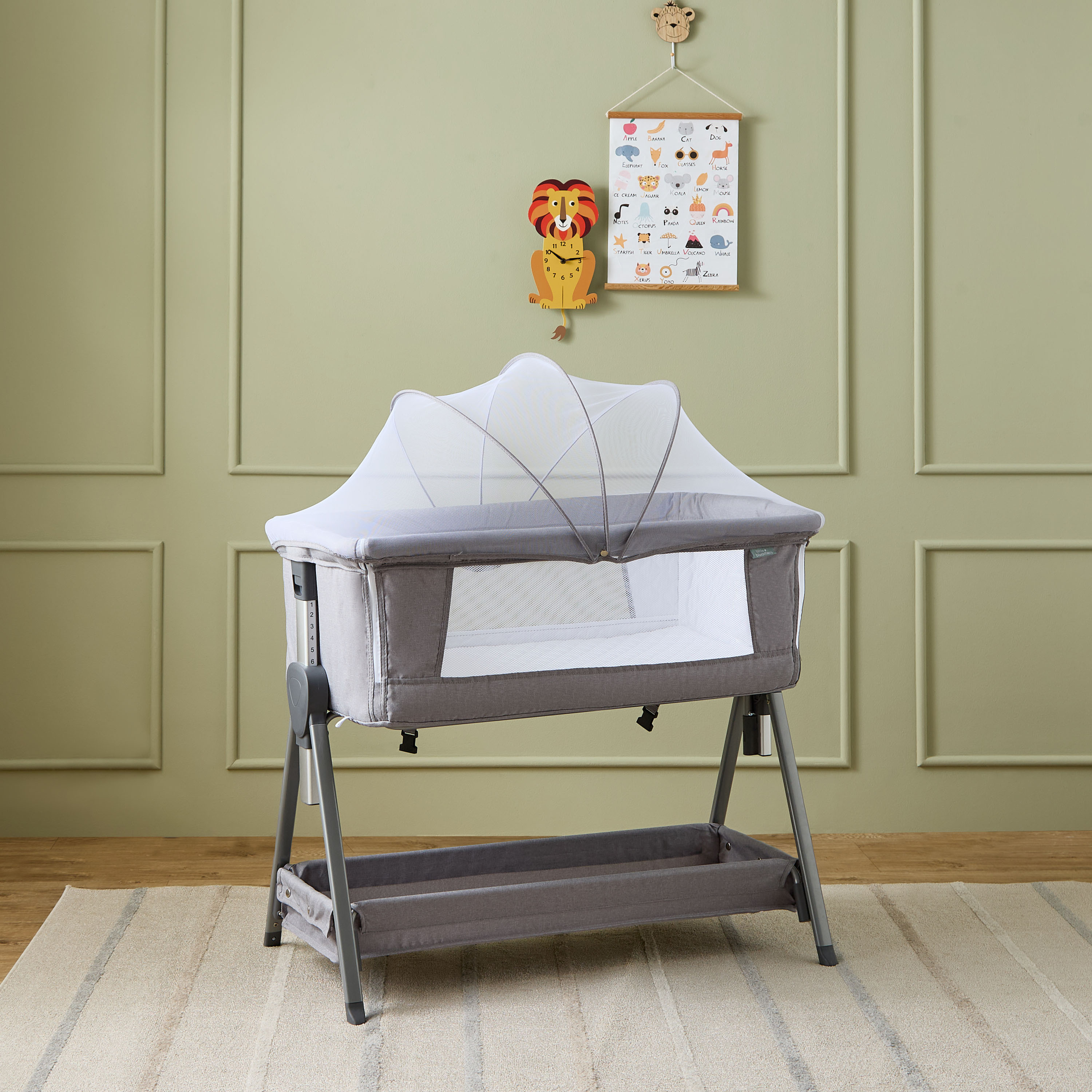
Traditional bassinet: A small, raised sleep space with a stand or fixed base. It is often light and easy to place near the parent’s bed.
Portable bassinet: A lighter model that may fold or move from room to room. Confirm that it is approved for sleep and that the base stays stable when moved.
Bedside sleeper: A bassinet made to stand next to an adult bed. Some have a lowered side or adjustable height. The baby still sleeps on a separate, flat surface.
Travel bassinet: A compact product for trips. Check whether the maker permits overnight sleep or only supervised use.
Moses basket: A basket-style sleep space. It needs a stable stand or base designed for that specific basket. Never place a basket on a bed, sofa, table, or other raised surface unless the manufacturer specifically designs and approves that setup.
Rocking or vibrating bassinet: Motion may soothe some babies, but the sleep surface must remain safe and flat. Motion does not replace safe sleep rules.
Bassinet versus mini crib
A bassinet usually has a shorter use period and a smaller footprint. A mini crib may last longer, but it takes up more space and can be harder to move.
Choose a bassinet if you value portability and need a sleep space for the early months. Choose a mini crib if you want a longer-use product and have enough room.
Always follow the product’s height, weight, and developmental limits. Stop use when the manual says to stop, or sooner if the baby can roll, push up, sit, or move in a way that makes the product unsafe.

How Do You Know if a Bassinet Is Safe to Buy?
A safe bassinet should have a firm, flat, level sleep surface and a fitted sheet made for that model. The sides should stay secure, and the frame should not wobble or fold during use.
In the United States, bassinets and cradles fall under federal safety requirements. The Consumer Product Safety Commission’s bassinet and cradle standard incorporates requirements based on ASTM F2194.
This does not mean every online listing is correctly labeled. Look for clear product information, a real manufacturer, a model number, assembly instructions, and safety warnings.
Use this safety check before buying
- Confirm the intended use. The manual should state whether the product is made for infant sleep.
- Check the sleep surface. It should be firm, flat, and level. Avoid products with a deep dip, hammock shape, or built-in incline.
- Check the mattress fit. There should be no dangerous gap between the mattress and the sides.
- Inspect the frame. It should lock into place and remain stable when touched or moved normally.
- Review the weight and developmental limits. These limits differ by model.
- Check for recalls. Search the model on the CPSC recalls page.
- Read the manual. If the manual is missing, find it on the manufacturer’s website before use.
- Check the seller. Be cautious if the listing has vague photos, no model number, or unusually low pricing.


Do not use pillows, loose blankets, crib bumpers, sleep positioners, stuffed toys, or added padding in the bassinet. The American Academy of Pediatrics safe sleep guidance recommends placing babies on their backs on a firm, flat, noninclined surface with no soft items.
A bassinet should be in the same room as the parent, but not in the same bed. The AAP recommends room sharing without bed sharing, ideally for at least the first six months.
What Should You Look for When Shopping?
The right bassinet depends on your room, routine, budget, and how long you expect to use it. Safety comes first, but practical details affect whether you will use it correctly every night.
Measure your space
Measure the area beside your bed before ordering. Include space for:
- Opening drawers and doors
- Walking around the bassinet
- Lowering a bedside panel, if included
- Moving the bassinet for cleaning
- Using the product’s wheels or folding parts
A bassinet that blocks a walkway may become a daily safety problem.
Check height and access
A bedside model should sit securely at the correct height beside your bed. Do not place books, blocks, or other objects under the bassinet to raise it.
A lower side may make nighttime access easier, but it should lock as directed. Never leave a side partially lowered unless the manual specifically allows that position during sleep.
Look at portability
Wheels, handles, and folding frames can help in small homes. However, portability should not come at the cost of stability.
If you plan to move the bassinet while the baby is inside, confirm that the manufacturer allows it. Lock wheels before putting the baby down.
Compare ongoing costs
The purchase price is only part of the cost. You may also need:
- Approved fitted sheets
- A replacement mattress or pad, if offered by the maker
- Replacement wheels or hardware
- Shipping
- Assembly
- A return shipment if the product does not fit your room
Avoid buying an after-market mattress or pad unless the manufacturer states that it is compatible. Even a small gap can create a serious hazard.
How Much Does a Bassinet Cost?
Bassinet prices in the United States vary widely by design, brand, materials, and features. Prices and availability change, so treat any store price as a current listing rather than a permanent market range.
A basic stationary model may cost less than a larger bedside model with wheels, storage, motion, or electronic features. Used bassinets may cost less, but the savings can disappear if you need missing parts or replacement accessories.


When comparing prices, use the total cost, not only the headline price:
Total cost = bassinet + shipping + required accessories + replacement parts − valid discount
For example, a low-cost bassinet may become more expensive if it needs a special sheet, paid delivery, or a replacement part that is no longer available.
Do not pay extra for features that do not solve a real need. Lights, sounds, vibration, and app controls are optional. They do not make an unsafe sleep surface safe.
Should You Buy a New or Used Bassinet?
A new bassinet is usually the easier choice when you want current instructions, known ownership history, available parts, and a clear warranty.
A used bassinet may be reasonable when the exact model is known and you can verify its condition. This is especially important for products that have been stored in garages, moved between homes, or used around pets and smoke.
Before buying used, complete these checks:
- Search the exact model on the CPSC website.
- Confirm that the seller has all required parts.
- Compare the item with the manufacturer’s manual.
- Inspect the mattress and frame in person.
- Check that labels and warnings are readable.
- Make sure the product has not been modified.
- Ask why the seller is getting rid of it.
- Keep the receipt or written record of the sale.
Do not buy a recalled product even if the seller offers a refund later. A recall may involve a fall hazard, structural failure, fire risk, or an unsafe sleep surface.

What Should You Avoid When Buying a Bassinet?
Avoid any product that is hard to identify, difficult to assemble, or marketed with unclear sleep claims.
Be especially careful with:
- Inclined sleepers
- In-bed sleepers
- Products with a hammock-like sleep surface
- Thick padded nests
- Positioners and anti-roll devices
- Products with loose fabric or large openings
- Bassinets with no firm mattress
- Unbranded marketplace listings
- Items with missing instructions
- Products modified with extra padding or replacement parts
A product can look cozy and still be unsafe for sleep. Soft padding, pillows, and loose blankets can cover a baby’s face or limit movement.
Also avoid using a car seat, stroller seat, swing, bouncer, or infant carrier as a routine sleep space. If a baby falls asleep in one of these products, follow the product guidance and move the baby to a firm, flat, approved sleep surface as soon as practical.
What If the Bassinet Does Not Fit or Seems Unsafe?
Stop using the bassinet if it wobbles, has a broken lock, shows a gap around the mattress, or does not match the manual.
Use this troubleshooting order:
- Stop placing the baby in the product.
- Check the assembly against the manual.
- Look for missing, bent, or damaged parts.
- Contact the manufacturer with the model number.
- Check the CPSC recall database.
- Return the product if the retailer allows it.
- Report a serious safety problem through SaferProducts.gov.
Do not repair a sleep product with tape, glue, zip ties, homemade padding, or hardware from another product. Ask the manufacturer for approved parts or replace the bassinet.


If you are unsure whether a product is approved for infant sleep, use a different sleep space until you can verify it.

Frequently Asked Questions
Where is the best place to buy a bassinet?
For most families, a major U.S. retailer or the manufacturer’s website offers the best balance of selection, documentation, and returns. A baby specialty store may be better if you want to see the bassinet in person. Compare the exact model, not just the brand name.
Can I buy a bassinet at a hospital?
Some hospitals sell or recommend baby products, but many do not operate as retail stores. Ask your hospital or maternity unit before delivery if it has a local supplier or approved product list. Hospital use or recommendation is not a substitute for checking the product’s manual and recall status.
Is it safe to buy a bassinet from Facebook Marketplace or another used marketplace?
It can be safe only when you can identify the exact model, check for recalls, inspect the condition, and confirm that all parts are present. Do not buy a used bassinet with an unknown history or missing safety information.
Do bassinets expire?
Bassinets do not usually have one universal expiration date. However, materials can wear out, manuals and replacement parts may become unavailable, and safety standards may change. Follow the manufacturer’s stated limits and avoid products with damaged or degraded parts.
Can a baby sleep in a bedside bassinet all night?
A bedside bassinet may be used for sleep if the manufacturer identifies it as a sleep product and it is assembled as directed. The baby should remain on the separate bassinet surface, not in the adult bed. Keep the surface flat and free of loose items.
Quick Buying Checklist
Before you place an order, confirm that:
- The product is intended for infant sleep.
- The sleep surface is firm, flat, and level.
- The model number is clearly listed.
- The bassinet meets current U.S. requirements.
- No recall applies to the exact model.
- The mattress fits without gaps.
- The frame locks and stays stable.
- The weight and developmental limits fit your baby’s stage.
- The seller offers a clear return policy.
- Replacement sheets and parts are available.
- You have measured the space beside your bed.
Conclusion
You can buy a bassinet from major U.S. retailers, baby stores, manufacturer websites, registries, and carefully screened secondhand sellers. The safest choice is not simply the cheapest or most popular model. It is the one that is made for infant sleep, has a firm flat surface, fits your space, includes all parts, and has no recall.
Start by measuring your room and setting a budget. Then compare exact models, read the manual, check the CPSC recall database, and review the return policy before buying.
