
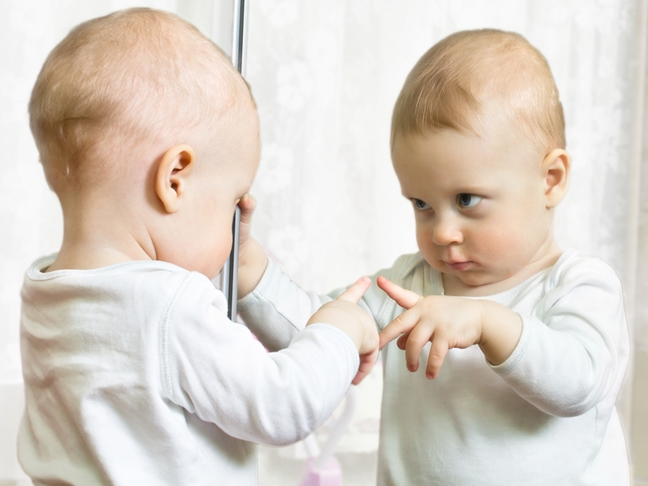
Most babies begin to recognize themselves in a mirror between 18 and 24 months. Many show clear self-recognition closer to age 2, though the timing varies. Before then, babies may smile at, touch, or study the baby they see without knowing that the reflection is their own.
For families in the United States, this is a normal part of toddler development. A child who enjoys mirrors at 6 months is not necessarily showing self-awareness yet. Mirror play usually develops in steps, from noticing faces to understanding that the image moves with them and belongs to them.

The short answer: Around 18 to 24 months
Self-recognition in a mirror often appears during the second year of life. Researchers commonly study this skill with the mirror self-recognition test, also called the rouge test.
In this test, an adult places a small, harmless mark on a child’s face without the child noticing. The child then looks in a mirror. If the child touches the mark on their own face, rather than touching the mirror, this suggests that they understand the reflection represents them.


The exact age is not fixed. Some children show signs of self-recognition before 18 months, while others do not pass this type of test until after their second birthday.
What babies understand at different ages
| Approximate age | What a baby may do in a mirror | What it may mean |
|---|---|---|
| Birth to 3 months | Looks briefly at faces and high-contrast shapes | Early visual interest |
| 3 to 6 months | Smiles, coos, or watches movement | Enjoys social-looking images |
| 6 to 12 months | Touches the mirror or looks behind it | Explores how the image works |
| 12 to 18 months | Copies movements and watches the reflection closely | May be building an understanding of the image |
| 18 to 24 months | Touches their own face after seeing a mark in the mirror | Stronger evidence of self-recognition |
| After 24 months | Names themselves, points to body parts, or poses | Growing self-awareness and self-concept |
These age ranges are guides, not strict deadlines. Child development does not move in one exact order for every child.
How self-recognition develops
Self-recognition is more than knowing that a mirror image is interesting. It means a child connects the image with their own body and identity.
This skill depends on several abilities working together:
- Visual tracking: Following the reflection as it moves.
- Body awareness: Understanding where their own face, hands, and body are.
- Memory: Remembering what they looked like before seeing the mirror.
- Cause and effect: Learning that their movements change the image.
- Self-concept: Beginning to understand “me” as separate from other people.
A baby may first treat the reflection like another child. The baby may smile, wave, or lean toward the mirror. Later, the child may notice that the reflection moves at the same time and in the same way.
That change is important. The child is beginning to link the image with their own actions.
Why mirror interest does not prove self-recognition
A baby can enjoy mirror play without recognizing the reflection as themselves. Babies are naturally drawn to faces, eyes, motion, and social responses. A mirror provides all of these at once.
For example, a 9-month-old may laugh at the “other baby” in the mirror. The child may also pat the glass or search behind it. These actions show curiosity, but they do not confirm that the child understands the image is their own reflection.
The mark test gives stronger evidence because it checks whether the child connects the reflection with their own face.

Signs your baby may recognize themselves
The clearest signs usually appear during the toddler years. A child may:


- Look at the mirror and then touch their own face.
- Notice a sticker, spot, or food mark on their face.
- Move their body while watching the matching movement.
- Point to themselves in the mirror.
- Point to named body parts.
- Use their name or words such as “me” or “mine.”
- Compare their reflection with a parent’s reflection.
- Smile, pose, or make faces while watching the mirror.
These signs do not all appear at once. A child may show body awareness before using words for themselves.
A simple example
Suppose a toddler has a small piece of washable face paint placed on the forehead while distracted. When the toddler looks in the mirror, they touch their own forehead. That response suggests the toddler understands that the reflection shows their own body.
If the toddler touches the mirror instead, they may still be learning how mirrors work. If the toddler ignores the mark, the test may not have worked. The child may be tired, shy, distracted, or uninterested.
A single attempt cannot measure a child’s full development.
How to encourage healthy mirror play
Mirror play can support social, language, and body awareness skills. You do not need special equipment or a formal test.
Try these simple activities:
Sit with your baby in front of a safe mirror.
Keep your face close to your baby’s reflection.Name what you see.
Say, “There is your nose,” or “I see your hand.”Copy your baby’s movements.
Smile, wave, clap, or gently nod.Use simple body-part games.
Ask, “Where is your ear?” Then point to the ear in the mirror.Add songs and facial expressions.
Songs with gestures can make the activity more engaging.Let your child lead.
If your baby loses interest, stop and try another day.
The goal is shared play, not passing a test. Short, happy sessions work better than trying to make a child respond.
Mirror safety in an American home
Use a mirror that is firmly attached to a wall, furniture, or a developmentally appropriate play surface. Avoid placing a loose glass mirror where a baby can pull it down or hit it.
Also:
- Supervise babies near mirrors.
- Check for sharp edges, cracks, and loose parts.
- Keep floor mirrors stable.
- Avoid small mirrors with detachable pieces.
- Do not use a mirror as a substitute for active supervision.
A shatter-resistant acrylic mirror may reduce breakage risk, but it still needs to be secured and checked often.

What if a baby does not recognize themselves by age 2?
A child who does not clearly recognize themselves in a mirror at exactly 18 or 24 months does not automatically have a developmental problem. The mirror test is influenced by mood, language, attention, culture, and the child’s comfort with the task.
Some children do not like marks on their faces. Others understand the reflection but do not show it in the expected way. A child may also show self-awareness through language, pretend play, body-part knowledge, or independent actions before responding to a mirror test.
Look at the full pattern of development
Parents and caregivers should consider several skills together, including whether the child:
- Makes eye contact and shares attention.
- Responds to their name.
- Uses gestures such as pointing or waving.
- Shows interest in people and objects.
- Understands simple instructions.
- Uses sounds, words, or other communication.
- Imitates actions.
- Shows a range of emotions.
- Uses familiar objects in a typical way.


If you have concerns about development, speak with the child’s pediatrician. In the United States, parents can also contact their local Child Find program for a free developmental evaluation for children under age 3. The CDC’s Milestone Tracker can help families prepare questions, but it does not diagnose developmental conditions.
Contact a health professional sooner if a child loses skills they previously had. Loss of skills deserves prompt medical attention.

Is the mirror test a reliable measure of self-awareness?
The mirror test is useful, but it is not a complete measure of self-awareness. It mainly tests whether a child recognizes a visual image as their own body.
A child can have self-awareness without passing the test. The child may not understand the instructions, may not care about the mark, or may express recognition in a different way.
The test can also be affected by:
- Age and attention span.
- Language and communication style.
- Familiarity with mirrors.
- Cultural experience with mirrors.
- Motor skills.
- Anxiety or discomfort.
- Whether the mark is easy to feel or see.
- The child’s interest at that moment.
Researchers therefore treat the mirror test as one measure among many. It should not be used by parents as a stand-alone developmental screening tool.
Mirror recognition is not the same as body image
Recognizing a reflection does not mean a child understands appearance, attractiveness, or social judgment. Those ideas develop much later and are shaped by language, relationships, and culture.
In the second year, mirror recognition is mainly about linking a visual image to the child’s own body. It is an early step in self-awareness, not a mature understanding of identity.
Common questions about babies and mirrors
Do babies know it is them in the mirror?
Most young babies do not clearly understand that the reflection is themselves. They may recognize a familiar face or enjoy the image, but clear self-recognition usually develops between 18 and 24 months.
Why does my baby smile at the mirror?
Babies are attracted to faces, movement, and social cues. Smiling at a reflection is normal and shows interest. It does not prove that the baby knows the reflection is their own image.
Can a 6-month-old recognize themselves?
A 6-month-old may recognize familiar patterns, enjoy their reflection, and notice that the image moves. However, most children do not show strong evidence of mirror self-recognition at this age.
Should I test my child with a mark on the face?
You may use a gentle, playful version of the activity, but do not treat it as a diagnosis or deadline. Use a washable mark only if your child is comfortable, avoid the eyes and mouth, and stop if your child becomes upset.
Do children with autism recognize themselves in mirrors?
Mirror self-recognition varies among all children, including children with autism. A mirror response alone cannot identify or rule out autism. If you have concerns about communication, social interaction, behavior, or lost skills, discuss them with a pediatrician or qualified developmental professional.
When should I ask a pediatrician about development?
Ask your child’s pediatrician whenever you have a concern, especially if your child loses a skill or has concerns across several developmental areas. Do not wait for a mirror milestone alone if your instincts tell you something may be wrong.
Key takeaways
- Most children recognize themselves in a mirror between 18 and 24 months.
- Mirror interest in infancy is normal but does not always mean self-recognition.
- Touching a mark on their own face after looking in a mirror is a classic sign.
- The mirror test is only one part of development and is not a diagnosis.
- Safe, playful mirror time can support body awareness and language.
- Talk with a pediatrician about broader concerns or any loss of skills.


Conclusion
Babies often enjoy mirrors long before they understand that the reflection is their own. Clear self-recognition usually develops during the second year, with many children showing it between 18 and 24 months.
Let your child explore at their own pace. Talk about faces, body parts, and movements, but avoid turning mirror play into a pass-or-fail test. If concerns extend beyond mirror recognition, a pediatrician can help you decide what support or evaluation may be useful.
Sources and further reading
- Centers for Disease Control and Prevention: Developmental Milestones
- CDC Milestone Tracker App
- Amsterdam, B. “Mirror self-image reactions before age two.” Developmental Psychobiology, 1972.
- Lewis, M., and Brooks-Gunn, J. “Social cognition and the acquisition of self.” Plenum Press, 1979.
- Gallup, G. G. “Chimpanzees: Self-recognition.” Science, 1970.
