
In the United States, there is no single medical age that applies to every baby. The American Academy of Pediatrics (AAP) says ear piercing can be done at any age when a parent chooses, but it should be performed safely with sterile equipment by a trained professional. Many U.S. pediatricians suggest waiting until a baby is at least 2 to 3 months old, has received some routine vaccines, and is healthy. Others recommend waiting longer, since an older child may help with aftercare.
The safest choice depends on your baby’s health, your pediatrician’s advice, the piercer’s age policy, and your state or local rules.
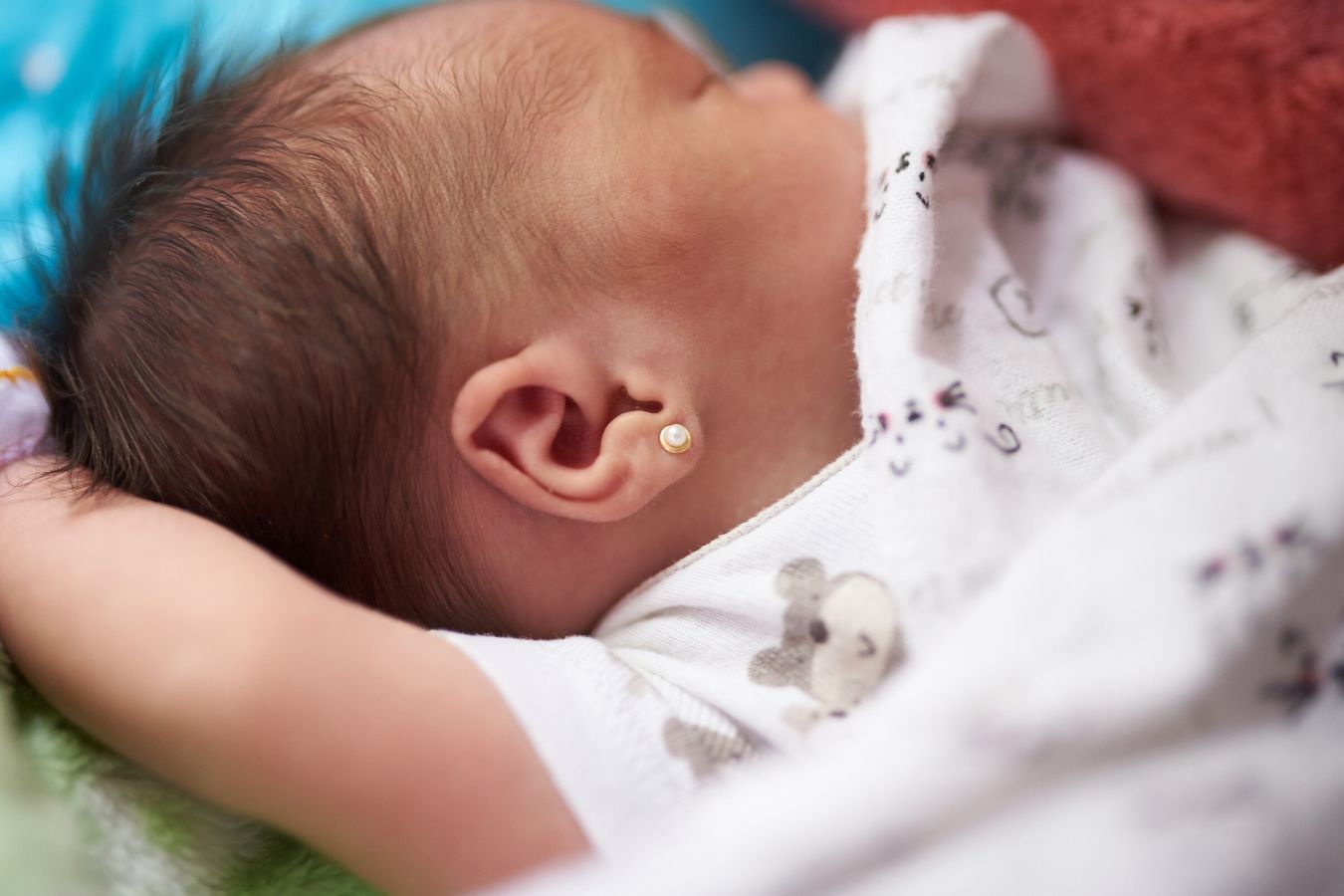
Is there a recommended age for baby ear piercing?
There is no official AAP minimum age for ear piercing. The AAP’s guidance focuses on safe technique, sterile equipment, proper jewelry, and careful aftercare rather than one fixed birthday.


Still, age affects practical safety:
- Newborns: They have immature immune systems and may not yet have received routine vaccines.
- Around 2 to 3 months: Some babies have started their primary vaccine series, but they are still very young.
- Around 6 months or later: Babies may have more vaccine protection, but they can also grab and pull at their earrings.
- Toddlers: They may touch the area often or remove jewelry, which can increase irritation and choking risk.
- Older children: They may understand cleaning instructions and help protect the healing piercings.
A common U.S. approach is to wait until after the first set of infant vaccines, often around 2 to 3 months. This is not a universal medical rule. Your child’s doctor may suggest a different age based on health history, skin conditions, vaccine status, and local infection concerns.
Why some parents wait until 3 months or later
Waiting can offer several possible benefits:
- Your baby may have received early routine vaccines, including protection against tetanus.
- A doctor can check for health issues before the procedure.
- Parents may find it easier to watch for infection in an older, more settled baby.
- Some professional piercers will not pierce very young infants.
Waiting does not remove every risk. Older babies may pull at earrings, sleep on their ears, or rub the new piercings against bedding.
What should you check before piercing a baby’s ears?
Before booking an appointment, ask your baby’s pediatrician and the piercer four key questions:
- Is my baby healthy enough for ear piercing?
- What age does the piercer accept?
- What jewelry material and size will be used?
- What cleaning steps should we follow?
Do not pierce your baby’s ears if the baby is sick, has a fever, has an active skin rash near the ears, or is recovering from another procedure. Ask the pediatrician first if your child has eczema, a history of keloid scars, immune problems, bleeding problems, metal allergies, or a heart condition.
A pediatrician may also advise extra caution if close family members develop thick, raised scars after minor skin injuries. These scars are called keloids. They can grow beyond the original wound and may be difficult to treat.

Where is the safest place to pierce a baby’s ears?
The safest setting is a medical office or a reputable professional piercing studio that follows strict hygiene practices. The person performing the piercing should have experience with infants and should follow local health rules.


A pediatric office
A pediatric office may be a good choice because a health professional can review your baby’s medical history and examine the ears first. However, not every pediatric office offers ear piercing.
Ask whether the office:
- Uses sterile, single-use needles or sterile equipment
- Uses gloves and cleans the skin properly
- Has experience piercing infant earlobes
- Provides written aftercare instructions
- Uses jewelry designed for fresh piercings
A professional piercing studio
A professional studio may have more experience with piercing technique and jewelry placement. Before choosing one, visit the studio or call ahead.
Look for:
- A clear age and consent policy
- A clean, private work area
- Hand washing and new gloves
- Sterile, single-use needles
- An autoclave for sterilizing reusable tools
- Written aftercare instructions
- Staff who answer questions without pressure
- Jewelry made for initial healing
Avoid any place that uses a reusable piercing gun without explaining how the device is sterilized. Some piercing guns cannot be fully sterilized between customers. They may also cause more tissue trauma than a properly used sterile needle.
Many retail stores have minimum-age rules or require a parent to sign a consent form. A store’s policy is not the same as medical guidance, so check both.
What type of earrings are safest for a baby?
Choose small, smooth earrings made from a material that is less likely to cause an allergic reaction. Implant-grade titanium is often used for people with metal sensitivity. High-quality nickel-free gold may also be suitable.
Ask the piercer to explain the exact material. “Hypoallergenic” is a marketing term and does not always identify the metal clearly.
Good starter earrings usually have:
- A small, smooth front
- A secure flat or rounded back
- Enough room for early swelling
- No dangling parts
- No sharp edges
- No stones or parts that can loosen
Avoid large hoops, dangling earrings, screw-back parts that pinch, and inexpensive jewelry that may contain nickel. Nickel is a common cause of allergic contact dermatitis. The AAP has recommended gold posts for children, but gold purity and alloy content still matter.
Do not use oversized backs that press tightly against the earlobe. Swelling can cause the back or post to become embedded in the skin.

How should you prepare for the appointment?
Preparation can make the visit safer and less stressful.
Before the appointment
- Confirm the piercer’s minimum age.
- Check whether your state or city requires parental consent or identification.
- Ask which jewelry materials are available.
- Review your baby’s vaccine record with the pediatrician.
- Make sure your baby is well and feeding normally.
- Bring a clean blanket or comfort item.
- Plan for a calm time when your baby is usually rested.
Do not give your baby pain medicine unless a health professional tells you to do so. Many medicines are not appropriate for young infants, and the correct dose depends on age and weight.


During the piercing
The piercer should mark both earlobes and let you check the placement before starting. The marks should look even when the baby’s head is upright.
The professional should:
- Wash their hands.
- Put on new gloves.
- Clean the earlobes with an appropriate antiseptic.
- Use sterile, single-use equipment.
- Pierce the soft earlobe, not the upper ear cartilage.
- Insert suitable starter jewelry.
- Explain aftercare and warning signs.
Infant ear piercing should be limited to the soft earlobe. Piercing cartilage has a higher risk of serious infection and healing problems than piercing the lobe.
How do you care for a baby’s new ear piercings?
Follow the piercer’s written instructions and your pediatrician’s advice. In general, keep the area clean, avoid unnecessary touching, and leave the starter jewelry in place during healing.
Basic aftercare steps
- Wash your hands before touching the earrings or ears.
- Clean the front and back of each piercing as directed.
- Use sterile saline if recommended by the piercer.
- Keep hair, clothing, and bedding from rubbing the area.
- Do not apply alcohol, hydrogen peroxide, strong antiseptics, or antibiotic ointment unless a clinician recommends it.
- Do not twist or rotate the earrings unless your medical professional specifically tells you to.
- Keep the original jewelry in place for the full healing period recommended by the piercer.
Many earlobe piercings take about 6 to 8 weeks to heal, but healing time varies. A piercing may look better on the outside before the inside has healed. Do not change the jewelry early just because the skin looks normal.
Avoid pools, lakes, hot tubs, and dirty water while the piercings heal if your pediatrician or piercer advises avoiding them. Keep the baby from sleeping on rough or dirty surfaces, and wash items that touch the ears often.
What normal healing may look like
Mild tenderness, slight redness, or a small amount of clear fluid may occur soon after piercing. These signs should improve rather than worsen.
Healing is more likely on track when:
- Redness stays close to the piercing
- Swelling decreases
- The baby does not seem increasingly uncomfortable
- There is no thick drainage or bad odor
- The jewelry moves only as expected and does not press into the skin

What are the risks of piercing a baby’s ears?
The main risks include infection, allergic reaction, tearing, embedded jewelry, and raised scars.
Infection
Contact a pediatrician if redness, swelling, warmth, or pain increases after the first day or two. Yellow or green drainage, bad odor, fever, or red streaks also need medical advice.
Do not remove the jewelry on your own if you suspect infection. Closing the channel can trap infection under the skin. Call your child’s doctor for instructions.
Embedded earrings
An earring can become partly or fully covered by swollen skin. This is more likely when the back is too tight or swelling is ignored.
Call a clinician promptly if:
- The front or back is sinking into the earlobe
- You cannot see part of the post
- The earlobe is very swollen
- The jewelry will not move at all
- The baby seems very painful when the ear is touched


Do not force an embedded earring out at home.
Metal allergy
A rash that is itchy, dry, or spreading around the jewelry may suggest a metal reaction. Nickel is a frequent cause. Ask a pediatrician or dermatologist what to do before changing the jewelry.
Tearing and choking
Babies can pull earrings out, tear the earlobe, or place loose parts in the mouth. Use small, secure studs only. Never use dangling earrings on a baby or young child.
Keloids and thick scars
Some children develop raised scars after piercing. A family history of keloids raises concern. Ask the pediatrician before piercing if your baby or close relatives have had this problem.
When should you call the pediatrician?
Call your baby’s pediatrician if the piercing site gets worse instead of better or if your baby seems unwell.
Seek medical advice for:
- Fever
- Increasing redness, warmth, swelling, or pain
- Pus or foul-smelling drainage
- Red streaks from the ear
- Bleeding that does not stop with gentle pressure
- An earring that is stuck or embedded
- A rash that spreads beyond the piercing
- A torn earlobe
- A baby who is unusually sleepy, irritable, or feeding poorly
For a young infant, a fever can require urgent medical evaluation. Follow your pediatrician’s instructions about what temperature and symptoms require immediate care.
If the piercing involves upper-ear cartilage, seek medical advice sooner. Cartilage infections can be more serious than ordinary earlobe irritation.

What do U.S. laws and policies say about baby ear piercing?
Rules vary by state, county, and city. Some places require parental permission, identification, record keeping, or specific sanitation practices. Others regulate piercing studios through health departments or body-art laws.
Before the appointment:
- Check your state or local health department website.
- Ask the studio what identification and consent forms are required.
- Confirm whether the parent must be present.
- Ask who is legally allowed to perform the piercing.
- Verify that the studio follows current sanitation rules.
These legal requirements can change. A business’s compliance with local rules does not replace medical screening, so discuss your baby’s health with a pediatrician when there is any concern.
Baby ear piercing decision guide
| Situation | Practical choice |
|---|---|
| Baby is sick or has a rash near the ears | Wait and ask the pediatrician |
| Baby has a history or family history of keloids | Ask a pediatrician before deciding |
| Baby has a metal allergy or severe eczema | Discuss jewelry materials with a clinician |
| Piercer uses unclear or nonsterile equipment | Choose another provider |
| The studio will not explain aftercare | Do not book the appointment |
| The earlobe is swollen and the jewelry is tight | Call the pediatrician |
| You are unsure about local consent rules | Check the state or local health department |
The key trade-off is simple: waiting may make the procedure easier to assess and care for, while piercing earlier may reduce the chance that an older baby pulls at the jewelry. Neither timing removes all risk.

Frequently asked questions
Can a newborn baby get their ears pierced?
A newborn may be physically able to have the earlobes pierced, but many parents and professionals choose to wait. Newborns have not yet received routine infant vaccines, and some professional piercers do not accept newborn clients. Ask your pediatrician first.
Should I wait until after my baby’s vaccines?
Many U.S. clinicians suggest waiting until a baby has started routine vaccinations, often around 2 to 3 months. This is a cautious approach, not a universal minimum age. Your pediatrician can explain what is best for your baby.


Is ear piercing painful for babies?
Piercing causes brief pain. The earlobes may remain tender for a short time. Babies may cry from the procedure, being held still, or the unfamiliar setting. Ask a pediatrician before using any pain medicine.
Can I use a piercing gun for a baby?
Equipment policies differ, but a sterile, single-use needle used by a trained professional is generally preferred by professional piercing organizations. Ask how the equipment is sterilized and whether it is suitable for infants.
How long should baby earrings stay in?
Starter jewelry often needs to remain in place for at least 6 to 8 weeks, or longer if the piercer or pediatrician advises it. The outside may look healed before the piercing channel is fully healed.
Can my baby wear gold earrings?
Gold may be suitable, but ask about purity and alloy content. Nickel-free, high-quality gold or implant-grade titanium may be better choices for babies with sensitive skin. Avoid jewelry with loose, sharp, or dangling parts.
Key takeaways
- The AAP does not set one minimum age for ear piercing.
- Many U.S. families wait until at least 2 to 3 months and after early vaccines.
- Ask the pediatrician first if your baby has health, skin, immune, bleeding, or scar concerns.
- Use a trained professional, sterile equipment, and safe starter jewelry.
- Pierce only the soft earlobe, not the upper-ear cartilage.
- Watch for worsening redness, swelling, drainage, fever, or embedded jewelry.
- Check your state and local consent rules before booking.
Conclusion
The best time to pierce a baby’s ears is when your baby is healthy, your pediatrician has no concerns, and a qualified professional can provide sterile care and clear aftercare instructions. In the United States, many parents choose to wait until around 2 to 3 months or later, but there is no single age that is right for every child.
If you decide to proceed, choose a reputable medical office or professional piercing studio, use safe jewelry, and monitor the ears closely while they heal. When in doubt, ask your baby’s pediatrician before making the appointment.
Sources and further reading
- American Academy of Pediatrics: Prevention and treatment of ear-piercing complications
- American Academy of Pediatrics: HealthyChildren.org
- Centers for Disease Control and Prevention: Recommended child and adolescent immunization schedule
- Association of Professional Piercers: Picking Your Piercer
- Association of Professional Piercers: Aftercare
