
Introduction
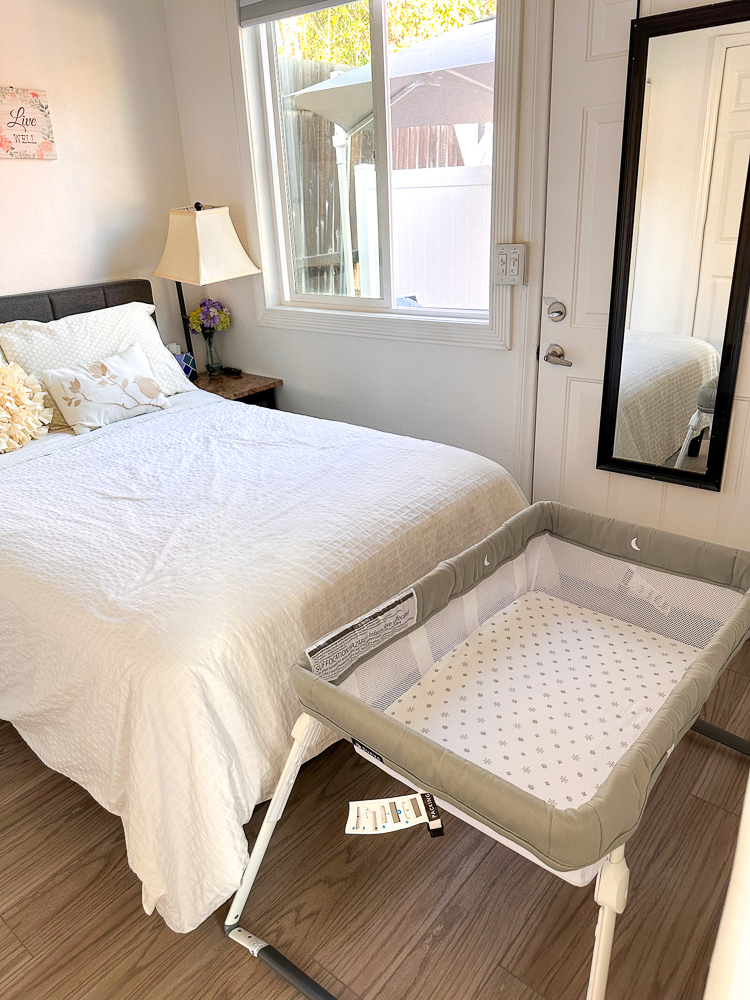
For most families in the United States, the next sleep space after a bassinet is a full-size crib. A certified portable crib or properly used play yard may also work, especially for travel or small rooms.
Move your baby when the bassinet reaches its weight or height limit, when your baby can roll or push up, or when the manual says to stop. Age alone is not the best guide. Many babies outgrow a bassinet around 3 to 6 months, but each baby and product is different.
The safest next sleep space has a firm, flat, level mattress, a fitted sheet made for that mattress, and no loose items. The baby should sleep on their back for every sleep. These points follow guidance from the American Academy of Pediatrics (AAP) and the U.S. Consumer Product Safety Commission (CPSC).
The Best Choice After a Bassinet
A full-size crib is the best long-term choice after a bassinet for most babies. It gives your child more room, lasts for years, and is designed for infant sleep when it meets current U.S. safety rules.


You can also use one of these options:
- Full-size crib: Best for a permanent nursery sleep space.
- Mini crib: Useful when space is tight, but it may be outgrown sooner.
- Portable crib: A small crib that can move from room to room.
- Play yard: Suitable for sleep only when the product is approved for that use and used exactly as the manual states.
- Travel crib: Helpful for trips, but it should not replace a safe, familiar sleep space at home unless the product is designed for regular use.
Do not choose a toddler bed yet unless your child is ready for that stage. Most babies need the enclosed sides of a crib until they can safely climb out or reach the crib’s stated height or weight limit.
Quick decision table
| Situation | Usually suitable after a bassinet | Main point to check |
|---|---|---|
| You want one long-term sleep space | Full-size crib | Current U.S. safety standards |
| Your room is small | Mini crib | Mattress fit and weight limit |
| You need to move the sleep space | Portable crib | Locking parts and manual |
| You travel often | Approved travel crib or play yard | Use only the included sleep surface |
| Your baby rolls or pushes up | Crib or approved larger sleep space | Stop swaddling and follow bassinet limits |
| Your baby climbs out of the crib | Toddler bed or another approved option | Child’s ability and product instructions |
The main trade-off is simple: a full-size crib usually lasts longer, while a mini crib or portable option may save space.

When Should You Move a Baby Out of a Bassinet?
Move your baby out of a bassinet as soon as the product’s instructions require it. Do not wait for a certain birthday if your baby has already reached a safety limit.
Check for these signs:
- Your baby reaches the bassinet’s weight limit.
- Your baby reaches the height limit.
- Your baby can roll over.
- Your baby can push up on their hands or knees.
- Your baby can sit up, pull up, or shift the bassinet.
- Your baby’s head or body can reach the sides in a way the manual warns against.
- The bassinet looks damaged, unstable, or worn.
Some bassinets have a fixed maximum age. Others list only a weight limit or a developmental limit. Read the exact manual for your model. If you no longer have it, look for the model number on the product and check the manufacturer’s U.S. website.
A baby who begins to roll should not remain swaddled. The AAP advises stopping swaddling when a baby shows signs of trying to roll. Use a properly sized sleep sack that leaves the arms free instead.
Do not place a bassinet inside a crib to extend its use. Do not add a homemade insert, pillow, pad, or extra mattress. These changes can create gaps or soft areas.

How to Choose a Safe Crib or Other Sleep Space
Choose a product that is made for infant sleep and has a firm, flat surface. The mattress should fit tightly, with no visible gaps between the mattress and the frame.
Before using the product, check the following:


1. Confirm the product type
A crib, bassinet, bedside sleeper, portable crib, and play yard are different products. Each has its own rules.
A play yard may look like a small crib, but its mattress and frame are not interchangeable with those of a crib. Never add a third-party mattress unless the manufacturer specifically approves it.
2. Check current U.S. safety requirements
The CPSC regulates cribs, bassinets, bedside sleepers, play yards, and other infant sleep products sold in the United States. Check for recalls at CPSC.gov/Recalls.
Avoid products with:
- Missing or broken hardware
- Loose rails or sides
- Cracked wood or bent metal
- A mattress that does not fit tightly
- Missing instructions
- A sloped or curved sleep surface
- Added padding or soft parts
- A history of recall that has not been corrected
For a used crib, find the model and manufacture date. Older cribs may not meet current federal rules. Drop-side cribs made before the current U.S. crib standards are a particular concern and should not be used.
3. Use only the correct mattress
A crib mattress should be firm and should fit the crib made for it. A portable crib or play yard should use the included mattress or the exact replacement approved by the manufacturer.
Do not use:
- An adult mattress
- A sofa cushion
- A memory-foam topper
- A crib bumper
- A pillow under the baby
- A positioner
- A folded blanket as a mattress
- A thick pad added for comfort
A surface that feels soft to an adult can be dangerous for an infant. Infant sleep surfaces need to resist sinking and keep the baby’s face clear.
4. Keep the sleep area empty
Place the baby on their back on a bare sleep surface. The crib should contain only:
- The baby
- A firm mattress
- A fitted sheet made for that mattress
Keep pillows, quilts, loose blankets, stuffed toys, bumper pads, and wedges out of the sleep area. If your baby needs warmth, use clothing or a wearable blanket that fits correctly.

Crib, Mini Crib, Portable Crib, or Play Yard?
The right choice depends on where your baby sleeps and how often you need to move the product.
Full-size crib
A full-size crib is usually the most practical choice for everyday sleep. It offers a stable, enclosed space and can often be used from infancy through the toddler years, if the child remains within the product’s limits.
Look for a crib with:
- A firm, fitted mattress
- Adjustable mattress height
- Strong, secure hardware
- No decorative cutouts or unsafe gaps
- Clear assembly instructions
- A model that has not been recalled
Lower the mattress before your baby can pull up. This helps prevent falls.


Mini crib
A mini crib can fit in a smaller bedroom or shared room. It may be a good option when a full-size crib will not fit safely.
The main drawback is that your child may outgrow it sooner. Check the manufacturer’s height and weight limits rather than assuming it will last as long as a full-size crib.
Portable crib
A portable crib can be useful when the baby naps in different rooms. It should lock fully and stand on a stable, level floor.
Fold and unfold it according to the manual. Never use it if the locking frame is not secure or if the sides do not fully open and lock.
Play yard
A play yard can serve as a sleep space if the product is designed and approved for infant sleep. Use the original sleep surface and fitted sheet specified by the manufacturer.
Do not add a thicker mattress because the supplied pad feels firm. Do not place a play yard on a bed, table, sofa, or other raised surface.
Bedside sleeper
A bedside sleeper is not usually the next stage after a bassinet. Most are intended for younger babies and have limits related to rolling, sitting, pushing up, or weight. Read the manual before using one for an older infant.
A bedside sleeper should not be confused with an adult bed rail. Bed rails do not make an adult bed safe for an infant.

How to Make the Transition From Bassinet to Crib
A new sleep space can feel strange to a baby. You can make the change gradual without adding unsafe items.
Step 1: Set up the new space early
Assemble the crib or other sleep product before the move. Confirm that it is stable, level, and free from recalls.
Put it in the room where your baby will sleep. This lets your baby see and become familiar with it during calm, awake times.
Step 2: Use the same safe sleep routine
Keep the order of events similar. For example:
- Feed your baby.
- Change the diaper.
- Dim the lights.
- Use a short song or story.
- Place the baby on their back in the sleep space.
A familiar routine can help even when the sleep surface changes.
Step 3: Start with one sleep
Some families begin with a daytime nap. Others move the baby at night. Either approach can work if the new sleep space is safe and the baby is supervised according to normal safe-sleep practice.


Do not put the bassinet inside the crib or place the crib mattress on the floor beside the bassinet. The products are not designed to be combined.
Step 4: Stop swaddling when rolling begins
If your baby is swaddled, stop once they show signs of rolling. A swaddled baby may not be able to use their arms to change position.
An arms-free sleep sack may help maintain a familiar feeling. It should fit at the neck and arm openings without covering the face.
Step 5: Give the change time
Some babies sleep well in the crib on the first night. Others need several nights. Keep the space boring and clear. Do not add pillows, nests, loungers, or padded products to make it feel more like the bassinet.
If your baby falls asleep in a swing, stroller, car seat, or carrier, move them to a firm, flat, approved sleep surface as soon as practical. These products are not routine sleep spaces.

Safe Sleep Rules After the Bassinet
The basic safe-sleep rules remain the same after you move to a crib.
- Place your baby on their back for every sleep.
- Use a firm, flat, level mattress.
- Use only a fitted sheet made for that mattress.
- Keep the crib free of loose bedding and soft objects.
- Share a room, but not a bed, ideally for at least the first 6 months.
- Keep smoke, nicotine, alcohol, marijuana, and other impairing substances away from the baby’s sleep area.
- Avoid overheating and dress the baby for the room.
- Offer a pacifier at sleep time if your baby accepts one. Do not force it, and do not attach it to clothing with a cord or clip during sleep.
- Give the baby supervised tummy time while awake.
- Follow the product manual and check for recalls.
The AAP does not recommend routine sleep in inclined sleepers, loungers, nursing pillows, or other products that are not designed and approved for infant sleep.
If you bring your baby into bed to feed or comfort them, return them to their own sleep space before you go to sleep. A couch or armchair is especially risky because a baby can become trapped in cushions or against an adult’s body.
Common Mistakes to Avoid
Waiting for a specific age
There is no single age when every baby must leave a bassinet. Product limits and motor skills matter more than the calendar.
Using a crib bumper
Bumpers do not make a crib safer. They can add soft material and may create a risk of suffocation, entrapment, or strangulation. The CPSC has restricted the sale of crib bumpers in the United States.
Adding a mattress to a play yard
A thicker mattress may leave gaps between the pad and the sides. Use only the sleep surface supplied or approved by the maker.
Using a recalled or damaged crib
A low price does not make an old crib a safe choice. Check the model, date, condition, and recall history before use.
Moving to a toddler bed too soon
A toddler bed is not required just because a baby leaves a bassinet. A crib is usually the safer next step until the child can climb out or reaches the crib’s limits.


Using a blanket as a sleep aid
Loose blankets can cover a baby’s face. Use appropriate clothing or a wearable blanket instead, while avoiding overheating.
Treating a nap product as a bed
A stroller, swing, bouncer, or car seat may be useful when a baby is awake or traveling. It is not a substitute for a crib or other approved sleep space.

What If Your Baby Will Not Sleep in the Crib?
First, check safety and comfort rather than adding soft items. Confirm that the mattress is firm, the sheet fits, the room is not too hot, and the crib is level and stable.
Next, review the timing. An overtired baby may have more trouble settling. A short, consistent routine may help. Keep the lights low and place your baby on their back when sleepy or asleep, based on your family’s routine and medical advice.
If your baby can roll both ways, you do not need to keep turning them back after they move on their own. Continue placing the baby on their back at the start of sleep, and keep the crib empty.
Call your child’s clinician if sleep problems come with breathing trouble, blue or gray skin, unusual limpness, repeated vomiting, poor feeding, fever in a young infant, or other signs of illness. For questions about a specific sleep product, contact the manufacturer and your pediatrician rather than modifying the product yourself.
Frequently Asked Questions
Is a crib the only thing I can use after a bassinet?
No. A mini crib, portable crib, or approved play yard may also be suitable. The product must be made for infant sleep, meet applicable U.S. safety requirements, and be used according to its manual.
Can a baby go straight from a bassinet to a toddler bed?
Usually, a crib is the better next step. A toddler bed removes the protective sides before many babies are ready. Consider a toddler bed when your child can climb out of the crib, reaches its limit, or is developmentally ready for the change.
Can my baby sleep in a pack-and-play after a bassinet?
A play yard may be used for sleep when the model is approved for that purpose. Use the included mattress and fitted sheet. Never add an extra mattress, topper, blanket, or pad.
When should I lower the crib mattress?
Lower it before your baby can sit or pull up. Use the lowest setting once your baby can stand. Check the crib manual because mattress positions and instructions vary.
Is a used crib safe?
It may be, but check the model, manufacture date, recall history, hardware, stability, and mattress fit. Do not use a crib with missing parts, damage, unsafe modifications, or a drop-side design that does not meet current U.S. rules.
What should my baby wear in the crib?
Use clothing that keeps the baby comfortably warm without loose blankets. A properly fitted, arms-free sleep sack may be used after swaddling ends. Avoid weighted sleep sacks and products that cover the face or restrict normal movement.
Conclusion
For most U.S. families, a full-size crib is the best choice after a bassinet. Move your baby when the bassinet reaches its limit or your baby begins to roll, push up, sit, or pull up.
Set up a firm, flat, empty sleep space. Use the correct mattress and fitted sheet, stop swaddling when rolling starts, and check every product for recalls. When in doubt, follow the product manual and ask your pediatrician about your baby’s specific needs.
The next practical step is to find your bassinet’s manual, confirm its limits, and inspect the crib or portable sleep space before your baby uses it.
