
For families in the United States, the best bassinet is not the one with the most features. It is a product with a flat, firm sleep surface; a tight fitted sheet; strong sides; a stable base; and clear safety instructions. It should also fit your room, budget, and daily routine.
Before you buy, check the product against U.S. Consumer Product Safety Commission (CPSC) rules, the manufacturer’s manual, and current safe-sleep guidance from the American Academy of Pediatrics (AAP). A bassinet can make nighttime care easier, but it does not replace safe sleep habits.

1. Start With a Flat, Firm, and Level Sleep Surface
The sleep surface is the most important part of a bassinet. Choose one that is flat, firm, level, and covered only by a fitted sheet made for that model.
A firm surface does not sink deeply under a baby’s head or body. The mattress should keep its shape when you press it. It should not feel like a pillow, padded lounger, nest, or soft travel bed.


Look for these features:
- A firm mattress or pad that fits the bassinet frame closely
- No gaps around the edges
- A level sleep surface
- A fitted sheet that stays tight
- A mattress pad that came with the product or is specifically approved by the maker
- No extra topper, blanket, pillow, bumper, or positioner
The AAP recommends placing babies on their backs for every sleep on a firm, flat surface. The sleep area should contain only the baby and a fitted sheet.
Why mattress fit matters
A gap between the mattress and the frame can create an entrapment risk. A mattress that is too small, too soft, or not designed for the bassinet may also change the product’s safety performance.
Do not assume that a “universal” bassinet mattress will fit safely. Use the exact replacement part listed by the manufacturer. If the company does not sell replacement sheets or mattress pads, ask how to obtain approved parts before you buy.
Skip inclined bassinets
Avoid a bassinet with a sleep surface that tilts the baby’s head or torso. Inclined products may look comfortable, but an angle can allow a young baby’s head to fall forward. This can affect breathing.
A product marketed for lounging, napping, soothing, or supervised sitting may not be approved for unsupervised sleep. Read the intended-use section in the manual, not just the product title.

2. Check U.S. Safety Standards and Recalls
A bassinet sold in the United States should comply with the applicable federal safety rule for bassinets and cradles. The CPSC rule is found in 16 CFR Part 1218 and incorporates requirements from the voluntary ASTM F2194 standard.
Compliance is a useful starting point, but it is not the only thing to check. A compliant product can still be a poor fit for your home if it is hard to assemble, easy to tip, or difficult to use correctly.
What to verify before purchase
Check the following:
- Product identity: Record the brand, model name, model number, and manufacture date.
- Recall status: Search the CPSC recall database before buying, especially for a used bassinet.
- Instructions: Confirm that the manual is available online or included in the box.
- Replacement parts: Check whether the maker sells approved sheets, mattresses, wheels, locks, and other parts.
- Age and weight limits: Find the exact limits in the manual.
- Stop-use warnings: Look for rules about rolling, pushing up, sitting, climbing, or reaching the stated weight limit.
You can search the CPSC recalls page by brand and model. Also check the manufacturer’s safety notices. A recall may apply to only one model, production period, or component.


Do not rely on vague safety claims
Terms such as “safe,” “breathable,” “natural,” or “hospital-inspired” do not tell you enough. Ask what the claim means and what evidence supports it.
Mesh sides can improve airflow, but mesh does not make it safe to add blankets, toys, or a padded liner. A product may also have a breathable side panel while still having an unsafe mattress or an unstable frame.

3. Choose a Stable Frame That Will Not Tip or Collapse
A good bassinet should remain stable when you place the baby in it, lift the baby out, or brush against the frame. Stability matters even more when the bassinet has wheels, a folding frame, a rocking feature, or a detachable bedside section.
Before buying, inspect or ask about:
- A wide, stable base
- Legs that lock firmly into place
- Wheels with working brakes
- A frame that does not twist or wobble
- A locking mechanism that is easy to confirm
- Secure attachment points for any removable section
- Clear assembly steps
- No loose fabric or cords near the sleep area
If you shop in a store, gently test the frame according to the instructions. Do not push hard or place weight inside it. If you shop online, read the manual and customer service information before ordering.
Wheels and rocking features
Wheels can help you move the bassinet, but they also create a tipping or movement risk if the brakes are not engaged. Use the brakes whenever the bassinet is parked.
Rocking or automatic motion is not required for safe sleep. If you choose a model with motion, confirm:
- The bassinet can stop moving
- The sleep surface remains flat
- The motion feature does not require loose straps or accessories
- The product gives clear instructions for when motion must stop
- The motor, battery, and power cord stay away from the baby
Do not attach third-party motion devices to a bassinet unless the manufacturer specifically approves them. An added motor or vibration unit can change the product’s balance and may void its safety approval.

4. Look for Strong, Breathable Sides Without Extra Padding
The sides should keep the baby inside the sleep space and reduce the chance of an arm, leg, or head becoming trapped. Many parents prefer mesh sides because they can see the baby and airflow is less blocked.
Mesh is helpful, but it is not a substitute for a safe sleep setup. The side walls should be:
- Securely attached to the frame
- Free from tears, holes, and loose seams
- Tall enough for the product’s intended use
- Firm enough to stay in place
- Free from large openings or loose fabric
Avoid adding a bumper, padded liner, rolled towel, or homemade cover. These items can create an entrapment or suffocation hazard.
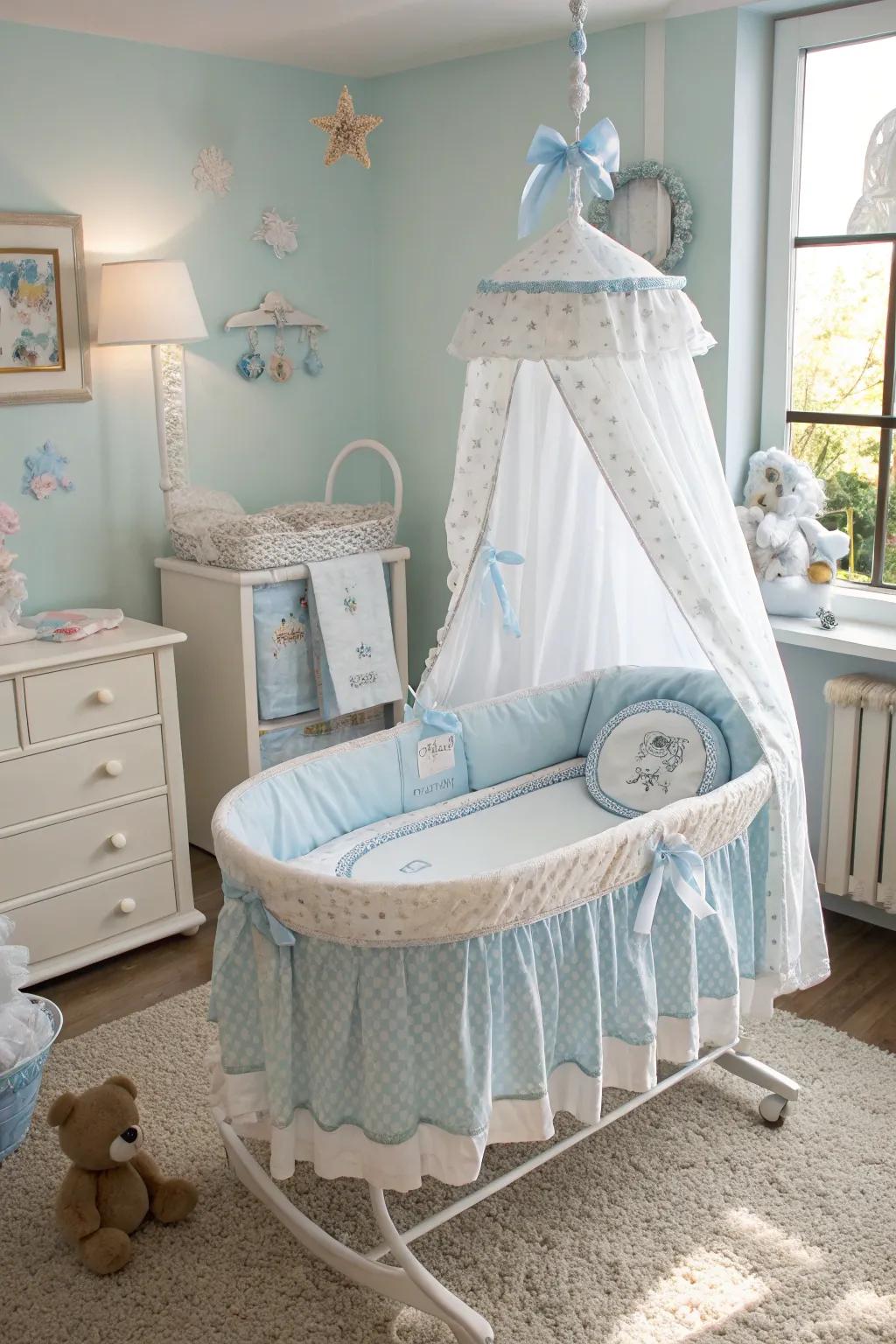
A decorative canopy may also create a problem if it hangs over the sleep area or has long ties. Keep cords, straps, and hanging objects away from the baby.


Visibility versus stimulation
A clear view can make nighttime checks easier. However, bright lights, music, screens, and moving toys may make it harder for some babies to settle.
Treat built-in features as optional. The core safety features are more important than lights, sounds, app controls, or decorative fabric.

5. Confirm the Bassinet Fits Your Room and Routine
The safest bassinet is one you can use correctly every night. Measure the space before buying. Leave enough room to walk around it, open drawers, and lift the baby without twisting or reaching over furniture.
For many U.S. families, room sharing without bed sharing is a practical goal. The AAP recommends that infants sleep in the parents’ room, close to the parents’ bed, ideally for at least the first six months. A bassinet can support this plan if it fits beside the bed without blocking exits or creating a trip hazard.
Bedside sleeper versus bedside caddy
A bedside sleeper is designed to stand next to an adult bed. Some have a side that lowers or opens. A bedside caddy may attach to the bed or hang from a frame, but the design and limits vary.
Do not treat every “co-sleeper” as a safe sleep space. Check:
- Whether the product is intended for overnight sleep
- How it attaches to the adult bed
- Whether the attachment system works with your bed frame and mattress height
- Whether the side remains secure
- Whether the baby can roll or move into the adult bed
- Whether the manual requires a gap-free installation
Never leave a baby in an adult bed, couch, recliner, or chair as an alternative to a properly set-up bassinet.
Portability
A portable bassinet may be useful for travel or moving between rooms. Before using it away from home, check that:
- The frame locks fully
- The mattress stays flat
- The product is placed on the floor or another surface approved by the manual
- It cannot be reached by pets, siblings, cords, or curtains
- It is not placed on a bed, sofa, table, or raised platform unless the instructions clearly allow it
A folding design should make setup simple, not create another step that can be missed when you are tired.

6. Read the Weight, Age, and Stop-Use Limits
Every bassinet has limits. These may include a maximum weight, a maximum age, or a developmental limit such as rolling, sitting, kneeling, or pushing up.
Use the earliest limit that applies. For example, if the manual says to stop use when the baby begins to roll, stop then even if the baby is below the listed weight limit.
Common signs that it is time to stop using the bassinet
Move the baby to an appropriate crib, portable crib, or play yard when the manufacturer says to stop, or when the baby:


- Rolls or tries to roll
- Pushes up on hands and knees
- Sits without support
- Pulls up
- Reaches the weight limit
- Can climb or lean over the side
- No longer fits comfortably on the sleep surface
Do not extend use by removing a side, lowering the mattress, adding a restraint, or placing the bassinet inside another product. Use the next sleep space according to its own manual.

7. Consider Cleaning, Parts, Power, and Daily Use
Newborn care creates frequent spills and messes. A bassinet should be easy to clean without damaging the fabric or mattress.
Look for:
- A removable, washable fitted sheet
- Wipe-clean surfaces
- Fabric that dries fully
- Replacement sheets and mattress pads
- Clear cleaning instructions
- No deep seams that trap moisture
- A cover that can be removed without changing the mattress fit
Do not use bleach, solvents, essential oils, or other cleaners unless the manual permits them. Strong chemicals can damage waterproof layers or leave residues.
Battery and cord features
If the bassinet uses a motor, light, sound system, or app, consider what happens when the battery dies or the power fails. The product should remain safe without the electronic feature.
Keep power cords away from the bassinet and out of the baby’s reach. Do not place a phone, power bank, monitor cord, or charger inside or against the sleep space.
Also check the ongoing cost. A low-priced bassinet may require costly proprietary sheets, batteries, adapters, or replacement parts. These expenses may matter more than a small difference in the purchase price.

Bassinet Features: What Matters Most?
Use this table to compare models without giving too much weight to marketing features.
| Feature | Why it matters | Priority |
|---|---|---|
| Flat, firm, level mattress | Supports a safer sleep setup | Essential |
| Tight fitted sheet | Reduces loose material in the sleep area | Essential |
| Close mattress fit | Helps prevent gaps and entrapment | Essential |
| Stable, locking frame | Reduces movement and tipping risk | Essential |
| Clear weight and developmental limits | Tells you when to stop use | Essential |
| Recall and model information | Helps you check safety notices | Essential |
| Washable approved sheet | Makes routine cleaning easier | High |
| Mesh sides | Helps visibility and airflow | Useful |
| Wheels with brakes | Helps move the bassinet when used correctly | Useful |
| Automatic rocking | A comfort feature, not a safety requirement | Optional |
| Sound, lights, or app control | May add convenience but also cost and upkeep | Optional |
| Foldable frame | Useful for travel or storage | Depends on need |
| Bedside access | May help nighttime care if installed correctly | Depends on bed setup |
The main trade-off is simple: comfort and convenience features should never compromise the flat sleep surface, stable frame, or clear stop-use rules.

Bassinet Safety Mistakes to Avoid
Many problems come from how a product is used, not only from the product itself. Avoid these common mistakes:
Adding soft items
Do not add pillows, quilts, loose blankets, stuffed toys, sleep positioners, or padded bumpers. A wearable blanket can provide warmth without loose bedding, but choose one that fits the baby and follow the product instructions.
Using the wrong mattress or sheet
A sheet that is too loose can bunch up. A mattress that is too soft or too small can create gaps. Use only parts made for the exact model.
Placing the bassinet on a raised surface
Do not put it on a bed, couch, counter, table, or other raised surface unless the manufacturer’s instructions specifically permit that setup. A fall can happen quickly when a bassinet is bumped or moved.
Leaving it near hazards
Keep the bassinet away from:


- Window cords
- Curtains
- Heaters and radiators
- Lamps
- Wall outlets and chargers
- Pet access
- Sibling access
- Furniture that a child could climb
Assuming a used product is safe
A used bassinet may be missing a part, have hidden damage, or be affected by a recall. If you cannot identify the exact model and find its instructions, choose another product.
Using it after visible damage
Stop using the bassinet if the frame bends, a lock fails, mesh tears, a wheel breaks, the mattress becomes misshapen, or a seam opens. Contact the manufacturer for an approved replacement. Do not repair the sleep structure with tape, zip ties, glue, or homemade parts.
A Practical Bassinet Buying Checklist
Before you place an order or bring home a used bassinet, answer “yes” to these questions:
- Does it have a flat, firm, level sleep surface?
- Does the mattress fit tightly with no visible gaps?
- Does it use a fitted sheet made for that model?
- Is the frame stable when locked?
- Do wheels have working brakes?
- Are the sides secure and free of tears?
- Can you find the manual?
- Can you identify the brand, model, and manufacture date?
- Did you check the CPSC recall database?
- Are the age, weight, and developmental limits clear?
- Can you buy approved replacement parts?
- Does it fit safely beside your bed?
- Can you keep cords, pets, siblings, and loose items away?
- Is it easy to clean?
- Will you still use it correctly when you are tired?
If the answer to a key safety question is no, choose a different model. A bassinet does not need to be expensive to meet the basic needs of a safe sleep space.
Bassinet or Crib: Which Should You Choose?
A bassinet is smaller and often easier to place near an adult bed. A full-size crib usually lasts longer and may offer more room as the baby grows.
Choose a bassinet when:
- You want a small sleep space for the early months
- You plan to room-share near your bed
- You value portability
- You understand that it has a short use period
Choose a crib or approved portable crib when:
- You want a longer-lasting sleep space
- Your baby is close to rolling, sitting, or pushing up
- You do not need to move the sleep space often
- The bassinet’s size or limits no longer fit your baby
The right choice depends on the product’s instructions and your baby’s development. A bassinet is not automatically better because it is smaller, and a crib is not automatically safer if it is filled with loose items or used incorrectly.

Frequently Asked Questions
What is the safest type of bassinet?
Look for a bassinet with a flat, firm, level sleep surface, a fitted sheet that fits tightly, stable sides, and a secure frame. It should comply with applicable U.S. safety requirements and have clear instructions and stop-use limits.
Can a newborn sleep in a bedside bassinet?
A newborn may sleep in a bedside bassinet if the product is designed and labeled for infant sleep, installed exactly as directed, and used with its approved mattress and sheet. Keep the baby in the bassinet rather than in the adult bed.
Are mesh bassinets safer?
Mesh sides can improve visibility and airflow, but mesh alone does not determine safety. The mattress, frame, side design, assembly, and use of loose items matter too.
Can a baby sleep in a rocking bassinet all night?
Follow the exact manufacturer instructions. The sleep surface must remain flat, and any motion feature must be approved for the product’s intended sleep use. Stop using the bassinet when the manual says to stop, even if the motion still works.
How long can a baby use a bassinet?
There is no single age that applies to every model. Stop when the baby reaches the listed weight or age limit, begins rolling or pushing up, or reaches another developmental limit in the manual.
Should I buy a used bassinet?
A used bassinet can be considered only if you can identify the exact model, confirm that it has not been recalled, inspect it for damage, obtain the manual, and verify that all approved parts are present. When those details are unknown, a new product is the safer choice.

Final Takeaway: Choose Safety Before Features
When deciding what to look for in a bassinet, begin with the sleep surface and frame. Choose a model that is flat, firm, level, stable, easy to clean, and simple to use correctly.
Then confirm the model’s U.S. safety information, recall status, mattress fit, replacement parts, and developmental limits. Skip products that depend on extra padding, loose accessories, an incline, or vague safety claims.
Before the first sleep, assemble the bassinet exactly as directed, use only the approved fitted sheet, place the baby on their back, and keep the sleep space clear. Recheck the manual as your baby grows, because the correct bassinet today may not be appropriate after the baby starts to move.
