
Introduction
The best bassinet for a newborn in the United States is a firm, flat, non-inclined sleep space that meets current U.S. safety rules and fits beside your bed. It should have a firm mattress, a tight fitted sheet, strong sides, and no loose items inside.
For most families, a simple bedside bassinet is the best balance of safety, access, and cost. It lets your baby sleep in the same room as you, but not in the same bed. The American Academy of Pediatrics (AAP) recommends room-sharing without bed-sharing, ideally for at least the first six months. (AAP safe sleep guidance)
Fancy features are not a substitute for a safe sleep surface. Rocking, vibration, lights, and smart alerts may be convenient, but they do not make a product safer than a basic bassinet that follows the rules.

Quick answer: Which bassinet should you choose?
Choose the safest bassinet that you will use correctly every night. Look for these features:
- A firm, flat, level sleep surface
- A tight-fitting mattress and sheet
- No pillows, blankets, bumpers, toys, or positioners
- A stable base that does not tip or fold by accident
- Mesh or open sides for airflow and visibility
- Clear newborn weight and age limits
- Compliance with the current U.S. Consumer Product Safety Commission (CPSC) bassinet and bedside sleeper rules
- A design that keeps the baby on a separate surface next to your bed
A bedside bassinet is often the most practical choice for a newborn. It reduces the need to walk across the room for feeds and checks. However, a “bedside sleeper” must still have a complete, safe sleep surface. A product that attaches to an adult bed is not automatically safe for unsupervised sleep.
Best choice for most families
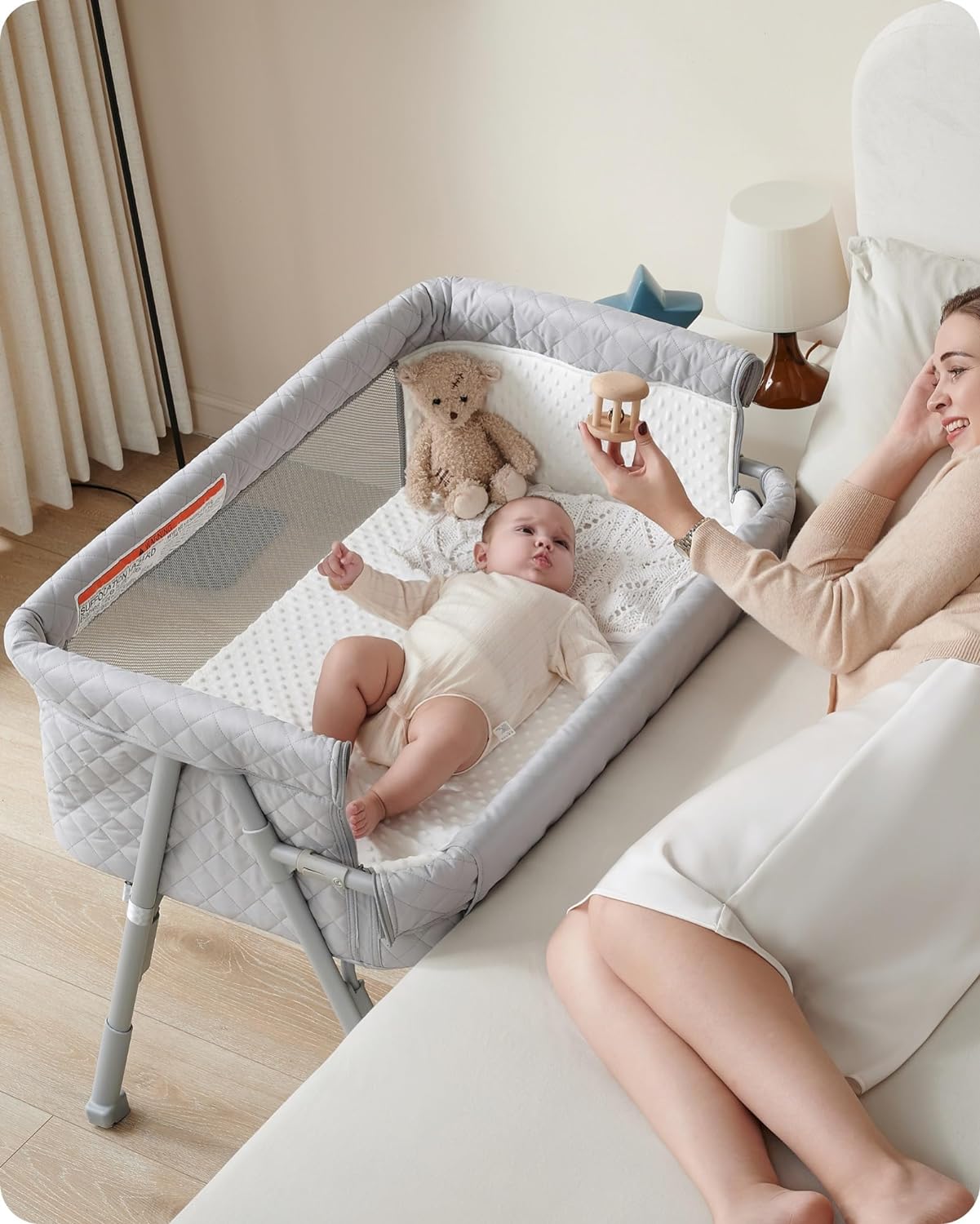
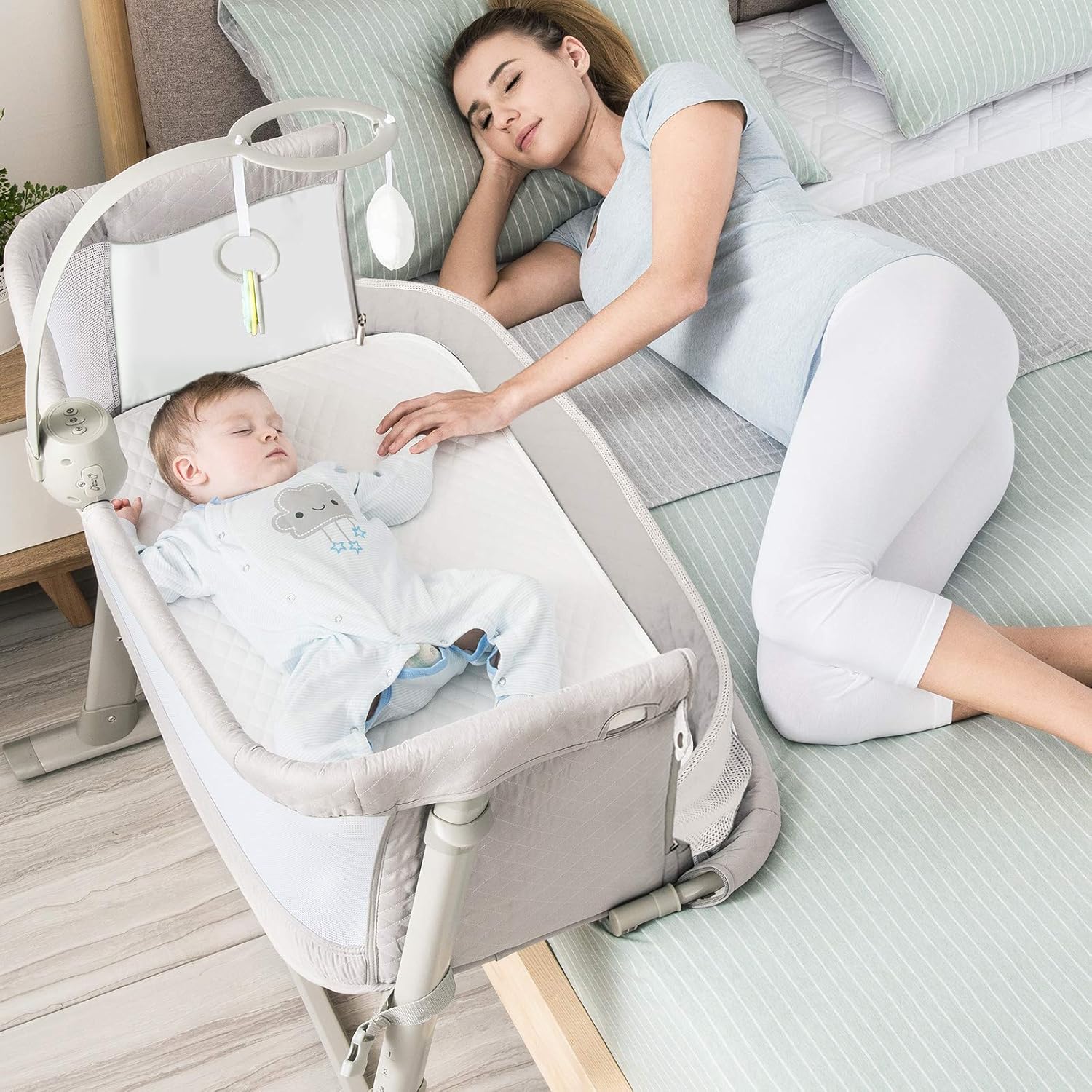
A standard, freestanding bedside bassinet is usually the best overall option. It should stand beside the adult bed without sharing the mattress. Choose one with:
- A stable four-point base
- A washable cover
- Easy access from the parent’s side
- A height that works with your bed
- A firm mattress with no visible gap around the edges
- A simple setup and clear instructions
Best choice for a small bedroom
Choose a compact bassinet or a CPSC-compliant portable crib with a small footprint. Measure the space first. Leave room to get out of bed and reach the baby without stepping over the bassinet.
Do not place the bassinet against a wall where cords, curtains, or blinds can reach it. Keep it away from heaters, lamps, windows, pets, and furniture that could fall.
Best choice for travel
A properly designed portable crib or play yard may work better than a traditional bassinet for travel. Check the manual to confirm that the model is approved for infant sleep and that the newborn’s age, weight, and height fall within its limits.
Do not use a car seat, stroller seat, lounger, or inclined travel product as a routine sleep space. If a baby falls asleep in one of these products, move the baby to a firm, flat sleep surface as soon as practical.

What makes a bassinet safe for a newborn?
A bassinet is safe when its design supports a baby on a firm, flat surface and prevents common hazards such as entrapment, suffocation, falls, and structural collapse.
In the United States, bassinets and bedside sleepers must meet federal requirements enforced by the CPSC. The applicable rules address issues such as structural strength, side height, stability, spacing, mattress fit, and warning labels. Product compliance is necessary, but it is not enough by itself. Safe use also depends on setup and daily habits.
Firm and flat sleep surface
The mattress should feel firm. It should not form a deep dip under the baby’s head or body. The surface should be level, not tilted toward the head or feet.
The mattress must fit tightly inside the bassinet. If you can slide more than a very small gap around the edges, stop using it until you confirm the correct mattress and assembly.
Never add a second mattress, foam pad, topper, wedge, or folded towel. Extra padding can raise the risk of suffocation and may create a gap.
Clear sleep area
Place the baby on the back for every sleep. The bassinet should contain only:
- The baby
- The manufacturer-approved mattress
- One tight fitted sheet made for that model
Keep these items out:
- Loose blankets
- Pillows
- Crib bumpers
- Stuffed animals
- Sleep positioners
- Weighted swaddles
- Nursing pillows
- Mattress pads that do not fit the model
- Decorative liners
The AAP and the National Institutes of Health’s Safe to Sleep program both advise using a bare sleep surface with no soft objects or loose bedding. (NIH Safe to Sleep)
Stable frame and secure sides
A good bassinet should not wobble, tip, or fold when a parent gently presses on the side. Lock every wheel, leg, hinge, and folding point before use.
Mesh sides can improve visibility and airflow. But mesh does not remove the need for a fitted sheet and a clear sleep space. Check the fabric often for tears, loose seams, or openings.
Correct height and bedside position
A bassinet should be easy to reach, but it should not create a path for the baby to fall into the adult bed. Follow the manual for the permitted bed height and attachment method.
Never improvise with straps, blocks, books, furniture, or homemade connectors. If the bassinet cannot attach as directed, use it as a freestanding unit or choose another product.

Bassinet, bedside sleeper, crib, or play yard: Which is best?
The best sleep product depends on where you want the baby to sleep and how long you want to use it. A bassinet is not always the best value, especially if you already own a compliant crib or play yard.
| Product | Main benefit | Main limit | Best use |
|---|---|---|---|
| Freestanding bassinet | Small and easy to place near the bed | Usually has a short use period | Newborn sleep in the parents’ room |
| Bedside sleeper | Easy access for feeding and checks | Must be used exactly as directed | Families who want the baby close without bed-sharing |
| Full-size crib | Long useful life and more space | Takes more room | A main sleep space from infancy onward |
| Portable crib or play yard | Useful for travel and multiple rooms | Some models have different sleep rules | Travel or a flexible second sleep space |
| Moses basket or soft-sided basket | Light and portable | May have fewer features and a short life | Only when the product is approved for infant sleep |
| Rocking or smart bassinet | May soothe some babies and offer monitoring | Higher cost and more parts to maintain | Families who value those features and can follow all limits |
The key question is not, “Which product has the most features?” Ask instead: Where will my baby sleep, and can I keep that space bare, flat, and stable every time?
A full-size crib may be the better long-term choice if you have room for it. A bassinet can be useful for the early months, but many babies outgrow one when they reach the product’s weight limit, push up, roll, or can sit.
Is a bedside sleeper safer than a regular bassinet?
Not automatically. A bedside sleeper can make room-sharing easier, but it must still provide a separate sleep surface. The side should remain in the position required by the manual during sleep.
Some bedside products allow a side to lower only during supervised access. Others must stay fully raised. Follow the exact instructions for your model.
Is a smart bassinet safer?
A smart bassinet may offer movement, sound, or monitoring features. Those features do not replace safe sleep practices and do not prove that the product lowers the risk of sleep-related death.
Use the product only within its listed limits. Turn off features that conflict with the manual or that make the baby’s position hard to see. If a baby rolls, pushes up, or reaches a product limit, move the baby to a suitable sleep space.
Can a baby sleep in a play yard?
Many play yards are designed for infant sleep, but only when used with the original approved bassinet or sleep surface. Do not add an aftermarket mattress or padding unless the manufacturer specifically approves it.
The CPSC has warned against using unauthorized mattresses and accessories in play yards because they may create gaps or make the surface too soft.
How to choose the best bassinet for your home
Use this five-step process before you buy.
1. Measure the room and adult bed
Measure:
- The available floor width
- The distance from the floor to the top of your mattress
- Doorways and storage areas
- The path from the bed to the bathroom or nursery
- Space needed to lift the baby safely
A bassinet that barely fits may become a tripping hazard. Leave enough room to stand beside it and lift the baby with both hands.
2. Check the product’s exact sleep approval
Read the product page and manual. Look for clear language about infant sleep, not just phrases such as “lounge,” “rest,” or “supervised use.”
Confirm:
- Minimum and maximum weight
- Maximum age, if listed
- Height or developmental limits
- Whether overnight sleep is allowed
- Whether the side may be lowered
- Whether the product is intended for use beside an adult bed
- Which mattress and sheet are approved
If the manufacturer gives conflicting information, contact the company before using the product.
3. Inspect the mattress and sheet
The mattress should be firm and should fit the frame without bending or curling. The fitted sheet should stay tight at the corners.
Buy replacement sheets from the manufacturer or a source that confirms exact model compatibility. A sheet that looks close may still be too loose.
4. Check recalls before buying and after setup
Search the exact brand and model on the CPSC recalls website. Check the product’s model number, not only its brand name.
Also check:
- The manufacturer’s recall page
- The date of manufacture
- Secondhand seller information
- Missing parts
- Damage from storage or transport
A used bassinet can be safe only if its model, age, parts, instructions, and recall history are known. Avoid products with missing labels or unknown repair history.
5. Practice the daily routine
Before the baby arrives, practice:
- Lowering and raising the side
- Locking the wheels
- Removing the sheet
- Moving the bassinet
- Adjusting its height
- Checking the mattress fit
- Turning off motion or sound features
- Placing the baby on the back
The best bassinet is one that caregivers can use correctly at 2 a.m. when they are tired.

Features worth paying for—and features to question
Some features solve real problems. Others mainly add cost.
Useful features
These can improve daily use:
- A washable cover
- Removable, machine-washable fabric
- A firm mattress included with the product
- Locking wheels
- Clear assembly marks
- A visible weight limit
- Height adjustment that matches your bed
- A storage basket that stays outside the sleep area
- Replacement parts sold by the manufacturer
- A warranty and accessible customer service
Features that need caution
Rocking and vibration
Motion may calm some babies, but it can also make it harder to see whether the baby has shifted. Use only the settings and sleep positions allowed by the manual. The baby must remain on a flat, approved surface.
Inclined design
Avoid inclined sleep products. Babies can slide down, and the chin may fall toward the chest, which can affect breathing. The CPSC has warned about inclined infant sleep products and has recalled or restricted several categories over time.
Built-in blankets or swaddles
A product with an attached swaddle must still allow the baby to sleep flat and move safely. Stop swaddling when the baby shows signs of rolling. Never use a weighted swaddle for sleep unless current medical guidance specifically supports its use; the AAP warns against weighted sleep products for infants.
Cameras and breathing monitors
A monitor may alert a parent to sound or movement, but it does not make an unsafe sleep space safe. Consumer monitors are not a replacement for supervision, safe sleep practices, or medical equipment prescribed for a specific condition.
If your baby has a health issue, ask the baby’s clinician which monitoring is needed. Do not use a consumer monitor to make medical decisions without professional guidance.

How much should you spend on a newborn bassinet?
A higher price does not prove better safety. The main safety features are a compliant design, a firm flat surface, a tight sheet, a stable frame, and correct use.
A practical way to set a budget is to include the full cost:
- Bassinet
- Approved fitted sheets
- Replacement parts
- Shipping
- Batteries or subscription fees, if required
- A later crib or play yard
- Return costs if the product does not fit your room
A lower-cost basic bassinet may be enough if it meets current requirements and has good construction. A costly smart model may be useful for a family that values its specific features, but those features are optional.
Before buying, ask:
- Will I use this every night?
- Does it fit beside my bed?
- Can I lift the baby without bending or twisting?
- Can I wash the fabric?
- Can I buy replacement sheets?
- What happens when my baby rolls or reaches the weight limit?
- Is there a safe next sleep space?

Common bassinet mistakes to avoid
The most common errors involve the sleep surface, not the bassinet brand.
Adding soft padding
Parents sometimes add a mattress topper because the original surface feels hard. That defeats the product’s tested design and can create gaps. Use only the original mattress or a replacement approved for the exact model.
Using a “nest” or lounger overnight
Infant loungers and nests may look cozy, but many are not intended for unsupervised or overnight sleep. Their soft sides can cover the nose and mouth. Keep them out of the bassinet.
Moving a sleeping baby in a car seat
A car seat protects a baby during travel. It is not a flat sleep space. Move the baby to a firm, flat surface when you arrive.
Leaving the bassinet near cords or pets
Keep cords, monitor wires, window-blind cords, blankets, and pet access away from the bassinet. A stable product can still become unsafe because of its surroundings.
Continuing to use the bassinet after a limit
Stop using it when the baby reaches the listed weight, height, age, or developmental limit. A baby who rolls, pushes up, sits, or climbs may need to move sooner, depending on the manual.
Treating a recall as a minor issue
Stop using a recalled product and follow the official remedy. Do not rely on a replacement part unless the manufacturer or CPSC confirms it is the correct fix.

What to do if your newborn will not sleep in the bassinet
First, check safety and comfort basics:
- Confirm that the mattress is flat and firm.
- Make sure the sheet is tight and smooth.
- Place the baby on the back.
- Keep the sleep area empty.
- Check that the room is not too warm.
- Feed, burp, and change the baby as needed.
- Try placing the baby down when calm and drowsy.
- Stay nearby and observe.
Newborn sleep can be uneven. A baby may sleep well in your arms but wake after being placed down. That does not mean you should add a pillow, blanket, wedge, or positioner.
If you feel too tired to stay awake while holding the baby, place the baby in the bassinet and step away briefly to rest. Falling asleep with a baby on a couch or chair is especially dangerous. If you are concerned about feeding or soothing at night, make a plan with another adult and speak with your health care professional.
Call a clinician for urgent help if your baby has trouble breathing, turns blue or gray, is unusually hard to wake, has a fever, or is not feeding normally.
Key takeaways
- The best bassinet for a newborn is firm, flat, level, stable, and approved for infant sleep.
- A simple bedside bassinet is often the best choice for room-sharing.
- Keep the bassinet empty except for the baby and a tight fitted sheet.
- Never add pillows, bumpers, blankets, wedges, positioners, or extra mattresses.
- Check the exact model for recalls and follow its age, weight, height, and developmental limits.
- Motion, monitoring, and smart features do not replace safe sleep practices.
- Move the baby to a new sleep space when the bassinet limit is reached or the baby begins to roll, push up, or sit.
Frequently asked questions
What is the safest type of bassinet for a newborn?
The safest type is a U.S.-compliant bassinet or bedside sleeper with a firm, flat, level mattress, tight fitted sheet, stable frame, and clear use limits. The design matters, but correct daily use matters just as much.
Can a newborn sleep in a bedside bassinet all night?
Yes, if the product is approved for overnight infant sleep and you follow the manual. Keep the bassinet beside the adult bed, not on the adult bed. Keep any adjustable side in the position required for sleep.
Is it safe to use a secondhand bassinet?
It may be safe if you know the exact model, have every required part, can confirm its recall status, and can inspect it for damage. Do not use it if the mattress is missing, the frame is bent, the label is gone, or the history is unknown.
When should a baby stop using a bassinet?
Stop when the baby reaches the manufacturer’s weight, height, or age limit. Stop sooner if the baby rolls, pushes up, sits, or tries to climb, unless the manual gives different developmental guidance.
Should a baby sleep in a bassinet with a swaddle?
A properly fitted, nonweighted swaddle may be used for some newborns if the baby is placed on the back and the product instructions are followed. Stop swaddling as soon as the baby shows signs of trying to roll. Never place a loose blanket over a swaddled baby.
Conclusion
For most families in the United States, the best bassinet for a newborn is a basic, stable bedside model with a firm, flat mattress and a clear safety manual. Choose the product that fits your room, your bed, and your nightly routine—not the one with the longest feature list.
Check the model for CPSC recalls, assemble it exactly as directed, and keep the sleep space bare. When your baby reaches the stated limit or begins to roll or push up, move the baby to an appropriate crib, portable crib, or other approved sleep space.
