
Introduction
A mild fever after a routine vaccine is common in babies in the United States. It often means the immune system is responding. In most cases, you can help your baby with fluids, light clothing, rest, and close watching. You may also use the right dose of acetaminophen when your child’s doctor says it is safe.
A fever is usually a temperature of 100.4°F (38°C) or higher. The best way to check a young baby is with a digital rectal thermometer. Do not use a fever reducer only to prevent a fever unless your child’s doctor tells you to do so.
This guide follows advice from the Centers for Disease Control and Prevention (CDC), the American Academy of Pediatrics (AAP), and other U.S. medical sources. It explains what to do at home, when to call the doctor, and when to seek emergency care.


Is fever after a baby’s vaccination normal?
Yes. A low-grade fever can occur after many childhood vaccines. It may start within the first day or two. Your baby may also be fussy, sleepy, or have a sore leg or arm.
A fever is not always caused by the vaccine. Babies can also catch a virus around the same time. This is why your baby’s age, temperature, symptoms, and vaccine type all matter.
Some vaccines can cause a delayed fever. For example, fever may occur about 5 to 12 days after the measles, mumps, rubella, and varicella (MMRV) vaccine. A delayed fever after the measles, mumps, and rubella (MMR) vaccine may also occur.
A vaccine-related fever should usually be mild and short. Your baby should still have some periods of alertness, take fluids, and breathe normally.

What to do when your baby has a fever after shots
Use this simple care plan:
1. Check the temperature correctly
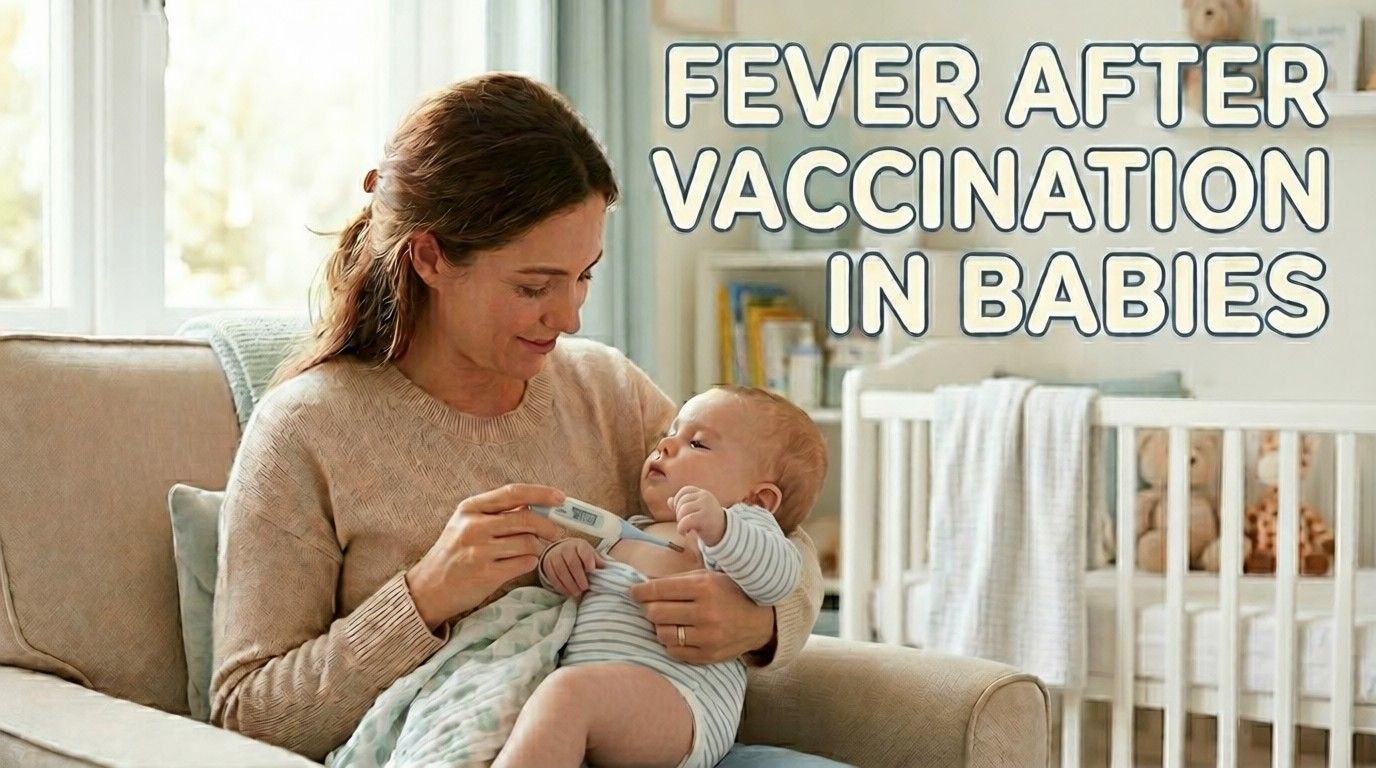
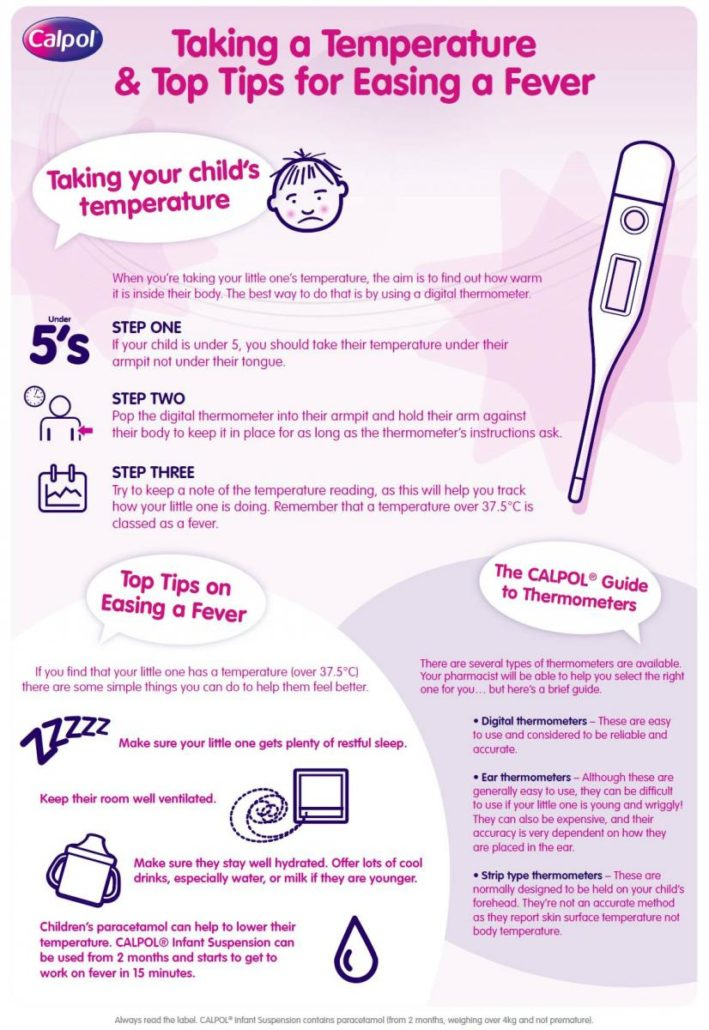
Use a digital thermometer. For babies under 3 months, a rectal temperature gives the most reliable result.
Do not rely only on how warm your baby feels. A warm forehead does not tell you the exact temperature.
Record:
- The temperature
- The time you checked it
- How you checked it
- Your baby’s symptoms
- The vaccines your baby received
Avoid glass mercury thermometers. Do not use a forehead strip as your only reading. Ear thermometers may not give accurate results in very young babies.
2. Keep your baby comfortable
Dress your baby in one light layer. Keep the room at a comfortable temperature. Do not wrap your baby in heavy blankets.
Offer breast milk or formula often. A baby who breastfeeds may want shorter, more frequent feeds. Do not give water to a young infant unless a health professional tells you to do so.


If your baby eats solid foods, continue normal foods as tolerated. Do not force food.
3. Use a cool, not cold, cloth if needed
A lukewarm cloth may help your baby feel better. Stop if your baby shivers or becomes upset.
Do not use:
- Ice baths
- Cold-water baths
- Rubbing alcohol
- Alcohol-soaked cloths
These methods can harm a baby or cause more discomfort.
4. Help the sore injection site
A cool, damp cloth on the injection site may ease pain and swelling. Do not massage the spot hard.
Mild redness, warmth, or swelling can be normal. The area should not keep getting worse over several days.
5. Let your baby rest
Sleep can help your baby recover. You do not need to wake a sleeping baby only to give fever medicine. However, check your baby from time to time.
Your baby should wake enough to feed, cry, or respond. A baby who is very hard to wake needs prompt medical care.
Can you give a baby acetaminophen after vaccination?
You may be able to give acetaminophen after vaccination if your baby has a fever or seems uncomfortable. First ask your child’s doctor or nurse for the correct dose.
The dose depends on your baby’s current weight and the product’s strength. Infant liquid medicines can have different concentrations. Always read the label.
Follow these safety rules:
- Use the dosing syringe that comes with the medicine.
- Measure in milliliters, or mL.
- Do not use a kitchen spoon.
- Do not give more than the label or doctor allows.
- Check other medicines for acetaminophen.
- Ask a doctor before giving it to a baby under 3 months.
Do not give acetaminophen simply because your baby received a vaccine. Giving it before or at the time of vaccination may reduce some vaccine responses, and it does not prevent every fever.
A medicine may lower the temperature, but comfort matters more than reaching a normal number. If your baby is feeding, alert, and comfortable, medicine may not be needed.
If you think you gave too much acetaminophen, call Poison Control at 1-800-222-1222 in the United States. Call 911 for trouble breathing, collapse, or severe symptoms.
Can babies take ibuprofen after vaccines?
Ibuprofen is generally not used in babies younger than 6 months unless a doctor specifically says to use it.


For babies 6 months and older, ask your child’s doctor before using ibuprofen. It may not be suitable if your child is dehydrated, vomiting, has kidney disease, or has certain other health problems.
Do not switch back and forth between acetaminophen and ibuprofen unless a health professional gives you a clear plan. Alternating medicines can lead to dose mistakes.
Never give aspirin to a child or baby unless a doctor specifically prescribes it. Aspirin has been linked with Reye’s syndrome, a rare but serious illness.
When should you call the doctor?
Call your baby’s doctor promptly if:
- Your baby is younger than 3 months and has a temperature of 100.4°F (38°C) or higher.
- The fever reaches 104°F (40°C) or higher.
- The fever lasts longer than expected or keeps returning.
- Your baby is not drinking or feeding well.
- Your baby has fewer wet diapers than usual.
- Your baby has repeated vomiting or diarrhea.
- Your baby is much less active than usual.
- Your baby cries constantly and cannot be comforted.
- The injection-site redness or swelling grows after the first day.
- Your baby seems to be getting worse instead of better.
- You are worried, even if the temperature is not high.
A fever in a baby under 3 months needs medical advice because young babies can develop serious infections quickly. Do not wait to see whether the fever goes away after a vaccine.
The CDC advises parents to contact a health professional when they have concerns after vaccination. The Vaccine Adverse Event Reporting System, or VAERS, also accepts reports of possible vaccine side effects. A VAERS report does not prove that a vaccine caused a problem, but it helps public health teams watch for safety patterns.

When is baby fever an emergency?
Call 911 in the United States if your baby has any of these signs:
- Trouble breathing
- Blue, gray, or very pale skin
- Swelling of the face, lips, tongue, or throat
- Hives with breathing trouble or repeated vomiting
- A seizure
- Severe weakness or collapse
- No response or extreme difficulty waking
These can be signs of a severe allergic reaction or another medical emergency. A severe allergic reaction usually happens soon after vaccination, but seek help whenever the symptoms occur.
A fever with a seizure also needs urgent care. Most fever-related seizures do not cause lasting harm, but the first seizure should always be assessed by a medical professional.
Do not put anything in your baby’s mouth during a seizure. Place your baby on a safe surface on the side, move nearby objects away, and watch the time. Do not restrain your baby.

How long does vaccine fever last?
Many mild vaccine fevers improve within one to two days. Soreness and fussiness may last a little longer.
The timing depends on the vaccine. Examples include:
| Vaccine or vaccine group | When fever may occur | What to know |
|---|---|---|
| DTaP, IPV, Hib, hepatitis B, and pneumococcal vaccines | Often within 1–2 days | Mild fever and soreness may occur |
| Rotavirus vaccine | Often mild or absent | Watch for severe stomach symptoms |
| MMR or MMRV vaccine | Often about 5–12 days later | A delayed fever can occur |
| Flu vaccine | Usually mild or absent | The injected flu vaccine cannot cause influenza |
These are general patterns, not a diagnosis. Your baby can have a fever from another infection at the same time.


A fever that starts many days after vaccination may still be related to a live vaccine such as MMR or MMRV. But a high fever, worsening symptoms, or a fever in a very young baby needs medical advice.

What should you know about the rotavirus vaccine?
The rotavirus vaccine is given by mouth. Mild fussiness, diarrhea, or vomiting can occur.
Rarely, rotavirus vaccination has been linked with intussusception. This is a type of bowel blockage. Get emergency help if your baby has:
- Repeated severe crying or pain
- Drawing the legs up toward the belly
- Repeated vomiting
- Blood in the stool
- Extreme weakness
- A swollen or painful belly
These symptoms need urgent evaluation. Do not assume they are just normal vaccine fussiness.

Common mistakes to avoid
Do not give the wrong medicine dose
Many liquid medicines look similar. Their strengths may differ. Use the exact product and dose recommended for your baby.
Do not treat the number alone
A fever is one sign. Feeding, breathing, alertness, urine output, and behavior also matter.
Do not overdress your baby
Heavy clothes and blankets can trap heat. Use light layers instead.
Do not use cold water or alcohol
These methods can cause shivering, skin injury, or poisoning.
Do not delay care for a young infant
A temperature of 100.4°F or higher in a baby under 3 months needs prompt medical advice, even after vaccination.
Do not assume every symptom is from the vaccine
A cough, runny nose, rash, or diarrhea may come from an infection. Tell the doctor about all symptoms.

How to tell if your baby is improving
Your baby is likely improving when:
- The temperature comes down or stays mild.
- Your baby feeds better.
- Wet diapers return to the usual pattern.
- Your baby has periods of normal alertness.
- Fussiness becomes easier to soothe.
- Injection-site swelling stops growing.
Keep watching even after the fever drops. A fever reducer can hide the temperature for a few hours, but it does not treat the cause of an infection.


If your baby does not improve, contact the pediatrician. When in doubt, call. A short phone call can help you choose between home care, a same-day visit, and emergency care.
Frequently asked questions
What temperature is considered a fever in a baby?
A rectal temperature of 100.4°F (38°C) or higher is a fever. The same threshold is especially important for babies under 3 months. Call a health professional right away for a baby in this age group with that temperature.
Should I wake my baby to give acetaminophen?
Usually, you do not need to wake a comfortable, sleeping baby only to give acetaminophen. Follow your doctor’s instructions if your baby has a medical condition or a prescribed dosing plan.
Can a vaccine cause a fever at night?
Yes. Vaccine symptoms can appear several hours after the shot. Check your baby if they feel warm or seem unwell. Use a digital thermometer rather than touch alone.
Can my baby get vaccines while sick?
A mild cold does not always prevent vaccination. A moderate or serious illness may change the plan. Tell the vaccine provider about your baby’s symptoms before the shots.
Can a baby have a fever without a vaccine reaction?
Yes. Babies can develop viral or bacterial infections at any time. A fever that is high, persistent, or paired with poor feeding or breathing problems needs medical advice.
Conclusion
Most mild fevers after baby vaccinations improve with rest, fluids, light clothing, and careful monitoring. Ask your child’s doctor about acetaminophen dosing, and avoid ibuprofen in babies under 6 months unless a doctor directs you to use it.
For a baby under 3 months, a temperature of 100.4°F or higher requires prompt medical advice. Call 911 for breathing trouble, facial swelling, collapse, or a seizure.
For reliable U.S. guidance, use the CDC vaccine information pages, your pediatrician, and the American Academy of Pediatrics’ HealthyChildren.org.
