
In the United States, infant Tylenol (acetaminophen) is usually given every 4 to 6 hours when needed. Do not give more than 5 doses in 24 hours, unless your child’s doctor gives different instructions.
The right dose depends on your baby’s weight, age, and the product strength. Never guess the dose. Check the label, use the dosing syringe that comes with the medicine, and ask a pediatrician before giving acetaminophen to a baby younger than 3 months.
A fever in a baby younger than 3 months needs prompt medical advice, even if Tylenol lowers the temperature.
When can I give my baby Tylenol?
You can give acetaminophen for pain or fever when your child’s health care provider or the product label says it is appropriate.


Use this general timing guide:
| Child’s age | General guidance |
|---|---|
| Younger than 3 months | Call a doctor before giving any acetaminophen. A rectal temperature of 100.4°F (38°C) or higher needs prompt medical care. |
| 3 to 5 months | Give only if your child’s doctor confirms the dose and timing. |
| 6 months and older | Often given every 4 to 6 hours as needed, based on weight and product directions. |
| Any age | Do not give more than 5 doses in 24 hours unless a doctor specifically directs you to do so. |
The age ranges above are general safety guidance. Weight-based dosing is more accurate than age-based dosing. If your baby was born early, has liver disease, takes other medicines, or has a complex medical condition, ask a health professional before giving acetaminophen.
Why babies younger than 3 months need special care
A fever can be the first sign of a serious infection in a young baby. Fever medicine may lower the temperature, but it does not treat the cause of the fever.
For a baby younger than 3 months, call your pediatrician or seek urgent medical advice for a rectal temperature of 100.4°F (38°C) or higher. A rectal temperature is the most reliable method for infants, but use the method your health professional recommends.
Do not delay care to see whether Tylenol works. Do not give acetaminophen first unless a clinician tells you to do so.
Call 911 for emergency symptoms such as:
- Trouble breathing
- Blue, gray, or very pale skin
- A seizure
- Severe difficulty waking
- A stiff neck
- Signs of shock, such as cold skin and extreme weakness

How much Tylenol should I give my baby?
The dose should be based on your baby’s weight and the medicine’s concentration. In the United States, many infant and children’s liquid acetaminophen products contain 160 milligrams per 5 milliliters (160 mg/5 mL).
Always confirm the concentration before measuring. Do not use a dosing chart for a different concentration.
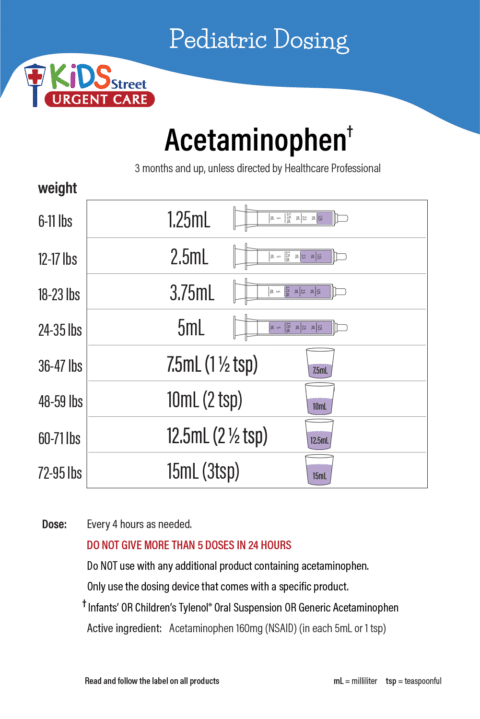
For liquid acetaminophen labeled 160 mg/5 mL, this general chart is commonly used for children 6 months and older:
| Weight | Amount per dose |
|---|---|
| 6–11 pounds | 1.25 mL |
| 12–17 pounds | 2.5 mL |
| 18–23 pounds | 3.75 mL |
| 24–35 pounds | 5 mL |
| 36–47 pounds | 7.5 mL |
| 48–59 pounds | 10 mL |
| 60–71 pounds | 12.5 mL |
| 72–95 pounds | 15 mL |
This chart is a general reference, not a personal prescription. The product label or your child’s doctor may give different instructions based on your baby’s age or health.
Example
If your baby weighs 14 pounds and the bottle says 160 mg/5 mL, the chart amount is 2.5 mL per dose. If needed, the next dose should usually be no sooner than 4 to 6 hours later. Do not give more than 5 doses in 24 hours.


Do not round up to the next weight range. If your baby’s weight falls near a cutoff, ask a pharmacist or pediatrician.
How to give infant Tylenol safely
Follow these steps each time:
- Check the active ingredient. It should say acetaminophen.
- Check the strength. Confirm that the liquid contains 160 mg per 5 mL, or follow the directions for the exact strength you have.
- Weigh your baby if possible. Use a recent, accurate weight.
- Read the last-dose time. Make sure at least 4 hours have passed, unless your doctor gave another schedule.
- Measure with an oral syringe. A kitchen spoon may hold much more or less than 5 mL.
- Give the medicine slowly. Place the syringe inside the cheek, not straight toward the throat.
- Record the dose and time. This helps prevent an accidental extra dose.
- Keep the bottle out of reach. Store it according to the label.
Do not mix acetaminophen into a full bottle of formula or breast milk. Your baby may not finish the bottle, making the dose unclear. If needed, ask a pharmacist whether a small amount of milk is suitable for that specific product.
Do not combine Tylenol with other acetaminophen products
Many cold, cough, allergy, and pain medicines contain acetaminophen. Giving two products with acetaminophen can cause an overdose, even when each product seems to contain a safe dose.
Check the Drug Facts label for these names:
- Acetaminophen
- APAP
- Paracetamol
Do not give a separate acetaminophen product at the same time as a medicine that already contains acetaminophen. Avoid adult products unless a doctor specifically prescribes them for your child.
The same rule applies to different brands. Tylenol is a brand name; acetaminophen is the active medicine.
What if my baby spits out or vomits the dose?
If your baby spits out some medicine, do not automatically repeat the dose. You may not know how much was swallowed.
If your baby vomits soon after taking the medicine, call a pharmacist, pediatrician, or poison control center for advice. Have this information ready:
- Your baby’s age and weight
- The product name
- The concentration
- The amount given
- The time it was given
- How much may have been vomited
Do not give an extra dose just because the fever has not dropped. Acetaminophen may improve comfort without bringing the temperature back to normal.
What happens if I give too much Tylenol?
Too much acetaminophen can seriously damage the liver. Early symptoms may be mild or absent, so do not wait for symptoms after a possible overdose.
In the United States, call Poison Control at 1-800-222-1222 for immediate guidance. The service is free and available 24 hours a day. Call 911 if your baby is unconscious, having trouble breathing, having a seizure, or is otherwise in immediate danger.
Have the bottle nearby when you call. Do not make your baby vomit, and do not give another medicine to “cancel out” the dose.


Possible overdose symptoms can include:
- Nausea or vomiting
- Unusual sleepiness
- Sweating
- Pale skin
- Poor feeding
- Pain in the upper right side of the belly
Symptoms may take time to appear. A baby can be in danger even without obvious signs.
When should I call the doctor instead of giving Tylenol?
Call your baby’s doctor before giving medicine when:
- Your baby is younger than 3 months.
- You are unsure of the correct dose.
- Your baby has liver disease.
- Your baby is dehydrated or is not feeding well.
- Your baby has repeated vomiting or diarrhea.
- Your baby takes other medicines.
- The fever lasts more than 24 hours in a child younger than 2 years.
- Pain continues or keeps returning.
- You think your baby may have received too much acetaminophen.
Seek urgent care for a baby who is hard to wake, breathing poorly, refusing most feeds, having far fewer wet diapers, developing a seizure, or showing a purple or unusual rash.
Tylenol treats discomfort. It does not cure an ear infection, urinary infection, pneumonia, or another illness that may cause fever.
Tylenol and teething
Teething can make a baby fussy and may cause sore gums. It usually does not cause a high fever.
If your baby has a significant fever, diarrhea, breathing trouble, a widespread rash, or seems very ill, do not assume teething is the cause. Call your child’s doctor.
For mild teething discomfort, try a clean, cool teething ring or gentle gum pressure. Do not use products containing benzocaine for babies unless a health professional specifically tells you to use one.
Can I give ibuprofen instead?
Ibuprofen is a different medicine. In the United States, it is generally not recommended for babies younger than 6 months unless a doctor directs you to use it.
Do not switch between acetaminophen and ibuprofen on your own. Alternating medicines can lead to timing errors and accidental overdoses. Ask your child’s doctor for a written schedule if both medicines are medically appropriate.
Never give aspirin to a child or baby unless a doctor specifically prescribes it. Aspirin has been linked to Reye’s syndrome, a rare but serious illness.
Common mistakes to avoid
The most common errors involve the timing, product strength, or measuring tool.
Avoid these mistakes:
- Giving a dose sooner than 4 hours after the last dose
- Giving more than 5 doses in 24 hours
- Using age alone instead of checking weight
- Using a kitchen teaspoon
- Confusing teaspoons with milliliters
- Using a syringe from a different medicine
- Giving adult-strength medicine
- Combining Tylenol with a cold medicine that contains acetaminophen
- Repeating a dose after spit-up without professional advice
- Treating a fever in a baby younger than 3 months without calling a doctor


A simple written log can help. Record the time, amount, and product concentration after each dose.
Quick answer: How often can I give my baby Tylenol?
For many babies 6 months and older, acetaminophen may be given every 4 to 6 hours as needed, using the dose for the child’s weight and the product’s strength. Do not exceed 5 doses in 24 hours.
For babies younger than 3 months, call a doctor before giving Tylenol. A rectal temperature of 100.4°F (38°C) or higher needs prompt medical attention.
Frequently asked questions
Can I give Tylenol every 3 hours?
No. Do not give routine doses every 3 hours. The usual minimum interval is 4 hours, and the daily limit is 5 doses unless your child’s doctor gives different instructions.
Should I wake my baby to give Tylenol?
Usually, no. Do not wake a comfortable, sleeping baby only to give fever medicine unless your child’s doctor tells you to follow a scheduled plan. If your baby is difficult to wake, breathing abnormally, or not feeding, seek medical help.
Can I give Tylenol for a fever without other symptoms?
You can ask a doctor or follow the label for a child who is old enough for the product. Focus on your baby’s comfort, fluids, feeding, and behavior—not only the number on the thermometer.
A baby younger than 3 months with a rectal temperature of 100.4°F (38°C) or higher needs prompt medical advice.
Does Tylenol make a fever go away?
It may lower a fever and help relieve pain, but it may not return the temperature to normal. A lower temperature does not prove that the underlying illness is gone.
Can I give Tylenol after vaccines?
Some babies may need acetaminophen after vaccination for discomfort or fever, but routine preventive dosing is not always advised. Follow the instructions from your child’s clinician or vaccine provider.
What is the safest way to measure liquid Tylenol?
Use the oral syringe supplied with the medicine or one marked in milliliters. Do not use a household spoon, and do not assume that 1 teaspoon is the same as the dose your baby needs.
Bottom line
For babies who are old enough to receive acetaminophen, Tylenol is commonly given every 4 to 6 hours when needed, with no more than 5 doses in 24 hours. Use your baby’s weight, confirm the bottle strength, and measure with an oral syringe.
If your baby is younger than 3 months, has a fever of 100.4°F (38°C) or higher, has a medical condition, or may have received too much medicine, contact a health professional right away. For a possible overdose in the United States, call Poison Control at 1-800-222-1222.
