
Introduction
Yes. Most U.S. airlines let you gate check a stroller, often at no extra charge. You usually use the stroller through the airport, then leave it at the gate or aircraft door before boarding. The airline places it in the cargo hold and may return it at the aircraft door after landing—or send it to baggage claim.
Rules vary by airline, airport, stroller size, and stroller type. A compact stroller is more likely to qualify for gate checking than a large double stroller, jogging stroller, or stroller wagon. Check your airline’s current policy before you travel, and ask the gate agent where you will collect it at your destination.

What Does “Gate Check a Stroller” Mean?
Gate checking means you keep your stroller until you reach the boarding gate. You then hand it to airline staff before you board the plane. The stroller travels underneath the aircraft instead of inside the passenger cabin.


This differs from checking a stroller at the ticket counter:
- Ticket-counter check: You hand over the stroller when you check in.
- Gate check: You use the stroller inside the airport and hand it over near the aircraft door.
- Cabin storage: A small, folded stroller may fit in an overhead bin, but only if the airline and crew allow it and space is available.
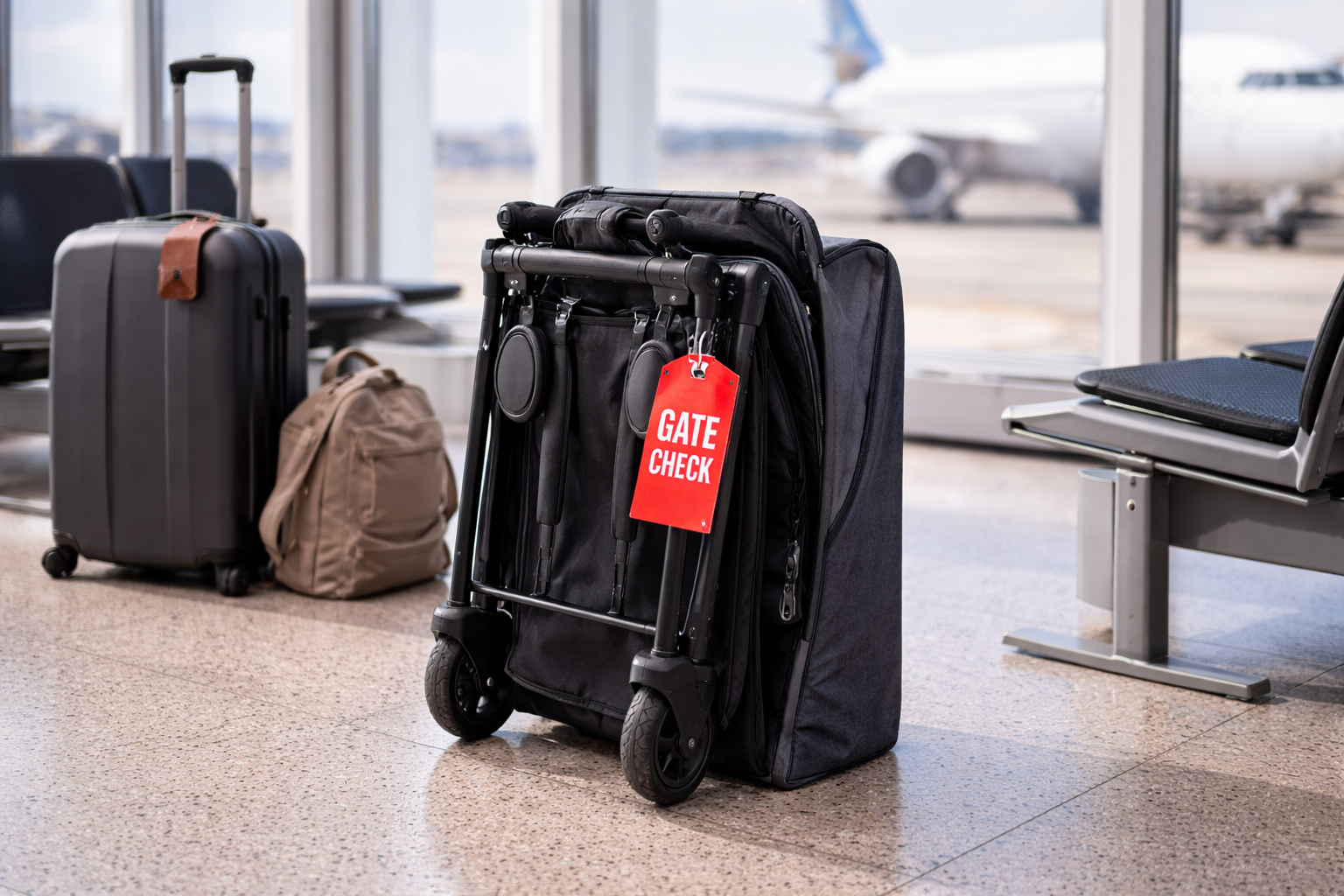
The airline may attach a gate-check tag to the stroller. Keep the receipt portion of that tag until you pick up the stroller.
Most airlines do not promise that a gate-checked stroller will be returned at the aircraft door. The process can depend on the airport, aircraft, ramp crew, and local handling rules.
How to Gate Check a Stroller
Follow these steps to reduce delays and protect the stroller.
1. Check your airline’s stroller policy
Look at the airline’s official baggage or traveling-with-children page before leaving home. Confirm:
- Whether strollers may be gate checked
- Whether the service is free
- The maximum size or weight
- Whether stroller wagons are treated as strollers or checked baggage
- Whether you may collect the stroller at the aircraft door
- Whether the rule changes for connecting flights
Airline policies can change. A policy that applied to a past trip may not apply to your next one.
2. Decide whether to use the stroller through security
You can usually take a stroller to the security checkpoint. The Transportation Security Administration may ask you to remove your child and place the stroller through screening or send it for a separate inspection.
The exact process depends on the stroller and the airport checkpoint. Follow the instructions of the TSA officer. Do not assume that a stroller will be exempt from screening because you are traveling with a baby.
TSA recommends checking its official traveling with children guidance for current screening information.


3. Fold and prepare the stroller
Before you reach the gate, remove loose items such as:
- Toys
- Blankets
- Cup holders
- Bags
- Snacks
- Diaper supplies
- Electronics
Place those items in your carry-on. Loose parts can fall off during handling, and items left in the stroller may not be covered if they are lost or damaged.
If the stroller folds, practice folding it before the trip. A gate agent or ramp worker may ask you to fold it before tagging it.
4. Ask the gate agent where to leave it
Some airports use a marked area at the end of the jet bridge. Others ask you to leave the stroller beside the aircraft door or at the bottom of the stairs.
Do not leave the stroller until an airline employee tells you to do so. Ask:
“Will this stroller be returned at the aircraft door, or should I collect it at baggage claim?”
The answer may differ between your departure and arrival airports.
5. Attach the gate-check tag
The gate agent will usually tag the stroller. Confirm that the tag matches your destination and keep the claim portion.
If you have a stroller bag, ask whether the bag must remain on the stroller during handling. Some airlines allow protective bags; others may have specific procedures.
6. Pick it up after landing
After landing, follow signs or ask an airport employee where gate-checked items are returned. Wait near the aircraft door if the airline says the stroller will be brought there.
If the stroller does not appear, do not leave the gate area immediately. Speak with the gate agent first. If the airline tells you to collect it at baggage claim, go to the airline’s baggage service office if it is missing or damaged.
Is Gate Checking a Stroller Free?
Often, yes—but the airline sets the rule. Many major U.S. airlines allow a stroller to be checked at the gate without counting it as a standard checked bag. This benefit may apply even when a child is traveling as a lap infant.
However, “free” does not always mean “accepted at the gate.” An airline may allow free stroller checking but require a large stroller to go to the ticket counter or baggage office.
The safest approach is to check three separate points in the airline’s policy:


- Cost: Is the stroller free?
- Location: Can you gate check it, or must you check it at the counter?
- Return point: Will the airline return it at the gate or send it to baggage claim?
Do not rely only on a general baggage allowance. A stroller may have its own rule.
Can I Take a Stroller Through TSA?
Usually, yes. You may take a stroller to the TSA checkpoint, but the stroller must still be screened.
TSA officers may ask you to:
- Remove your child
- Fold the stroller
- Remove items from pockets or baskets
- Place parts on the X-ray belt
- Walk through screening while carrying your child
- Wait while the stroller receives additional inspection
Large strollers may not fit through the standard X-ray machine. In that case, TSA may inspect the stroller by another method.
A stroller does not replace a child safety seat on an airplane. If you plan to use a car seat during the flight, check the car seat separately and follow the FAA guidance on child safety seats.

Can a Stroller Go in the Airplane Cabin?
A small, folded stroller may fit in an overhead bin, but cabin storage is not guaranteed. The stroller must meet the airline’s size rules and fit without blocking the aisle or emergency equipment.
Even if the stroller fits, the crew may require you to gate check it because:
- Overhead bins are full
- The stroller is too large
- The aircraft has limited storage
- The stroller blocks required access
- The crew must follow a different loading procedure
Never force a stroller into an overhead bin. If it does not fit easily and safely, ask the crew to gate check it.
A stroller that fits in the cabin can be useful on a long airport connection. Still, gate checking is often simpler for larger models.
Can I Gate Check a Double Stroller, Jogging Stroller, or Stroller Wagon?
It depends on the airline and the exact model. A double stroller or jogging stroller may be accepted at the gate, but its size and weight can require counter check-in.
Stroller wagons are less predictable. Some airlines treat them as strollers. Others treat them as oversized items, baggage, or special equipment. A wagon may also be too large to return at the aircraft door.
Before traveling with one, check:
- Folded dimensions
- Weight
- Wheel size
- Whether it fits through the jet bridge
- Whether the airline lists wagons separately
- Whether the airport can handle it at the gate
If the airline’s policy is unclear, call the airline and ask about the exact brand and model. Save a screenshot or print the policy, but understand that airport staff may still need to follow local handling rules.


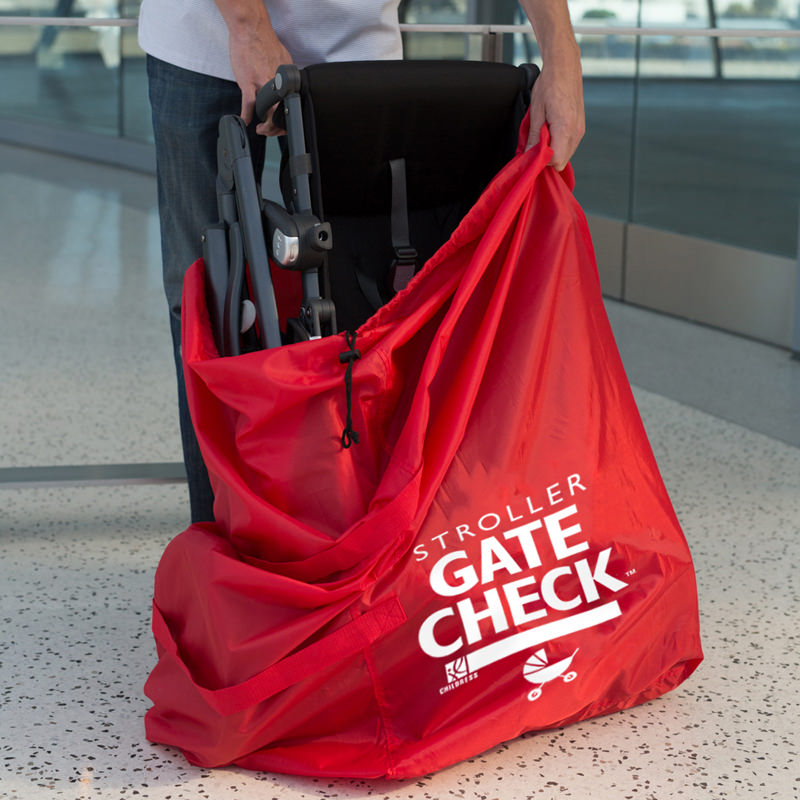
Should I Use a Stroller Bag?
A stroller bag can reduce dirt and scratches during transport, but it does not guarantee that the stroller will arrive undamaged.
A bag may help by:
- Keeping straps and small parts together
- Protecting fabric from grime
- Making the stroller easier to carry
- Making damage easier to identify
A bag can also slow down the gate-check process if it takes time to remove or close. Label the bag with your name and contact information. Do not place passports, medication, keys, or valuables inside it.
If you use a protective bag, ask the gate agent whether the airline wants the bag attached to the stroller or handled separately.
What Should I Do if the Stroller Is Damaged or Missing?
Report damage as soon as you notice it. Take photographs before leaving the airport if possible.
Use this process:
- Inspect the stroller near the aircraft door or baggage claim.
- Photograph broken wheels, bent frames, torn fabric, or missing parts.
- Keep the gate-check tag and any baggage receipt.
- Report the issue to the airline’s baggage service desk.
- Ask for a written incident report or case number.
- Submit any required claim form by the airline’s deadline.
The U.S. Department of Transportation explains that airlines must address baggage problems under federal passenger-protection rules, but the details can vary by situation. Review the DOT airline passenger rights guidance and the airline’s conditions of carriage.
Do not assume that a stroller is automatically covered for its full replacement cost. Airlines may have limits, exclusions, or different procedures for damage that existed before transport.
Can I Gate Check a Stroller Without Traveling With a Child?
Airlines may limit free stroller checking to passengers traveling with an infant or child. Some may accept a stroller as ordinary checked baggage if you are not traveling with a child.
This rule is airline-specific. If you are transporting a stroller for someone else, ask the airline whether:
- It qualifies for free checking
- You must pay a checked-bag fee
- It must go to the ticket counter
- It counts toward your baggage allowance
- A stroller bag changes its classification
Do not assume that a stroller receives a free allowance when no child is traveling.
Gate Checking a Stroller on a Connecting Flight
Ask the gate agent what will happen at each airport in your itinerary. The stroller may be returned at the aircraft door after one flight but sent to baggage claim after another.
For a connection:
- Allow extra time to collect the stroller.
- Check whether you must reclaim it during a customs inspection.
- Ask whether the stroller will be tagged to the final destination.
- Keep the stroller tag until the last flight.
- Confirm where to leave it for the next flight.
International connections can involve customs, security screening, and a new baggage process. The rules may differ from a domestic U.S. connection.


Gate Check or Counter Check: Which Is Better?
Gate checking is usually better when you need the stroller inside the airport. Counter checking may be easier when the stroller is large, heavy, or difficult to fold.
| Situation | Usually more practical |
|---|---|
| You need help moving through the airport | Gate check |
| You have a small folding stroller | Gate check or cabin storage, if allowed |
| You have a large double stroller | Counter check may be required |
| You use a stroller wagon | Confirm with the airline first |
| You have a long connection | Gate check can help |
| You want to avoid handling the stroller at the gate | Counter check |
| Your stroller is needed until boarding | Gate check |
Gate checking adds one more step after landing. Counter checking removes the stroller earlier but may leave you carrying your child and bags through the terminal.
Common Mistakes to Avoid
Avoid these problems before your flight:
- Assuming every stroller is gate-check eligible: Large models may have separate rules.
- Leaving valuables in the basket: Remove all personal items.
- Forgetting the gate-check tag: Keep it until you have the stroller.
- Not asking about the return point: The stroller may go to baggage claim.
- Arriving without folding practice: Folding can be difficult in a crowded boarding area.
- Using a damaged stroller: Photograph its condition before travel.
- Confusing a stroller with a car seat: They have different airline and FAA rules.
- Waiting until the last second: Arrive at the gate early enough to tag and fold the stroller.
- Relying on an old policy: Check the current airline page before each trip.
Quick Stroller Gate-Check Checklist
Before leaving home:
- Check the airline’s current stroller rule.
- Measure the folded stroller.
- Confirm whether the stroller wagon has a separate policy.
- Remove loose and valuable items.
- Add a name tag and contact information.
- Pack a stroller bag if you choose to use one.
- Take photos of the stroller before the trip.
At the airport:
- Use the stroller through the terminal if needed.
- Follow TSA screening instructions.
- Ask the gate agent where to leave it.
- Keep the claim tag.
- Ask where it will be returned.
After landing:
- Wait at the aircraft door if instructed.
- Check the stroller for damage.
- Report problems before leaving the airport when possible.

Frequently Asked Questions
Can I gate check a stroller and a car seat?
Often, yes. Many airlines have separate rules for strollers and child safety seats. Ask the airline whether both items are free and whether each can be gate checked.
Do I need a ticket for my baby to gate check a stroller?
Usually, the child must be included in the reservation, even if the baby travels as a lap infant. The exact free-baggage rule comes from the airline, so confirm it before travel.
Will I get my stroller back at the plane door?
Maybe. Some airports return gate-checked strollers at the aircraft door. Others send them to baggage claim. Ask the gate agent before boarding and again after landing if needed.
Can I gate check a stroller in a bag?
Usually, a stroller bag can be used, but the airline may have handling instructions. A bag protects against some dirt and scratches but does not remove the risk of transport damage.
Can I gate check a stroller on an international flight?
Often, yes, but international routes can have different handling rules. Customs, security, aircraft type, and the operating airline may affect where you check and collect the stroller.
What if the airline says my stroller is too large to gate check?
Take it to the ticket counter or baggage service area as directed. Ask whether it can be checked for free and where you will collect it after landing.
Conclusion
You can usually gate check a stroller on a U.S. flight, and many airlines allow it at no extra charge. The main limits are the stroller’s size, the airline’s policy, and the airport’s handling process.
Check the exact airline rule, remove loose items, keep the gate-check tag, and ask where the stroller will be returned. If you use a large stroller, double stroller, jogging stroller, or wagon, confirm its eligibility before you arrive at the airport.
