
For families in the United States, “sleeping through the night” usually means a baby sleeps for about 6 to 8 hours without a full wake-up. It does not always mean sleeping from 7 p.m. to 7 a.m. Newborns need to wake for feeds, and many babies do not sleep for a long stretch until they are developmentally ready.
You can help your baby sleep better by using a steady routine, responding to hunger and discomfort, providing safe sleep conditions, and teaching healthy sleep habits over time. Safety comes first: always place your baby on their back, on a firm, flat surface, with no loose items in the sleep space.
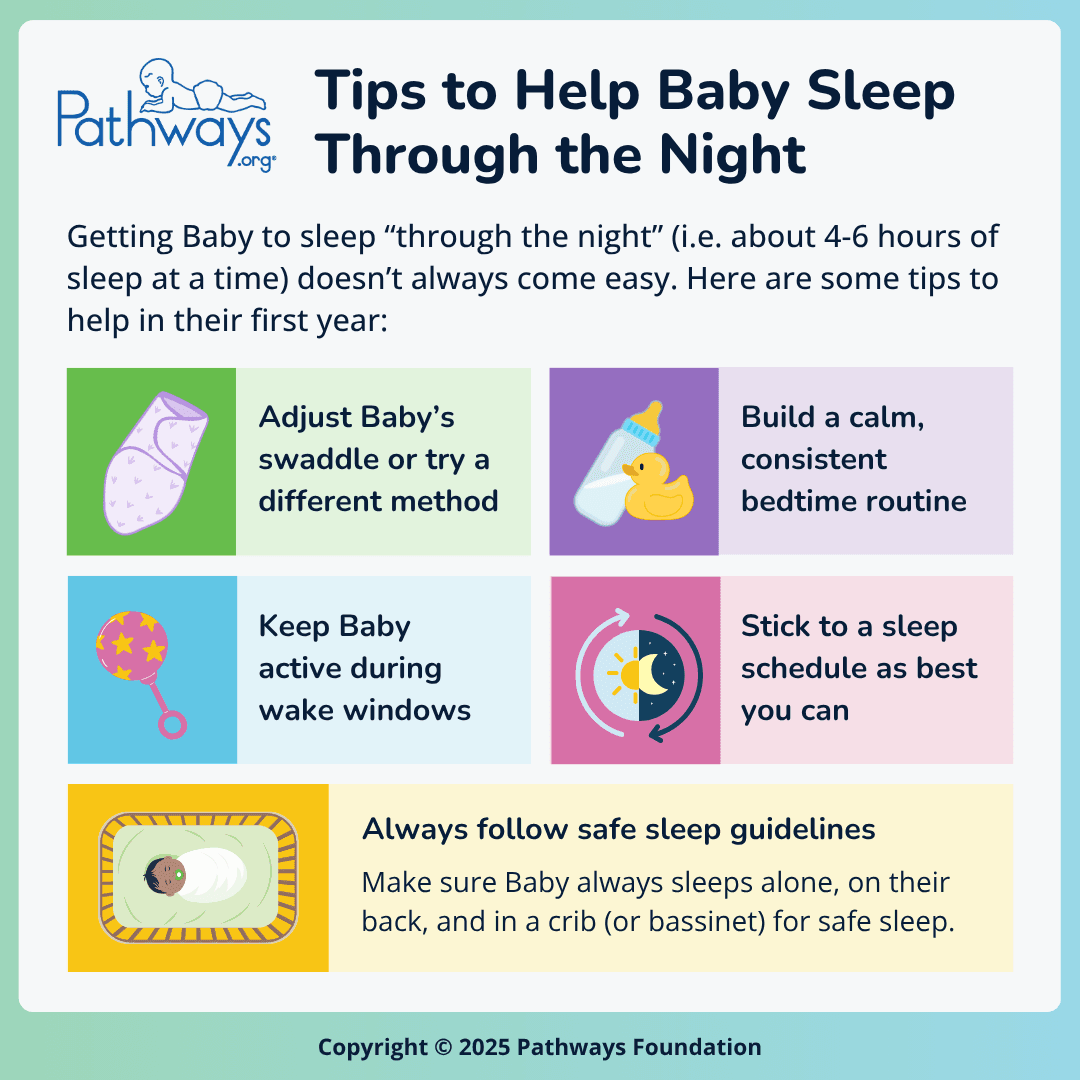
What “sleeping through the night” means for babies
A baby who sleeps through the night may still wake briefly and return to sleep without help. Babies move through light and deep sleep many times, so small sounds, grunts, and movements do not always mean they are fully awake.


Sleep also changes with age. A newborn may sleep for only 1 to 3 hours at a time. By about 3 to 6 months, some babies begin to sleep for longer stretches. Others still wake to feed or need help settling.
The American Academy of Pediatrics does not set one age when every baby should sleep all night. Growth, feeding needs, health, temperament, and development all affect sleep.
Typical sleep patterns by age
These are general patterns, not rules:
| Baby’s age | What sleep may look like |
|---|---|
| Newborn to 2 months | Short sleep periods, frequent feeds, no clear day-night pattern |
| 3 to 4 months | Longer night stretches may begin, but night feeds are still common |
| 4 to 6 months | Some babies can learn to settle with less help |
| 6 to 12 months | Many babies sleep for a longer stretch, but teething, illness, and separation anxiety may cause wake-ups |
The American Academy of Sleep Medicine recommends that infants ages 4 to 12 months get about 12 to 16 hours of sleep in 24 hours, including naps. Babies younger than 4 months have changing sleep patterns, so a fixed sleep target is less useful.

Start with a safe sleep space
Safe sleep is more important than getting a baby to sleep for a longer time. The safest setup is a baby who sleeps alone, on their back, on a firm, flat surface made for infant sleep.
Follow these steps:
- Place your baby on their back for every nap and night sleep.
- Use a firm crib, bassinet, or portable play yard mattress.
- Cover the mattress only with a fitted sheet.
- Keep pillows, blankets, quilts, stuffed toys, bumpers, and sleep positioners out of the sleep area.
- Keep your baby’s sleep space in your room, ideally for at least the first 6 months.
- Avoid sleeping with your baby on a couch, recliner, or adult bed.
- Move your baby from a car seat, swing, stroller, or carrier to a firm, flat sleep surface when practical.
Room sharing can make feeding and comforting easier while reducing the dangers linked with bed sharing. The AAP recommends room sharing without bed sharing.
Use a wearable blanket instead of loose bedding
If your baby needs warmth, use a properly fitted wearable blanket or sleep sack. Choose clothing based on the room temperature and your baby’s clothing layers.
Do not use weighted sleep sacks, weighted swaddles, or weighted blankets for infants. Their safety has not been established, and added weight may limit movement or breathing.
Stop swaddling when your baby shows signs of rolling
Swaddling can calm some young babies, but it must stop when your baby begins trying to roll. Rolling may start as early as 2 months.
Once your baby can roll from back to stomach or stomach to back, keep placing them on their back. If they roll on their own during sleep, you usually do not need to turn them back unless a medical professional has given you different instructions.


Do not use a swaddle that restricts the hips. Your baby needs room to bend and move their legs.

Build a day-and-night rhythm
Newborns do not begin with a mature body clock. Regular light, activity, feeding, and sleep cues help the body learn when to be alert and when to rest.
During the day:
- Open the curtains and expose your baby to normal daylight.
- Feed your baby as advised by your pediatrician.
- Talk, play, and use normal household sounds.
- Offer naps, but avoid keeping your baby awake for long periods to “make them tired.”
At night:
- Keep lights low.
- Use a calm, quiet voice.
- Change the diaper only when needed.
- Feed and comfort your baby, then return them to their safe sleep space.
- Avoid bright screens and active play.
A dark room can help an older baby sleep, but newborns do not need a silent or completely dark home. A steady, low background sound may help block sudden noise. If you use white noise, place the machine far from the crib, keep the volume low, and do not use it at close range for the whole night.
Watch your baby’s awake time
Overtired babies may cry more, resist sleep, and wake often. Under-tired babies may play or babble when you want them to sleep.
Rather than following the clock alone, look for early sleep cues:
- Yawning
- Looking away
- Slower movement
- Less interest in play
- Rubbing the eyes
- Fussing
Crying can be a later sign of tiredness. Start the wind-down routine when your baby first seems sleepy.
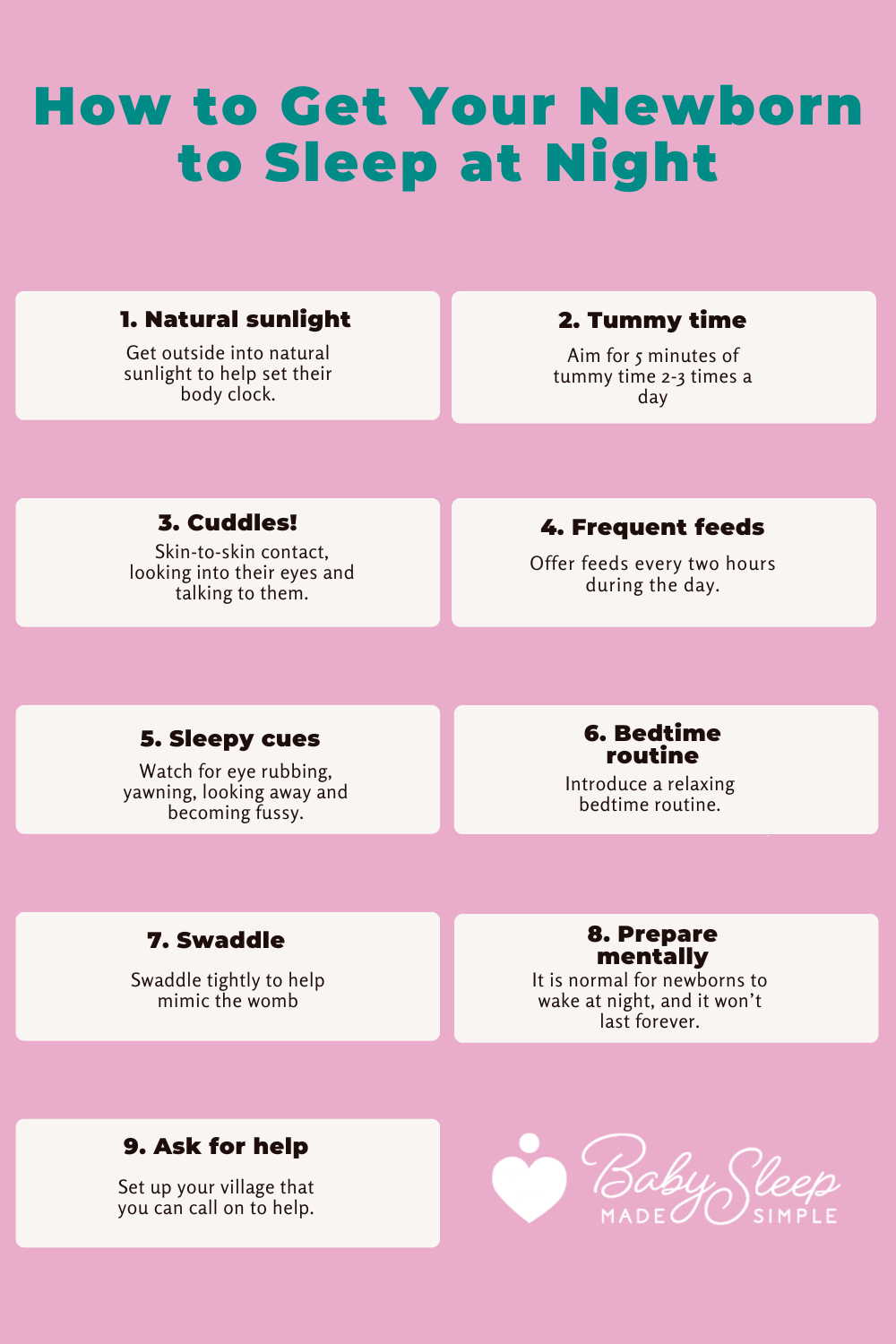
Create a simple bedtime routine
A short, repeatable routine helps your baby understand that sleep is coming. The routine does not need to be long or elaborate.
Try this order:
- Feed your baby.
- Burp and change the diaper if needed.
- Put on a sleep sack or suitable pajamas.
- Dim the lights.
- Read a short book, sing, or cuddle.
- Place your baby on their back in the crib while calm and awake when possible.
The goal is not to make every night perfect. The goal is to repeat the same calm signals often enough that they become familiar.
Why “drowsy but awake” can help
Putting a baby down calm but awake may help them learn how their sleep space feels before they are fully asleep. This can make it easier for some babies to return to sleep after normal night waking.
It is not a test of parenting, and it does not work every time. Young babies often need to be held, fed, or rocked. You can use this approach when it fits your baby and family.
If your baby falls asleep while feeding, you can gently move them to their crib or bassinet. Never leave a sleeping baby on an adult bed, sofa, or chair.


Make sure feeding needs are met
Hunger is a normal reason for a baby to wake. Newborns often need several feeds during the night, and some older babies still need one or more night feeds.
Do not remove night feeds just to improve sleep unless your child’s pediatrician says your baby is ready. This is especially important for babies who were born early, have slow weight gain, have medical conditions, or have feeding problems.
Ask your pediatrician whether your baby is growing well and whether you should wake them to feed. Your clinician can also help you decide when it is reasonable to reduce or stop a night feed.
Breastfeeding and sleep
Breastfed babies may wake more often because human milk is digested quickly. This does not mean breastfeeding has failed or that your baby has a sleep problem.
If you feed in bed because you may fall asleep, remove pillows, blankets, and other soft items from the area first. When you wake, place your baby back in their own sleep space. Avoid feeding on a couch or recliner, where accidental sleep can be especially dangerous.
Consider a pacifier if it works for your baby
Offering a pacifier at nap time and bedtime may lower the risk of sudden infant death syndrome, or SIDS. If you breastfeed, the AAP suggests waiting until breastfeeding is well established before introducing a pacifier.
Do not force a pacifier. Do not attach it to a cord, ribbon, clip, or stuffed toy during sleep. If it falls out after your baby falls asleep, you do not need to put it back.

Choose a gentle way to respond to night waking
When your baby wakes, first check for a real need. Hunger, illness, a wet diaper, temperature, pain, and developmental changes can all disrupt sleep.
Use a quick check:
- Pause for a moment to see whether your baby is fully awake.
- Check breathing, position, temperature, and signs of illness.
- Feed if your baby is hungry or your clinician has advised a feed.
- Offer a quiet comfort method, such as a hand on the chest or gentle rocking.
- Return your baby to the safe sleep space.
A brief pause is not the same as leaving a baby in distress. It gives a baby who is grunting or lightly stirring a chance to settle. If your baby is crying hard, respond and provide comfort.
Sleep training is optional
Sleep training means using a planned approach to help a baby fall asleep or return to sleep with less direct help. It may include gradual soothing, scheduled check-ins, or other responsive methods.
Research reviewed by the AAP suggests that some behavioral sleep approaches can improve sleep for babies and parents without harming the parent-child bond when used appropriately. However, sleep training is not required, and no single method works for every family.
Before trying a structured method:
- Ask your pediatrician if your baby is healthy and growing well.
- Make sure the sleep space follows safe sleep guidance.
- Confirm that night feeds are not still needed.
- Pick a method you can follow calmly and consistently.
- Stop and seek advice if your baby seems ill or feeding and growth change.
Never use physical punishment, shaking, unsafe restraint, or a method that leaves a baby in an unsafe place.

Troubleshoot the most common sleep problems
When sleep suddenly worsens, look for a change before changing everything at once.


| What you notice | Possible reason | What to try |
|---|---|---|
| Baby fights every nap | Too much awake time or an awkward nap schedule | Start the nap routine at earlier sleep cues |
| Baby wakes soon after bedtime | Hunger, discomfort, or overtiredness | Review feeding, room comfort, and bedtime timing |
| Baby wakes every 1–2 hours | Normal sleep-cycle waking, feeding need, or sleep association | Check health and feeding first; then use a steady settling plan |
| Baby wakes at 4 or 5 a.m. | Light, noise, hunger, or early bedtime | Keep the room dark and boring; review the full schedule |
| Sleep worsens after improving | Illness, teething, travel, growth, or new skills | Offer extra comfort and return to the routine when the change passes |
| Baby only sleeps when held | Strong sleep association or discomfort | Add a gradual crib-settling step while keeping responses calm |
These are possibilities, not diagnoses. A baby who snores often, gasps, pauses in breathing, sweats heavily during sleep, or struggles to breathe needs medical advice.
Recheck the room
Keep the room comfortable, but do not overheat your baby. Dress your baby in about one more layer than an adult would comfortably wear in the same room, unless your pediatrician advises otherwise.
Check for:
- A hat worn indoors during sleep
- Sweating or a hot chest
- Loose blankets
- A soft mattress or sleep surface
- Smoke or vaping exposure
- Strong light or sudden noise
- A crib near cords, curtains, or other hazards

Know when to call your pediatrician
Contact your pediatrician if your baby has ongoing trouble sleeping along with poor feeding, fewer wet diapers, poor weight gain, persistent vomiting, fever, unusual sleepiness, or behavior that concerns you.
Get urgent help if your baby has trouble breathing, turns blue or gray, is difficult to wake, has a seizure, or has a serious injury.
Talk with a clinician before changing night feeds if your baby:
- Was born prematurely
- Has a health condition
- Has difficulty gaining weight
- Has feeding or swallowing problems
- Has frequent vomiting or reflux symptoms
- Takes medicine that may affect sleep
A pediatrician can help separate normal sleep changes from pain, illness, feeding problems, or a sleep disorder.

Common mistakes that can make infant sleep less safe
Avoid these popular but risky shortcuts:
- Using cereal to make a baby sleep longer: Solid food does not reliably improve sleep and should not be added to a bottle.
- Putting a baby to sleep on the stomach: Stomach sleeping increases the risk of sleep-related death.
- Using crib bumpers: They can cause suffocation, entrapment, or strangulation.
- Relying on inclined sleepers: Babies can slide into a position that blocks breathing.
- Using weighted sleep products: Added weight may limit movement or breathing.
- Keeping a baby awake all day: Overtired babies often sleep worse, not better.
- Using melatonin without medical advice: Melatonin is not a routine sleep solution for infants.
- Using alcohol, antihistamines, or other medicine to make a baby sleepy: These can be dangerous and may hide a medical problem.
Products sold for infant sleep are not automatically safe because they appear in a store or have many reviews. Check whether the product gives your baby a firm, flat, empty sleep surface.

A practical one-week plan
You do not need to change every sleep habit at once. Use this simple plan:
Days 1 and 2: Check safety and health
Set up the crib or bassinet correctly. Review feeding, wet diapers, room temperature, and signs of illness. Ask your pediatrician about night feeds if you are unsure.
Days 3 and 4: Add clear day-night cues
Use daylight and normal activity during the day. Keep nighttime feeds and changes quiet and brief.
Days 5 and 6: Repeat the bedtime routine
Use the same short routine each night. Try placing your baby down calm and awake when practical.


Day 7: Review, then adjust one thing
Look for trends rather than one good or bad night. If your baby is very tired, move bedtime earlier. If your baby is wide awake for long periods, review naps and awake time.
Progress may look like a longer first sleep period, fewer full wake-ups, or an easier return to sleep. It does not have to mean sleeping for 12 hours.

FAQs about helping a baby sleep through the night
At what age can a baby sleep through the night?
Some babies sleep for 6 to 8 hours by 3 to 6 months, but there is wide variation. Many healthy babies still wake at night after 6 months. Your baby’s feeding needs and growth matter more than a specific age.
Should I wake my newborn to feed?
Follow your pediatrician’s advice. Many newborns need frequent feeds, and some must be woken until they regain birth weight and show good growth. Do not reduce or remove feeds without medical guidance.
Should I let my baby cry at night?
You can choose a responsive sleep approach that fits your family. A brief pause may help you tell the difference between light sleep and full waking, but you should respond to hunger, illness, or distress. Sleep training is optional.
Can a baby sleep with a blanket?
The safest choice is a bare crib with a fitted sheet. Use a wearable blanket if your baby needs warmth. Keep loose blankets, pillows, quilts, and stuffed toys out of the sleep area.
Why does my baby sleep well for naps but wake at night?
Night sleep may be affected by hunger, light, noise, overtiredness, illness, or the normal shift between sleep cycles. Check safety and health first, then review bedtime timing and your settling routine.
Can white noise help a baby sleep?
Low, steady background sound may mask sudden noise. Keep the device far from the crib and at a low volume. Do not place it inside the crib or near your baby’s head.
Conclusion
The best way to help a baby sleep through the night is to combine safe sleep with realistic expectations. Meet feeding and comfort needs, use a steady day-night rhythm, follow a short bedtime routine, and make changes gradually.
Your baby may still wake, and that does not mean you are doing anything wrong. If sleep problems come with feeding concerns, poor growth, breathing changes, or illness, contact your pediatrician.
For current U.S. guidance, review the American Academy of Pediatrics’ HealthyChildren.org safe sleep advice, the CDC’s infant safe sleep recommendations, and NIH Safe to Sleep resources.
