
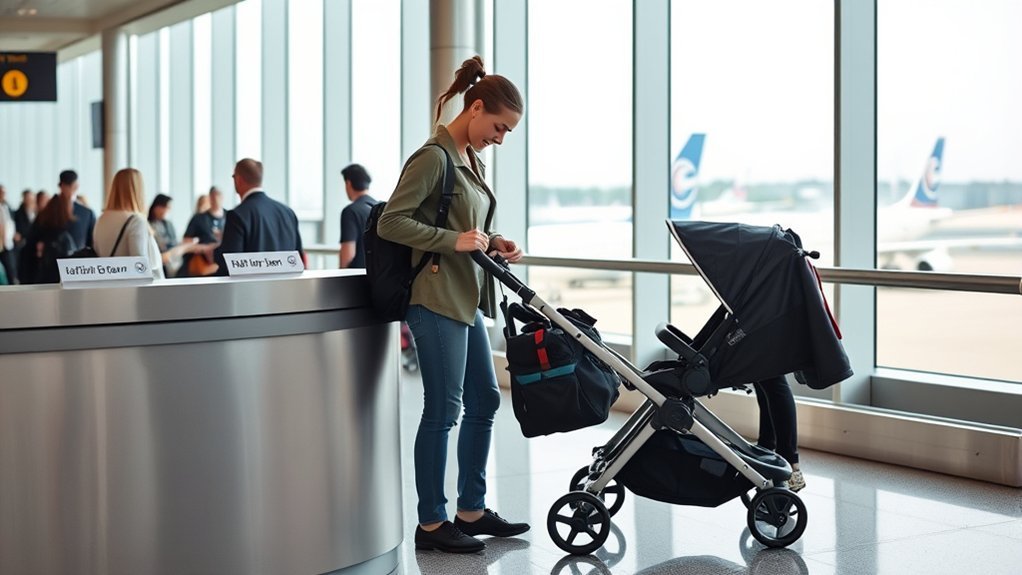
Gate checking a stroller means using the stroller through the airport, then handing it to airline staff at the gate before you board. Staff place a gate-check tag on it and move it to the aircraft’s cargo area. Depending on the airport and airline, you may get it back at the aircraft door after landing or at baggage claim.
This process is common on flights departing from airports in the United States. It can make travel easier with a child, but the exact rules vary by airline, stroller size, aircraft, and airport layout. Check your airline’s current stroller policy before you leave home.

What Does Gate Checking a Stroller Mean?
Gate checking is a form of checked baggage that takes place at the boarding gate instead of the ticket counter. You keep the stroller during check-in, security screening, and most of the time before boarding.
When boarding begins, you fold the stroller and leave it in the area named by the gate agent. Airline workers then attach a tag and load the stroller below the aircraft.


Gate checking is different from carrying a stroller onto the plane:
- Gate checked stroller: You give it to airline staff at the gate.
- Carry-on stroller: You take it into the cabin, if it fits the airline’s size rules and there is space.
- Checked stroller at the ticket counter: You hand it over before security and do not use it in the airport.
Many U.S. airlines allow passengers to gate check a stroller, often without a separate fee. However, “often” does not mean “always.” Policies can differ for umbrella strollers, double strollers, wagons, jogging strollers, and large travel systems.
The U.S. Department of Transportation recommends checking the airline’s baggage rules before travel. The airline’s policy controls the process for your specific trip.
How to Gate Check a Stroller Step by Step
The process is simple once you know where the stroller changes hands.
1. Check the airline’s stroller rules
Before your trip, look at the airline’s official baggage or family-travel page. Check for rules about:
- Stroller size and weight
- Umbrella and compact strollers
- Double or side-by-side strollers
- Wagons
- Jogging strollers
- Stroller-and-car-seat travel systems
- Protective bags
- Gate-check fees
- Pickup location after landing
Also check the airport. Some airports do not return large items to the aircraft door. A stroller may instead go to the oversized-baggage area.
A stroller that is allowed on one flight may not be accepted at the gate on another flight. Aircraft size and airport equipment can affect the decision.
2. Arrive with enough time
Gate checking adds a few minutes to boarding. Arrive early enough to complete check-in, security screening, and the walk to your gate without rushing.
If you need the stroller for a child with mobility needs, tell the airline when you book and again at the airport. The airline may provide additional instructions or assistance.


3. Use the stroller through the airport
You can usually use the stroller after check-in and while walking to the gate. Keep your child safely buckled according to the stroller maker’s instructions.
Do not hang heavy bags from the handles. Extra weight can make the stroller tip backward. Keep passports, medication, electronics, and other valuables with you rather than in the stroller basket.
4. Ask the gate agent for a gate-check tag
At the gate, tell the agent that you want to gate check the stroller. The agent will usually give you a tag or prepare one for you.
The tag may show:
- Your name
- Flight details
- A tracking number
- The stroller’s pickup location
- A destination code
Attach the tag where airline staff can see it. Keep the claim portion, if the agent gives you one.
If you have a connecting flight, ask whether the stroller will be returned at the aircraft door during the connection or sent to the final destination. Do not assume the answer.
5. Fold and empty the stroller
Before handing over the stroller:
- Remove your child.
- Fold the stroller.
- Remove loose items from the seat, basket, cup holder, and parent console.
- Detach removable accessories.
- Lock the folded frame if it has a latch.
- Take photographs if you want a record of its condition.
Airline workers may place the stroller in a protective bag, but this is not guaranteed. You can use a stroller travel bag if the airline accepts it at the gate.
6. Leave the stroller where the gate agent directs you
The drop-off point may be:
- At the gate counter
- At the end of the jet bridge
- Near the aircraft door
- At a marked oversized-item location
Do not leave the stroller in a walkway or beside the aircraft until staff tell you to do so. The correct location can change during boarding.
7. Collect it after landing
Ask the gate agent before departure where the stroller will be returned. At your destination, look for it:
- At the aircraft door
- At the end of the jet bridge
- In a marked gate-check area
- At oversized baggage
- At the regular baggage carousel
Door delivery is common for some gate-checked items, but it is not guaranteed. If the stroller does not appear, speak with the airline’s baggage service office before leaving the airport.


What Happens to a Gate-Checked Stroller on the Plane?
After you hand over the stroller, airline or airport workers move it to the aircraft’s cargo hold. It does not travel in the passenger cabin unless the airline accepts it as a carry-on item.
The stroller normally goes through a separate loading process from standard checked bags. That process can vary by airport and aircraft. The stroller may be placed in a cart, loaded by hand, or sent through the airport’s baggage system.
A gate-check tag helps staff identify the stroller and its intended destination. It does not guarantee that the stroller will be returned at the aircraft door.
The main practical issue is the time between landing and retrieval. If the stroller is returned at the gate, you can usually use it soon after leaving the aircraft. If it goes to baggage claim, you may need to carry your child or use an airport wheelchair or loaner cart while you wait.
Can You Take a Stroller on the Plane Instead?
You may be able to bring a small stroller into the cabin, but it must meet the airline’s carry-on limits and fit in an approved storage area.
A compact folding stroller may fit in an overhead bin on some aircraft. This depends on:
- The folded dimensions
- The stroller’s weight
- Available overhead-bin space
- The aircraft type
- The airline’s policy
- The boarding group and cabin
- Whether the stroller contains a battery
Cabin space is limited. Even if a stroller fits physically, airline staff may require you to gate check it if the bins are full or the item cannot be safely stored.
Do not place a stroller in the aisle, under a seat unless it fits fully, or near an emergency exit. Federal aviation safety rules require aisles and emergency areas to remain clear.
A stroller that does not fold may be more likely to require gate checking. Large double strollers, jogging strollers, and stroller wagons commonly need special handling.
How Does Gate Checking Work With a Car Seat?
A car seat and stroller are separate items, even when they form a travel system.
If your child has a ticketed seat, you may be able to use an approved child restraint system on the aircraft. The Federal Aviation Administration advises parents to use an FAA-approved child restraint when possible. Look for the required aircraft-use label on the restraint and follow the airline’s instructions.
If you do not use the car seat onboard, you can ask the airline how to check it. Options may include:
- Gate checking the car seat
- Checking it at the ticket counter
- Placing it in a protective travel bag
- Using it with a stroller frame until the gate
A car seat checked as baggage may be exposed to impact, dirt, or rough handling. A padded travel bag can help keep it clean, but a bag cannot prevent all damage.


Never use a car seat after a crash unless the manufacturer says it is safe to do so. A baggage-handling event is not automatically the same as a vehicle crash, but inspect the seat for cracks, bent parts, missing pieces, or damage before use. Contact the manufacturer if you are unsure.
What Should You Remove Before Gate Checking?
Remove anything loose or valuable. Airline baggage rules generally do not protect fragile or valuable items packed in checked baggage.
Take out:
- Wallets and passports
- Phones and tablets
- Medication
- Snacks and bottles
- Toys
- Removable cup holders
- Stroller organizers
- Blankets
- Diaper-changing supplies
- Batteries and power banks
- Keys and travel documents
A stroller’s basket is not a secure suitcase. Items can fall out when the frame is folded or moved.
If the stroller has a battery, powered motor, or electronic feature, check the airline’s dangerous-goods rules. Lithium batteries may have special packing and removal requirements. Do not assume that a battery-powered stroller follows the same rule as a basic manual stroller.
Should You Use a Stroller Travel Bag?
A travel bag is optional, but it can help protect the stroller from dirt and scratches. It also keeps loose stroller parts together.
A bag works best when:
- It fits the folded stroller
- It has a strong handle
- Your contact information is visible
- The airline allows the bag at the gate
- You remove all personal items from the stroller
Some airlines treat a stroller inside a bag as one checked item. Others may apply their own size, weight, or handling rules. Confirm the policy before using a large protective bag.
A bag does not make an oversized stroller cabin-approved. It also does not ensure door delivery after landing.
What If the Stroller Is Damaged or Missing?
Inspect the stroller before leaving the airport. Check the wheels, frame, brake, folding latch, seat, canopy, harness, and handle.
If you find damage:
- Take clear photographs.
- Keep the gate-check tag.
- Report the problem to the airline’s baggage service office.
- Ask for a written report or claim number.
- Keep receipts for reasonable repair costs.
- Follow the airline’s deadline for submitting a claim.
Do not wait several days if the stroller is missing or badly damaged. Reporting it at the airport creates a clear record of when and where you discovered the issue.
The airline’s liability and claim process can depend on the type of damage, the route, the airline’s contract of carriage, and whether the stroller was properly packed. Read the airline’s current baggage terms for the applicable rules.
If the stroller is not at the gate, ask an employee to check both the oversized-baggage area and the regular carousel before filing a missing-item report.

Gate Checking a Stroller on a Connecting Flight
A connection can change the pickup process.


Ask the gate agent these questions before boarding:
- Will I receive the stroller at the aircraft door?
- Will it be tagged to my final destination?
- Do I need to collect it during the connection?
- Where do I return it for the next flight?
- What happens if the next gate is in another terminal?
If you receive the stroller during a connection, allow time to collect it, move through the airport, and return it at the next gate. Some airports require another security screening when you change terminals.
If the stroller goes to your final destination, plan for the connection without it. Carry a child carrier or use an airport-provided wheelchair if appropriate.
Common Mistakes to Avoid
The most common problems are easy to prevent.
Assuming every stroller is free to gate check
Many airlines allow stroller gate checks at no charge, but restrictions may apply to wagons, large strollers, and multiple items. Read the exact policy for your airline.
Leaving items in the stroller
Loose items can fall out or become separated. Treat the stroller as checked baggage once you hand it over.
Forgetting the claim tag
The tag helps the airline identify and locate the stroller. Keep the receipt or claim portion until you have the stroller back.
Expecting automatic door delivery
Door delivery is not guaranteed. Ask where the stroller will be returned before you board.
Waiting until the last moment
A rushed gate check makes it easier to leave behind a phone, bag, or removable stroller part. Start folding and clearing the stroller before the final boarding call.
Using the stroller after handoff
Once staff accept the stroller, do not try to retrieve it without permission. Airport and aircraft areas may have safety limits.
Confusing a stroller with a child restraint
A stroller helps move a child on the ground. A car seat or child restraint is designed for use in a vehicle or aircraft when approved. They are not interchangeable.
Quick Decision Table
| Your situation | Usually practical choice | What to confirm |
|---|---|---|
| Small folding stroller | Ask whether it can go in the cabin | Folded size and overhead-bin rules |
| Standard full-size stroller | Use it through the airport, then gate check it | Fee and pickup location |
| Double stroller | Gate check or counter check may be required | Size, weight, and special-item rules |
| Stroller wagon | Check the airline’s special-item policy | Whether gate checking is allowed |
| Child needs a stroller after landing | Request door delivery, but plan a backup | Whether the airport returns large items at the gate |
| Infant car seat | Use onboard if approved and the child has a seat, or check it | FAA label and airline instructions |
| Stroller with a battery | Ask about battery removal and packing | Airline dangerous-goods rules |
This table is a planning aid, not a universal airline policy. The airline and airport make the final decision.
Frequently Asked Questions
Is gate checking a stroller free?
Many U.S. airlines allow passengers to gate check a stroller without charging a standard checked-bag fee. Some apply limits based on stroller type, size, weight, or the number of child-related items. Check the airline’s current policy before travel.
Do I need a bag to gate check a stroller?
Usually, no. A travel bag is often optional. It may protect the stroller from dirt and scratches, but it does not guarantee careful handling or door delivery.
Can I gate check a stroller with a child in it?
No. Remove the child before handing the stroller to airline or airport staff. The stroller must be folded or prepared as the gate agent directs.
Will I get my stroller back at the plane door?
You may, but it is not guaranteed. Some airports return gate-checked strollers at the aircraft door. Others send them to oversized baggage or the regular baggage area.
Can I gate check a stroller and car seat together?
Sometimes. Airlines may treat them as separate items or allow them together as part of a travel system. Ask the airline how it tags and handles the specific stroller and car seat.
Final Takeaway
Gate checking a stroller lets you use it through the U.S. airport and hand it over just before boarding. The basic process is to check the airline’s rules, use the stroller to the gate, remove loose items, attach the gate-check tag, fold it, and collect it after landing.
The key uncertainty is where the stroller will be returned. Ask the gate agent about door delivery, especially if you have a tight connection or need the stroller immediately after landing. For your next trip, check the airline’s official stroller policy and pack a backup plan for carrying your child.
