
Most babies flinch, jerk, twitch, or suddenly spread their arms while sleeping. In many cases, this is normal. The most common reasons are the Moro reflex, normal newborn sleep movements, and brief muscle twitches called sleep myoclonus.
A baby may also flinch because of noise, touch, a change in position, gas, or an uncomfortable sleep setting. These movements often happen during light sleep and become less common as the nervous system matures.
In the United States, safe sleep still matters even when a baby moves often. The American Academy of Pediatrics (AAP) recommends placing babies on their backs for every sleep, on a firm, flat sleep surface, with no pillows, blankets, toys, or other soft items. This article explains what is typical, what you can do, and which signs need medical care.

Common reasons babies flinch in their sleep
A baby may flinch during sleep for several normal reasons. The movement itself is usually brief and stops without help.


The Moro reflex, or startle reflex
The Moro reflex is an automatic response to a sudden sound, movement, or feeling of falling. A baby may:
- Throw out both arms
- Open the hands
- Stretch the legs
- Arch the back
- Cry briefly
- Pull the arms back toward the body
This reflex begins before birth and is strongest during the first weeks of life. It often fades by about 3 to 6 months, although the exact timing varies.
A baby can trigger the reflex without a loud noise. A shift in the mattress, a change from your arms to the crib, or the sensation of losing support may be enough.
Normal newborn sleep movements
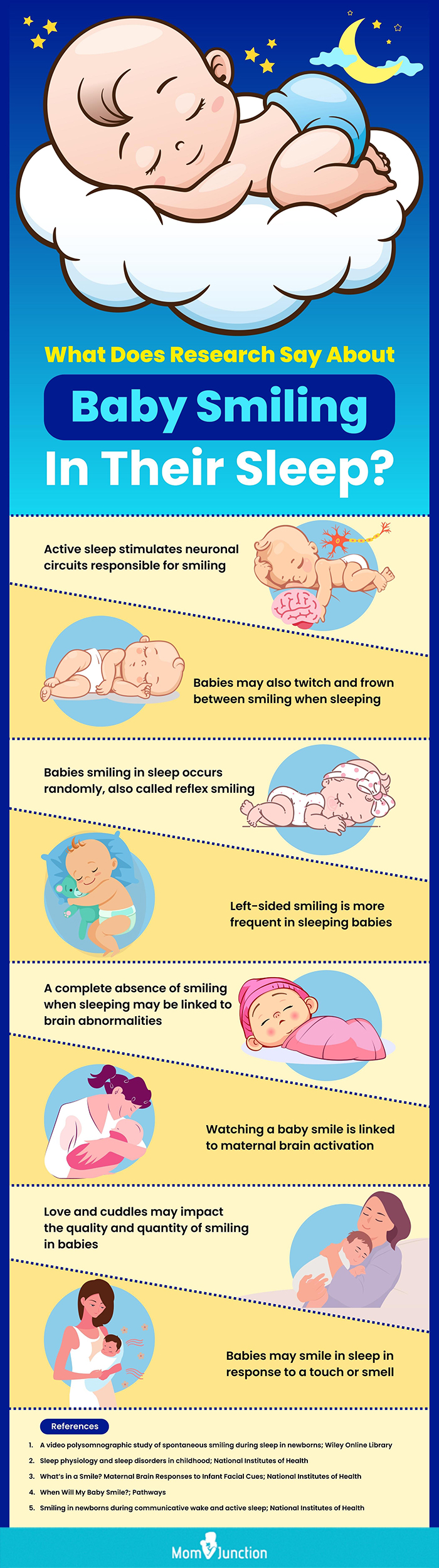
Newborns spend a large part of sleep in active sleep, which is similar to rapid eye movement, or REM, sleep. During this stage, babies may:
- Smile or frown
- Move their eyes under closed lids
- Suck or make brief sounds
- Twitch the face, hands, or feet
- Stretch or wiggle
- Breathe unevenly for short periods
These movements can look dramatic because newborns do not stay still during sleep as older children often do.
Sleep myoclonus
Sleep myoclonus means a short, sudden muscle jerk that occurs during sleep. It may affect one limb, several limbs, or the whole body. It often lasts only a few seconds.
Benign neonatal sleep myoclonus generally happens only during sleep. It usually stops when the baby wakes and tends to improve as the baby grows. A pediatrician should still assess repeated or unclear jerking, especially if it also occurs while the baby is awake.
A response to sound, touch, or movement
Babies have sensitive nervous systems. A door closing, a dog barking, a cold wipe, or a hand touching the chest can cause a brief flinch.
Some babies flinch when a caregiver sets them down. This may reflect the loss of body warmth and support rather than pain or illness.


Discomfort from gas, hunger, or temperature
A baby who is hungry, needs a diaper change, feels too warm, or has gas may move more during sleep. Discomfort often comes with other signs, such as grunting, drawing up the legs, rooting, crying, or waking often.
Flinching alone does not prove that a baby has reflux, colic, or another digestive problem.
How to tell whether a baby’s flinching is normal
The pattern matters more than one isolated movement. A brief jerk is usually less concerning when the baby remains well before and after it.
Look at these features:
| Feature | More often reassuring | Needs medical advice |
|---|---|---|
| Timing | Happens during sleep | Happens often while awake |
| Length | Lasts a few seconds | Continues or repeats in long clusters |
| Body pattern | Brief, flexible movements | Repeated stiffening, rhythmic jerking, or one-sided movements |
| Awareness | Baby returns to normal | Baby is hard to wake, unusually limp, or not acting normally |
| Color | Normal skin color | Blue, gray, very pale, or dusky color |
| Breathing | Normal after the movement | Breathing pauses, struggling, or gasping |
| Recovery | Settles without help | Remains distressed or shows weakness |
A simple video can help a pediatrician understand what you saw. Record from a safe distance, keep the baby on the safe sleep surface, and do not delay urgent care to take a video.
Normal flinching usually has these signs
Normal sleep movements tend to be:
- Brief
- Irregular
- Seen during sleep or while falling asleep
- Not linked with a change in skin color
- Not linked with breathing trouble
- Followed by normal feeding and behavior
The movements may happen several times in one sleep period. Frequency alone does not diagnose a problem.
Concerning movements may look different
Call a pediatrician promptly if the movements are new, frequent, worsening, or difficult to describe. Ask for medical guidance if you see:
- Repeated jerks in a steady rhythm
- Stiffening that lasts more than a few seconds
- Eyes rolling up or fixed staring
- Repeated lip smacking or unusual mouth movements
- A sudden loss of muscle tone
- Movement on only one side
- Episodes that happen while the baby is awake
- Poor feeding, fever, unusual sleepiness, or developmental concerns
These signs do not always mean a seizure. They do mean that a clinician should review the pattern.

What to do when your baby flinches during sleep
For most brief and typical movements, you do not need to stop the flinch. Focus on safe sleep and comfort.
1. Check the baby without creating more stimulation
Look at the baby’s color and breathing. If the baby settles and appears comfortable, avoid picking the baby up right away. Extra handling can trigger another startle.
If the baby seems uncomfortable, check the diaper, clothing, temperature, and hunger cues.
2. Use a safe sleep setup
Place your baby:
- On the back for every nap and nighttime sleep
- On a firm, flat mattress made for the crib, bassinet, or play yard
- In their own sleep space
- In the same room as you, but not in the same bed
- Without loose blankets, pillows, bumpers, stuffed toys, or positioners


The AAP and the U.S. Consumer Product Safety Commission provide guidance on safe sleep products and sleep environments. An inclined sleeper, sitting device, couch, or adult bed is not a substitute for a firm, flat infant sleep surface.
3. Reduce sudden changes
Move slowly when transferring a sleeping baby. Keep the baby close to your body until the back touches the mattress, then gently remove your hands.
Lower noise and dim the light during sleep. You do not need to keep the home silent. Normal household sounds are fine, but sudden loud sounds may trigger the startle reflex.
4. Consider swaddling only when it is safe
Swaddling may reduce arm movements for some newborns. If you swaddle, place the baby on the back and keep the wrap snug around the chest but loose around the hips and legs.
Stop swaddling as soon as the baby shows signs of trying to roll. This often happens around 2 months, but timing varies. Never use a weighted swaddle, and do not place a swaddled baby in an unsafe sleep position.
A properly sized sleep sack that allows free movement is an option after swaddling ends. Always follow the product directions and avoid overheating.
5. Track the pattern
Write down:
- When the movement occurs
- How long it lasts
- Whether the baby is asleep or awake
- Which body parts move
- Whether sound or touch triggers it
- What the baby does afterward
This record can help separate a normal startle from a movement that needs evaluation.
When should you call a doctor about baby flinching?
Contact your baby’s pediatrician if you are unsure whether the movement is normal. You do not need to wait for a routine visit if the episodes are frequent, changing, or worrying you.
Seek urgent help now for emergency signs
Call 911 in the United States if your baby:
- Has trouble breathing
- Turns blue, gray, or very pale
- Does not wake or respond normally
- Has a prolonged seizure-like episode
- Becomes suddenly limp
- Has repeated episodes without returning to normal
- Has a serious injury or possible poisoning
Do not put anything in the baby’s mouth during a seizure-like event. Do not restrain the baby. Place the baby on a safe, flat surface if possible, move nearby objects away, and note the start time.
Contact the pediatrician soon
Arrange medical advice if:
- Jerking happens while the baby is awake
- The same movement repeats in a steady pattern
- One side moves differently from the other
- The baby has fever or appears ill
- Feeding becomes poor
- The baby is unusually sleepy or difficult to comfort
- The Moro reflex seems absent on both sides or clearly different on one side
- Movements continue well beyond the expected newborn period
A pediatrician may ask about birth history, medicines, feeding, development, sleep, and family history. In some cases, the clinician may recommend an examination, video review, or additional testing.


Flinching during sleep versus seizures
A startle or sleep twitch can resemble a seizure, especially in a newborn. You cannot reliably diagnose the cause from one description alone.
Normal sleep twitches often stop when the baby wakes. Seizure-like events may occur during sleep or wakefulness and can include repeated rhythmic jerking, stiffening, unusual eye movements, changes in breathing, or a change in responsiveness.
Avoid relying on a single sign. For example, crying after a movement does not prove that the movement was harmless, and stillness does not prove that it was a seizure.
If you record an event, do not wake or shake the baby to test it. Keep the baby safe and contact a health professional. The American Academy of Pediatrics and the National Institute of Neurological Disorders and Stroke provide parent-focused information, but a clinician must assess an individual baby.
Common mistakes to avoid
A baby’s flinching can lead caregivers to try unsafe fixes. Avoid these common mistakes:
- Do not place the baby on the stomach to reduce movement. Back sleeping is recommended for every sleep.
- Do not use sleep positioners or wedges. They can create a suffocation or entrapment risk.
- Do not cover the baby with a loose blanket. Use appropriate clothing or an approved wearable blanket instead.
- Do not use weighted sleep products. Added weight can affect breathing and movement.
- Do not shake the baby to wake or settle them. Shaking can cause severe injury.
- Do not assume every jerk is a seizure. Note the pattern and seek medical advice when needed.
- Do not assume every jerk is harmless. Episodes with breathing changes, color changes, or poor responsiveness need urgent attention.
The goal is not to stop every movement. The goal is to keep the baby safe while identifying patterns that may need care.
Frequently asked questions
Is it normal for a newborn to jerk while sleeping?
Yes. Brief jerks, twitches, stretches, and startles are common in newborn sleep. They often reflect active sleep, the Moro reflex, or sleep myoclonus. Contact a pediatrician if the movements happen while awake, follow a steady rhythm, or occur with breathing or color changes.
Why does my baby flinch when I put them down?
The change from your arms to the mattress can remove warmth, pressure, and body support. That change may trigger the Moro reflex. Lower your baby slowly onto a firm, flat sleep surface and keep the sleep area free of loose items.
Should I wake my baby when they twitch?
Usually, no. If the twitch is brief and the baby has normal color and breathing, let the baby sleep. Check the baby if you are concerned, but seek urgent help for breathing problems, blue or gray color, poor responsiveness, or prolonged repeated movements.
Can reflux cause a baby to flinch in sleep?
Reflux may cause discomfort, arching, fussing, or waking, but flinching alone does not show that reflux is the cause. Keep the baby on the back for sleep. Do not use an inclined sleeper or raise the crib mattress unless a qualified clinician gives specific advice.
When does the startle reflex go away?
The Moro reflex commonly becomes less noticeable by about 3 to 6 months. Babies develop at different rates. A reflex that is absent, very unequal on one side, or still strong with other developmental concerns should be discussed with a pediatrician.
Key takeaways
- Babies often flinch because of the Moro reflex, active sleep, or brief sleep twitches.
- A short, irregular movement during sleep is often normal when the baby has normal color, breathing, feeding, and behavior.
- Always use back sleeping on a firm, flat surface with no loose items.
- Stop swaddling when the baby shows signs of rolling, and avoid weighted swaddles.
- Seek urgent help for breathing trouble, blue or gray color, poor responsiveness, or prolonged repeated movements.
- Record a safe video and track the pattern when you plan to call the pediatrician.
Conclusion
Most babies who flinch while sleeping are showing normal newborn reflexes or sleep movements. The safest response is calm observation, a proper sleep setup, and attention to the full pattern rather than one sudden jerk.


If the movement looks rhythmic, occurs while awake, affects one side, or comes with breathing, color, feeding, or alertness changes, contact a pediatrician. When symptoms are severe or urgent, call 911 in the United States.
