
You can usually hear a baby’s heartbeat with a Doppler around 10 to 12 weeks of pregnancy.
Knowing when can you hear a baby's heartbeat with a Doppler can make early pregnancy feel more real. However, the timing varies with the device, the baby’s position, your body shape, and how far along the pregnancy is. This guide explains what to expect, why a heartbeat may be hard to find, and how to use Doppler information safely.

When can you hear a baby’s heartbeat with a Doppler?
A trained health care provider may detect fetal heart sounds with a handheld Doppler at about 10 to 12 weeks. In many routine visits, the heartbeat is easier to find between 12 and 14 weeks.
The answer to when can you hear a baby's heartbeat with a Doppler is not the same for everyone. Some providers hear it before 10 weeks, while others may need more time. A few days can make a large difference in early pregnancy.
A home Doppler may not detect the heartbeat until 12 to 16 weeks. Some parents cannot find it until later, even when the pregnancy is healthy.
Why the timing varies
Several factors affect when can you hear a baby's heartbeat with a Doppler:
• Gestational age: The baby is very small in early pregnancy.
• Baby’s position: The baby may face away from the Doppler or move out of range.
• Placenta location: An anterior placenta can make the heartbeat harder to hear.
• Maternal body size: Extra tissue can reduce the strength of the sound.
• Doppler quality: Clinical devices may be more sensitive than home models.
• User experience: Finding the heartbeat takes training and practice.
A Doppler works much like a small sonar device. It sends sound waves into the body and detects movement, including the motion of the fetal heart. If the heart is tiny or positioned far from the probe, the sound may be too faint to detect.
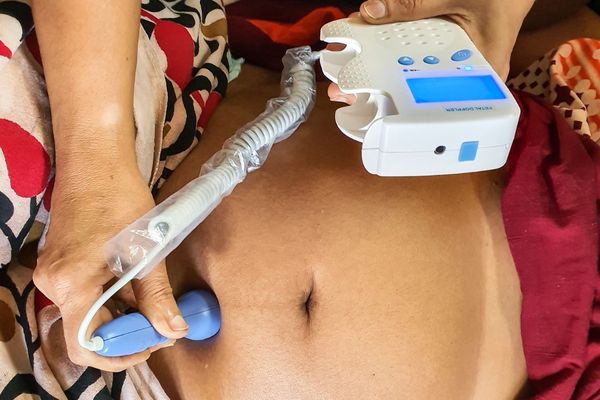
What is a fetal Doppler?
A fetal Doppler is a handheld ultrasound device that detects movement and turns it into sound. During pregnancy, it is used to hear the baby’s heart rate through the abdomen.
A health care provider places ultrasound gel on the skin and moves the probe slowly across the lower abdomen. The provider listens for a fast, rhythmic sound. A fetal heartbeat often sounds like quick galloping or the flutter of tiny wings.
Dopplers are different from a standard stethoscope. A stethoscope may detect fetal heart sounds later in pregnancy, often around 18 to 20 weeks, depending on the device and conditions.
Dopplers are also different from an ultrasound scan. An ultrasound creates an image and can show the baby’s size, movement, and development. A Doppler mainly detects motion and provides a heart rate.
Handheld Doppler versus home Doppler
A clinical Doppler is used by a trained professional during prenatal care. The provider knows where to place the probe and can interpret the sound in context.
A home Doppler may be sold online or through retail stores. It can seem reassuring, but it has limits. Hearing a sound does not prove that the pregnancy is progressing normally, and not hearing a sound does not automatically mean something is wrong.

Can you hear a heartbeat before 10 weeks?
It is possible, but it is not reliable with a handheld Doppler. Before 10 weeks, the embryo is very small, and the uterus may still sit low in the pelvis.
An ultrasound can often detect cardiac activity earlier than a Doppler. Transvaginal ultrasound may show cardiac activity around 6 to 7 weeks, although dates can vary and early findings should be interpreted by a medical professional.
This difference explains why someone may see a heartbeat on an ultrasound but not hear one with a Doppler. The tools work in different ways and have different levels of sensitivity.
If you are asking when can you hear a baby's heartbeat with a Doppler at 8 weeks, the safest answer is that it may be too early. A failed attempt at this stage is common and does not diagnose a problem.
What early cardiac activity means
Early pregnancy scans may show cardiac activity rather than a sound that you can hear. The embryo’s heart is developing, and the rate changes as pregnancy progresses.
Your clinician will consider:
• The estimated gestational age
• The size of the embryo
• The heart rate
• Findings from the ultrasound
• Your symptoms and medical history
One measurement alone rarely gives the full picture. This is why prenatal care uses exams, ultrasounds, and follow-up visits together.
:max_bytes(150000):strip_icc()/GettyImages-516206510-57c5a26f5f9b5855e5b7ac65-4ca07266dc0146dab30dcef6919e8a4e.jpg)
Why might a Doppler not find the heartbeat?
Not hearing a heartbeat does not always mean there is a problem. The most common reason is simply that the pregnancy is still early.
Other common reasons include:
• Your due date may be off by several days.
• The baby may be behind the pubic bone.
• The baby may be facing away from the probe.
• The placenta may be between the probe and the baby.
• The probe may be placed too high or too low.
• The gel or probe angle may not be correct.
• The device may not be sensitive enough.
• The sound may be confused with the mother’s pulse.
A baby’s heartbeat is usually much faster than an adult pulse. The fetal heart rate often ranges from about 110 to 160 beats per minute later in pregnancy, though normal rates can vary by gestational age and clinical situation.
The placenta can change what you hear
An anterior placenta sits at the front of the uterus. It can act like a cushion between the Doppler and the baby.
This does not usually harm the baby. It may simply make the heartbeat softer or harder to locate. Your provider may need to search in a different area or wait until the pregnancy is further along.
The baby can move out of range
Babies move, even in early pregnancy. A small change in position can make the heartbeat disappear from the speaker.
Think of it like trying to pick up a radio station while driving through hills. The signal may be clear in one spot and weak a few inches away.

How health care providers find a fetal heartbeat
At a prenatal visit, the provider usually asks you to lie back in a comfortable position. They may ask you to empty your bladder, depending on how far along you are and the type of exam.
The provider applies gel to your lower abdomen. They then place the Doppler near the pubic bone and move it slowly from side to side.
The process may include these steps:
The provider estimates where the uterus and baby are located.
They apply ultrasound gel to improve contact.
They place the Doppler at a low angle.
They move it slowly rather than sweeping quickly.
They compare the sound with your pulse.
They count or display the fetal heart rate.
A skilled provider may find the heartbeat quickly, but even professionals sometimes need patience. A quiet or unsuccessful search early in pregnancy is not unusual.
How the fetal heartbeat sounds
The fetal heartbeat often sounds like a rapid gallop. Your own pulse may sound slower and more like a soft whoosh.
The Doppler may also pick up:
• Placental blood flow
• Movement in the uterus
• Your abdominal blood vessels
• Bowel sounds
This is why sound alone should not be used for self-diagnosis. A trained provider knows how to distinguish common signals and understands what the heart rate means in context.

Is using a home fetal Doppler safe?
Ultrasound energy is widely used in prenatal care, and medically indicated Doppler exams are generally considered safe when performed by trained professionals. Still, experts advise against unnecessary or prolonged home use.
The main risk is not only the ultrasound energy. The greater concern is misunderstanding the result.
A parent may hear a heartbeat and assume everything is fine, even when urgent symptoms are present. Another parent may fail to find a heartbeat and experience severe panic when the pregnancy is healthy.
The Food and Drug Administration advises that fetal heartbeat monitors should be used only by trained health care professionals or under their supervision. A home Doppler should never replace prenatal visits, ultrasound exams, or medical advice.
If you choose to use one
If you decide to use a home Doppler, keep these safety steps in mind:
• Ask your prenatal care provider for guidance first.
• Use the device only for a short period.
• Follow the manufacturer’s instructions.
• Do not press hard on your abdomen.
• Do not use it to check on reduced fetal movement.
• Do not interpret a number without professional advice.
• Contact your provider if you have pain, bleeding, fluid leakage, fever, or other concerns.
When can you hear a baby's heartbeat with a Doppler at home? Often later than at a clinic, and sometimes not until 14 weeks or beyond. That delay is normal and does not make the device a reliable test of fetal health.

What should you do if you cannot hear the heartbeat?
Try not to assume the worst. If you are less than 12 weeks pregnant, it may simply be too early for a Doppler.
Call your prenatal care provider if the heartbeat cannot be found at a medical appointment. The provider may repeat the Doppler check, review your dates, or recommend an ultrasound.
Seek urgent medical care for symptoms such as:
• Heavy vaginal bleeding
• Severe or one-sided abdominal pain
• Fainting or severe dizziness
• Fever with pelvic pain
• A gush or steady leak of fluid
• A major change in fetal movement later in pregnancy
Do not wait for a Doppler reading if you feel unwell. A home device cannot rule out miscarriage, ectopic pregnancy, placental problems, or other complications.
A practical example
Suppose you are 11 weeks pregnant and a home Doppler does not find a heartbeat. This result is not enough to show that anything is wrong. Your dates may be slightly earlier than expected, or the baby may be too small and low in the pelvis.
Now suppose you are 24 weeks pregnant and notice much less movement than usual. Listening with a home Doppler is not a safe substitute for calling your maternity unit or provider. Reduced movement needs clinical assessment, even if you hear a heartbeat.

What is a normal fetal heart rate?
A typical fetal heart rate later in pregnancy is often about 110 to 160 beats per minute. The rate can change with movement, sleep, gestational age, contractions, and other factors.
A brief reading outside that range does not always mean an emergency. Providers look at the pattern over time, not only one number.
A home Doppler may display a rate that is inaccurate if it detects the mother’s pulse or placental blood flow. The number may also change when the probe shifts.
This is why you should not compare your reading with someone else’s reading online. Every pregnancy has its own timing and clinical details.
Heart rate changes during pregnancy
The fetal heart begins developing early, and its rate changes as the pregnancy progresses. It may rise during early development and then settle into a more stable pattern.
Your provider may explain the result based on:
• How many weeks pregnant you are
• Whether the baby is moving
• Whether you have contractions
• The quality of the Doppler signal
• Findings from other prenatal tests
A single Doppler check offers only a small piece of information. Prenatal care is more like assembling a puzzle: the heartbeat is one piece, not the whole picture.

Common mistakes to avoid with a pregnancy Doppler
Many problems come from using the device too early or expecting it to provide medical certainty.
Avoid these common mistakes:
• Searching for the heartbeat for a long time
• Pressing the probe firmly into the abdomen
• Using little or no gel
• Moving the probe too quickly
• Checking the same spot repeatedly
• Confusing your own pulse with the fetal heartbeat
• Believing a heartbeat confirms a healthy pregnancy
• Ignoring symptoms because a heartbeat was heard
• Comparing your result with online videos
One of the most important lessons in prenatal care is that reassurance and diagnosis are not the same thing. A Doppler can offer a moment of connection, but it cannot assess every part of maternal or fetal health.
Tips for a clearer clinical reading
At a medical visit, these factors may help:
• Wear clothing that allows easy access to the lower abdomen.
• Tell the provider your estimated due date.
• Mention if you have been told that you have an anterior placenta.
• Ask what the reading means for your stage of pregnancy.
• Ask when you should call if symptoms develop.
The best time to ask questions is during a prenatal visit, when a professional can explain the result in relation to your health.
When can you hear a baby’s heartbeat with a Doppler during different stages?
Timing differs throughout pregnancy. The following guide gives general expectations, not a promise for every pregnancy.
Before 10 weeks
A handheld Doppler often cannot detect the heartbeat. An ultrasound may be more useful if your clinician needs to confirm early pregnancy development.
Around 10 to 12 weeks
Some clinicians can hear the heartbeat during this period. It may still take time, and an unsuccessful attempt can be completely normal.
Around 12 to 14 weeks
The heartbeat is often easier to find during a clinic visit. Baby position, placenta location, and body shape still affect the result.
After 14 weeks
Many providers can detect the heartbeat with a Doppler at routine appointments. A home device may still need careful positioning and may not give a dependable reading.
After 20 weeks
The heartbeat is usually easier to locate, but fetal movement and position can still change the sound. Later in pregnancy, changes in movement should be discussed with your provider rather than checked only with a Doppler.
So, when can you hear a baby's heartbeat with a Doppler? The broad clinical range is about 10 to 14 weeks, while home detection may take longer.
Emotional side of listening to the heartbeat
Hearing a baby’s heartbeat can bring joy, relief, and a strong sense of connection. It can also create worry when the sound is hard to find.
Both reactions are normal. Early pregnancy often involves waiting, uncertainty, and many questions. A missed heartbeat on a home device can turn an exciting moment into a stressful one within seconds.
Try to set realistic expectations before using a Doppler. If you know that the device may not work early, you may be less likely to panic when the speaker stays quiet.
A useful approach is to treat the Doppler as a medical tool, not a home reassurance test. Let your prenatal team provide the reassurance and evaluation you need.
Frequently Asked Questions
When can you hear a baby’s heartbeat with a Doppler at a doctor’s office?
Many providers can detect it between 10 and 12 weeks, but it is often easier around 12 to 14 weeks. The exact timing depends on the baby’s position, placenta location, body shape, device, and provider experience.
When can you hear a baby’s heartbeat with a Doppler at home?
Many people cannot detect it until 12 to 16 weeks or later. Home Dopplers vary in quality, and not finding a heartbeat does not show that the pregnancy is unhealthy.
Can a Doppler detect a heartbeat at 8 weeks?
It may be possible in rare cases, but a handheld Doppler often cannot detect the heartbeat that early. Ultrasound is usually better for evaluating early pregnancy development.
Is it normal not to hear a heartbeat at 12 weeks?
Yes, it can be normal, especially if your dates are off or the baby is in a difficult position. Your health care provider may repeat the check or use an ultrasound for a clearer assessment.
Can you hear the baby’s heartbeat with a stethoscope?
A stethoscope may detect fetal heart sounds later in pregnancy, often around 18 to 20 weeks. The timing varies with the device, pregnancy, baby’s position, and placenta location.
Can hearing a heartbeat confirm that the baby is healthy?
No. A heartbeat is reassuring, but it does not assess growth, oxygen levels, anatomy, placenta function, or every possible pregnancy problem. Continue regular prenatal care even when a heartbeat is heard.
What should I do if I cannot find the heartbeat at home?
Stop searching rather than using the Doppler for a long time. Contact your prenatal provider for guidance, and seek urgent care for bleeding, severe pain, fluid leakage, fainting, or other concerning symptoms.
Conclusion
You can often hear a baby’s heartbeat with a Doppler at about 10 to 12 weeks in a clinic, although 12 to 14 weeks is more reliable for many pregnancies. Home Dopplers may not work until later, and a quiet device does not automatically mean something is wrong.
Use Dopplers carefully, avoid treating them as diagnostic tools, and never let a heartbeat replace prenatal care. If you have symptoms or concerns, contact your health care provider directly. For more pregnancy guidance, explore trusted prenatal resources and bring your questions to your next appointment.