
In the United States, most babies are ready to use a high chair for meals at about 6 months old. Age alone does not decide readiness. Your baby should also hold their head and neck steady, sit upright with little help, and show other signs that they are ready for solid foods.
A baby does not need to sit completely alone before using a high chair. However, they must be able to stay upright with support and keep their head from slumping forward. Always follow the high chair’s manual, use every safety strap, and stay within arm’s reach while your baby is seated.

The Short Answer: Around 6 Months, With Good Head and Trunk Control
Most babies can start sitting in a high chair when they are close to 6 months old, provided they meet the physical readiness signs. Some babies are ready a little earlier or later.
The key question is not, “Has my baby reached 6 months?” It is:


Can my baby sit upright safely, keep their head steady, and remain in a supported position?
A baby may be ready if they can:
- Hold their head up without wobbling.
- Keep their head centered rather than letting it fall forward.
- Sit upright with little support.
- Control their upper body for several minutes.
- Reach for toys or food without collapsing sideways.
- Show interest in food.
- Open their mouth when food approaches.
- Move food from the front of the mouth toward the back.
- Stop pushing every spoonful out with the tongue.
The Centers for Disease Control and Prevention lists sitting without support as a milestone that many babies reach by about 9 months. That does not mean you must wait until 9 months to use a high chair. A properly designed chair can provide support while your baby is learning to sit independently.
Still, a baby who cannot hold their head steady or who folds forward in the chair is not ready for upright feeding. Wait and ask the child’s health care professional for advice.

Signs Your Baby Is Ready for a High Chair
Readiness depends on posture, head control, and feeding skills more than on a specific birthday.
1. Your baby has steady head control
Your baby should keep their head upright without it bobbing or dropping. Good head control helps them breathe, swallow, and manage food safely.
A baby who repeatedly lets their chin fall toward their chest may need more time. This position can make it harder to manage food and may affect breathing.
2. Your baby can sit with support
Your baby does not need to sit on the floor alone. They should, however, remain upright when placed in a high chair with its built-in support.
Watch what happens after you secure your baby:
- Do they stay centered?
- Do they lean only slightly?
- Can they bring their head back to midline?
- Do they remain alert and engaged?
- Do their hips stay low rather than sliding forward?
If your baby slumps, slides under the tray, or falls to one side, the chair may not fit well or your baby may need more time.


3. Your baby shows interest in food
Interest in food is helpful, but it is not enough by itself. A baby may watch you eat long before they can safely manage solid foods.
Stronger signs include reaching for food, opening the mouth when food comes near, and swallowing small amounts rather than pushing them out with the tongue.
4. Your baby can coordinate hands, eyes, and mouth
Babies need to see food, reach for it, bring it to the mouth, and begin learning how to chew or mash it. These skills develop over time.
At first, meals may be messy and slow. That is normal. The goal is not to eat a large amount right away. The goal is to practice safe feeding.

High Chair Readiness Checklist
Use this quick checklist before the first meal. Your baby does not need to perform every skill perfectly, but the basic posture and head-control signs should be present.
| Readiness sign | What to look for |
|---|---|
| Age | Usually about 6 months, but age is only one factor |
| Head control | Head stays upright and centered |
| Trunk control | Baby does not fold forward or slump |
| Supported sitting | Baby stays upright with the chair’s support |
| Alertness | Baby can stay awake and engaged during a meal |
| Feeding interest | Baby watches, reaches, opens their mouth, or accepts food |
| Swallowing | Baby can move food back instead of pushing it out every time |
| Chair fit | Harness fits snugly and the chair supports the baby correctly |
If the answer is “no” to head control or upright posture, do not begin chair feeding yet. Try again in a week or two, unless your pediatrician has given different advice.
For babies born prematurely, ask the pediatrician how to judge readiness. Developmental skills and corrected age may matter more than the original due date or birth date.

How to Use a High Chair Safely
A safe high chair is only safe when an adult uses it correctly. The American Academy of Pediatrics and the U.S. Consumer Product Safety Commission stress the need for close supervision and proper restraint.
1. Read the manufacturer’s instructions
Check the chair’s age, weight, height, and developmental limits. Some chairs are made for babies who can sit independently. Others provide more support for younger infants.
Do not use a chair in a way the manufacturer does not allow. Do not add pillows, rolled towels, cushions, or homemade supports unless the manual specifically permits them.
2. Use the full restraint system
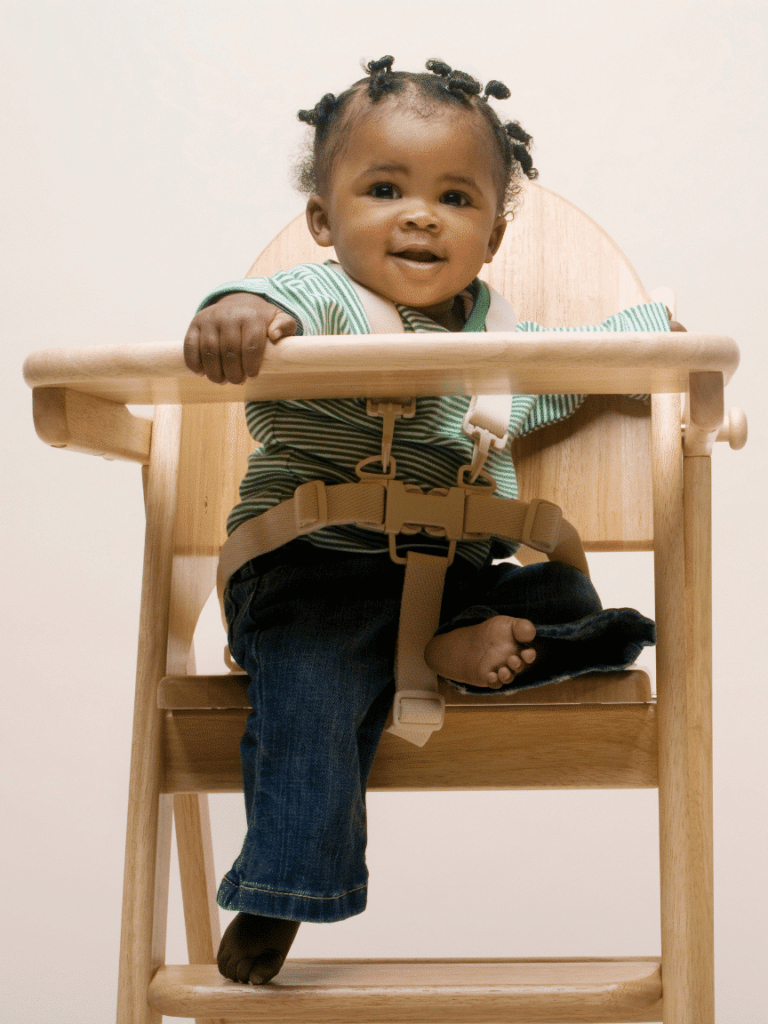
Fasten the waist strap and the strap that passes between the legs, if the chair has one. The tray is not a restraint.
The harness should be snug but not painfully tight. Check that your baby cannot slide under the tray or stand up in the chair.
3. Place the chair on a stable floor
Set the high chair on a flat floor away from stairs, cords, table edges, windows, and hot surfaces. Do not place it on a table, countertop, bed, sofa, or other raised surface.
Keep the chair far enough from a table or counter that your baby cannot push against it and tip the chair.
4. Stay close during every meal
Stay within arm’s reach and watch your baby while they eat. Do not leave the room, even for a short task.


A baby can choke silently. A caregiver should be able to respond quickly if the baby coughs, gags, or struggles to breathe.
5. Inspect the chair often
Before each use, check that:
- The harness works and is not torn.
- Screws, bolts, and locking parts are tight.
- The chair does not wobble.
- The tray locks in place.
- There are no broken or sharp parts.
- The chair has not been recalled.
You can search for recalls through the U.S. Consumer Product Safety Commission at CPSC.gov.

High Chair Position: How Upright Is Upright Enough?
Your baby should sit in a position that keeps the head and chest upright. A slight recline may be allowed by some chair designs, but feeding a baby in a deeply reclined position is not appropriate for spoon-feeding or finger foods.
Look at your baby from the side:
- The head should remain above the chest.
- The chin should not rest on the chest.
- The back should be supported.
- The hips should stay back in the seat.
- The knees may bend naturally.
- The feet may rest on a footrest when available.
A footrest can give a baby more stability, but it does not replace head and trunk control. If your baby still slumps despite correct adjustment, stop the meal and reassess the chair’s fit.
Avoid using the high chair for sleep. If your baby falls asleep, move them to a safe sleep space on a firm, flat surface, placed on their back, according to American Academy of Pediatrics safe-sleep guidance.

What to Feed a Baby in the High Chair
Once your baby is developmentally ready, offer age-appropriate foods in a form that is soft and easy to manage. Start with small amounts and allow your baby to set the pace.
Safe early options may include:
- Smooth or mashed vegetables.
- Soft fruits.
- Iron-fortified infant cereal.
- Mashed beans.
- Soft, finely shredded meat or fish without bones.
- Plain yogurt without added sugar.
- Soft strips of cooked vegetables.
- Other foods recommended by your pediatrician.
Introduce foods in textures your baby can manage. Always remove bones, pits, hard pieces, and tough skins.
Do not give foods that pose a choking risk. The CDC and the Food and Drug Administration identify choking as a major feeding hazard for young children. Examples may include whole grapes, raw pieces of apple or carrot, nuts, popcorn, chunks of meat, hot dogs, hard candy, and spoonfuls of nut butter.
Cut and prepare food based on your baby’s age and feeding skills. A pediatrician or feeding specialist can help if you are unsure about texture or portion size.
What to Do If Your Baby Slumps, Cries, or Tries to Climb Out
A poor response does not always mean your baby is not ready. It may mean the chair needs adjustment, the meal is too long, or your baby is tired.
If your baby slumps forward
Stop feeding and check the following:


- Is the harness fastened correctly?
- Is the seat adjusted according to the manual?
- Is the tray too far away?
- Is your baby too small for the chair?
- Does your baby have enough head and trunk control?
Do not use blankets or pillows to force your baby into position unless the manufacturer and your pediatrician specifically recommend them.
If your baby leans to one side
A small amount of leaning can happen as babies build strength. Repeated or severe leaning may signal a poor chair fit or a developmental concern.
Remove your baby from the chair if they cannot stay upright. Ask your pediatrician for guidance, especially if your baby always leans to the same side or seems unusually stiff or floppy.
If your baby cries
Your baby may be tired, hungry, overstimulated, uncomfortable, or not ready for the chair. Keep the first sessions short. Let your baby sit in the chair without food for a few minutes while you stay close.
Never force food or keep a distressed baby strapped in for a long meal.
If your baby tries to stand or climb
End the session. Check the harness and chair setup. If your baby repeatedly tries to climb out, they may be uncomfortable, bored, or developmentally ready for a different feeding setup.
Never allow a baby to stand in a high chair, even when an adult is nearby.

High Chair Alternatives Before Your Baby Is Ready
Do not rush a baby into a high chair just because family meals have started. Before your baby has reliable head and trunk control, feeding should follow advice from the child’s pediatrician.
Some families use a supported infant seat for short periods before high-chair readiness. These seats are not automatically safe for feeding. Check the product’s instructions and make sure your baby is not slumped or left unattended.
A caregiver may also hold a baby during early tastes if the baby’s health care professional approves and the baby can remain upright. Never feed a baby while they are lying flat, moving in a car, or resting in an unsafe sleep position.
The best option is the one that supports an upright posture and allows close supervision.

When to Ask a Pediatrician for Help
Contact your child’s pediatrician if you are unsure whether your baby is ready, especially if your baby:
- Cannot hold their head steady near 6 months.
- Always slumps or falls to one side.
- Seems very stiff or very floppy.
- Coughs or struggles with nearly every bite.
- Has trouble swallowing.
- Has poor weight gain.
- Was born prematurely or has a medical condition.
- Shows a major loss of a skill they previously had.
A pediatrician may refer your baby to an occupational therapist, speech-language pathologist, or feeding specialist. These professionals can assess posture, swallowing, oral motor skills, and food texture needs.


If your baby is choking and cannot breathe, call 911 and use infant choking first aid if you are trained. Gagging can be noisy and may be part of learning, while choking may be quiet and prevent normal breathing. Learn the difference before starting solid foods.

Common Mistakes Parents Make
Several common habits can make high-chair use less safe:
- Starting based only on age.
- Treating the tray as a safety belt.
- Leaving the baby alone “for just a minute.”
- Feeding while the baby is slumped.
- Using pillows or towels as makeshift supports.
- Putting the high chair on a table or counter.
- Letting the baby stand in the chair.
- Giving hard, round, sticky, or large pieces of food.
- Allowing a baby to sleep in the chair.
- Buying a used chair without checking for recalls or missing parts.
- Continuing a meal after the baby becomes tired or loses posture.
A calm, short meal in a properly fitted chair is safer than a long meal that leaves your baby struggling to sit upright.

Frequently Asked Questions
Can a 4-month-old sit in a high chair?
Some 4-month-olds may sit in a reclined infant seat designed for their age, but most are not ready for upright high-chair feeding. A baby should have strong head control and be able to stay upright with support. Ask your pediatrician before starting solids or using a high chair for meals at this age.
Does my baby need to sit independently before using a high chair?
No. A baby may use a supportive high chair before sitting fully alone. They do need steady head control and enough trunk strength to remain upright without folding forward or sliding down.
Can my baby sit in a high chair at 5 months?
Some babies are ready around 5 months, while others need more time. Look for stable head control, supported sitting, and other feeding-readiness signs. If your baby is not steady, wait rather than using age alone as the deciding factor.
How long can a baby sit in a high chair?
Keep early sessions short and supervised. Remove your baby when they become tired, slump, cry, or try to climb. The chair should be used for meals and brief seated activities, not as a place to sleep or spend long periods.
Is it safe to feed a baby in a reclining high chair?
A slight recline may be part of a chair’s approved design, but babies should be upright enough to manage food safely. Do not feed a baby who is deeply reclined or whose chin falls toward the chest. Follow the chair instructions and ask your pediatrician if the position is unclear.
Conclusion: Use Readiness, Not Age Alone
Most babies begin using a high chair at about 6 months, but the safest time depends on development. Your baby should hold their head steady, sit upright with support, and show signs of readiness for solid foods.
Use the full harness, keep the chair on the floor, stay within arm’s reach, and stop if your baby slumps or struggles. When in doubt, wait and ask your pediatrician.
Next step: Place your baby in the chair without food for a brief, supervised trial. If they stay upright, alert, and comfortable, check the chair manual and discuss starting solids with their pediatrician.
Sources
- American Academy of Pediatrics: Starting Solid Foods
- American Academy of Pediatrics: High Chair Safety
- Centers for Disease Control and Prevention: Developmental Milestones
- Centers for Disease Control and Prevention: Foods and Drinks for 6 to 24 Month Olds
- U.S. Consumer Product Safety Commission: High Chair Safety
- U.S. Food and Drug Administration: Food Choking Hazards
