
A baby can sleep in a bassinet until they reach the bassinet’s weight limit or developmental limit—whichever comes first. Stop using it sooner if your baby can roll, push up on their hands and knees, sit up, or pull up, unless the product manual gives a stricter limit.
There is no single age that fits every bassinet. Many bassinets are made for young infants and may have limits around 15 to 20 pounds, but the exact limit depends on the model. Always check the manufacturer’s instructions.
For safe sleep in the United States, the American Academy of Pediatrics (AAP) recommends placing babies:
- On their backs for every sleep
- On a firm, flat, level surface
- In their own sleep space
- Without pillows, blankets, bumpers, toys, or other loose items


A bassinet is usually meant for the early months, not for long-term use through the first year.
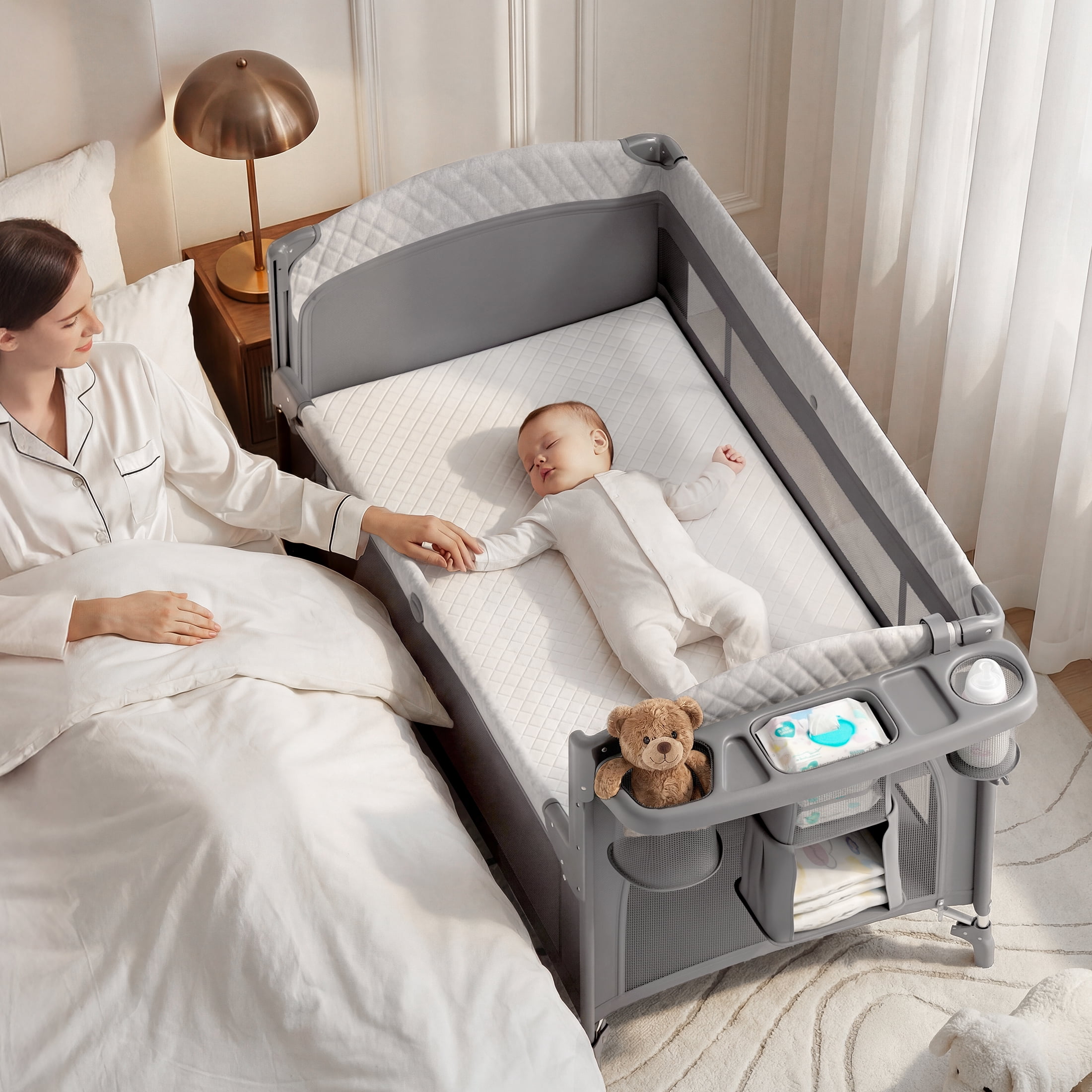
What “How Long” Means: Sleep Duration Versus Bassinet Age Limit
“How long can babies sleep in a bassinet?” can mean two different things:
- How many hours can a baby sleep at one time?
- How many weeks or months can a baby use the bassinet?
The safe answer is different for each question.
How long can a baby sleep at one time?
A bassinet may be used for naps and nighttime sleep if it is designed and approved for infant sleep. There is no general rule that says a baby must leave the bassinet after a certain number of hours in one sleep period.
Newborns often wake to feed. Some sleep for short periods, while others have a longer stretch at night. The total amount of sleep varies with age, feeding, health, and development.
If your baby is a newborn, ask your pediatrician whether you should wake them for feeds. This may be needed for babies who were born early, have trouble gaining weight, have jaundice, or have another health concern. Do not rely on the bassinet’s safety rating to decide how often a baby needs to eat.
How many months can a baby use a bassinet?
The use period ends when the first of these limits occurs:
- Your baby reaches the product’s weight limit.
- Your baby reaches the product’s height limit, if one is listed.
- Your baby can roll or shows signs of trying to roll.
- Your baby can push up on their hands and knees.
- Your baby can sit up, pull up, or move into an unsafe position.
- The manufacturer says to stop use.
Some bassinets have a fixed age limit. Others do not. A product marked “newborn to 5 months” may require earlier removal if the baby reaches a developmental milestone before 5 months.
The U.S. Consumer Product Safety Commission’s federal bassinet and cradle rule includes a limit tied to developmental ability. In general, a bassinet is not intended for a child who can push up on their hands and knees or who reaches the manufacturer’s stated weight limit, whichever comes first.
The exact instructions for your model still control how you should use it.

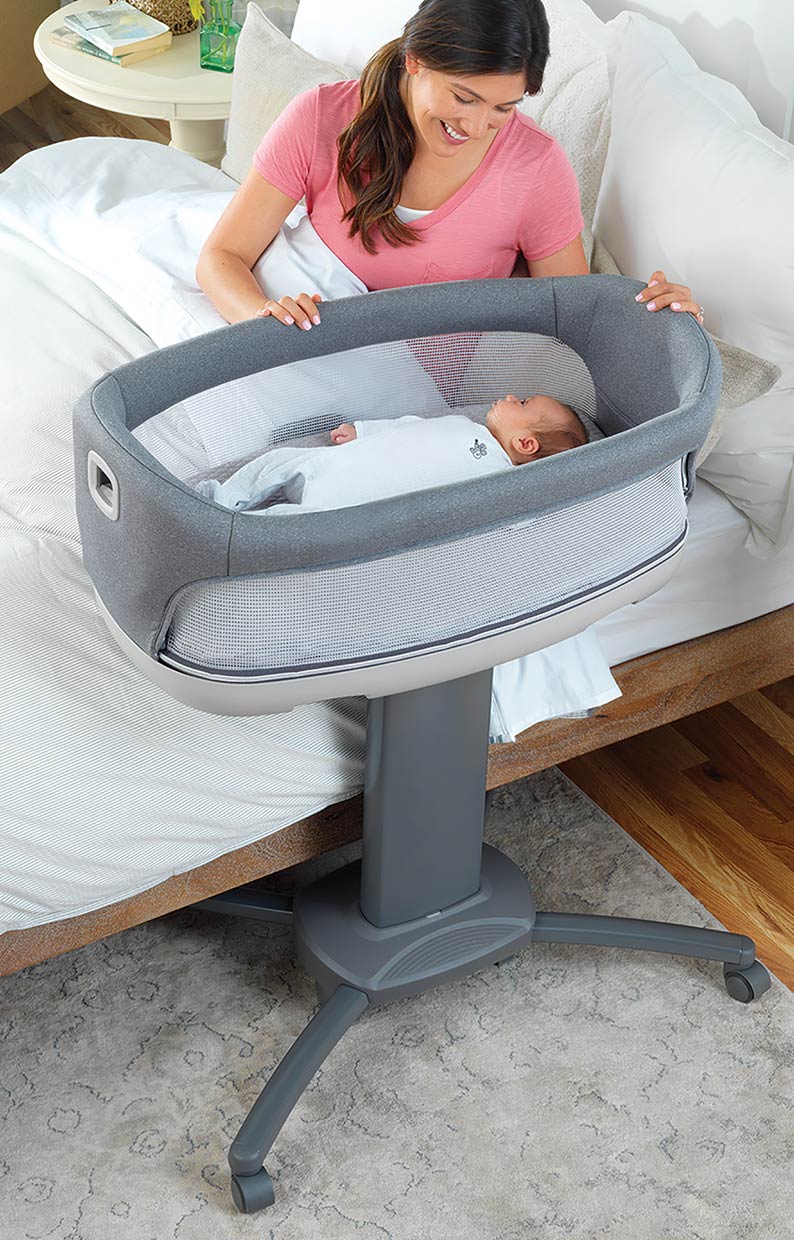
When Should You Move a Baby Out of a Bassinet?
Move your baby to a crib or play yard as soon as the bassinet’s limit is reached or your baby becomes mobile enough to make the bassinet unsafe.
Stop using the bassinet if your baby can roll
Rolling is one of the clearest signs that it may be time to stop using a bassinet. A baby who rolls may press against the side, shift into an awkward position, or get closer to the edge.
Some bassinets have low sides. They may not provide enough room or height once a baby begins to move with purpose.
If your baby rolls from back to stomach, gently return them to their back when you notice it. Once a baby can roll both ways on their own, you do not need to keep turning them back each time, but you must still place them on their back at the start of every sleep.
Stop using it if your baby pushes up
A baby who can push up on their hands and knees may be able to raise their body higher than the bassinet was designed to contain. This can increase the chance of falling or getting stuck.
Do not wait until your baby climbs out. The first signs of pushing up, sitting, or pulling up may be enough to end bassinet use.
Follow the strictest limit
Use this simple rule:
The earliest limit wins: weight, age, development, or the manufacturer’s written instructions.
For example, if a bassinet says it is for babies up to 20 pounds but instructs parents to stop use when the baby begins to roll, rolling ends use first.
Quick decision table
| Situation | Continue using the bassinet? | What to do |
|---|---|---|
| Baby is below the weight limit and cannot roll | Usually yes | Follow the manual and safe-sleep rules |
| Baby reaches the weight limit | No | Move to a compliant crib or play yard |
| Baby begins rolling | Usually no | Check the manual and prepare a new sleep space |
| Baby pushes up on hands and knees | No | Stop using the bassinet |
| Baby can sit or pull up | No | Move the baby immediately |
| Bassinet has damage or loose parts | No | Stop use and contact the manufacturer |

How to Use a Bassinet Safely
A safe bassinet setup is simple: a firm, flat sleep surface, a fitted sheet, and no loose items.
1. Use only a sleep-approved product
A bassinet should be designed for infant sleep. A baby lounger, nest, pod, stroller seat, car seat, swing, or inclined sleeper is not automatically a safe substitute.
Check that the product:
- Has a firm, flat, level sleep surface
- Has sides that keep the baby in the sleep area
- Comes with clear safety and weight instructions
- Has no broken, missing, or loose parts
- Is used according to the manufacturer’s instructions
The CPSC’s safe-sleep guidance warns against products with inclined sleep surfaces and against using sitting or lounging products for routine sleep.
2. Put the baby on their back
Place your baby on their back for every nap and nighttime sleep. Do this even if your baby sleeps more soundly on their stomach or side.


Side and stomach sleeping can make it harder for a young baby to breathe. Do not use positioning devices to keep a baby in one position unless a health professional gives specific medical instructions.
3. Keep the sleep space empty
The bassinet should contain only:
- The baby
- A firm mattress or pad made for that bassinet
- A fitted sheet made for that mattress
Do not add:
- Pillows
- Quilts
- Comforters
- Loose blankets
- Stuffed animals
- Bumpers
- Mattress toppers
- Wedges
- Sleep positioners
These items can cover a baby’s nose and mouth or cause overheating.
4. Keep the bassinet in your room
The AAP recommends room sharing without bed sharing. Keeping the bassinet near your bed can make feeding and checking on your baby easier while avoiding the risks of sharing an adult bed.
The AAP recommends room sharing ideally for at least the first six months and preferably for the first year when practical. This does not mean the baby must remain in the bassinet for that entire time. A crib or play yard can also be placed in the parents’ room.
5. Use a safe swaddle routine
If you swaddle your baby, place the baby on their back and use a light, properly fitted swaddle. Stop swaddling as soon as the baby shows signs of trying to roll.
Never use a weighted swaddle or weighted sleep product for an infant. A wearable blanket that leaves the arms free can be used after swaddling ends, as long as it fits correctly and does not overheat the baby.

How to Know Whether Your Bassinet Is Still Appropriate
Check three things: the product, the baby, and the sleep setup.
Check the product
Read the bassinet manual or the label attached to the product. Look for:
- Maximum weight
- Maximum age, if listed
- Developmental limits
- Mattress requirements
- Sheet requirements
- Folding or travel-use instructions
- Warnings about swaddling, rocking, or attachments
If you bought the bassinet used, find the exact model number. Search the manufacturer’s website for recalls and updated instructions. Do not assume that a similar-looking model has the same limits.
Check your baby
Ask yourself:
- Has my baby started rolling?
- Does my baby lift their chest with their arms?
- Can my baby push onto their hands and knees?
- Can my baby sit without help?
- Does my baby pull on the sides?
- Has my baby reached the listed weight limit?
If the answer is yes to any developmental limit in the manual, stop using the bassinet.


Check the sleep surface
The mattress should fit tightly, without gaps around the edges. Use only the pad supplied or approved by the manufacturer.
Do not make the surface softer by adding a blanket under the sheet. Do not raise one end of the mattress for reflux unless your child’s clinician gives specific instructions for a medically necessary setup. Babies can slide into a position that makes breathing harder on an inclined surface.
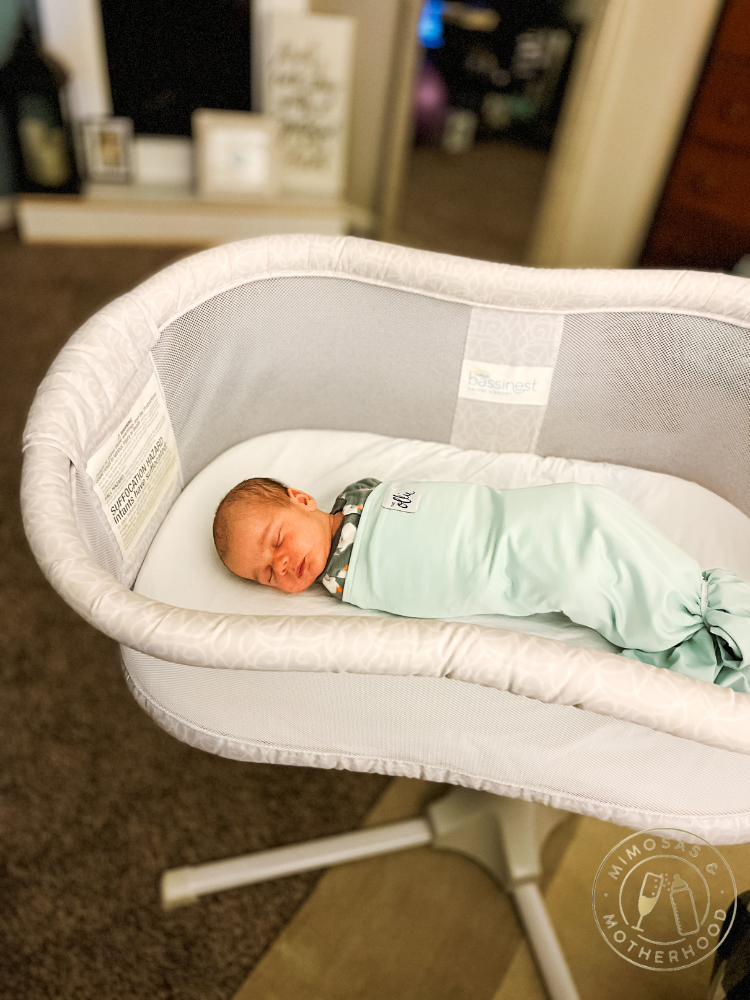
What to Use After the Bassinet
When your baby outgrows the bassinet, the usual next step is a full-size crib, mini crib, or play yard that meets current U.S. safety requirements.
The new sleep space should have:
- A firm, flat mattress
- A fitted sheet
- No loose bedding or objects
- Enough room for the baby to move safely
- Correctly installed parts
A baby does not need to sleep in a bassinet before using a crib. You can start with a crib from birth if it meets safety standards and is set up correctly.
Bassinet versus crib
| Feature | Bassinet | Crib or play yard |
|---|---|---|
| Best use | Early months | Longer-term infant sleep |
| Size | Small and easy to keep near the bed | Larger sleep area |
| Main limit | Often reached when baby becomes mobile | Usually lasts longer |
| Portability | Often easier to move | Some play yards are portable |
| Transition point | Weight or movement limit | Product-specific age and weight limits |
The key difference is not that a crib is automatically safer than a bassinet. Both can be safe when they meet current standards and are used as directed. The bassinet simply has a shorter useful period and less room for a moving baby.

Common Bassinet Mistakes to Avoid
Waiting for a specific age
A baby does not become safe to keep in a bassinet just because they have not reached a certain month. Development matters more than age.
A four-month-old who rolls may need to move out sooner than a five-month-old who remains still. Use the bassinet’s written limits and your baby’s abilities together.
Using a bassinet as a general baby holder
Some bassinets are made for sleep. Others are only meant for supervised rest, travel, or temporary use. A product that looks like a bassinet may not meet the same requirements.
Check the manual before using it for overnight sleep.
Adding padding
Parents sometimes add padding because the original mattress feels firm. That firmness is intentional. A soft topper, folded towel, pillow, or extra pad can create gaps or increase the risk of suffocation.
Use the original mattress and the correct fitted sheet only.
Letting the baby sleep in a car seat
A car seat is essential for travel, but it is not a routine sleep space outside the vehicle. If your baby falls asleep during a car ride, move them to a firm, flat sleep surface when you arrive, when it is safe to do so.
The same principle applies to swings, bouncers, loungers, and strollers.
Continuing to swaddle after rolling begins
Swaddling can limit a baby’s ability to use their arms when they roll. Stop as soon as the baby shows signs of rolling, even if the baby has not completed a roll yet.


Using a recalled or damaged bassinet
Stop using any bassinet with:
- A cracked frame
- Loose mesh
- Missing hardware
- A bent support
- A mattress gap
- A broken locking mechanism
- A recall notice
Check the CPSC recall database and contact the manufacturer if you cannot confirm the product’s safety.

What to Do if Your Baby Keeps Waking in the Bassinet
Frequent waking does not usually mean that the bassinet is too small or unsafe. Young babies wake often because they need food, comfort, help regulating temperature, or a clean diaper.
First, confirm that the sleep space is safe. Then check basic needs:
- Feed the baby according to your pediatrician’s guidance.
- Check the diaper and clothing.
- Keep the room comfortable without overheating the baby.
- Use a calm, low-light routine.
- Place the baby on their back in the bassinet while drowsy or awake.
- Avoid moving the baby to an adult bed, couch, or recliner for sleep.
If the baby seems uncomfortable, has trouble breathing, vomits repeatedly, has a fever, feeds poorly, or is difficult to wake, contact a health professional promptly. Seek emergency help for severe breathing trouble, blue or gray skin, limpness, or an inability to wake the baby.
Sleep problems alone are not a reason to use wedges, positioners, inclined products, or loose bedding.

Frequently Asked Questions
Can a baby sleep in a bassinet all night?
Yes, if the bassinet is approved for infant sleep, the baby is within its weight and developmental limits, and the space is set up safely. There is no general rule that limits a baby to a certain number of nighttime hours in a compliant bassinet.
Can a baby sleep in a bassinet after rolling?
Usually, no. Stop using the bassinet when your baby begins to roll unless the manufacturer clearly states that the product is designed for that stage. A crib or play yard usually provides more room and is more appropriate for a mobile baby.
Is a bassinet safer than a crib?
Neither is automatically safer. A compliant bassinet and a compliant crib can both provide a safe sleep surface when used correctly. A bassinet is smaller and often easier to keep beside the bed, but it has a shorter use period.
Can a baby sleep in a bassinet with a blanket?
The safest setup is a bare bassinet with no loose blanket. If your baby needs warmth, use clothing or a properly fitted, non-weighted wearable blanket. Follow the product’s temperature guidance and avoid overheating.
What if my baby reaches the weight limit but cannot roll?
Stop using the bassinet when the weight limit is reached, even if your baby has not started rolling. The weight limit is a safety boundary based on the product’s design and stability.
Can a newborn sleep in a crib instead of a bassinet?
Yes. A crib, mini crib, or play yard can be used from birth if it has a firm, flat sleep surface and is set up according to the manufacturer’s instructions. A bassinet is convenient, but it is not required.
The Bottom Line
Babies can sleep in a bassinet for naps and overnight sleep until they reach the product’s weight or developmental limit. In practice, the transition often happens when a baby starts rolling, pushes up, sits, pulls up, or reaches the stated weight limit.
Use the manual for the exact model. Keep the bassinet bare, place your baby on their back, and move them to a compliant crib or play yard as soon as the first limit is reached.
