
No, you usually do not need a bassinet mattress protector for safe sleep. A bassinet needs a firm, flat, bare sleep surface with a tight-fitting sheet. The safest setup is the mattress that came with the bassinet, covered only by a sheet made for that mattress.
A protector may help with spit-up, milk, sweat, or diaper leaks. But it is optional. It must not make the sleep surface soft, loose, raised, or less secure.
In the United States, the American Academy of Pediatrics (AAP) advises using a firm, flat surface with a fitted sheet and no loose bedding or soft items. The U.S. Consumer Product Safety Commission (CPSC) also sets safety rules for bassinets and cradles. Always check your bassinet’s manual before adding any accessory.


What Is a Bassinet Mattress Protector?
A bassinet mattress protector is a thin layer placed over the bassinet mattress and under the fitted sheet. Its main job is to block fluids and stains.
Some protectors use:
- Waterproof polyurethane or similar backing
- Quilted fabric
- A fitted design with elastic edges
- A removable, washable cover
- A thin pad made for a specific bassinet model
A protector is not the same as a mattress pad, cushion, topper, or extra mattress. Those products may add padding or change the fit. That difference matters because a bassinet sleep surface must stay firm and flat.
Mattress protector vs. mattress pad
The names can be confusing. A protector usually aims to block moisture. A mattress pad often adds padding. Some products use both terms in their names, so read the product details carefully.
Avoid any item that:
- Makes the mattress feel softer
- Adds visible loft or thickness
- Has thick quilting or foam
- Fits loosely
- Covers only part of the mattress
- Creates folds or wrinkles
- Is not made for your bassinet
The product name does not prove that an item is safe for infant sleep. The fit, thickness, and manufacturer’s instructions matter more.
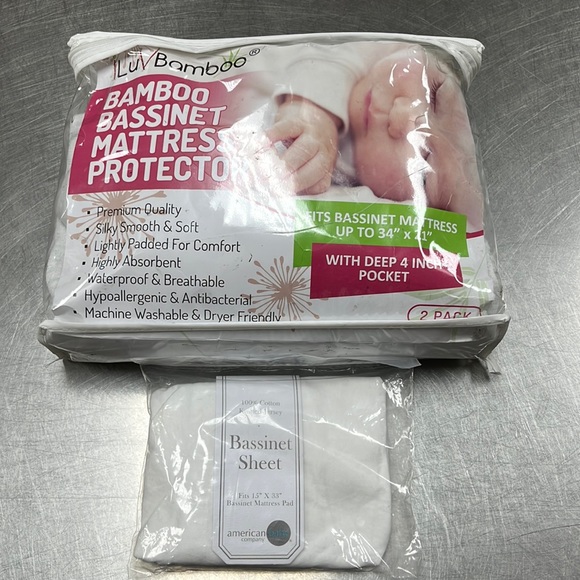
When Is a Bassinet Mattress Protector Useful?
A protector can be useful when you want to reduce stains and washing. Newborns often spit up, sweat, or have diaper leaks. A waterproof layer can help keep liquid from reaching the bassinet mattress.
It may be especially useful if:
- Your bassinet mattress has a removable cover
- The manufacturer allows a protector
- You use a thin protector made for that exact model
- You can wash the protector often
- The protector stays tight and flat under the sheet
The benefit is mainly practical. It helps with cleaning. It does not make the bassinet safer, reduce the risk of sleep-related death, or replace safe-sleep practices.
A protector is also not a substitute for checking the baby after a large spill. If the sheet or protector becomes wet, remove the baby from the bassinet and change the bedding.
When you may not need one
You may skip a protector if:


- The bassinet mattress already has a waterproof, washable cover
- The manual says not to use extra bedding
- The protector does not fit tightly
- You cannot confirm its thickness or materials
- It causes the sheet to loosen
- It changes the mattress shape or fit
A simple setup is often the safest setup. If the original mattress is easy to clean, adding another layer may offer little benefit.

Is a Mattress Protector Safe for a Newborn?
It can be safe only when it is approved or allowed by the bassinet maker and fits correctly. A protector that is loose, thick, or poorly matched to the mattress can create a safety problem.
The AAP’s safe-sleep guidance recommends:
- A firm, flat, non-inclined sleep surface
- A fitted sheet made for that surface
- No pillows, blankets, bumpers, toys, or other loose items
- Placing the baby on their back for every sleep
The AAP does not recommend adding soft products to the sleep area. A protector should therefore be treated as a limited bedding accessory, not as comfort padding.
The main safety risks
An unsuitable protector can:
Loosen the fitted sheet.
A thicker layer can stretch the sheet or make it slide off the corners.Create gaps.
A poor fit may leave space between the mattress and bassinet sides.Make the surface softer.
Thick foam or padding can change the firm sleep surface.Cause bunching.
Wrinkles can create an uneven surface.Interfere with the bassinet design.
An added layer may affect how the mattress sits in the frame.Trap heat or moisture.
Waterproof materials can reduce airflow and hold moisture against the baby’s skin. This is a comfort and skin-care concern, even when the main sleep risk comes from poor fit or soft bedding.
No protector should be used if it prevents the original sheet from fitting as designed.

How to Choose a Safe Bassinet Mattress Protector
Start with the bassinet manual. The manual is the best source for approved mattress sizes, sheet types, and accessory limits. Some manufacturers allow a specific protector. Others say to use only the supplied mattress and fitted sheet.
Use this checklist:
1. Match the exact bassinet model
Do not assume that a “universal” protector fits every bassinet. Bassinet mattresses vary in length, width, corner shape, and thickness.
Check:
- Bassinet brand and model
- Mattress measurements
- Corner shape
- Protector measurements
- Manufacturer approval or instructions
A protector made for a full-size crib may not fit a bassinet.
2. Choose a thin, firm layer
The protector should not feel like a cushion. Avoid memory foam, thick quilted pads, plush fabric, and padded toppers.


There is no single thickness number that makes every protector safe. The right limit depends on the bassinet, mattress, sheet, and manufacturer’s design. If the maker does not state that an accessory is allowed, do not rely on a generic thickness claim.
3. Make sure it fits under the original sheet
The fitted sheet should still wrap tightly around the mattress. It should not ride up, pop off, or leave loose fabric.
After fitting the sheet, check all four corners. Look for:
- A smooth surface
- No folds
- No exposed protector
- No lifted corners
- No gaps at the mattress edge
4. Avoid loose straps and ties
Do not use a protector with ribbons, cords, loose ties, or parts that can come free inside the bassinet.
An elastic edge should stay under the mattress. It should not sit where the baby can pull it loose.
5. Check the care label
Choose a protector that can be washed as often as needed. Follow the care instructions. Replace it if the waterproof layer cracks, peels, shrinks, or loses its shape.

How to Install a Bassinet Mattress Protector
Use the protector only if the bassinet manual permits it or the manufacturer identifies it as compatible.
Read the bassinet manual.
Confirm that an extra layer is allowed.Remove the fitted sheet.
Inspect the mattress and frame for damage.Place the protector flat.
Center it on the mattress. Keep it under every mattress corner if it has fitted edges.Add the correct fitted sheet.
Use the sheet made for that mattress or one that the manufacturer approves.Check the edges.
Make sure the sheet is tight. The protector should not show around the edges.Press across the surface.
Look for bumps, folds, or soft spots.Check the mattress fit.
The mattress should sit as it did without the protector. It should not rise, tilt, or leave a gap.Recheck after washing.
A protector can shrink or lose its shape. Do not keep using it if the fit changes.
Signs that installation failed
Remove the protector if:
- The sheet comes loose
- The protector bunches up
- The mattress no longer lies flat
- The mattress sits higher than before
- A gap appears near the bassinet wall
- The protector curls at a corner
- The product shifts when you press on it
If you cannot get a smooth, tight fit, use the bassinet without the protector.

What Should Go on the Bassinet Mattress?
For routine sleep, use only:
- The bassinet’s original mattress or an approved replacement
- One tight-fitting sheet
- A compatible protector, only if the manufacturer allows it
Do not add:
- Blankets under the baby
- Quilts
- Pillows
- Mattress toppers
- Foam inserts
- Rolled towels
- Extra pads
- Sheepskins
- Bumpers
- Positioners
- Wedges
- Stuffed toys


A baby may need clothing or a wearable blanket for warmth. Those items go on the baby, not under the baby. The AAP advises avoiding loose blankets and overheating. Follow the clothing maker’s directions and dress the baby for the room temperature.
The CPSC’s federal bassinet and cradle rules address the product’s structure and sleep surface. They do not mean that every aftermarket accessory is suitable for every bassinet. Product compliance does not remove the need to follow the individual manual.

What to Do After a Leak or Blowout
A protector does not allow a baby to keep sleeping on wet bedding. Change the bedding as soon as possible.
Use this process:
- Move the baby to a safe, supervised place.
- Remove the wet sheet and protector.
- Check the mattress for moisture.
- Clean the mattress as the manufacturer directs.
- Dry every part fully.
- Inspect the protector for damage or shrinkage.
- Reinstall only when the mattress is dry and the fit is tight.
If liquid reaches the inside of the mattress, check the manual before using it again. Some bassinet mattresses cannot be fully cleaned inside. Do not cover a wet mattress with a new layer.
Replace a protector when it has:
- Cracks
- Peeling waterproof material
- Torn elastic
- Permanent wrinkles
- A strong odor after washing
- Shrinkage
- Leaks
- Loose seams

Bassinet Mattress Protector Decision Guide
Use this quick guide before buying one:
| Your situation | Best choice |
|---|---|
| The manual forbids extra bedding | Use the original mattress and fitted sheet only |
| The mattress cover is already waterproof and washable | A protector may not be needed |
| You want easier cleanup | Consider a thin, model-approved protector |
| The product is thick or padded | Do not use it |
| The protector is loose or universal | Do not use it unless the maker confirms the fit |
| The fitted sheet becomes loose | Remove the protector |
| The mattress becomes soft or uneven | Remove the protector |
| You cannot verify compatibility | Skip it and contact the manufacturer |
The key trade-off is simple: a protector may make cleaning easier, but a poor fit can undermine the bassinet’s safe-sleep design. When in doubt, choose the bare approved mattress and fitted sheet.

Common Mistakes to Avoid
Buying by bassinet size alone
Two bassinets may look similar but use different mattress shapes. Check the exact model, not just the general product type.
Using a crib protector in a bassinet
Crib and bassinet mattresses have different dimensions. A crib protector may fold, shift, or leave gaps.
Adding a second fitted sheet
Layering sheets can make a change faster, but it can also create a loose top layer. Use only the number of layers allowed by the manual.
Treating “waterproof” as “safe”
Waterproof describes moisture resistance. It does not confirm fit, firmness, or approval.
Using a soft pad for comfort
Babies do not need a softer bassinet surface. A firm, flat surface is the safer choice.
Leaving the baby in the bassinet during a bedding change
Move the baby first. Do not try to pull out wet bedding while the baby is lying on it.
Ignoring a recalled product
Check the CPSC recall database if you have concerns about the bassinet, mattress, or accessory. Stop using a product that is recalled or damaged and follow the recall instructions.


Frequently Asked Questions
Can I use a waterproof sheet instead of a mattress protector?
A waterproof fitted sheet may provide some moisture protection, but it must fit the bassinet mattress tightly and be approved or allowed by the manufacturer. Do not use a loose waterproof cover or a sheet that changes the mattress fit.
Do bassinet mattresses come waterproof?
Some do, and some do not. Check the product manual or manufacturer’s specifications. Do not assume that a wipe-clean cover means the entire mattress is waterproof.
Can a mattress protector cause overheating?
A protector may add a nonbreathable layer or hold moisture against the skin. The larger safety concern is whether it changes the fit or firmness of the sleep surface. Use only a thin, compatible product and avoid heavy padding or plush materials.
Can I use a protector under a baby who spits up often?
Possibly, if the bassinet maker allows it and the protector fits tightly. Do not raise the baby’s head, add a wedge, or use an inclined layer for spit-up. Place the baby flat on their back for sleep.
When should I stop using a bassinet?
Follow the bassinet’s weight, height, and developmental limits. Stop sooner if the baby can roll, push up, sit, kneel, or otherwise reach a milestone listed in the manual as a reason to stop. Move the baby to an appropriate crib or other approved sleep space.
Who should I contact if I am unsure about a protector?
Contact the bassinet manufacturer with the exact model number and protector measurements. A pediatrician can help with general safe-sleep questions, but the manufacturer is the best source for product compatibility.
Key Takeaways
- You usually do not need a bassinet mattress protector.
- Use a firm, flat mattress with a tight-fitting sheet.
- Add a protector only when the manufacturer allows it.
- Choose a thin protector made for the exact bassinet model.
- Remove it if the sheet loosens, the mattress becomes soft, or the protector bunches.
- Never use a protector as a cushion, wedge, or sleep positioner.
- Change wet bedding at once and dry the mattress fully.
Conclusion
A bassinet mattress protector is an optional cleaning aid, not a safe-sleep requirement. The safest choice is the one that keeps the approved mattress firm, flat, and correctly fitted.
Before buying one, read the manual and confirm the exact model. If the protector adds padding, creates a gap, or makes the fitted sheet loose, do not use it. When compatibility is unclear, the original mattress and fitted sheet are the safer default.
