
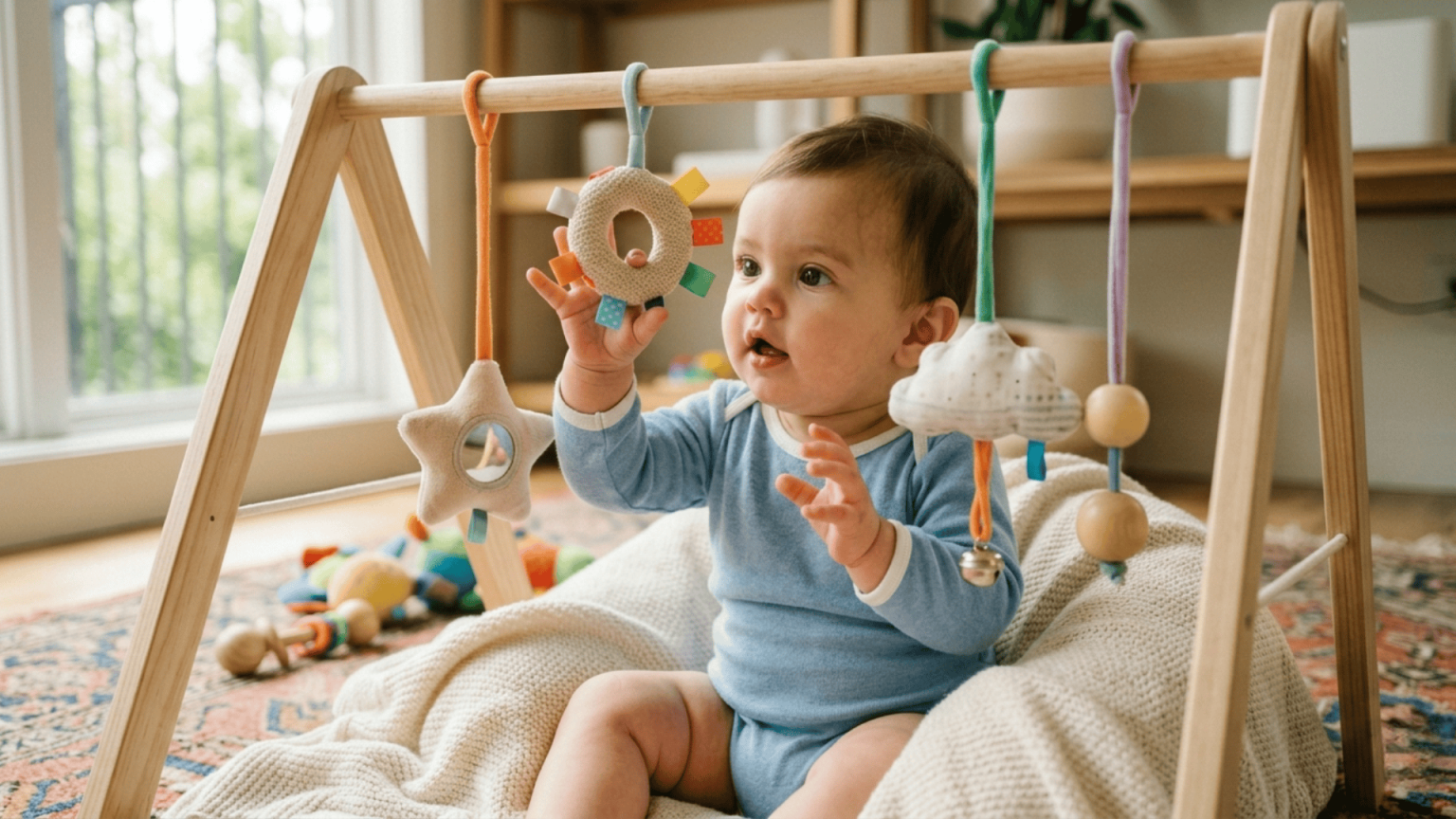
Most babies start reaching for and grabbing objects between 4 and 6 months. At about 4 months, a baby may swing at a toy or hold it when you place it in their hand. By around 6 months, many babies can reach for a toy they want, grasp it, and bring it to their mouth.
Development varies. Some babies grab a little earlier or later and still develop normally. Premature babies may reach milestones based on their adjusted age, not their birth date.
Introduction: What to Expect in the First Year
Grabbing is not one single skill. It develops through several smaller steps:
- Looking at a toy
- Reaching toward it
- Opening the hand
- Closing the fingers around it
- Holding it steady
- Moving it from one hand to the other
- Picking up small items with the thumb and finger


A baby’s first grabs may look clumsy. They may miss the toy, swipe at it, or hold it only for a few seconds. That is normal practice. Hand control improves as the brain, eyes, shoulders, arms, and fingers learn to work together.
The Centers for Disease Control and Prevention (CDC) lists reaching to grab a wanted toy as a common 6-month milestone. Its 4-month milestones include holding a toy when placed in the hand and swinging the arm toward toys. These milestones describe what most children—at least 75%—can do by a given age. They are not a strict test or deadline.
Baby Grasping Milestones by Age
The table below shows a general pattern. Your baby may move through these stages at a different pace.
| Age | Common hand and reaching skills |
|---|---|
| Birth to 2 months | Keeps hands closed much of the time, briefly opens them, and may grasp a finger by reflex |
| Around 3 to 4 months | Watches toys, reaches toward them, swipes at them, and may hold a toy placed in the hand |
| Around 4 to 6 months | Reaches with more purpose, grasps larger toys, and brings objects to the mouth |
| Around 6 to 8 months | Holds toys for longer, transfers objects between hands, and explores by shaking, banging, and mouthing |
| Around 8 to 10 months | Uses a raking motion to pull small items closer and picks up larger pieces with more control |
| Around 9 to 12 months | Begins using a thumb-and-finger “pincer grasp” to pick up small foods or objects |
| Around 12 months | May pick up very small items with better accuracy, release objects on purpose, and point or place objects |
These ranges overlap because grasping develops gradually. A baby may transfer a toy between hands before they can pick up a small crumb. Another baby may show a neat pincer grasp but still drop toys often.
The palmar grasp
The palmar grasp uses the whole hand. A baby wraps the fingers around a toy and holds it against the palm. This is usually the first purposeful grasp.
The raking grasp
A raking grasp happens when a baby uses several fingers to pull an object toward the palm. Babies often use this motion before they can pick up small pieces with the thumb and index finger.
The pincer grasp
A pincer grasp uses the thumb and index finger. It helps a baby pick up small pieces of food and tiny objects. This skill often becomes more accurate between 9 and 12 months, though early attempts can appear sooner.

When Do Babies Start Reaching for Toys?
Babies often begin reaching toward toys at about 3 to 4 months. At first, they may wave their arms, miss the toy, or touch it by chance. Repeated practice helps them learn how far away the toy is and how to move the arm toward it.
By about 4 to 6 months, many babies reach with a clear goal. They may lean forward, open the hand, and grab a toy within easy reach. The CDC includes reaching to grab a desired toy as a 6-month movement milestone.
A baby may reach more easily when:
- The toy is bright or has a simple shape.
- The toy is close to the baby’s chest.
- The baby is alert and rested.
- The baby is lying on their back or sitting with support.
- The toy is light enough to hold.
- The room is calm and not full of competing sights and sounds.


Do not worry if your baby does not reach every time. Hunger, tiredness, illness, position, and interest can all affect performance.

How to Help Your Baby Learn to Grab
You do not need special equipment to support grasping. Safe, simple play works well.
Place one toy within easy reach.
Put the toy about 8 to 12 inches from your baby, where they can see it. If it is too far away, your baby may become frustrated before they can practice.Pause before handing it over.
Give your baby time to look, reach, and try. The goal is not to make the grab happen but to let your baby work out the movement.Offer toys with different textures.
A soft cloth, smooth rattle, rubber teether, or crinkly toy can give useful sensory feedback. Choose items made for the baby’s age and follow the package safety guidance.Play on the floor during awake time.
Floor play gives babies room to move their arms and body. Tummy time also helps build shoulder and upper-body strength, which supports later reaching.Use both sides of the body.
Place toys first on one side and then the other. This gives your baby chances to turn, reach, and use both hands.Talk and copy your baby’s actions.
If your baby shakes a toy, you can gently shake another toy. This makes play social while giving your baby more chances to repeat the movement.Let your baby explore safely.
Babies learn about objects by looking, touching, shaking, and mouthing them. Stay close and remove anything that could cause choking or injury.
The American Academy of Pediatrics recommends active supervision during play. A toy should be large enough that it cannot fit through a toilet-paper roll, with no loose parts, sharp edges, long cords, or easily detached pieces.

Why Babies Put Toys in Their Mouths
Mouthing is a normal part of infant development. Babies use their mouths to learn about an object’s shape, texture, temperature, and firmness. Teething may also increase the urge to chew.
Mouthing does not mean a baby is ready for every food or small object. A baby can be able to grab something before they can safely handle it. Keep small objects away from babies, including:
- Coins
- Beads
- Marbles
- Small toy parts
- Pen caps
- Uninflated balloons
- Button batteries
- Magnets
- Hard pieces of food
- Pet food
Button batteries and magnets can cause severe internal injuries if swallowed. If you think your child swallowed a button battery, magnet, or other dangerous object, seek emergency help in the United States right away. You can call Poison Control at 1-800-222-1222 for guidance.
Never attach a toy, pacifier, or teether to a baby with a cord or string around the neck. Also keep toys, blankets, and other loose items out of the sleep space. The American Academy of Pediatrics recommends a firm, flat sleep surface with no loose bedding or soft objects.

What If Your Baby Is Not Grabbing Yet?
A baby who is not grabbing at 4 months may simply need more time. Early reaching is often inconsistent. Look at the full pattern of development rather than one attempt.
By about 6 months, contact your child’s pediatrician if your baby:
- Does not reach for objects at all
- Does not try to hold objects placed in their hand
- Rarely opens their hands
- Does not bring objects toward the mouth
- Uses one hand much more than the other
- Seems unusually stiff or floppy
- Has trouble seeing or tracking toys
- Stops using a skill they had already learned
A missed milestone does not automatically mean there is a serious problem. It does mean a clinician should review the child’s development. The CDC advises parents to act early if a child is not meeting milestones, loses skills, or has other concerns.
For babies born prematurely, ask the pediatrician how to use adjusted age. This usually means counting from the original due date when considering early developmental milestones. The exact approach may differ based on the baby’s medical history.

When Is a Baby Ready to Pick Up Finger Foods?
Grabbing food and eating food are related but different skills. Many babies begin eating solid foods at about 6 months, when they show signs of readiness. The American Academy of Pediatrics and CDC advise looking for signs such as:


- Sitting upright with good head and neck control
- Bringing objects to the mouth
- Showing interest in food
- Opening the mouth for food
- Moving food from the front of the mouth toward the back
A baby does not need a perfect pincer grasp before starting solids. At first, babies often use the whole hand to hold larger, soft pieces. They may later use their thumb and finger to pick up smaller pieces.
Food must be soft and prepared in a shape and size that lowers choking risk. Avoid common choking hazards such as whole grapes, nuts, popcorn, hot dog rounds, hard raw vegetables, chunks of meat, and spoonfuls of nut butter. Cut or prepare foods according to current guidance from your pediatrician and the CDC.
Always keep your baby seated upright and watch them closely while eating. Choking can happen quickly and silently.

Grabbing vs. Holding: What Is the Difference?
Reaching, grasping, holding, transferring, and releasing are separate skills.
A baby may reach for a toy but miss it. Another baby may grab a toy but drop it right away. These differences are expected because hand control develops in stages.
| Skill | What it means |
|---|---|
| Reaching | Moving the arm or hand toward an object |
| Grasping | Closing the hand around an object |
| Holding | Keeping the object in the hand |
| Transferring | Moving the object from one hand to the other |
| Releasing | Letting go on purpose |
| Pincer grasp | Using the thumb and index finger to pick up a small item |
A baby who drops toys is not necessarily behind. Purposeful release often takes practice. Babies may first let go because they lose their grip, then later learn to drop an object into a container or hand it to someone.

Common Parent Questions
Do babies grab things at 3 months?
Some babies begin reaching or swiping at toys around 3 months. They may not grasp the toy consistently yet. Purposeful grabbing is more common from about 4 to 6 months.
When do babies grab their feet?
Many babies discover their feet between about 4 and 6 months. They may touch, hold, or bring their feet toward the mouth. This varies with body position, flexibility, and interest.
When do babies transfer toys between hands?
Many babies begin transferring objects from one hand to the other between about 6 and 8 months. Some do it earlier or later. This skill helps babies explore objects from different angles.
When do babies develop a pincer grasp?
A pincer grasp often develops between 9 and 12 months. Babies may first use a less precise thumb-and-finger motion before they can pick up very small items accurately.
Should I worry if my baby only uses one hand?
Occasional preference is common, especially when a toy is placed to one side. Consistent use of only one hand, refusal to use the other hand, or a sudden change in hand use deserves a call to the pediatrician.
Key Takeaways
- Most babies start grabbing objects between 4 and 6 months.
- Reaching may begin around 3 to 4 months.
- The CDC lists reaching for a wanted toy as a common 6-month milestone.
- Babies usually develop whole-hand grasping before a thumb-and-finger pincer grasp.
- Safe floor play and toys placed within easy reach can support practice.
- Keep small objects, button batteries, magnets, cords, and choking hazards away from babies.
- Talk with your pediatrician about missed milestones, loss of skills, poor vision, or one-sided movement.
Conclusion
Grabbing is a gradual skill, not a single event. Your baby may first swipe at a toy, then hold it briefly, then transfer it between hands and pick up small items with a pincer grasp.
Give your baby safe chances to move, reach, and explore during awake play. If your baby is not reaching or holding objects by around 6 months, or loses a skill, contact a pediatrician for an individual developmental check.


