
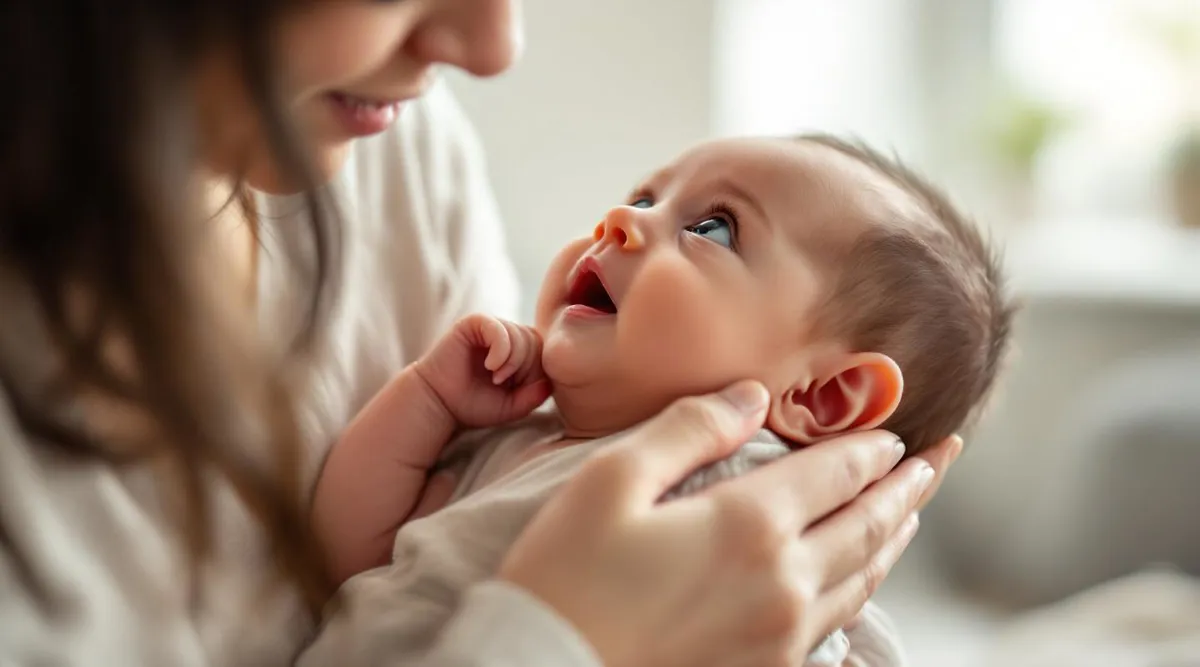
Most babies begin looking at faces from birth, but clear, purposeful eye contact often becomes easier to notice between 6 and 12 weeks. By about 2 months, many babies look at a parent’s face, watch them move, and appear to study their eyes.
Every baby develops at a different pace. Brief eye contact in the early weeks is normal. It may last only a few seconds and may happen more often when your baby is calm, fed, and alert.
This guide explains what eye contact may look like by age, how to encourage it, and when to discuss concerns with your child’s doctor in the United States.

What does eye contact mean in a baby?
Baby eye contact means a baby looks toward another person’s eyes or face for a short time. It is one part of early social communication, along with smiling, listening, making sounds, and turning toward voices.


Eye contact is not an exact test. A baby may look at your face without looking directly into your eyes. They may also look away after a few seconds because faces, light, sound, and movement can feel like a lot to process.
Newborn vision is still developing. At first, babies see best at about 8 to 12 inches, which is roughly the distance from a parent’s face during feeding. High-contrast patterns and human faces often attract their attention.
A baby who looks away is not always tired or upset. Looking away can be a normal way to take a short break.

When do babies start making eye contact?
Babies may make short looks toward faces in the first weeks of life. More steady and social eye contact often develops over the first three months.
Birth to 6 weeks
A newborn may:
- Look briefly at a parent’s face
- Focus best on a face held close
- Watch a bright window or high-contrast object
- Follow a face for a short distance
- Look away when tired or overstimulated
At this age, eye contact may seem random. Your baby may look at your forehead, nose, or mouth instead of your eyes. This is still part of learning to study faces.
Around 2 months
By about 2 months, many babies:
- Look at a parent’s face
- Watch a person move
- Seem happy when a parent approaches
- Smile when spoken to or smiled at
- Watch a caregiver during feeding or talking
The Centers for Disease Control and Prevention lists looking at a caregiver’s face as a common 2-month social and emotional milestone. Milestones describe what most children—about 75% or more—can do by a certain age. They do not predict the exact day a skill will appear.
Around 3 to 4 months
Eye contact may become more purposeful. Your baby may look at you, smile, make sounds, and then look back as if taking part in a simple conversation.
Many babies also begin to:
- Follow moving faces and toys
- Turn toward familiar voices
- Watch your mouth while you talk
- Smile to get your attention
- Look between a toy and your face


Around 5 to 6 months
Your baby may use eye contact as part of back-and-forth play. They may look at you before laughing, reaching, or making a sound.
Babies at this age often recognize familiar people. They may also look at faces for longer periods, track objects from side to side, and show more interest in social games such as peekaboo.
7 to 12 months
Eye contact becomes part of a wider communication system. Your baby may:
- Look at you when you say their name
- Look from a toy to you and back again
- Watch your reaction in a new situation
- Use eye contact during games
- Point, reach, or gesture while looking at you
- Follow your gaze or point
These skills are sometimes called joint attention. Joint attention means two people focus on the same object or event. It is an important part of language and social development.

Baby eye contact by age: quick guide
The table below shows common patterns, not strict deadlines.
| Baby’s age | What eye contact may look like |
|---|---|
| Birth to 6 weeks | Brief looks at faces, especially at close range |
| About 2 months | Looks at a parent’s face and watches them move |
| 3 to 4 months | More steady looks during talking, smiling, and play |
| 5 to 6 months | Uses eye contact during social games and interaction |
| 7 to 9 months | Looks between people and objects; responds to familiar voices |
| 9 to 12 months | Uses eye contact with gestures, pointing, sounds, and shared play |
A baby may reach these skills earlier or later. Premature babies are often assessed by corrected age during the first two years. Corrected age accounts for how early the baby was born.
For example, a baby born 8 weeks early may be 4 months old by the calendar but closer to 2 months in corrected age. Ask your pediatrician how to track milestones if your baby was born preterm.

How can you encourage eye contact?
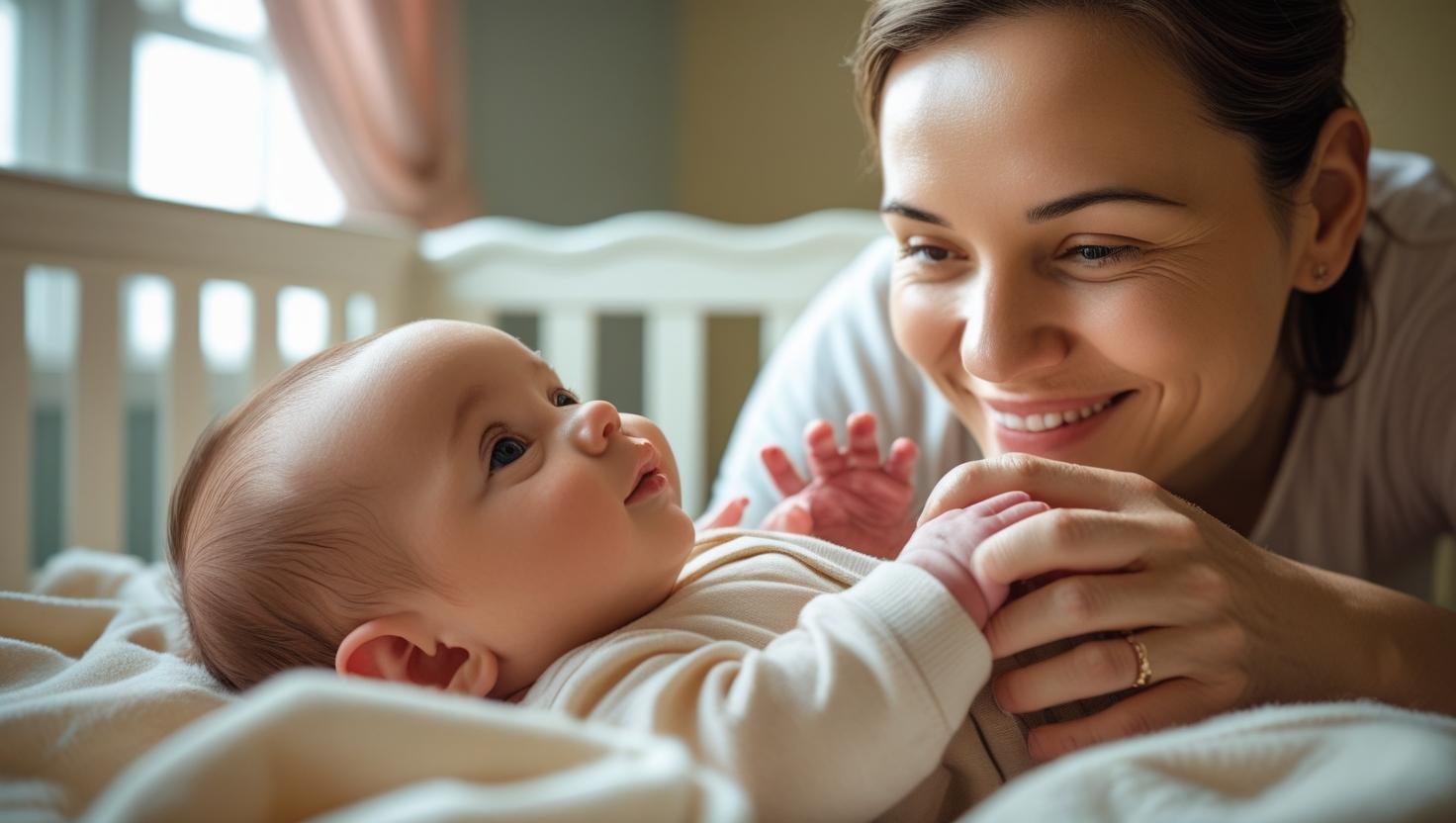
You can support eye contact through calm, face-to-face moments. You do not need special toys or training.
Try these steps:
- Get close. Hold your face about 8 to 12 inches from your newborn’s face.
- Choose a calm time. Try after a nap or feeding, when your baby is awake but not hungry.
- Use a soft voice. Talk, sing, or copy your baby’s sounds.
- Pause. Give your baby time to look, move, or make a sound.
- Follow your baby’s lead. If they look away, lower the noise or take a break.
- Repeat during daily care. Diaper changes, feeding, bathing, and dressing offer natural chances to connect.
Keep your face well lit, but avoid shining a bright light into your baby’s eyes. During feeding, hold your baby in a position that lets them see your face without strain.
Short moments count. A baby does not need to hold eye contact for a long time to benefit from face-to-face interaction.

Why might a baby avoid eye contact?
Brief or inconsistent eye contact can have many ordinary causes. Babies may look away when they are:
- Sleepy
- Hungry
- Full
- Overstimulated
- Uncomfortable
- Sick
- In a bright or noisy room
- Trying to focus on a nearby object
Vision also affects eye contact. A baby may have trouble looking at faces if they have difficulty seeing clearly, tracking objects, or coordinating both eyes.


Some babies are naturally more watchful or less socially expressive. Temperament can change how often a baby looks at a caregiver, even when development is progressing well.
One observation does not tell you whether a baby has a developmental problem. Look at the full pattern: Do they respond to voices? Smile at people? Track faces or toys? Make sounds? Show interest in interaction?

When should you call the pediatrician?
Talk with your baby’s health care professional if your baby does not make eye contact by about 3 months, especially if they also do not respond to faces or voices. You should also call if your baby loses a skill they previously had.
Contact the pediatrician sooner if you notice:
- Eyes that often cross or wander after the early newborn period
- A white or unusual reflection in the pupil
- One eye that always turns in or out
- Trouble tracking a face or toy
- No reaction to bright light or nearby movement
- No social smile by about 3 months
- No response to loud sounds or familiar voices
- Very little interest in people by the end of the first year
- Loss of eye contact, smiles, sounds, or other social skills
These signs do not diagnose a condition. They simply give a doctor a reason to check vision, hearing, development, or other health factors.
The American Academy of Pediatrics recommends routine developmental screening during well-child visits. General developmental screening is recommended at 9, 18, and 30 months, with autism-specific screening at 18 and 24 months. A doctor may assess a child earlier when a parent has concerns.
Do not wait for a later screening visit if something worries you. In the United States, you can contact your child’s pediatrician, a pediatric eye doctor, or your state’s early intervention program. Children under age 3 may qualify for evaluation through early intervention without waiting for a diagnosis.
Does lack of eye contact mean autism?
No. Lack of eye contact alone does not mean a baby has autism.
Eye contact is only one part of social communication. Autism evaluations consider a broader pattern that may include social interaction, communication, play, repetitive behaviors, and sensory responses. Some autistic children make eye contact, while some non-autistic children make less eye contact.
A baby’s age also matters. Eye contact is often brief in newborns and becomes more social over time. A doctor should consider vision, hearing, temperament, language, motor skills, family history, and the child’s overall development.
If you are concerned, write down what you see. Note your baby’s age, when the behavior occurs, what helps, and whether other skills are changing. A short video may help the pediatrician understand the concern, but it should not replace an in-person assessment.

What is normal newborn eye movement?
Newborn eyes may briefly cross, wander, or move unevenly. This can happen because eye control is still developing.
Occasional wandering may be normal in the first weeks. However, persistent crossing, one eye that repeatedly turns, or unusual eye movement deserves medical advice. A white pupil or white reflection in a photo also needs prompt evaluation.
Do not use a phone flash as a home eye test. Photos can create harmless reflections, but they can also be hard to interpret. If you see an unusual pupil color in a photo or in normal light, contact your child’s doctor.


A pediatrician can refer your baby to a pediatric ophthalmologist when needed. Pediatric ophthalmologists are medical doctors trained to assess eye health and vision in children.

Common mistakes parents make when watching eye contact
Parents often expect eye contact to look like an adult conversation. Babies do not work that way. Their looks may be short, uneven, and mixed with glances at your mouth or hair.
Avoid these common mistakes:
- Testing your baby again and again: Repeated tests can tire or upset a baby.
- Trying only when the baby is crying: Hunger and stress reduce social attention.
- Using a strict deadline: Milestones are ranges, not appointments.
- Ignoring corrected age: Premature babies may need milestone review by corrected age.
- Focusing on one skill: Development is a pattern, not a single behavior.
- Waiting after a regression: Loss of a skill should be discussed promptly.
The best approach is simple: offer warm interaction, watch the overall pattern, and share concerns early.
Frequently asked questions
Do newborns see their parents clearly?
Newborns can see faces, but their vision is blurry compared with an older child’s vision. They usually focus best at close range, especially during feeding or holding.
Why does my baby look at me and then look away?
Looking away often means your baby needs a short break. Babies may also look away because they are tired, hungry, overstimulated, or trying to focus on something else.
Should my 1-month-old make eye contact?
A 1-month-old may make brief eye contact, but it may not happen often or last long. More consistent social looking often develops around 2 to 3 months.
Is it normal for a baby’s eyes to cross?
Brief crossing can occur in young newborns. If crossing continues, happens often, or affects one eye more than the other, ask the pediatrician for advice.
When should I worry about no eye contact?
Discuss it with your pediatrician if your baby has no eye contact by about 3 months, has trouble tracking faces or objects, does not respond to voices, or loses skills. A single missed milestone does not provide a diagnosis.

Key takeaways
- Babies may look at faces from birth.
- More purposeful eye contact often develops between 6 and 12 weeks.
- By about 2 months, many babies look at a caregiver’s face.
- Brief eye contact and looking away can both be normal.
- Premature babies may need milestone review by corrected age.
- Lack of eye contact alone does not diagnose autism.
- Contact your pediatrician about persistent concerns, vision changes, hearing concerns, or loss of skills.
Conclusion
If you are wondering when babies make eye contact, the short answer is: many begin with brief looks in the newborn period, and eye contact often becomes more steady around 2 to 3 months.
Use calm face-to-face time to support your baby, but do not pressure them to stare. If eye contact does not emerge, vision seems unusual, or your baby loses a skill, contact a pediatrician in the United States for an evaluation. Early questions are worth asking, and you do not need to wait for a major milestone visit.
