
In the United States, most babies who die during sleep fall into a group called sudden unexpected infant death (SUID). This group includes sudden infant death syndrome (SIDS), accidental suffocation or strangulation, and deaths from unknown causes.
Sleep itself does not usually cause death. The danger may come from an unsafe sleep setting, a hidden medical problem, or a sudden event that cannot be explained even after a full investigation. Safe sleep steps can lower risk, but no method can prevent every death.
If a baby is not breathing, will not wake, or looks blue or gray, call 911 immediately. Start infant CPR if you know how, and follow the dispatcher’s instructions.

What does it mean when a baby dies during sleep?
A baby who dies during sleep may have died from SIDS, accidental suffocation, a medical condition, or an unknown cause. Only a medical examiner or coroner can determine the official cause after an investigation.


Sudden infant death syndrome
SIDS is the sudden death of a baby younger than 1 year that remains unexplained after a complete review. This review often includes:
- An autopsy
- An examination of the death scene
- A review of the baby’s medical history
- Interviews with caregivers
- A review of the baby’s sleep position and sleep space
SIDS is not the same as suffocation. In SIDS cases, investigators do not find a clear cause of death. Researchers believe that some babies may have an unseen weakness in the parts of the brain that control breathing, heart rate, and waking.
SIDS is more common during the first 6 months of life. It can happen during a nap or at night. It is rare after a baby’s first birthday.
Sudden unexpected infant death
SUID is a wider term. It includes:
- SIDS
- Unknown causes
- Accidental suffocation and strangulation in bed
The Centers for Disease Control and Prevention reported that about 3,700 sudden unexpected infant deaths occurred in the United States in 2022. The total included deaths classified as SIDS, unknown cause, and accidental suffocation or strangulation.
These categories can be hard to compare because states and medical examiners may classify similar deaths in different ways. A death listed as “unknown cause” does not always mean that caregivers did something wrong. It means the investigation did not identify one clear cause.
Accidental suffocation
A baby may suffocate when the nose or mouth becomes blocked. Common hazards include:
- Soft bedding
- Pillows and blankets
- Adult beds
- Couches and recliners
- Bedside gaps
- Another person’s body
- A wall or the side of a sleep product
- Loose clothing or items near the face
Babies cannot reliably move away from an object that blocks their breathing. They also have less strength and control than older children.


Why can SIDS happen?
SIDS likely results from several factors working together, not from one known cause. A commonly used explanation is the triple-risk model.
This model suggests that a baby may be at higher risk when three conditions overlap:
- A hidden vulnerability
- A period of rapid development
- An outside stress, such as unsafe sleep conditions or illness
This model helps explain why one baby may survive a sleep risk while another does not. It does not predict which individual baby will die, and it does not prove that one specific action caused a death.
Hidden problems with breathing or waking
Some babies may have differences in how their brains respond to low oxygen, high carbon dioxide, or overheating. A baby with this type of vulnerability might not wake or change position when breathing becomes difficult.
This idea is still being studied. There is no routine test that can identify every baby at risk for SIDS.
Normal development may play a role
SIDS occurs most often during the first year, with many deaths happening between 1 and 4 months of age. This period includes major changes in sleep, breathing control, and brain development.
A baby’s age does not make unsafe sleep safe. Babies should follow safe sleep guidance from birth through their first birthday.
External stressors can add risk
Unsafe sleep conditions may place stress on a baby’s breathing or ability to wake. Examples include:
- Sleeping on the stomach or side
- Sleeping on a soft surface
- Sharing an adult bed
- Exposure to cigarette smoke
- Overheating
- Loose items around the head
- Swaddling after the baby starts trying to roll
These risks may matter more when combined. Still, finding a risk factor does not prove it caused a particular death.

How can parents reduce the risk of sleep-related infant death?
The safest routine is simple: place the baby on the back, alone, and on a firm, flat surface for every sleep.
Use a safe sleep space
Place the baby in a safety-approved crib, bassinet, portable crib, or play yard. The sleep surface should have:
- A firm, flat mattress
- A fitted sheet made for that mattress
- No gaps between the mattress and the sides
- No pillows, quilts, comforters, bumper pads, toys, or positioners
A baby should sleep in the same room as a parent or caregiver, but ideally on a separate sleep surface. The American Academy of Pediatrics recommends room sharing without bed sharing, especially during the first 6 months and preferably for the first year.


Do not use a car seat, stroller, swing, or infant carrier as a regular sleep space. If a baby falls asleep in one, move the baby to a firm, flat sleep surface as soon as it is safe to do so.
Always start sleep on the back
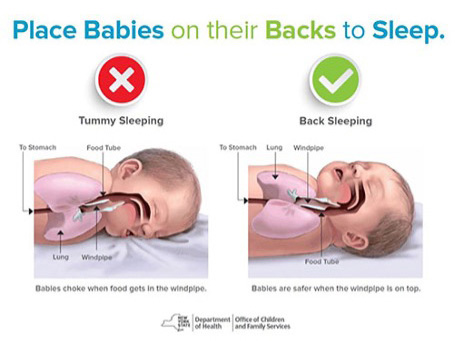
Place babies on their backs for naps and nighttime sleep. Side sleeping is not a safe middle option because a baby can roll from the side onto the stomach.
Once a baby can roll from back to stomach and stomach to back, caregivers do not need to keep turning the baby back. However, the baby should still be placed on the back at the start of each sleep, and the sleep area must remain clear.
Tummy time is good for development when the baby is awake and watched. It does not replace back sleeping.
Keep the sleep area free of loose items
Do not place these items in the crib:
- Blankets
- Pillows
- Stuffed animals
- Bumper pads
- Wedges
- Positioning devices
- Nursing pillows
- Weighted sleep products
If the baby needs warmth, use fitted infant sleep clothing or a wearable blanket that is not weighted. The baby’s head and face should remain uncovered.
Avoid overheating
Dress the baby in about one more layer than an adult would wear in the same room. Check the baby’s chest or back rather than relying only on hands and feet, which can feel cool even when the baby is comfortable.
Signs of overheating may include sweating, damp hair, flushed skin, hot skin, or a chest that feels very warm. Do not use hats indoors during sleep unless a medical professional gives a specific reason.
Keep smoke and vaping away
Cigarette smoke increases the risk of SIDS and other infant health problems. Keep the baby’s home and car smoke-free. This includes smoke from cigarettes, cigars, pipes, marijuana, and other burned products.
Vaping aerosols can also contain harmful substances. Caregivers should avoid vaping near a baby and should wash their hands and change outer clothing after smoking before holding the baby.
Consider a pacifier at sleep time
Offering a pacifier at naps and bedtime may reduce SIDS risk. If the baby is breastfed, some health groups suggest waiting until breastfeeding is well established before introducing one.
Do not force a pacifier. If it falls out after the baby falls asleep, it does not need to be replaced. Never attach it to a cord, ribbon, stuffed toy, or clothing during sleep.
Pacifiers should not be coated with honey, sugar, or medicine. Honey can cause infant botulism in babies younger than 1 year.
Breastfeed when possible
Breastfeeding is linked with a lower risk of SIDS. Any amount of breast milk may provide benefits. Feeding decisions can be affected by health, work, recovery, access, and personal choice.


Parents who cannot breastfeed should not blame themselves. Safe sleep remains important for every baby, regardless of how the baby is fed.

Which sleep situations are especially dangerous?
Some sleep settings are more dangerous because they increase the chance of suffocation, overheating, or entrapment.
Adult beds
Bed sharing can allow a baby’s face to become covered by bedding or another person. A baby can also become trapped between a mattress and a wall or fall from the bed.
The risk is higher when:
- The baby is younger than 4 months
- The baby was born prematurely or had a low birth weight
- An adult is very tired
- An adult smoked during pregnancy or after birth
- Anyone in the bed used alcohol, cannabis, opioids, sedatives, or other drugs
- The baby sleeps on a couch or recliner
- Pillows, blankets, or other soft items are present
A separate crib or bassinet placed next to the adult bed is safer than bed sharing.
Couches and recliners
Couches, sofas, and recliners are particularly unsafe for infant sleep. A baby can slip into a cushion gap or become pressed against an adult’s body.
A caregiver who feels sleepy while holding a baby should place the baby in a separate crib before falling asleep. If the caregiver wakes after accidentally falling asleep, move the baby to the safe sleep space right away.
Swaddling
Swaddling may calm some newborns, but it does not lower the risk of SIDS. A swaddled baby must always be placed on the back.
Stop swaddling as soon as the baby shows signs of trying to roll. Do not use weighted swaddles or weighted sleep sacks. Once rolling begins, use regular sleep clothing that leaves the arms free.
Inclined products and sleep positioners
Inclined sleepers, wedges, and positioners can allow a baby’s head to fall forward. This may narrow the airway. Products marketed to reduce reflux or help babies sleep are not automatically safe.
Babies with reflux should still sleep flat on their backs unless a qualified clinician gives a different medical instruction. Raising the head of a crib is not a safe treatment for routine infant reflux.

What should you do if you find a baby unresponsive?
If a baby does not respond or breathe normally, treat it as an emergency.
- Call 911. Put the phone on speaker so you can follow instructions.
- Check breathing. Look for normal chest movement. Gasping is not normal breathing.
- Begin CPR if trained. Follow the 911 dispatcher’s directions.
- Use an automated external defibrillator if one is available and instructed.
- Do not shake the baby. Shaking can cause severe brain injury.
- Do not give food, water, or medicine.
- Do not delay emergency care to search for a home monitor or look up symptoms.
If a baby has died, call 911 or local emergency services. Do not move the baby or change the sleep area unless there is an immediate danger. Emergency workers and investigators may need to examine the scene.
Parents and caregivers may feel panic, guilt, anger, or numbness after a sudden infant death. Those reactions are common. A pediatrician, hospital social worker, grief counselor, or bereavement group can help.
In the United States, the First Candle bereavement support line and the 988 Suicide & Crisis Lifeline may also provide support when grief becomes overwhelming.


Common myths about babies who die in their sleep
“A baby who sleeps deeply is more likely to die.”
Deep sleep alone does not cause SIDS. The concern is that some babies may not wake when breathing becomes difficult. A safe sleep space lowers hazards that can interfere with breathing.
“A baby can choke while sleeping on the back.”
Healthy babies are less likely to choke when sleeping on their backs. Their airway structure and protective reflexes help keep fluids from entering the lungs. Back sleeping remains safer than stomach sleeping, including for most babies with reflux.
“A home monitor can prevent SIDS.”
Home heart, breathing, and oxygen monitors have not been shown to prevent SIDS. They may be prescribed for selected babies with specific medical needs, but they should not replace safe sleep practices.
Wearable heart-rate or oxygen products sold to consumers may produce false alarms and may not detect every dangerous event. Ask a pediatrician before relying on any monitor.
“If a baby rolls over, the baby must be kept on the back all night.”
Place the baby on the back at the start of sleep. Once the baby can roll both ways, caregivers do not need to repeatedly reposition the baby. The crib must still contain only a firm mattress and fitted sheet.
“Parents cause SIDS.”
SIDS is not proof of neglect or a simple parenting mistake. Even families who follow every safe sleep recommendation can experience an unexplained death. Safe sleep guidance reduces risk, but it cannot remove all risk.

Frequently asked questions
Can SIDS be predicted?
No. There is no approved home test that can reliably predict which baby will die from SIDS. Some medical conditions may raise concern, so keep regular pediatric visits and discuss family history, premature birth, breathing events, or unusual symptoms with the child’s clinician.
Can a baby die from sleeping on the back?
A baby can still die unexpectedly while sleeping on the back, but back sleeping is safer than stomach or side sleeping. It greatly reduces the risk of sleep-related death and remains the recommended position for every nap and night.
How long should a baby sleep in the parents’ room?
The American Academy of Pediatrics recommends room sharing without bed sharing for at least the first 6 months and preferably the first year. Keep the baby in a separate crib, bassinet, or portable crib near the adult bed.
Is it safe to sleep with a baby during skin-to-skin contact?
Skin-to-skin contact can support bonding and feeding, but the adult must stay awake. If the adult may fall asleep, place the baby in a separate, empty crib or bassinet.
What is the safest bedding for a newborn?
Use a firm, flat mattress with one fitted sheet made for that mattress. A baby can wear a properly sized, non-weighted sleep sack or other wearable blanket. Keep the face and head uncovered.
Key takeaways
- Babies may die during sleep from SIDS, accidental suffocation, another medical problem, or an unknown cause.
- SIDS remains unexplained after an autopsy, death-scene review, and medical-history review.
- Place every baby on the back for every sleep.
- Use a firm, flat, separate sleep surface with only a fitted sheet.
- Keep pillows, blankets, toys, bumpers, and other loose items out of the sleep area.
- Avoid bed sharing, couches, recliners, smoke exposure, overheating, and weighted sleep products.
- Call 911 if a baby is unresponsive or not breathing normally.
Conclusion
The question “why do babies pass away in their sleep?” has more than one answer. Some deaths result from an unsafe sleep environment, while others remain unexplained even after careful investigation. SIDS is not the same as suffocation, and a sudden infant death is not automatically a sign that a caregiver caused it.
The most useful next step is to check the baby’s sleep space today: back position, firm flat surface, separate crib or bassinet, clear bedding, comfortable temperature, and no smoke exposure. For questions about a baby’s breathing, reflux, sleep products, or medical risk, speak with the baby’s pediatrician.
Sources and U.S. guidance
- Centers for Disease Control and Prevention: Sudden Unexpected Infant Death and Sudden Infant Death Syndrome
- American Academy of Pediatrics: Sleep-Related Infant Deaths—Updated Recommendations
- National Institute of Child Health and Human Development: Safe to Sleep
- U.S. Consumer Product Safety Commission: Safe Sleep
