
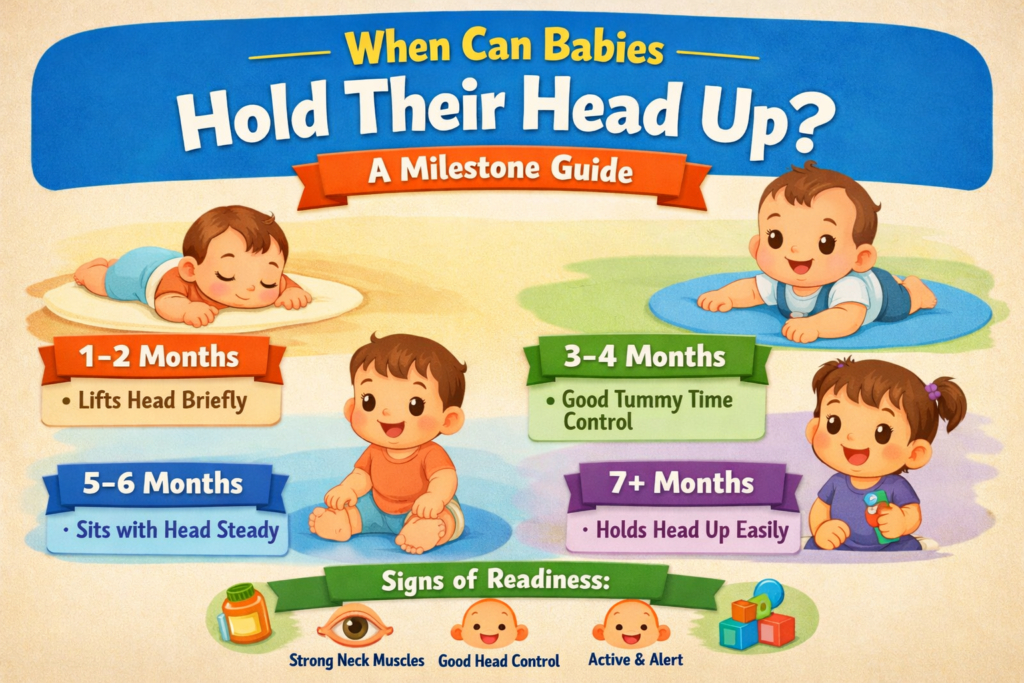
Most babies can hold their head steady without support by about 4 months. Many begin lifting and turning their head during tummy time around 2 months. Head control develops in steps, so small differences are often normal.
A newborn still needs full head and neck support. Never pull a baby by the arms or let the head fall back during lifting. If your baby was born early, use their corrected age when judging milestones and ask their pediatrician if you are unsure.

Baby head control milestones by age
Head control often improves from week to week. The ranges below describe common patterns, not strict deadlines.
| Age | What many babies can do |
|---|---|
| Newborn to 1 month | Turns the head to the side, briefly lifts the head, and needs full support when held |
| Around 2 months | Lifts the head during supervised tummy time and may keep it up for short periods |
| Around 3 months | Holds the head higher and shows less head lag when pulled gently to a sitting position |
| Around 4 months | Holds the head steady without support while being held or sitting with help |
| Around 5 to 6 months | Keeps the head stable during movement and may sit with less help |
The Centers for Disease Control and Prevention lists holding the head steady without support as a milestone for most babies by 4 months. “Most” means at least 75% of children in the CDC milestone data, not every child.


Head control may appear earlier when a baby is held upright than when the baby sits alone. Sitting without support is a separate skill and usually develops later. A baby can have good head control without being ready to sit independently.
What does “holding their head up” mean?
Holding the head up means a baby can keep the head from flopping forward, backward, or to the side without constant hand support. It does not mean the baby can sit alone.
You may see these signs as head control grows:
- The baby lifts the head during tummy time.
- The baby turns toward a voice or face.
- The baby keeps the head more centered while being held.
- The head moves with the body instead of falling behind.
- The baby keeps the head steady when supported in a sitting position.
Some head movement is still uneven in the early months. A young baby may tire quickly or rest the head after a short effort. Progress over time matters more than one brief attempt.
What is head lag?
Head lag happens when a baby’s head falls back when the upper body is gently moved from lying down toward sitting. Some head lag is common in young infants because neck muscles are still developing.
Head lag often becomes less noticeable by about 3 to 4 months. Tell your child’s pediatrician if strong head lag continues beyond this period, becomes worse, or occurs with other concerns such as poor movement, stiffness, or unusual floppiness.

How to help your baby build head and neck strength
The safest way to support early head control is regular, supervised tummy time while your baby is awake. Tummy time lets the baby practice lifting, turning, and holding the head against gravity.
Try these steps:
- Start with short sessions when your baby is calm and awake.
- Place your baby on their back first, then gently turn them onto their stomach on a firm, flat surface.
- Stay close and watch the entire time.
- Get down at eye level or place a high-contrast toy nearby.
- Stop when your baby becomes tired, upset, or unable to lift the head.
- Repeat several times during the day.
The American Academy of Pediatrics recommends starting tummy time soon after coming home from the hospital. Build up gradually toward about 15 to 30 minutes total each day by 7 weeks, as your baby tolerates it.
Tummy time can also happen on your chest while you are fully awake. Hold your baby securely and keep the face clear. This position is for awake play only, not sleep.


Easy tummy-time positions
You do not need special equipment. You can try:
- Tummy time on a clean floor mat
- Chest-to-chest time while you recline
- A baby lying across your lap with one hand supporting the chest
- Short sessions after a diaper change
- Carrying the baby upright with the head supported
If your baby dislikes tummy time, begin with one or two minutes. Several short sessions may work better than one long session. Do not force the baby to continue when they are crying hard or showing signs of fatigue.

Tummy time safety and safe sleep
Tummy time should happen only when your baby is awake and watched by an adult. For every sleep, place your baby on their back on a firm, flat, non-inclined sleep surface.
Do not use tummy time as a way to settle a baby for sleep. If your baby falls asleep during supervised floor play or on your chest, move them to their approved sleep space and place them on their back.
Avoid using pillows, loose blankets, sleep positioners, wedges, or inclined products to help a baby hold their head up. These items can increase the risk of suffocation or other sleep-related injury.
A baby should not sleep in a car seat, swing, bouncer, or stroller once you arrive at your destination. These products are not substitutes for a firm, flat sleep surface.
Good safety habits include:
- Support the head and neck when lifting a newborn.
- Keep one hand behind the head when passing the baby to another person.
- Do not shake, bounce forcefully, or swing the baby.
- Keep toys and objects away from the baby’s face during tummy time.
- Avoid leaving the baby on a bed, sofa, or changing table, even briefly.
- Follow the current safe-sleep guidance from the American Academy of Pediatrics.

When should you call the pediatrician?
Contact your baby’s pediatrician if you are worried about head control or if your baby is not making steady progress. A single missed milestone does not always mean there is a problem, but it is worth discussing.
Ask for medical advice if your baby:
- Cannot lift the head at all during supervised tummy time by about 3 months
- Still has marked head lag around 4 months
- Cannot hold the head steady by about 4 months
- Loses a skill they had already gained
- Seems very stiff or unusually floppy
- Moves one side of the body much less than the other
- Always turns the head to one side
- Has trouble feeding, breathing, or staying alert
- Does not seem to respond to voices, faces, or movement as expected
Seek urgent help for sudden weakness, trouble breathing, a seizure, extreme sleepiness, or a serious injury. If a baby has fallen or suffered a blow to the head, call a health professional for guidance even if the baby seems well.
Your pediatrician may check muscle tone, movement, vision, feeding, and overall development. They may also recommend physical therapy or an early-intervention evaluation. In the United States, parents can contact their state’s early intervention program directly for children under age 3; a doctor’s referral is not always required.

Does prematurity change when a baby holds their head up?
Yes. Babies born before 37 weeks may reach head-control milestones later when measured by their birth date. Health professionals often use corrected age for development during the first 2 years.
To estimate corrected age:
Chronological age − weeks born early = corrected age


For example, if a baby is 16 weeks old but was born 6 weeks early:
16 weeks − 6 weeks = 10 weeks corrected age
This calculation is only a guide. Prematurity, medical conditions, muscle tone, vision, and feeding challenges can all affect development. Use your baby’s corrected age as a starting point, then follow the plan from the pediatrician or neonatal team.

Common mistakes parents make
The most common mistake is treating a milestone range as a deadline. Babies develop at different rates, and a few weeks of variation may be normal.
Other mistakes include:
- Comparing a baby with siblings or friends
- Counting time in a swing or seat as tummy time
- Practicing tummy time on a soft bed or couch
- Letting a baby sleep on the stomach after falling asleep during play
- Using an inclined product to “train” head control
- Pulling a baby quickly from lying down to sitting
- Waiting to ask about a concern because the baby seems otherwise happy
A baby’s mood does not always show whether development is on track. Bring concerns to routine well-child visits, and write down what you observe. A short video of head movement during play may help the pediatrician understand the concern.
Key takeaways
- Most babies begin lifting the head during tummy time around 2 months.
- Most babies hold the head steady without support by about 4 months.
- Newborns need full head and neck support.
- Tummy time should be awake, supervised, and done on a firm surface.
- Always place a baby on their back for sleep.
- Use corrected age for a baby born prematurely.
- Call the pediatrician about persistent head lag, poor progress, lost skills, stiffness, floppiness, or uneven movement.
FAQs
Can a 2-month-old hold their head up?
Many 2-month-olds can lift their heads during tummy time for short periods. They may still wobble or tire quickly. A 2-month-old usually still needs head support when being carried.
When can I stop supporting my baby’s head?
Keep supporting your baby’s head until they can hold it steady in different positions. Even after a baby shows progress, provide support during lifting, carrying, feeding, and transfers until head control is reliable.
Is it normal for a baby to hate tummy time?
Yes. Many babies protest tummy time at first. Use short sessions, try chest-to-chest play, and practice when the baby is rested. Ask the pediatrician for advice if your baby cannot lift the head or becomes distressed during nearly every attempt.
Can a baby sleep on their stomach once they can hold their head up?
No. Babies should still be placed on their backs for every sleep, even after they develop strong head control. If a baby rolls independently from back to stomach and stomach to back, continue starting sleep on the back and keep the sleep space clear.
What if my baby is 4 months old and cannot hold their head steady?
Contact the baby’s pediatrician for an evaluation. Developmental milestones are not exact deadlines, but persistent head instability or head lag at this age deserves professional review, especially if the baby is very stiff, floppy, weak, or losing skills.
Conclusion
Most babies develop clear head control between 2 and 4 months, with steady support and supervised tummy time helping them practice. Newborns need full head support, and premature babies may need milestone tracking by corrected age.
Focus on gradual progress rather than comparison. If your baby is not improving, loses a skill, or shows unusual stiffness or floppiness, contact a pediatrician. For more guidance, use the CDC’s Learn the Signs. Act Early. milestone resources and the American Academy of Pediatrics’ safe-sleep guidance.


