
Introduction
A 6-month-old may sleep in a bassinet only if the bassinet’s manual allows it and the baby has not reached its weight, height, or movement limits. Many babies outgrow bassinets before 6 months. Some are no longer safe once they can roll, push up, sit, or pull against the sides.
In the United States, the safest sleep space is a firm, flat, separate surface made for infant sleep. This may be a bassinet, crib, mini crib, or play yard that meets current federal safety rules. The space should contain only a fitted sheet.
Check the bassinet label and manual before using it. If the manual says to stop use when your baby rolls, pushes up, sits, reaches a weight limit, or reaches a height limit, follow that rule even if your baby is only 4 or 5 months old.

The short answer: It depends on the bassinet and your baby
A 6-month-old can sleep in a bassinet only when all of these points are true:


- The bassinet is approved for the baby’s current age, size, and weight.
- The baby has not reached the bassinet’s movement limit.
- The baby cannot roll, sit, push up, or pull up in a way that creates a fall risk.
- The mattress is firm, flat, and properly fitted.
- The bassinet is made for sleep, not just for lounging or supervised rest.
- The manufacturer has not told you to stop using it.
Age alone does not decide the answer. A baby’s new skills often matter more than the calendar.
For example, one 6-month-old may still lie calmly on their back and fit within the bassinet’s limits. Another may roll both ways and push up on their hands. The second baby likely needs to move to a crib, mini crib, or approved play yard.
The American Academy of Pediatrics recommends moving a baby out of a bassinet when the baby reaches the product’s weight limit, can push up on their hands and knees, or can roll over. Always check the product instructions because limits differ by model.

When should a baby stop using a bassinet?
Stop using a bassinet when the first safety limit is reached. That limit may be based on age, size, weight, or movement.
Common stop-use signs include:
- Your baby rolls from back to belly or belly to back.
- Your baby tries to roll while sleeping.
- Your baby pushes up on their hands and knees.
- Your baby sits without help or tries to sit.
- Your baby pulls on the bassinet sides.
- Your baby’s head or body comes close to the top edge.
- Your baby reaches the listed weight or height limit.
- The bassinet begins to tip, flex, or move when the baby shifts.
- The manual says to stop use.
Some bassinets have a fixed age limit, such as “use until 5 months.” Others do not give a simple age limit. Instead, they say to stop when the baby can roll, push up, or reach a set weight.
Do not keep using a bassinet simply because your baby still fits inside it. A baby who can move well may climb or lean over a low side. That can lead to a fall or entrapment.
If you cannot find the manual, look for the model name and product number on the bassinet. Check the manufacturer’s official website for instructions and recalls. If you still cannot confirm the limits, use a crib or another approved sleep space with clear instructions.
Is it safe for a baby who rolls?
Usually, a bassinet is not the right sleep space once a baby can roll or is trying to roll. A rolling baby can move into a position that increases the risk of getting stuck against a side.
This rule can be confusing. Safe-sleep guidance says to place a baby on their back for every sleep. It does not mean you must keep turning a baby back all night after the baby can roll both ways on their own.
Instead:

- Place the baby on their back.
- Keep the sleep space clear.
- Stop swaddling once the baby shows signs of rolling.
- Use a sleep space that the manufacturer allows for a rolling baby.
- Do not use straps, wedges, positioners, or rolled towels to hold the baby in place.
A wearable blanket may replace a loose blanket. It should fit well and allow the hips and legs to move. Weighted sleep sacks and weighted swaddles are not recommended by the AAP and federal safe-sleep guidance.
If your baby rolls in a bassinet that does not allow rolling, move the baby to a suitable crib, mini crib, or play yard as soon as possible. Ask your child’s doctor if your baby has a medical condition that affects movement or sleep.

How to check whether your bassinet is still suitable
Use the bassinet manual as the main source for product limits. Online listings may show different limits for a similar-looking model, so identify the exact product.
1. Find the product limits
Look for these details:
- Maximum weight
- Maximum height
- Maximum age
- Roll-over rule
- Push-up or sit-up rule
- Use of a hood, canopy, vibration unit, or incline
- Mattress and sheet requirements
If the manual says “stop use when the child can push up,” that rule applies even if the weight limit has not been reached.
2. Check the sleep surface
The mattress should be firm and flat. Your baby’s head should not sink into it.
Use only the sheet made for that mattress or a sheet that fits tightly and is approved by the manufacturer. Do not add:
- A mattress topper
- A memory-foam pad
- A pillow
- A blanket
- A bumper
- A sleep positioner
- A nest or pod
- A stuffed toy
A product can look soft and cozy but still create a dangerous gap or airway risk.
3. Check the sides and frame
Inspect the bassinet for:
- Loose screws
- Torn mesh
- Broken fasteners
- Bent rails
- Gaps near the mattress
- Missing parts
- Unstable legs
- A damaged folding frame
Do not repair the bassinet with tape, cord, ties, or homemade parts. Contact the manufacturer or replace the sleep space.
4. Check for recalls
Search the product at the U.S. Consumer Product Safety Commission and the manufacturer’s website. A recall may apply to one model, date range, or batch.


The CPSC regulates bassinets and other infant sleep products under federal safety rules. That does not remove the need to follow the product manual or inspect the item.

Safe sleep rules for a 6-month-old
The safest setup is simple:
- Place your baby on their back for every nap and night.
- Use a firm, flat, level surface.
- Keep the baby in the same room as you, but not in the same bed.
- Use a fitted sheet only.
- Keep pillows, quilts, loose blankets, toys, bumpers, and other soft items out.
- Do not let your baby sleep in a car seat, swing, lounger, or inclined sleeper.
- Keep the bassinet away from cords, blinds, heaters, windows, and other hazards.
- Avoid overheating.
- Keep smoke and nicotine away from the baby.
- Stop swaddling when the baby shows signs of rolling.
The AAP recommends room-sharing without bed-sharing, ideally for at least the first six months. Room-sharing can make feeding and checking on your baby easier while avoiding the risks of adult beds and couches.
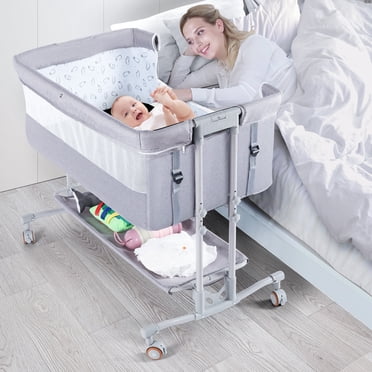
A bassinet beside your bed can be useful, but “bedside” does not always mean “attached to the bed.” Some products are bedside sleepers. Others are ordinary bassinets placed near the bed. Follow the instructions for the exact model.
Do not use a bedside sleeper with the side lowered unless the product is designed and approved for that setup. Never leave an opening between an adult mattress and an attached sleep product.

What to use when your baby outgrows the bassinet
A full-size crib is the usual next step. A mini crib or federally compliant play yard may also work if it provides a firm, flat surface and the baby meets its limits.
Before moving your baby, prepare the new sleep space:
- Assemble it exactly as the manual shows.
- Check that the mattress fits tightly.
- Use the correct fitted sheet.
- Remove all extra padding and soft items.
- Place the baby on their back.
- Keep the new sleep space in your room if possible.
- Stop using the bassinet once the baby reaches its limit.
A play yard is not automatically safe for every type of add-on. Use only the mattress and parts approved for that model. Do not add a third-party mattress or use an insert after the manufacturer says to stop.
A crib mattress may feel harder than a bassinet pad. That is expected. A firm surface helps keep the baby’s face and airway clear.
Transition tips
A short transition may help if your baby resists the new space:
- Start with one daytime nap in the new sleep space.
- Keep the same sleep routine.
- Use the same approved wearable blanket.
- Place the baby down drowsy or awake, based on what works for your family.
- Give the baby time to learn the new space.
Do not make the new space softer or more enclosed to imitate the bassinet. Safe sleep matters more than matching the old feel.
Common mistakes to avoid
Keeping a bassinet because the baby still fits
Length and weight are only part of the decision. A baby who can roll or push up may need to move even when there is plenty of room.


Using a padded insert in a crib or play yard
Extra padding can create gaps, soft spots, or an unsafe incline. Use only the surface supplied or approved by the product maker.
Swaddling a rolling baby
Swaddling can limit a baby’s ability to move out of an unsafe position. Stop when your baby shows signs of rolling. A standard wearable blanket leaves the arms free.
Letting the baby sleep in a sitting device
Car seats, swings, bouncers, and loungers are not routine sleep spaces. If your baby falls asleep there, move the baby to a firm, flat sleep surface as soon as practical.
Relying on breathing monitors
Consumer monitors do not make an unsafe sleep space safe. They also do not replace supervision, safe placement, or medical care. Use a monitor only as directed and do not use it to justify pillows, positioners, or inclined sleep.
Buying a used bassinet without its manual
A used product may be missing parts or may have a recall. Find the exact model, confirm its history, and obtain the instructions before use. If you cannot verify the product, choose another sleep space.

What if the baby sleeps better in the bassinet?
Sleep comfort does not override a safety limit. If your baby has reached the bassinet’s movement or size limit, move the baby even if the bassinet is familiar and the crib causes more waking.
You can keep the routine familiar without keeping the unsafe product. Use the same room, bedtime order, sleep clothing, and calming steps. Keep the sleep surface firm, flat, and empty.
If your baby wakes often after the move, check basic needs first:
- Is the baby hungry?
- Is the room too hot or cold?
- Is the sleep space level and correctly assembled?
- Has the baby started teething or learned a new skill?
- Is the baby sick?
Call your pediatrician if your baby has trouble breathing, unusual sleepiness, poor feeding, blue or gray skin, repeated vomiting, or another urgent symptom. Call 911 for a breathing emergency or a baby who cannot be awakened normally.

Key takeaways
- A 6-month-old may use a bassinet, but only if the exact model allows it.
- Follow the manual’s weight, height, age, and movement limits.
- Stop using the bassinet when the baby rolls, pushes up, sits, pulls up, or reaches a listed limit.
- Use a firm, flat, level mattress with a fitted sheet only.
- Place the baby on their back for every sleep.
- Move the baby to a crib, mini crib, or approved play yard when the bassinet is outgrown.
- When in doubt, ask your child’s pediatrician and contact the manufacturer.
Frequently asked questions
Can a 6-month-old sleep in a bedside bassinet?
Only if the exact bedside bassinet still allows the baby’s age, size, and movement. Many bedside bassinets have low sides or early stop-use rules. Follow the manual, and do not leave a gap between the adult bed and the sleeper.
What if my 6-month-old has not started rolling?
A baby who has not rolled may still have reached the bassinet’s age, weight, height, or push-up limit. Check every limit, not just rolling. If the product allows continued use and the baby fits safely, it may be acceptable.
Can a baby sleep in a bassinet after rolling both ways?
Usually not if the bassinet manual says to stop when rolling begins. Move the baby to a sleep space designed for a larger or more mobile infant. Continue placing the baby on their back.
Is a mini crib safer than a bassinet for a 6-month-old?
Neither is automatically safer. The safer choice is the product that meets current U.S. safety requirements, fits the baby, has a firm flat surface, and is used according to its instructions.
A mini crib often lasts longer because it usually has higher sides and a larger sleep area.

How do I know whether a used bassinet is safe?
Find the exact model and manual. Check for recalls, missing parts, damage, loose fabric, gaps, and altered components. Do not use it if you cannot confirm its limits or safe assembly.
Should I ask a pediatrician before moving my baby to a crib?
Most healthy babies can move to a crib without medical approval. Ask your pediatrician if your baby was premature, has a breathing or movement disorder, has low muscle tone, or has another condition that affects sleep safety.
Conclusion
A 6-month-old can sleep in a bassinet only when the bassinet remains within its stated limits and the baby has not reached a movement milestone that makes it unsafe. The exact age is less important than the product rules and the baby’s skills.
Check the manual today. If your baby rolls, pushes up, sits, pulls on the sides, or has reached the listed limit, move them to a firm, flat, approved crib, mini crib, or play yard. For current U.S. safe-sleep guidance, review the American Academy of Pediatrics recommendations, CDC safe-sleep guidance, and CPSC infant sleep product information.
