
In the United States, bassinet mattresses feel hard because they are designed to provide a firm, flat, level sleep surface for infants. A firm surface helps reduce the risk that a baby’s face will sink into the mattress or that the baby’s body will become trapped between the mattress and the bassinet sides. It may not feel cozy to an adult, but firmness is a key part of safe infant sleep.
Bassinet mattresses are also thin because most bassinets have limited space between the sleep surface and the side walls. A thick, soft pad could reduce the usable depth, create gaps, or change how the bassinet meets its safety requirements.

What Makes a Bassinet Mattress Feel So Firm?
A bassinet mattress usually has less cushioning than an adult mattress, crib mattress, or portable play yard pad. That design is intentional.
Most bassinet mattresses use one or more of these features:


- A thin foam or fiber core
- A firm support board beneath the pad
- A tightly fitted cover
- A flat, level shape with little or no contour
- Minimal quilting or padding
The mattress may feel almost rigid when you press it with your hand. That does not automatically mean it is defective. In many cases, the firmness comes from the need to support a small baby without allowing the sleep surface to form deep dips.
Firm is not the same as hard or unsafe
“Firm” does not mean that the mattress must be uncomfortable, rough, or damaged. It means the surface should resist significant sinking under the baby’s weight.
A safe bassinet mattress should generally be:
- Firm
- Flat
- Level
- Stable
- Free from tears, holes, bulges, or deep depressions
- Designed for that exact bassinet model
The American Academy of Pediatrics recommends a firm, flat, noninclined sleep surface with a fitted sheet and no loose bedding. The U.S. Consumer Product Safety Commission gives similar safe-sleep guidance for babies.
A soft mattress may feel nicer to an adult’s hand, but softness can allow an infant’s nose and mouth to press into the surface. Babies have less strength and control than older children, so they may not be able to move away from an obstructed position.
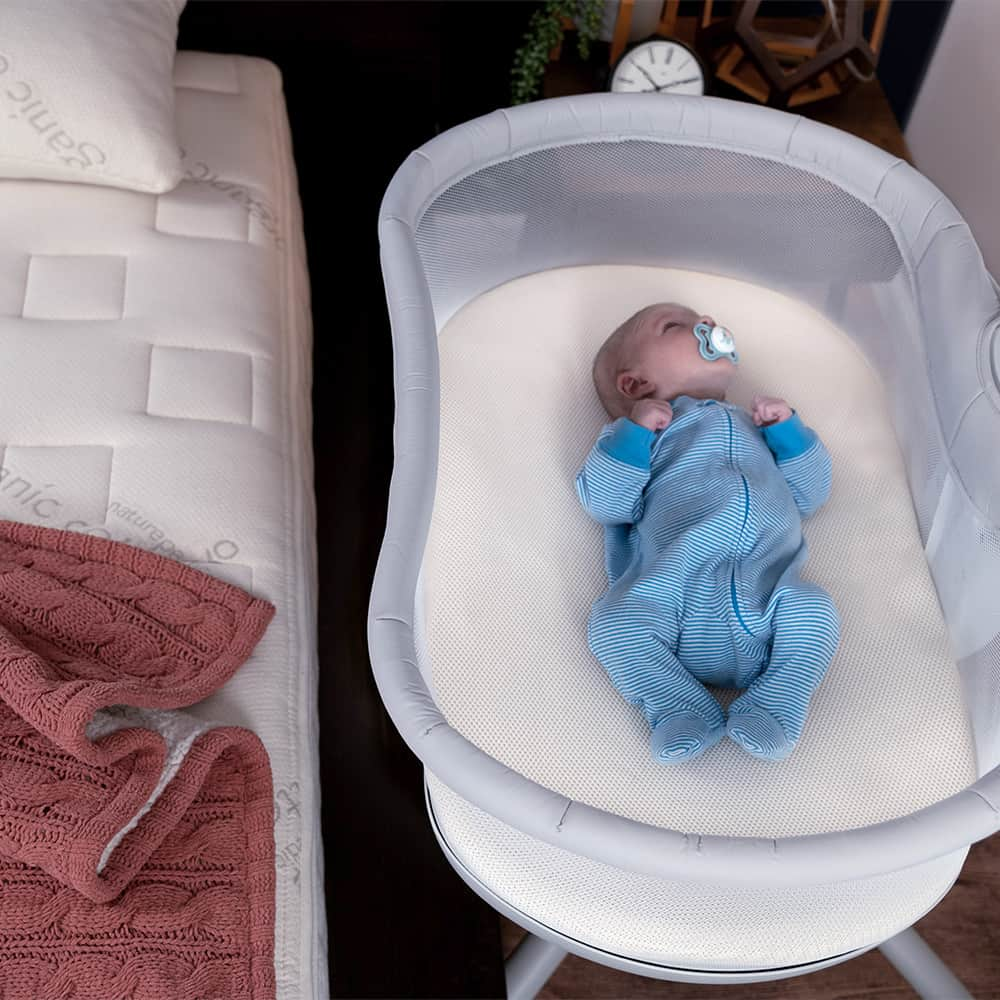
Why Do Babies Need a Firm Bassinet Mattress?
The main reason is to reduce hazards linked to suffocation, entrapment, and rebreathing.
When a mattress is too soft, a baby’s head can sink into it. This can block the nose or mouth. Soft surfaces may also create pockets around the baby’s face where exhaled air collects. If the baby breathes that air again, the air may contain less oxygen and more carbon dioxide.
A firm, flat surface helps limit these risks. It also supports a consistent sleep position and reduces the chance that the baby will roll into a pocket, crease, or gap.


A firm surface helps prevent dangerous gaps
A bassinet mattress must fit closely against the bassinet base and sides. If the mattress is too small, a baby can become trapped in the gap. If it is too thick, it may sit too high or press against the sides in a way the manufacturer did not design.
This is why a mattress from another bassinet may not be safe, even if it appears to be the same size. Small differences in length, width, thickness, corners, or fastening points can matter.
Softness is not a reliable sign of comfort
Adults often judge a mattress by how pleasant it feels when they press it with a hand or lie on it. Infants need a different type of support. A baby’s sleep surface should prioritize a firm, stable base rather than pressure relief or plush cushioning.
Do not try to make a bassinet mattress feel more comfortable by adding:
- A mattress topper
- A blanket under the fitted sheet
- A pillow
- A quilted pad
- A foam insert
- A sheepskin or other soft layer
- An aftermarket cushion
These items can change the sleep surface and add suffocation or entrapment hazards.

Is Your Bassinet Mattress Too Hard or Just Firm Enough?
A bassinet mattress is likely functioning as intended if it is firm, flat, and made for that bassinet. The surface should not have a large dip, fold, tear, or loose section.
Use this simple check:
- Read the bassinet manual. Confirm the approved mattress type and dimensions.
- Remove all extra padding. Check the mattress by itself with only its approved fitted sheet.
- Look for damage. Inspect the foam, board, cover, seams, and corners.
- Check the fit. The mattress should sit flat without visible gaps at the edges.
- Check for movement. It should not slide, curl, buckle, or lift when the bassinet is moved normally.
- Confirm the angle. The sleep surface should remain level unless the product is specifically designed and approved otherwise.
A mattress should not be used if it has a deep sag, a raised lump, a broken support board, exposed foam, torn fabric, or a gap that could allow part of the baby’s body to become trapped.
Do not use an informal “hand test” as a safety test
Pressing a mattress with your palm can tell you whether it feels soft, but it cannot confirm that the product meets the safety requirements for a bassinet. A mattress can feel firm and still be the wrong size, damaged, incompatible, or unsafe for a particular model.
The most useful checks are the product manual, the manufacturer’s instructions, the mattress fit, and the condition of the product.

Can You Make a Bassinet Mattress Softer?
You should not soften a bassinet mattress with an added layer. The safest approach is to use the mattress supplied with the bassinet or a replacement that the bassinet manufacturer identifies for that exact model.
If the mattress seems unusually hard, first determine whether the issue is discomfort or a product problem. Contact the manufacturer if:
- The mattress is much firmer than the one shown in the manual or product instructions.
- The mattress has a hard ridge, warped area, or uneven surface.
- The cover does not fit correctly.
- The mattress does not lie flat.
- The mattress leaves a visible gap around the edge.
- You received the wrong mattress.
- The bassinet was recalled or has missing parts.
Ask the manufacturer for the model-specific mattress dimensions and approved replacement part. Keep the bassinet model name, model number, purchase date, and photos available when you contact customer service.


Why a folded blanket is not a safe fix
A folded blanket may seem like a simple way to add softness. It can also bunch, shift, or create a loose layer beneath the baby. The same concern applies to towels, quilts, receiving blankets, and spare sheets.
The National Institutes of Health Safe to Sleep program advises placing babies on a firm, flat sleep surface covered only by a fitted sheet. The baby’s sleep area should remain free of loose or soft objects.
What about a waterproof pad?
Use a waterproof pad only if it is supplied or approved by the bassinet maker and fits tightly. It should not make the mattress softer, thicker, raised, or uneven.
A pad that changes the fit or creates folds should not be used. Always follow the bassinet manual before adding any accessory.

What Should a Baby Sleep on in a Bassinet?
A baby should sleep on their back on a firm, flat, level bassinet mattress covered with a fitted sheet made for that mattress.
The safest basic setup is simple:
- Baby on their back for every sleep
- Firm and flat mattress
- Correctly fitted sheet
- Empty sleep area
- Bassinet used within its weight, age, and developmental limits
Keep the bassinet in the same room as the caregiver, but not in the adult bed. The AAP recommends room sharing without bed sharing, ideally for at least the first six months when possible.
A wearable blanket may be used if appropriate for the room temperature and the baby’s size. It should fit correctly and should not weigh down the baby. Weighted sleep products are not recommended for infants.
Stop using the bassinet when the manual says to stop
Many bassinets have limits based on age, weight, height, or development. A baby may need to stop using the bassinet when they can:
- Roll over
- Push up on their hands and knees
- Sit up
- Pull up
- Reach the manufacturer’s weight or height limit
The exact limit depends on the product. Check the manual rather than relying on a general age estimate.
A baby who has started to roll should still be placed on their back, but the sleep area must remain clear. Swaddling should stop when the baby shows signs of trying to roll.

Common Mistakes With Bassinet Mattresses
The most common mistake is treating a bassinet like a miniature adult bed. Parents may add padding because the surface feels hard, but that can remove the safety features built into the original design.
Avoid these errors:
Using a crib mattress in a bassinet
A crib mattress is usually too large or too thick for a bassinet. Even if it fits inside the frame, it may not fit safely against the sides or may raise the sleep surface too much.
Buying a universal replacement mattress
“Universal” does not guarantee a safe fit. Choose a replacement approved for the exact bassinet model.


Adding a second fitted sheet
Two sheets can create folds and reduce the fit around the mattress. Use one fitted sheet that is made for the bassinet mattress.
Using an inclined insert for reflux
Inclined sleep surfaces can allow a baby to slide or place the head in a position that affects breathing. The U.S. Food and Drug Administration warns against using infant sleep products with an incline of more than 10 degrees because of the risk of suffocation.
If your baby has reflux, ask a pediatrician for feeding and medical guidance. Do not change the sleep surface without professional advice.
Keeping the mattress after a recall
Check the bassinet brand and model against the CPSC recalls database. Stop using a product that is subject to a recall and follow the stated remedy.

When Should You Replace a Bassinet Mattress?
Replace a bassinet mattress only when it is damaged, missing, recalled, or no longer fits correctly. A mattress does not need replacement simply because it feels firm.
Look for these replacement signs:
- Tears or holes in the cover
- Exposed foam or fiber
- A cracked or bent support board
- Permanent sagging
- A raised or uneven area
- Stretched seams
- A loose cover
- A visible edge gap
- Liquid damage, mold, or contamination that cannot be fully cleaned
- An unknown or secondhand history
Use a replacement from the manufacturer whenever possible. If an approved replacement is not available, ask the manufacturer whether the bassinet can still be used. Do not guess at dimensions or substitute a mattress from another brand.
For a used bassinet, verify the model, instructions, recalls, required parts, and mattress condition. The CPSC advises consumers to check secondhand products carefully because older products may lack current safety features or may have missing instructions.

Quick Answers
Are bassinet mattresses supposed to be hard?
They are supposed to be firm, flat, and level. A firm mattress may feel hard compared with an adult mattress, but it should not be cracked, warped, lumpy, or damaged.
Can I add a mattress topper to a bassinet?
No. Do not add a topper or extra padding unless the bassinet manufacturer specifically approves it for that model. Extra layers can create soft spots, gaps, or an unsafe incline.
Can a baby sleep on a firm foam mattress?
A foam mattress can be suitable if it is the original or manufacturer-approved mattress for that bassinet and it fits correctly. The material alone does not determine safety.
What if my baby seems uncomfortable on the firm mattress?
Check the room temperature, clothing, feeding routine, and the baby’s overall behavior. Do not add soft bedding to improve comfort. Contact the baby’s pediatrician if your baby seems distressed, has trouble breathing, feeds poorly, or shows other concerning symptoms.
Is a hard bassinet mattress safer than a soft one?
Firmness is one part of a safe sleep setup. The mattress must also be flat, level, undamaged, correctly fitted, and used with no loose items. A hard-feeling mattress from the wrong product or with a dangerous gap is not automatically safe.
The Bottom Line
Bassinet mattresses are firm because infants need a stable, flat sleep surface that does not allow the face to sink into soft padding. In the United States, safe-sleep guidance from the AAP, CPSC, NIH, and FDA supports using a firm mattress with only a properly fitted sheet.
Do not soften the mattress with blankets, toppers, pillows, or inserts. Instead, confirm that the mattress is the correct model, fits tightly, lies flat, and has no damage. If it does not pass those checks, contact the manufacturer before using the bassinet.


