
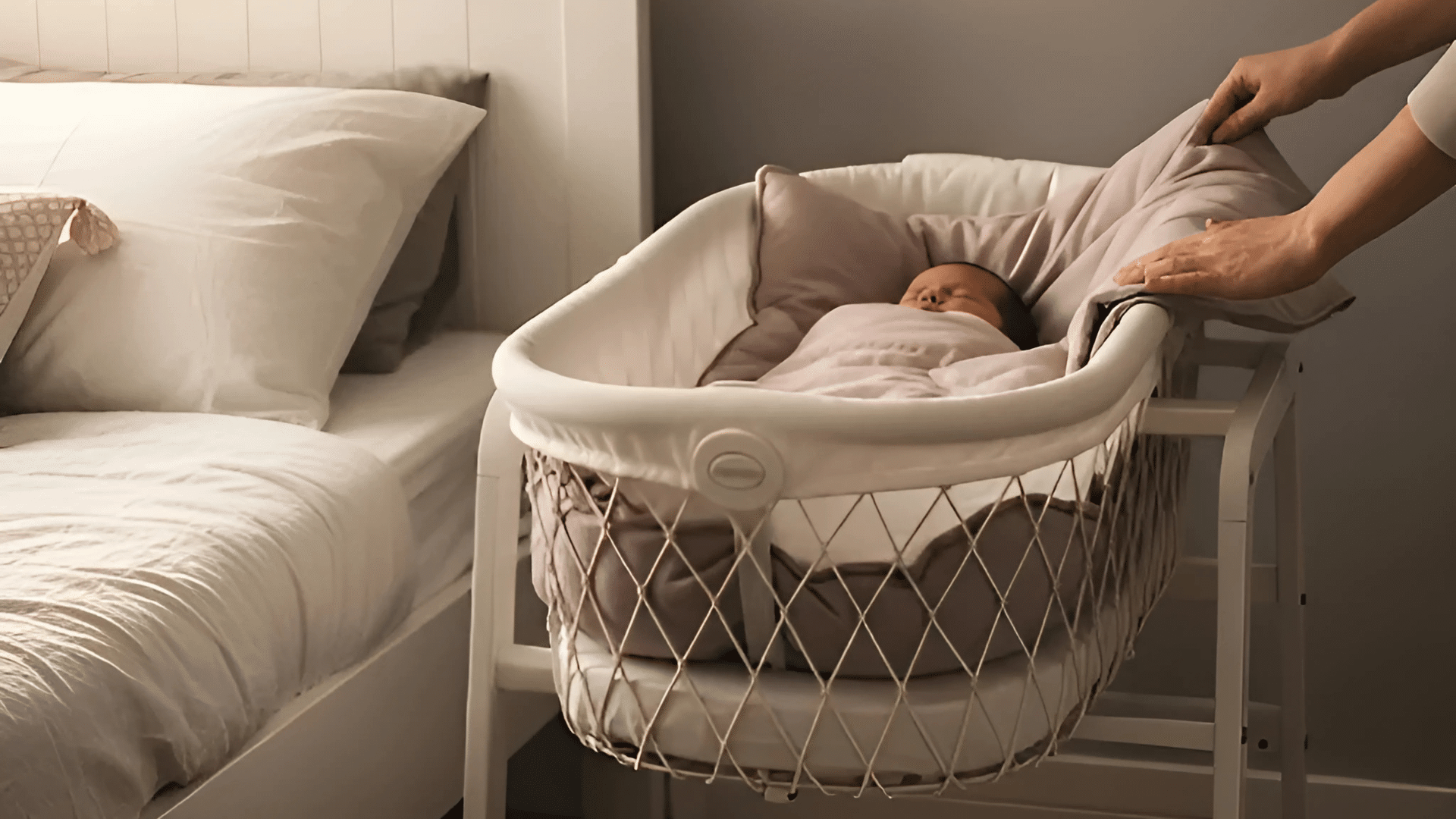
In the United States, most babies use a bassinet for the first 3 to 6 months. However, age is only a rough guide. You should stop using the bassinet sooner if your baby reaches its weight limit, grows too tall, rolls over, pushes up, or can sit up.
A baby may sleep in a bassinet for naps and overnight sleep. There is no set number of hours per day. The key is that the bassinet must be made for infant sleep, used according to its manual, and kept clear of loose bedding and other hazards.

What is the safest age to stop using a bassinet?
Stop using a bassinet when your baby reaches any of these limits:
- Your baby reaches the bassinet’s weight limit.
- Your baby is too tall for the product.
- Your baby rolls from back to side or back to stomach.
- Your baby pushes up on their hands and knees.
- Your baby can sit up or pull up.
- Your baby’s head or body comes close to the sides.
- The manufacturer says to stop at a certain age or stage.


Many babies outgrow a bassinet between 3 and 6 months. Some babies outgrow one sooner because they are active or large. Others may fit safely for longer. The product manual, not a general age range, gives the final limit.
Why rolling changes the answer
Rolling shows that your baby can change body position during sleep. A baby who rolls may press against the side of a small bassinet or move into an unsafe position.
You should not use restraints, straps, wedges, positioners, or rolled towels to keep a baby in place. These products can create a suffocation or entrapment risk unless they are part of the sleep product and approved by its manufacturer.
The American Academy of Pediatrics recommends moving a baby out of a bassinet when the baby reaches the product’s limits or begins trying to roll. Check the bassinet manual often as your baby grows. The CPSC also advises parents to follow the product’s warnings and instructions.
Can a baby sleep in a bassinet all night?
Yes. A baby can sleep in a bassinet overnight if the bassinet is approved for infant sleep and your baby still fits within its limits.
A bassinet is not only for short naps. Many families use one for both nighttime sleep and daytime sleep during the first months. The safe sleep setup matters more than whether the sleep period lasts 30 minutes or several hours.
For every sleep:
- Place your baby on their back.
- Use a firm, flat, level mattress made for that bassinet.
- Use only a fitted sheet designed for the product.
- Keep pillows, blankets, quilts, bumpers, toys, and sleep positioners out of the bassinet.
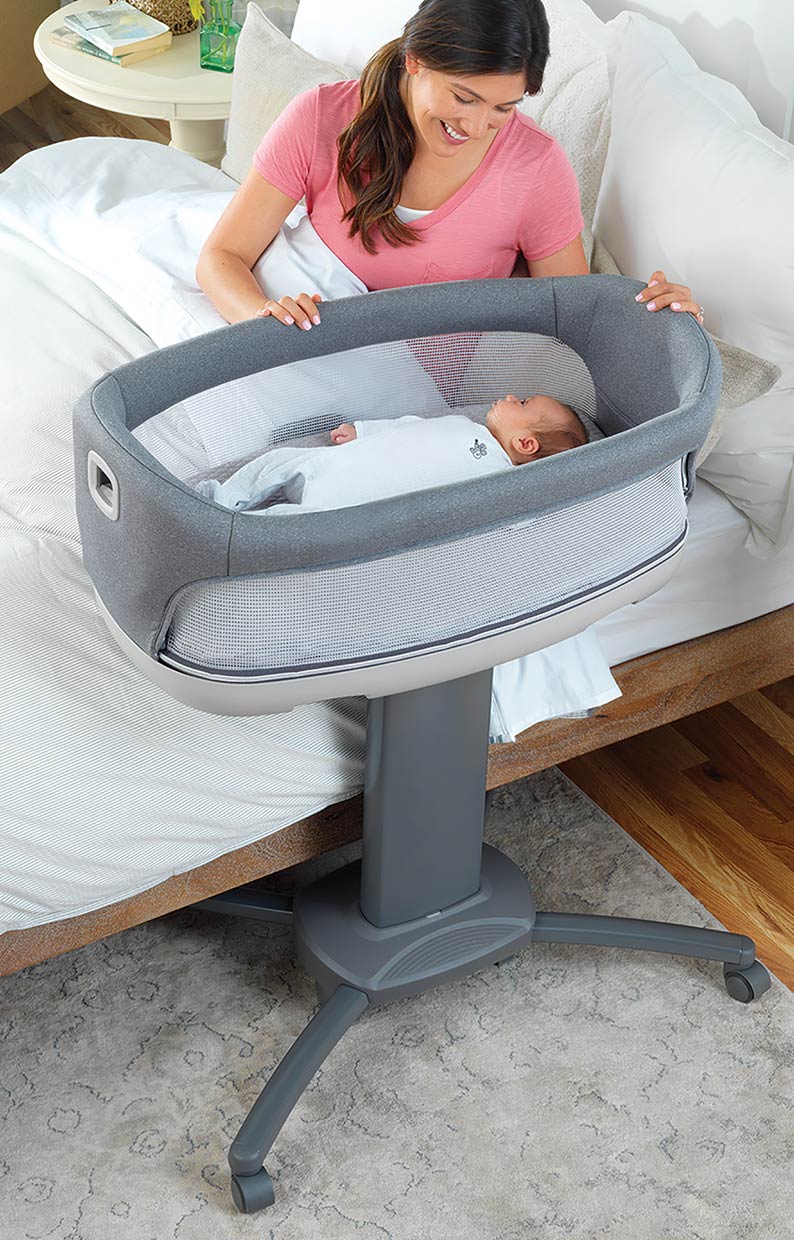
- Keep the bassinet in your room, close to your bed, but on a separate sleep surface.
- Keep the bassinet away from cords, window coverings, heaters, and other hazards.
- Stop swaddling when your baby shows signs of trying to roll.
The AAP recommends room-sharing without bed-sharing for at least the first 6 months, when possible. A bassinet beside the adult bed can support that recommendation while giving the baby a separate sleep space.

How do you know when a baby has outgrown a bassinet?
The clearest sign is that your baby reaches a limit listed by the manufacturer. You should also watch your baby’s movement and body position.
Check these five signs
1. Your baby reaches the weight limit.
Find the limit in the manual, on the product label, or on the manufacturer’s website. Do not guess based on how sturdy the bassinet feels.
2. Your baby reaches the height limit.
Some bassinets list a maximum length. If your baby’s head or feet are close to either end, check the manual before continued use.


3. Your baby starts rolling.
A baby does not need to complete a full roll for this to matter. Signs may include twisting onto the side, rocking from side to side, or trying to roll during floor play.
4. Your baby pushes up.
Pushing up on the hands and knees can allow a baby to shift, climb, or lean against the bassinet side.
5. Your baby can sit or pull up.
These skills usually mean the baby needs a larger sleep space with sides designed for the next stage.
A simple decision table
| What you see | What to do |
|---|---|
| Baby is under the limits and not rolling | Continue using the bassinet as directed |
| Baby reaches the weight or height limit | Stop using it and move to a suitable crib or play yard |
| Baby begins trying to roll | Stop using a swaddle; check the bassinet manual and prepare to move |
| Baby rolls, pushes up, sits, or pulls up | Stop using the bassinet |
| The mattress is soft, tilted, damaged, or does not fit | Do not use the bassinet until the issue is fixed or the product is replaced |
| You cannot find the manual or product limits | Contact the manufacturer before using it |
A baby may look comfortable in a bassinet and still be ready to move. Developmental signs are often more important than age.
What should a baby sleep in after a bassinet?
After a bassinet, most babies move to a full-size crib, mini crib, or play yard that meets current U.S. safety requirements.
The next sleep space should have:
- A firm, flat mattress
- A fitted sheet made for that mattress
- No gaps between the mattress and the sides
- No pillows, loose blankets, crib bumpers, stuffed toys, or sleep positioners
- A stable frame with no broken or missing parts
- Clear instructions and an identifiable manufacturer
A full-size crib is often the simplest long-term choice. A mini crib may work well in a small room, but it has less space and may be outgrown sooner. A play yard can be useful for travel or a second room, but use only the mattress and sheets approved for that model.
Do not place a bassinet mattress inside a crib or use a crib mattress in a bassinet unless the manufacturer specifically designed the combination. A mattress that seems to fit can still leave a dangerous gap.
What about bedside sleepers?
A bedside sleeper may attach to or sit next to an adult bed. It still needs to meet the product’s safety rules and weight or movement limits.
Do not leave the side lowered for unsupervised sleep unless the product is specifically designed and approved for that use. Follow the manual each time you set it up. Never use an improvised sidecar made from furniture or a modified crib.

Does a bassinet need to be flat?
For routine sleep, use a sleep surface that is firm, flat, and level. Avoid inclined products for sleep unless a qualified clinician gives you a specific medical plan, and do not try to create an incline with blankets, towels, pillows, or mattress wedges.
Inclined sleepers and products that hold a baby in a seated or curved position can allow the head to fall forward. This may restrict breathing. The AAP and CPSC advise against using inclined sleepers for infant sleep.
Rocking or vibrating features do not change the basic rule. If the product is marketed for soothing, check whether it is approved for unsupervised sleep. If it is not designed for sleep, move the baby to a safe crib, bassinet, or play yard once the baby falls asleep.
Is a bassinet safer than a crib?
A bassinet is not automatically safer than a crib. Both can provide a safe sleep space when they meet safety standards and are used correctly.
A bassinet can make room-sharing easier because it is small and often fits beside the adult bed. A crib usually lasts longer and gives an active baby more room. The safest choice is the product that:


- Is intended for infant sleep
- Has a firm, flat sleep surface
- Fits the baby’s current size and movement
- Has no missing, loose, or damaged parts
- Is used exactly as the manual states
Do not use a household basket, laundry basket, sofa, adult bed, couch, recliner, or padded lounger as a substitute. Some products look similar to bassinets but are not approved for unsupervised sleep.
The CPSC’s federal rules cover products such as bassinets, cradles, cribs, and play yards. You can also check recalls through the official CPSC recall database.

How long can a newborn sleep in a bassinet?
A newborn can sleep in a bassinet for naps and nighttime sleep from the first day home, provided the product is designed for newborn sleep and the baby fits its limits.
Newborns wake often to feed. That does not mean a bassinet is only for short sleep periods. It means the baby’s normal feeding pattern may break sleep into several short periods.
Always follow your pediatrician’s feeding advice. Some newborns need to be woken for feeds because of age, weight loss, jaundice, prematurity, or another health concern. Sleep-safety advice does not replace an individual feeding plan.
Never use a couch or recliner for a planned nap with a newborn. If you feel sleepy while holding the baby, place the baby on their back in the bassinet or another approved sleep space as soon as possible.

How should you transition a baby from a bassinet to a crib?
Move your baby when the bassinet is outgrown, not because the baby must reach a certain age. A calm, consistent routine can make the change easier.
Try these steps:
- Set up the crib before the move.
- Use the same safe sleep routine you used with the bassinet.
- Place the crib in your room if possible.
- Let your baby have short periods of supervised play in the crib while awake.
- Keep the mattress firm, flat, and empty except for a fitted sheet.
- Keep placing your baby on their back for every sleep.
- Give the new sleep space several days before judging whether it works.
Some babies adjust quickly. Others need more time. Comfort your baby before sleep, but avoid adding loose items to the crib. A wearable blanket may help keep a baby warm; it should fit correctly and should not be weighted unless your child’s clinician specifically advises it.
If your baby rolls, stop swaddling. You do not need to turn the baby back every time they roll after being placed on their back, but keep the sleep space empty and continue starting every sleep on the back.
Common bassinet safety mistakes
Many bassinet problems come from using the product beyond its intended stage or adding items that do not belong in it.
Using the bassinet after rolling begins
A baby may roll for the first time without warning. Check your baby’s movement each day. Once rolling attempts begin, stop swaddling and follow the manufacturer’s instructions about continued bassinet use.
Adding a pillow or soft liner
A soft liner, padded insert, or extra mattress can create gaps or cover the baby’s face. Use only the mattress and sheet supplied or approved for that exact model.
Using a recalled or secondhand product without checking it
Secondhand products may have missing instructions, worn parts, or safety updates that the original owner did not know about. Search the model in the CPSC recall database and confirm that all parts are present.


Treating a portable lounger as a sleep space
Baby loungers, nests, nursing pillows, and similar products may be useful for supervised awake time, but they are not automatically safe for sleep. Read the label and manual. If the product is not intended for unsupervised sleep, do not use it as a bassinet.
Assuming a lower weight means the product is safe
A baby who weighs less than the limit may still be too active or too tall for the bassinet. Weight is only one part of the decision.
Moving the bassinet onto an unsafe surface
Do not place a bassinet on a bed, sofa, table, counter, or other raised surface unless the product is specifically designed and approved for that setup. Use the stand and base as directed.

When should you ask a pediatrician for help?
Contact your baby’s pediatrician if you are unsure whether a health issue changes the sleep plan. This includes questions about reflux, breathing problems, prematurity, poor weight gain, low muscle tone, or a medical device.
Seek urgent medical help if your baby has trouble breathing, turns blue or gray, is unusually hard to wake, or may have become trapped in a sleep product.
A pediatrician can help with health-related sleep questions, but the product manual still controls the bassinet’s weight, height, and developmental limits. Do not keep using a product past its limits because a clinician has suggested a different sleep position unless you have clear, individualized medical instructions.
Frequently asked questions
Can a baby sleep in a bassinet past 6 months?
Possibly, but only if the baby still fits the bassinet’s limits and has not reached a developmental limit. Many babies outgrow bassinets before 6 months. Check the manual rather than relying on age alone.
Can a baby sleep in a bassinet after rolling?
Usually, you should stop using the bassinet when rolling begins, especially if the manual says to stop. At a minimum, stop swaddling as soon as your baby shows signs of rolling and move the baby to a sleep space designed for the next stage.
How many hours a day can a baby spend in a bassinet?
There is no universal hourly limit for a properly used sleep bassinet. A baby may use it for naps and nighttime sleep. The bassinet must remain safe, and the baby must stay within its size and developmental limits.
Can a baby sleep in a bassinet on an incline for reflux?
Do not incline a bassinet with towels, wedges, or extra padding. Babies with reflux should still sleep on a firm, flat surface unless your pediatrician gives a specific medical plan.
Is it safe to use a bassinet in another room?
The AAP recommends room-sharing without bed-sharing for at least the first 6 months when possible. A bassinet can be used in another room only if you can supervise appropriately, but room-sharing offers a safety benefit and makes nighttime care easier.
What if my baby hates the crib after leaving the bassinet?
Keep the crib setup safe and use a steady bedtime routine. You can comfort your baby with feeding, holding, rocking, or a song before placing the baby down. Do not add pillows, blankets, bumpers, or positioners to make the crib feel more like a bassinet.
Bottom line
Most babies use a bassinet for about 3 to 6 months, but the correct stopping point is based on the product’s limits and your baby’s development. Stop when your baby reaches the weight or height limit, begins rolling, pushes up, sits, or pulls up.
For every sleep, use a firm, flat, empty sleep surface and place your baby on their back. When the bassinet is outgrown, move your baby to a safe crib, mini crib, or play yard that meets current U.S. safety guidance.


