
A newborn can sleep in a bassinet for each sleep period, day or night, as long as the bassinet is safe and the baby has not reached its limits. Most babies outgrow a bassinet between 3 and 4 months, but some need to move sooner.
The key change is not a certain age. It is your baby’s growth and movement. Stop using the bassinet when your baby can roll, push up, sit, reach the product’s weight or height limit, or no longer fits safely.
This guide explains how long a newborn can sleep in a bassinet, how to use one safely in a U.S. home, and when to move your baby to a crib.

How Long Can a Newborn Sleep in a Bassinet at One Time?
A newborn may sleep in a bassinet for a full nap or night sleep. There is no standard time limit for one sleep session if the baby is placed on a firm, flat, empty sleep surface and the bassinet meets current U.S. safety rules.


Newborns often sleep in short blocks. Many wake every 2 to 4 hours to feed, though sleep patterns vary. Your baby’s doctor may give a different feeding plan, especially if your baby was born early, has jaundice, has poor weight gain, or has another health concern.
Do not wake a healthy, growing baby only because a certain number of hours has passed unless your pediatrician tells you to do so. In the early days, ask your baby’s doctor when it is safe to let your newborn sleep longer between feeds.
A bassinet is meant for sleep. It should not become a place for long periods of play, lounging, or supervised naps on soft items. Use the bassinet only as its instructions allow.
The simple rule
Your newborn can keep sleeping in the bassinet when all of these are true:
- The bassinet is made for infant sleep.
- The mattress is firm, flat, and fitted.
- The baby sleeps on their back.
- The sleep space contains only the fitted sheet.
- The baby has not reached the weight or height limit.
- The baby cannot roll, sit, or push up.
- The bassinet is in good condition and used as directed.

When Should You Stop Using a Bassinet?
You should stop using a bassinet as soon as your baby reaches any of its safety limits. Check the product manual for the exact limits. Do not rely on age alone.
Move your baby to a crib, mini crib, or other approved sleep space when you see any of these signs:
Your baby rolls or tries to roll.
A baby who turns from back to side or tries to roll may need more room. Follow the product manual, since some bassinets require removal at the first attempt to roll.Your baby pushes up on hands or knees.
This movement can let the baby lean over or shift into an unsafe position.Your baby can sit up.
Sitting changes the way a baby can move inside a low sleep space.Your baby reaches the weight limit.
The limit may be 15, 20, or another number of pounds. Each model differs.Your baby reaches the height limit.
A tall baby may touch the sides or have too little room before reaching the weight limit.Your baby looks cramped.
If your baby’s head or feet are close to the ends, check the manual and plan the move. Never add padding or use a larger mattress that did not come with the product.The bassinet shows damage.
Stop using it if the frame bends, the base is unstable, the mesh tears, or the mattress does not lie flat.
Most newborns leave a bassinet around 3 to 4 months. This is only a common range, not a safety rule. Some babies move at 2 months, while others fit safely for longer.

What Is the Safest Way for a Newborn to Sleep in a Bassinet?
The safest setup follows the American Academy of Pediatrics (AAP) and U.S. Consumer Product Safety Commission guidance:
- Place your baby on their back for every sleep.
- Use a firm, flat, level mattress.
- Use only the sheet made for that mattress.
- Keep the bassinet free of pillows, blankets, quilts, bumpers, toys, and positioners.
- Keep the baby’s face and head uncovered.
- Place the bassinet in your room, near your bed, but on a separate sleep surface.
- Keep the bassinet away from cords, curtains, heaters, windows, and pets.
- Follow the manufacturer’s setup and cleaning instructions.


Room sharing means the baby sleeps in the same room as a parent or caregiver but on a separate surface. The AAP recommends room sharing, ideally for at least the first 6 months, because it can lower the risk of sleep-related death. Bed sharing is different and carries added risk.
Can a newborn sleep in a bedside bassinet?
Yes. A bedside bassinet can be used if it is approved for infant sleep and set up correctly. A “bedside sleeper” may sit next to the adult bed, but it should still have a complete, secure sleep surface.
Do not remove a side panel or attach the bassinet to your bed unless the product is specifically designed for that use. Follow the manual for the attachment, height, and weight limits.
Can a newborn sleep in a portable bassinet?
Some portable bassinets are safe for sleep. Others are made only for supervised travel or short periods of use. Look for clear instructions that state the product is intended for infant sleep.
A soft-sided travel bed, lounger, nest, or padded pod is not automatically a safe bassinet. A product’s name or marketing does not replace its safety instructions.

What Should Be in a Newborn’s Bassinet?
A safe bassinet should contain only:
- Your baby
- The manufacturer’s fitted sheet
That is all your newborn needs for sleep. A wearable blanket may be used if it fits well and does not weigh down the baby. Stop swaddling when your baby shows signs of trying to roll.
Items to keep out of the bassinet
Do not place these items in the sleep space:
- Loose blankets
- Pillows
- Stuffed animals
- Crib bumpers
- Sleep positioners
- Wedges
- Nursing pillows
- Mattress toppers
- Weighted swaddles or blankets
- Hats, unless a clinician gives a specific reason
- Aftermarket inserts not approved by the maker
A light blanket can cover a baby’s face. Pillows and soft items can block airflow. Positioners can trap a baby against the side of the bassinet.
What if the baby spits up?
Healthy babies should still sleep flat on their backs. Raising one end of the bassinet or placing a towel under the mattress does not make sleep safer. It can cause the baby to slide into a position that blocks breathing.
Back sleeping does not increase the risk of choking from normal spit-up. If your baby has frequent vomiting, poor feeding, breathing trouble, or poor weight gain, contact a pediatric clinician.
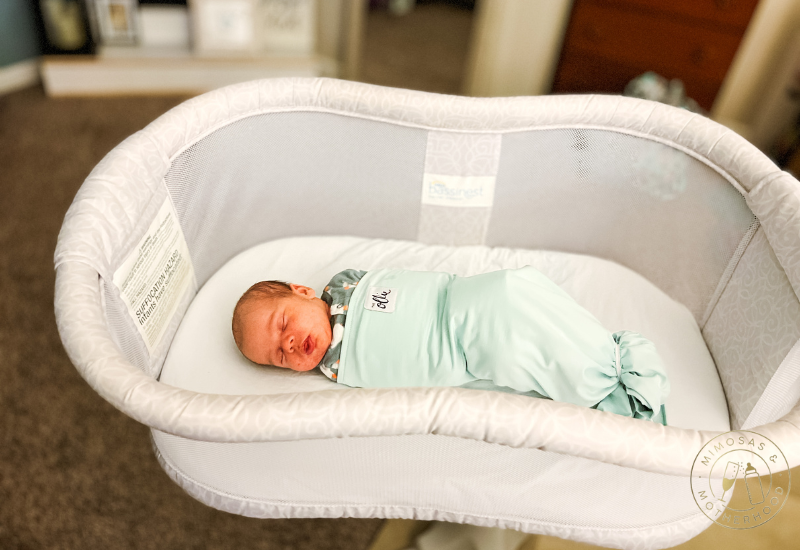
Bassinet vs. Crib: When Is It Time to Move?
A crib is usually the next sleep space after a bassinet. A full-size crib, mini crib, or play yard may work if it is approved for infant sleep and used with its original, firm mattress.
| Sleep space | When it may fit | Main limit |
|---|---|---|
| Bassinet | Newborn stage | Small size and early movement |
| Mini crib | After the bassinet stage | Check its weight and height limits |
| Full-size crib | From birth or after a bassinet | Requires a firm, fitted mattress |
| Play yard | Travel or everyday sleep if approved | Use only the included sleep pad |
| Adult bed | Not recommended for infant sleep | Soft bedding and gaps raise risk |
Do not wait for the baby to look uncomfortable if the baby has started to roll or push up. Movement is a stronger reason to move than age.


How to make the move easier
Place the new crib in the same room as your bed when possible. Keep the sleep routine simple and familiar:
- Feed your baby.
- Change the diaper.
- Use a safe sleep sack if appropriate.
- Dim the lights.
- Place your baby on their back in the empty crib.
Your baby may sleep differently after the move. That does not mean the crib is unsafe. Avoid adding pillows, wedges, or extra padding to make the crib feel more like the bassinet.

Can a Newborn Sleep in a Bassinet Overnight?
Yes, a newborn can sleep overnight in a bassinet when the bassinet is safe, stable, and within its limits. Place it next to your bed rather than placing the baby in the adult bed.
Night sleep still requires the same rules as naps. Use a firm, flat, empty surface. Keep loose bedding out. Check the baby during normal feeds and care, but do not use sleep positioners or monitoring devices as a substitute for safe sleep practices.
A monitor cannot prevent every sleep-related emergency. Home cardiorespiratory monitors are not recommended as a way to lower the risk of sudden infant death syndrome (SIDS).
Can a Newborn Sleep in a Bassinet During the Day?
Yes. A bassinet can be used for daytime naps if it is approved for sleep and placed in a safe location. Daytime sleep needs the same setup as nighttime sleep.
Avoid letting your baby nap for long periods in sitting devices such as:
- Car seats outside the car
- Swings
- Bouncers
- Rockers
- Strollers that are not fully approved for flat sleep
If your baby falls asleep in one of these products, move them to a firm, flat sleep surface as soon as practical. A car seat is for travel, not routine sleep outside a vehicle.

What If the Baby Falls Asleep Somewhere Else?
Move the baby to the bassinet, crib, or approved play yard when you can do so safely. This includes sleep in a couch, adult bed, recliner, swing, bouncer, or car seat after the ride ends.
Couches and recliners are especially risky because a baby can slip into a gap or become trapped against an adult. If you feel sleepy while feeding or holding your baby, place the baby in their own sleep space before you fall asleep.
If you bring the baby into bed to feed, clear pillows and blankets from the area and return the baby to the bassinet when feeding is done. The safest place for the baby is a separate, empty sleep surface.

Common Bassinet Mistakes to Avoid
The most common mistakes involve using the bassinet past its limits or adding items that seem comforting but create risk.
Using age as the only guide
A 4-month-old may still fit a bassinet, while a 2-month-old may already be rolling. Check movement, size, and the manual.


Adding a soft mattress topper
A soft topper can increase the chance of the baby’s face pressing into the surface. Use only the original mattress and fitted sheet.
Swaddling after rolling begins
Swaddling can limit a baby’s ability to move out of a dangerous position. Stop when your baby shows signs of rolling. A wearable blanket that leaves the arms free may be an option.
Using a recalled or damaged bassinet
Check the model, manual, and recall information before using a secondhand bassinet. Missing parts and unknown repair history are safety concerns.
In the United States, you can search the U.S. Consumer Product Safety Commission recall database for the product name and model number.
Placing the bassinet near hazards
Keep it away from window cords, wall cords, heaters, fans, shelves, and furniture that could fall. Make sure pets and young children cannot climb into it.

A Quick Decision Guide
Use this check before each sleep:
- Can your baby roll or try to roll? Move to a larger approved sleep space if the manual says to stop using the bassinet.
- Has your baby reached the weight or height limit? Stop using it.
- Is the mattress firm, flat, and level? If not, do not use the bassinet.
- Is the bassinet empty except for the fitted sheet? Remove loose items.
- Is the bassinet stable and undamaged? If not, stop using it.
- Is your baby on their back? Place them on their back for every sleep.
- Does the product manual allow sleep? If unclear, contact the manufacturer before use.
If you answer “no” to any safety question, use another approved sleep space or ask the manufacturer for help.
When Should You Call a Doctor?
Contact your baby’s pediatric clinician if your newborn is hard to wake, has trouble breathing, feeds poorly, has repeated vomiting, or has fewer wet diapers than expected.
Call 911 in the United States for severe breathing trouble, blue or gray lips or skin, unresponsiveness, or another emergency.
For questions about how often your newborn should wake to feed, ask the pediatrician who knows your baby’s birth history and growth. Feeding needs can differ widely in the first weeks.
Key Takeaways
- A newborn can sleep in a bassinet for a nap or overnight sleep when the setup is safe.
- Most babies outgrow a bassinet at about 3 to 4 months, but movement and product limits matter more than age.
- Stop using it when your baby rolls, tries to roll, pushes up, sits, or reaches the stated weight or height limit.
- Use a firm, flat, empty sleep surface with a fitted sheet.
- Place your baby on their back and keep the bassinet in your room, near your bed.
- Move the baby to a crib, mini crib, or approved play yard when the bassinet is no longer safe.
Frequently Asked Questions
Can a newborn sleep in a bassinet all night?
Yes. A newborn can sleep in a bassinet overnight if the bassinet is designed for infant sleep and remains within its safety limits. Use a firm, flat, empty surface and place the baby on their back.
How many hours can a newborn sleep in a bassinet?
There is no universal hourly limit for one sleep period. The baby may sleep for a nap or overnight stretch, with feeding and care as needed. Follow your pediatrician’s feeding advice and the bassinet’s manual.
What age do babies stop using bassinets?
Many babies stop using a bassinet between 3 and 4 months. Some stop earlier because they roll, push up, grow quickly, or reach the product’s limits.


Can a baby sleep in a bassinet after rolling?
Many bassinets should not be used once a baby rolls or tries to roll. Check the manual right away. If the manual says to stop, move the baby to a crib or another approved sleep space.
Is it safe to put a blanket in a newborn’s bassinet?
No. Loose blankets should not be placed in a newborn’s bassinet. Use a properly fitted wearable blanket if needed, and stop swaddling when the baby shows signs of rolling.
Conclusion
A newborn can sleep in a bassinet as long as the bassinet is approved for sleep, set up correctly, and still fits the baby safely. The usual transition happens around 3 to 4 months, but your baby’s movement and the product’s limits are the real deciding factors.
Check the manual today. If your baby rolls, tries to roll, pushes up, sits, or reaches the size limit, move them to a firm, flat crib or another approved sleep space.
