
Introduction
A rocking bassinet can be worth it for some families in the United States, but it is not a must-have baby item. Its main benefit is convenience: gentle motion may help some babies settle while a parent stays nearby. Its value depends on the baby, the design, the price, and whether the product meets current U.S. safe-sleep rules.
The safest choice is a bassinet with a firm, flat, non-inclined sleep surface. It should meet the applicable U.S. safety standard, fit your room, and be easy to use every night. Rocking should be an extra feature—not the reason to accept a weak mattress, a steep angle, poor stability, or unclear instructions.

Quick answer: Is a rocking bassinet worth it?
A rocking bassinet is usually worth considering if:


- Your baby settles with gentle motion.
- You want a small sleep space near your bed.
- You can rock it without leaving bed or holding the baby.
- The bassinet has a firm, flat, level sleep surface.
- The motion can be stopped or locked when needed.
- The product is easy to clean and does not require costly add-ons.
It may not be worth the extra cost if your baby sleeps well in a standard bassinet, if you need to move the bassinet often, or if the rocking feature is loud, hard to control, or not approved for use with a sleeping infant.
The best answer is simple: buy a safe bassinet first, then treat rocking as a useful bonus.

What is a rocking bassinet?
A rocking bassinet is a small infant bed that moves from side to side or back and forth. Some models rock by hand. Others use a motor, remote control, app, or built-in sensor.
A rocking bassinet is not the same as every baby swing, lounger, or vibrating seat. Those products may place a baby at an angle or use a harnessed seat. A bassinet is intended for infant sleep, but it still must meet safety rules and the maker’s instructions.
Common types include:
| Type | How it moves | Main benefit | Main drawback |
|---|---|---|---|
| Manual rocking bassinet | A parent pushes the frame | Simple and often less costly | Requires a parent to start the motion |
| Motorized rocking bassinet | A motor creates steady motion | Can soothe without constant hand movement | Costs more and has more parts to maintain |
| Vibrating bassinet | A small motor creates vibration | May calm some babies | Vibration is not the same as rocking |
| Smart bassinet | Motion, sound, and sensors may be controlled by an app | More automation | Higher cost, setup needs, and possible subscription fees |
The word “rocking” does not prove that a product is safe for unsupervised sleep. Check the product label, manual, safety notices, and current recall information before buying.

Why parents choose a rocking bassinet
The main reason parents buy one is to make settling easier. Gentle movement can feel familiar to a baby, much like the movement felt before birth. Some babies relax with it. Others do not care about it, and a few may become more alert when the motion stops.
A rocking bassinet may also reduce the need to walk, bounce, or hold a baby for every nap. That can be helpful during the first weeks, when parents in the United States often manage frequent night feeds and short sleep periods.
Other possible benefits include:
- Keeping the baby close during room sharing.
- Making short daytime naps easier to start.
- Offering a soothing routine before sleep.
- Reducing the need to carry a sleeping baby from room to room.
- Taking up less space than a full-size crib.
These benefits are practical, not guaranteed. There is no strong reason to assume that every baby will sleep longer because a bassinet rocks. A parent’s own comfort, the baby’s temperament, and the sleep setting often matter more than the motion feature.


What are the disadvantages?
The biggest drawback is that a rocking bassinet may cost more without solving the real sleep problem. Newborn sleep changes often. A baby who loves motion at two weeks may reject it at three months, or may sleep just as well in a still bassinet.
Other limits include:
- Short use period: Many bassinets are only suitable until a baby reaches the maker’s weight, size, rolling, pushing-up, or other use limit.
- More parts to fail: Motors, power cords, sensors, and control systems need care.
- Noise: A motor may disturb a light sleeper or a parent.
- Cleaning: Fabric covers, pads, and seams can trap spit-up or milk.
- Moving problems: Some rocking models are less convenient to carry or relocate.
- Power needs: A motorized model may need an outlet, batteries, or both.
- Habit concerns: A baby may begin to expect motion before settling. This is not always harmful, but it can make sleep routines less flexible.
- False confidence: Motion does not make an unsafe sleep surface safe.
A manual rocking bassinet may avoid some electronic problems. However, it still needs a stable frame, a level sleep surface, and clear instructions for when rocking is allowed.
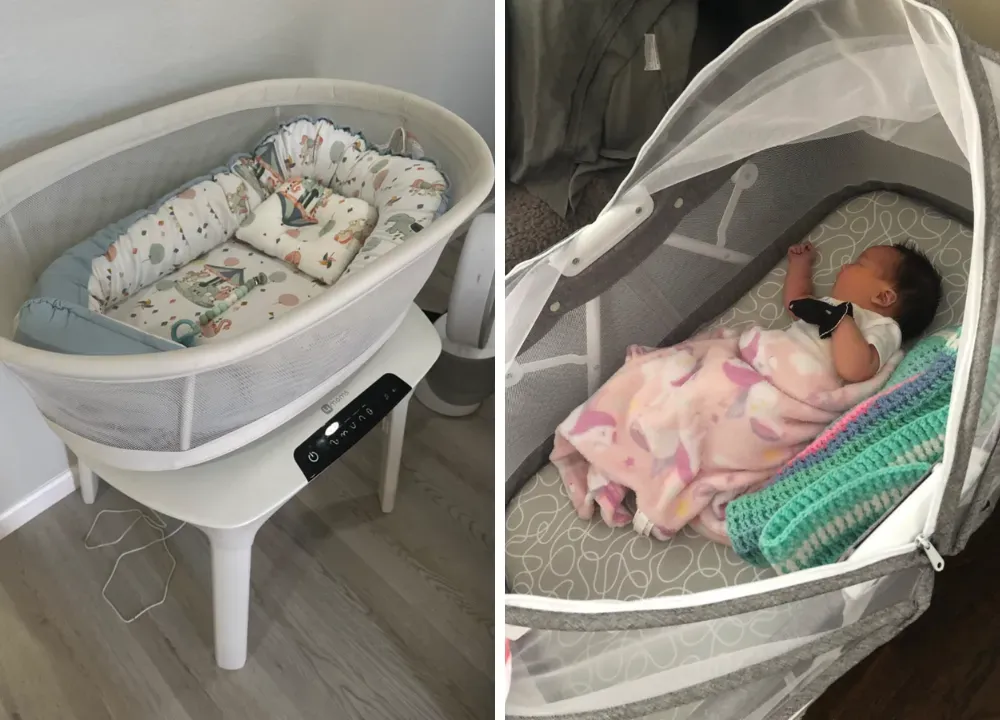
Rocking bassinet safety: what matters most
Safe sleep should decide the purchase. The American Academy of Pediatrics recommends that babies sleep on a firm, flat, non-inclined surface in their own sleep space. The U.S. Consumer Product Safety Commission also sets safety requirements for bassinets and cradles sold in the United States.
Follow these core rules:
Use a firm, flat, level surface
The mattress should be firm and fit the bassinet without gaps. Use only the pad or mattress supplied or approved by the manufacturer. Do not add a soft topper, pillow, extra blanket, sleep positioner, or homemade insert.
The surface should not slope. A baby’s head can fall forward on an incline, which may restrict breathing.
Keep the sleep space bare
Place the baby on their back for every sleep. Keep loose blankets, pillows, stuffed toys, crib bumpers, and other soft items out of the bassinet.
If warmth is needed, use an appropriately sized wearable blanket or swaddle that does not weigh the baby down. Stop swaddling when the baby shows signs of trying to roll, and follow the product instructions.
Check the rocking lock
A good design should make it clear when the bassinet is locked and when it can move. Use the lock as directed. If the manual says to lock the bassinet during sleep, do that every time.
Do not assume that a product can rock during unsupervised sleep just because it has a rocking function. Read the instructions for the exact model.
Keep the bassinet beside your bed, not in it
The AAP recommends room sharing without bed sharing, ideally for at least the first six months. A bassinet beside the adult bed can make feeding and checking easier while keeping the baby on a separate surface.
Do not place the bassinet on a bed, couch, recliner, table, or other raised surface unless the product is specifically designed and approved for that use.
Stop using it at the right time
Stop using the bassinet when the manual says to stop. This may be based on age, weight, height, rolling, pushing up, sitting, or another developmental change.
A baby who can roll, pull up, or move strongly may outgrow a bassinet before reaching its stated weight limit. A crib or other approved sleep product may then be safer.


For current guidance, consult:
- American Academy of Pediatrics safe-sleep recommendations
- U.S. Consumer Product Safety Commission bassinet and cradle safety information

Does rocking help babies sleep?
Rocking may help some babies calm down, but it does not reliably improve sleep for every baby. Motion can reduce fussing for a short time, yet it may not extend total sleep or reduce night waking.
A rocking bassinet works best as part of a simple routine:
- Feed the baby as needed.
- Change the diaper.
- Dim the room.
- Use a short calming routine.
- Place the baby on their back in the bassinet.
- Use the rocking feature only as the manual allows.
- Stop and reassess if the baby becomes upset or if the motion seems too strong.
Rocking is not a treatment for colic, reflux, illness, or breathing problems. If a baby has trouble breathing, turns blue, is unusually hard to wake, or shows signs of illness, seek urgent medical help. For ongoing crying or feeding concerns, contact the baby’s pediatrician.
A baby who falls asleep in a swing, stroller, car seat, or other sitting device should be moved to a firm, flat sleep surface when it is safe to do so. A rocking bassinet should not be used to replace medical advice or a proper sleep setting.

Rocking bassinet versus standard bassinet
Both products can provide a small sleep space near the parent’s bed. The main difference is whether motion adds enough value to justify the extra cost and complexity.
| Feature | Rocking bassinet | Standard bassinet |
|---|---|---|
| Soothing option | Gentle motion may help some babies | Parent may need to soothe by hand |
| Price | Often higher, especially with a motor | Usually lower |
| Maintenance | May include motors, cords, apps, or batteries | Usually simpler |
| Flexibility | Can be useful for babies who like motion | Works well for babies who prefer stillness |
| Noise | Motor noise may be present | Usually quiet |
| Long-term value | Often limited by the same size limits | Also usually used for a short period |
| Safety review | Requires checking motion and lock rules | Requires checking the same basic sleep rules |
A standard bassinet is often the better value when the budget is tight. Use the savings for a safe crib, fitted sheets, a wearable blanket, or other items you will use longer.
A rocking model may be worth more when a parent has limited mobility, needs a gentle way to settle the baby nearby, or has already learned that the baby responds well to motion. Even then, compare the exact safety instructions and return policy.

Manual or automatic rocking: which is better?
Neither type is always best. The right choice depends on how much control and convenience you want.
Manual rocking
Manual rocking is usually simpler. It may not need batteries, an outlet, an app, or a motor. It can also be quieter and easier to repair.
The trade-off is that someone must start the motion. It may not help a baby who wakes as soon as the parent stops rocking.
Automatic rocking
Automatic motion can be useful when a parent is tired or needs both hands free. Some models offer different speeds, timers, sounds, or responsive motion.
Before buying, check:
- Whether the product is approved for sleep while the motion is active.
- Whether it has a clear lock or off setting.
- Whether it needs Wi-Fi or an app.
- Whether a subscription is required for key functions.
- Whether it continues safely during a power outage.
- How loud the motor is.
- How the company handles repairs and replacement parts.
- Whether the motion can be too strong for your preference.
Do not add a third-party motor to a bassinet. An aftermarket device can change the product’s movement, stability, or safety performance.


How much should you spend?
The right price depends on how often the feature will help. A higher price does not prove better sleep or better safety.
Use this simple value test:
Estimated cost per month = purchase price ÷ expected months of useful use
For example, a $300 bassinet used for four months costs about $75 per month. A $100 bassinet used for the same four months costs about $25 per month. This does not measure comfort or convenience, but it makes the short use period easier to see.
Also include:
- Replacement sheets or mattress covers.
- Batteries or electricity.
- App or subscription charges.
- Delivery and return fees.
- Repair or replacement costs.
- A crib needed after the bassinet stage.
A rocking bassinet may be reasonable if the extra cost fits your budget and solves a real daily problem. It is less reasonable if buying it means delaying a safe crib or cutting other essential baby expenses.
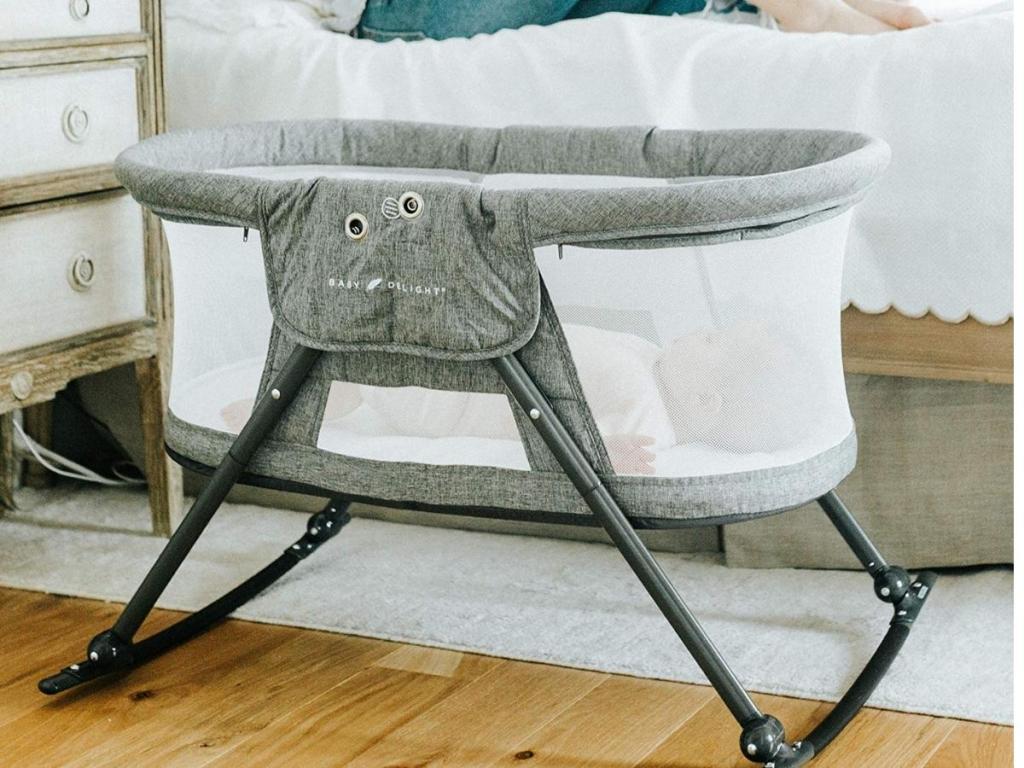
How to choose a safe rocking bassinet
Use this checklist before you buy:
1. Confirm the product category
Make sure the product is sold as a bassinet or cradle for infant sleep, not only as a swing, lounger, bouncer, or soothing seat.
2. Read the full manual
Look for instructions about:
- Manual or automatic rocking.
- Locked and unlocked positions.
- Maximum weight and height.
- Rolling, sitting, or pushing-up limits.
- Mattress and sheet requirements.
- Battery and power use.
- Cleaning.
- Folding and moving.
- Supervision.
If the instructions are hard to find, unclear, or inconsistent, choose another product.
3. Inspect the sleep surface
The mattress should be firm, flat, and well fitted. Avoid products with thick padding, deep cushions, large gaps, or a surface that tilts during motion.
4. Check stability
The frame should sit firmly on the floor. It should not tip, fold, or shift when used as directed. If it rocks, the movement should be controlled and predictable.
5. Search for recalls
Search the model name and model number on the CPSC recall website. Used products need extra care because they may be missing parts, have older instructions, or have an unknown repair history.
6. Test the daily routine
Ask yourself:


- Can I lift the baby in and out without twisting?
- Can I see the baby from my bed?
- Can I lock the motion quickly?
- Can I wash the parts that get dirty?
- Will the bassinet fit beside my bed?
- Can I use it if the power fails?
- Is the return window long enough to learn whether my baby likes it?
7. Avoid unsafe add-ons
Do not add pillows, positioners, weighted products, extra padding, aftermarket motors, or loose covers. Use only accessories approved for that product.

Common mistakes to avoid
Many problems come from treating motion as a safety feature. It is not.
Avoid these mistakes:
- Buying a rocking product without checking whether it is intended for sleep.
- Leaving the bassinet unlocked when the manual requires a locked position.
- Adding a softer mattress because the original feels firm.
- Using loose blankets to keep a baby warm.
- Using a bassinet beyond its rolling or weight limit.
- Assuming a “smart” bassinet can replace supervision.
- Using a swing or lounger for routine sleep.
- Buying a used model without checking recalls.
- Placing the bassinet on a sofa, adult bed, or table.
- Continuing to swaddle after the baby shows signs of rolling.
- Using an inclined position for reflux without medical guidance.
If the baby slides, curls forward, rolls into a side position, or seems unable to keep the airway clear, stop using the product and contact the manufacturer or pediatrician for guidance.

Who should buy a rocking bassinet?
A rocking bassinet may suit you if:
- You want a bassinet beside your bed.
- Your baby often calms with gentle motion.
- You value hands-free soothing.
- You can afford the extra cost without sacrificing other safety needs.
- You have checked the product’s sleep and motion instructions.
- You are comfortable with its short useful life.
A standard bassinet may be better if:
- Your baby already settles well without motion.
- You want the simplest setup.
- You have a limited budget.
- You move the sleep space often.
- You dislike motors, apps, cords, or batteries.
- You want to spend more on a crib or other long-use item.
The decision is not about finding the most advanced bassinet. It is about finding a safe sleep space that you can use correctly every night.

Key takeaways
- A rocking bassinet can be useful, but it is not essential.
- Gentle motion may soothe some babies, but it does not guarantee longer sleep.
- Choose a firm, flat, non-inclined sleep surface first.
- Follow the exact manual for rocking, locking, supervision, and use limits.
- Keep the bassinet free of pillows, loose bedding, toys, and added padding.
- Check recalls before buying, especially for a used product.
- A standard bassinet may offer better value if your baby does not need motion.
- Stop using the bassinet when the baby reaches the maker’s limit or begins to outgrow it.
Frequently asked questions
Can a baby sleep in a rocking bassinet all night?
Only if the specific product is designed and approved for that use and the instructions allow it. Follow the manual for rocking, locking, supervision, and developmental limits. The baby should still sleep on their back on a firm, flat, bare surface.
Should I lock a rocking bassinet while my baby sleeps?
It depends on the product. Some manuals require the bassinet to be locked during sleep, while others may allow controlled motion. Do not guess. Use the exact instructions for your model.
Is a rocking bassinet safe for a newborn?
A rocking bassinet can be appropriate for a newborn when it is made for infant sleep, meets applicable U.S. safety requirements, and is used exactly as directed. The newborn must lie on a firm, flat, non-inclined surface with no loose items.
Can rocking cause a baby to become dependent on motion?
A baby may begin to prefer motion as part of settling, but this varies. If you want more flexibility, use rocking as one part of a short routine rather than the only way the baby falls asleep. Gradually reduce the motion when your baby is calm and ready.
What should I use after my baby outgrows the bassinet?
Move the baby to a crib, portable crib, or other approved sleep product that meets current U.S. safety guidance. Make the change when the bassinet’s age, size, weight, or developmental limit is reached—not only when the baby looks crowded.
Conclusion
A rocking bassinet is worth it when the motion makes daily care easier and the product still meets basic safe-sleep needs. It is not worth paying more if the feature is unclear, hard to use, or used to justify an inclined or soft sleep surface.
Start with safety, then consider comfort, cost, noise, cleaning, power needs, and how long you will use it. If your budget is limited, a simple, sturdy bassinet is usually the smarter choice. If your baby responds well to gentle motion and the design is clearly approved for sleep, a rocking model can be a practical convenience.
