
Introduction
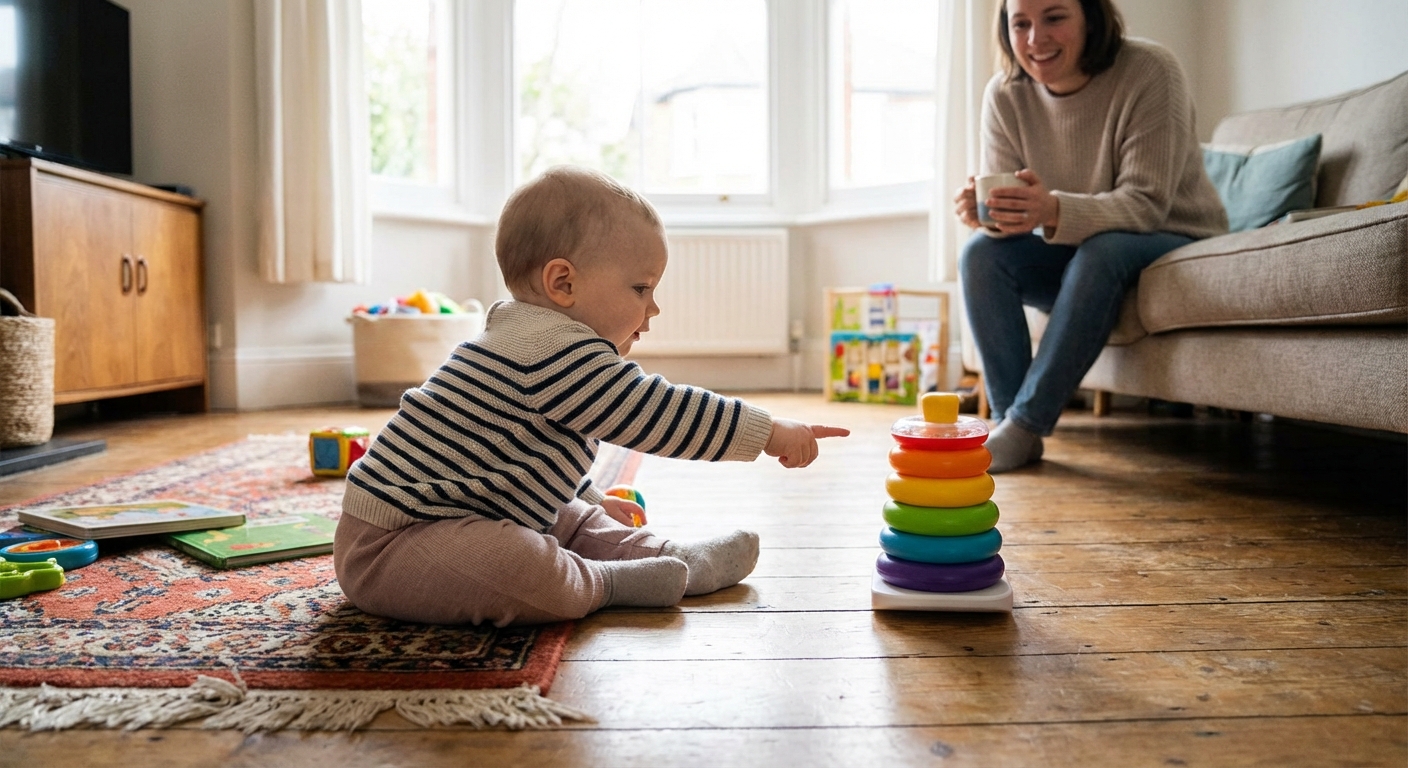
Most babies start pointing between 9 and 15 months. Many first point to ask for something, such as a toy or snack. By about 15 to 18 months, many children also point to share interest, such as showing you a dog, truck, or airplane.
In the United States, the CDC lists pointing to ask for something or get help as a milestone by 15 months. By 18 months, the CDC expects many children to point to show something interesting. Children develop at different rates, so one missed gesture does not give a diagnosis. Still, a lack of pointing by 18 months is worth discussing with your child’s pediatrician.


What Does Pointing Mean in Baby Development?
Pointing is a form of communication before speech. It lets a baby direct your attention without using words.
A baby may point to:
- Ask for food, a toy, or help
- Show you something new
- Choose between two items
- Share excitement
- Tell you where to look
- Learn the name of an object
Pointing is part of a larger skill called joint attention. Joint attention means that a child and another person focus on the same thing at the same time. For example, your baby points at a bird, looks at you, and then looks back at the bird.
This skill matters because it supports early language and social learning. When you respond, your baby learns that gestures can affect other people. Your response also gives the child useful words, such as “bird,” “more,” or “up.”
Not all pointing has the same purpose. Researchers and clinicians often describe two broad types:
- Requesting pointing: “I want that.”
- Showing pointing: “Look at that.”
Requesting pointing often appears first. Showing pointing may develop later because it requires the child to share interest, not just ask for an object.

A Typical Pointing Timeline
The age range for pointing is broad. Some babies point near the end of the first year. Others take several more months.
| Age range | Skills you may see |
|---|---|
| 6 to 9 months | Reaches, grabs, looks toward objects, and uses sounds or body movements to ask for help |
| 9 to 12 months | May begin pointing, reaching with an open hand, waving, or showing objects |
| 12 to 15 months | Often points to request an item or get help |
| 15 to 18 months | May point to show something interesting and follow another person’s point |
| 18 to 24 months | Often uses pointing with words, eye contact, sounds, and simple phrases |
These ages are guides, not deadlines. The CDC milestone system describes skills that most children—about 75% or more—can do by a stated age. It does not mean every child will gain the skill on the same day.
A child may also use other gestures before pointing. They may pull your hand, look at an item, reach, vocalize, or bring you an object. These actions show a desire to communicate, but they do not always replace pointing as a developmental milestone.
Why pointing may look different
Some babies point with one finger. Others use an open hand, touch the object, or point while holding another finger curled. A child may point at close objects before pointing across a room.


The setting also matters. A tired, shy, or sick baby may point less. A child may point often at home but rarely in a doctor’s office. Look at the overall pattern across days and weeks rather than one moment.

How to Encourage Pointing and Early Communication
You do not need special toys or a formal program to support pointing. Daily routines work well.
1. Follow your baby’s interest
Watch what your baby looks at. If your child stares at a fan, say, “Fan!” If they reach for a cup, say, “Cup. You want the cup.”
This teaches your baby that you notice their message. It also pairs the object with a clear word.
2. Model pointing
Point to things during normal activities:
- Point to a dog on a walk.
- Point to pictures in a book.
- Point to a light, car, or bird.
- Point to the food on your child’s plate.
- Point to a familiar person and name them.
Use a simple phrase. “Look, a bus!” is enough. Give your baby time to watch and respond.
3. Offer simple choices
Hold up two safe items and ask, “Do you want the ball or the book?” Wait several seconds.
Your baby may reach, look, point, or make a sound. Treat each clear response as communication. If your child reaches but does not point, you can model the point without forcing the hand.
4. Use books with pictures
Pause on each page. Point to a picture and name it. Then ask, “Where is the cat?” Give your baby time to look or gesture.
Do not turn reading into a test. The goal is shared attention and fun.
5. Create small reasons to communicate
Place a favorite toy in a clear container that your child cannot open alone. Pause before giving a snack or starting a favorite song. These moments can encourage your baby to look, reach, point, or ask for help.
Do not withhold basic needs for long periods. Communication practice should feel safe and playful.
6. Respond to every useful gesture
If your child points, look where they point. Then add language:
- “You see the ball.”
- “You want more.”
- “That truck is loud.”
- “You need help.”


This back-and-forth is more useful than repeatedly saying, “Point.”
When Should You Talk With a Pediatrician?
Talk with your child’s pediatrician if your baby is not pointing by about 18 months, especially if they also use few other gestures or show limited interest in sharing attention.
Consider contacting the pediatrician sooner if your child:
- Does not use gestures such as waving, reaching, showing, or pointing
- Rarely looks toward people or objects that you indicate
- Does not respond to their name at times
- Uses very few sounds or words for their age
- Does not seem to share enjoyment with you
- Loses pointing, words, eye contact, or another skill they once used
Loss of a skill is called regression. Tell the pediatrician promptly if regression occurs. Do not wait for the next routine visit.
A lack of pointing can have many possible causes. Hearing differences, communication delays, developmental differences, and autism can affect gestures and social communication. Pointing by itself does not diagnose autism, and not pointing by itself does not prove that a child has a developmental problem.
Your pediatrician may check hearing, review development, and use a screening tool. The American Academy of Pediatrics recommends developmental screening during well-child care and autism screening at 18 and 24 months. Screening is not a diagnosis. It shows whether a child may need a closer evaluation.

What Help Is Available in the United States?
If you have concerns, start with your child’s pediatrician. You can also ask about your state’s Early Intervention program.
Early Intervention serves infants and toddlers with developmental delays. Under the Individuals with Disabilities Education Act, Part C, states provide services for eligible children from birth through age 2. Each state manages its own program, so the name, eligibility rules, and referral process may differ.
You can contact Early Intervention even before you have a diagnosis. A doctor’s referral is not always required, although rules vary by state.
You may also ask about:
- A hearing test
- A speech-language evaluation
- A developmental evaluation
- A referral to a specialist
- Local parent support services
Early support can help a child build communication skills. It does not mean that a serious problem is certain. It means you are checking the concern while your child is young and learning quickly.
Before an appointment, write down what you see. Note when your child points, how they ask for things, whether they show objects, and whether they respond to your gestures. A short video from home may help if the behavior does not appear during the visit.

Common Questions About Baby Pointing
Is pointing at 9 months too early?
No. Some babies point near 9 months. Others start later. Early pointing is one normal pattern, but it is not a requirement for every baby at that age.


Is it normal for a baby to point but not talk?
Yes, especially during the first year. Pointing often comes before clear spoken words. Keep talking, naming objects, and responding to gestures. If your child has few gestures and few sounds or words, ask the pediatrician for guidance.
What if my baby grabs my hand instead of pointing?
Hand-leading can be a way to ask for help. Respond to the request, then model a gesture or simple word. For example, say, “Help,” while pointing to the item. If hand-leading is your child’s main way to communicate and they rarely use other gestures, mention it to the pediatrician.
Should I teach my baby to point by moving their finger?
Do not force or repeatedly move your child’s hand. Model pointing and make communication rewarding. Follow your child’s interest, then respond to natural looks, reaches, sounds, and gestures.
Can a baby point and still have a developmental delay?
Yes. A child may point and still have delays in speech, movement, hearing, learning, or social communication. Pointing is one milestone within a larger developmental picture.
Key Takeaways
- Babies often begin pointing between 9 and 15 months.
- Pointing to request something commonly develops before pointing to share interest.
- The CDC lists pointing to ask for something or get help by 15 months and pointing to show something interesting by 18 months.
- Model pointing, use simple words, read picture books, and respond to your baby’s gestures.
- Talk with your child’s pediatrician if your child is not pointing by 18 months, uses few other gestures, or loses a skill.
- In the United States, families can ask about pediatric developmental screening and state Early Intervention services.
Conclusion
Pointing is a small gesture with a big role in early communication. It helps babies ask, show, share, and connect before they can say much.
Many children develop this skill at different times. Watch the full pattern of communication, not just one milestone. If you are concerned, contact your pediatrician or your state’s Early Intervention program rather than waiting for the concern to resolve on its own.
