
Usually, no. Do not add a separate mattress pad, topper, cushion, or extra layer to a bassinet unless the bassinet manufacturer specifically approves it. A safe bassinet setup normally includes the original firm mattress or pad, a tight fitted sheet made for that model, and nothing else.
This advice follows safe-sleep guidance from the American Academy of Pediatrics and the U.S. Consumer Product Safety Commission, which recommend a firm, flat sleep surface with no loose or soft items.
A separate pad may make the bassinet feel softer, but that can raise the risk of your baby’s face pressing into the surface. It can also make the sheet fit poorly or leave gaps along the sides.

What counts as a bassinet mattress pad?
A bassinet mattress pad is the firm, flat insert that supports your baby inside the bassinet. Some brands call it a mattress, sleep pad, mattress board, or bassinet insert.


People also use “mattress pad” to mean an extra product placed on top of that original insert. These products may be marketed as:
- Waterproof mattress pads
- Bassinet toppers
- Quilted pads
- Cushioned liners
- Cooling pads
- Portable bassinet pads
- Replacement mattresses
- Mattress protectors
These items are not all the same. The original insert is part of the bassinet’s tested design. An added pad is an aftermarket product, and it may change how the sleep space works.
A fitted sheet is different from a padded mattress cover. A fitted sheet is a thin piece of fabric made to fit tightly over the approved mattress. It should not add meaningful softness, bunch up, or leave exposed edges.
The safest basic setup
For most healthy, full-term infants, the bassinet should contain:
- The manufacturer-approved mattress or pad
- One tight, fitted sheet made for that mattress
- Your baby
Keep blankets, pillows, toys, bumpers, positioners, sleep wedges, and loose covers out of the bassinet. The AAP recommends placing babies on their backs for every sleep on a firm, flat, non-inclined surface.
Why an extra bassinet pad can be unsafe
An added pad can create several problems, even when it looks thin and harmless.
It can make the surface too soft
A baby’s nose and mouth can press into a soft or quilted surface. Babies cannot always move away from an unsafe position. This is one reason safe-sleep guidance favors a firm, flat surface with no added padding.
A product labeled “firm” is not automatically safe. The full sleep setup matters. The pad may also change firmness when covered by a sheet or placed over the original mattress.
It can create gaps
A pad that is too small can slide or leave spaces near the bassinet wall. A baby can become trapped between the pad and the side of the bassinet.


A pad that is too large can curl at the edges. That can create an uneven surface or put pressure against the bassinet sides.
It can interfere with the fitted sheet
The sheet may fit the original mattress correctly but become loose after an extra pad is added. Loose fabric can gather near a baby’s face.
Never stretch a sheet over layers that were not included in the bassinet’s instructions. If the sheet no longer fits tightly, remove the extra layer.
It can change the bassinet’s tested design
Manufacturers test a bassinet with specific parts and dimensions. Adding a new mattress or pad may alter:
- The height of the sleeping surface
- The fit of the sheet
- The space between the mattress and bassinet wall
- The bassinet’s incline
- Airflow around the sleep surface
- The stability of the product
The CPSC’s safe-sleep guidance warns caregivers to use products according to their instructions and to avoid adding soft bedding.

When can you use a mattress pad in a bassinet?
You can use a pad only when it is part of the bassinet’s original design or the manufacturer clearly approves that exact replacement part.
There are three common cases.
The pad came with the bassinet
If the bassinet includes a mattress or pad, use that original part. Check that it sits flat and fits snugly against all sides.
Do not remove it and replace it with a softer product simply because the original pad feels firm. Firmness is a safety feature, not a comfort flaw.
The manufacturer sells an approved replacement
A replacement may be acceptable when it is made for your exact bassinet model and is listed in the current instructions or support materials.
Check all of the following:
- Brand and model name
- Model number
- Product version
- Mattress dimensions
- Recommended sheet
- Age, weight, or height limits
- Instructions for use
A pad made for a different bassinet may look similar but still be the wrong size.
The manual allows a specific protector
Some manufacturers may permit a thin, waterproof protector under the fitted sheet. If so, follow the manual exactly.
The protector should not:
- Add a pillow-like layer
- Have quilted padding
- Change the mattress shape
- Reduce the sheet’s tight fit
- Cover the bassinet’s sides
- Create an incline
If the manual does not mention an added protector, contact the manufacturer before using one.


How to choose a safe bassinet mattress or replacement pad
If the original mattress is missing, damaged, or no longer fits well, do not guess. Contact the manufacturer first.
Use this checklist:
| Check | What to look for |
|---|---|
| Exact model | The replacement is approved for your bassinet’s model and version |
| Firmness | The surface stays firm and flat under light pressure |
| Fit | No visible gap between the mattress and bassinet sides |
| Thickness | Matches the manufacturer’s stated size |
| Shape | Does not bow, fold, curl, or tilt |
| Cover | No torn, loose, or peeling material |
| Sheet | The correct sheet fits tightly over the mattress |
| Instructions | The product is permitted for infant sleep |
Do not rely only on a product listing that says “universal,” “fits most bassinets,” or “safe for newborns.” Those phrases do not prove that the product fits your bassinet or meets its instructions.
If you cannot find an approved replacement, replacing the bassinet may be safer than modifying it.

How to check whether your bassinet setup is safe
Check the setup each time you assemble it and after washing the sheet.
- Read the manual. Confirm which mattress, pad, and sheet the manufacturer allows.
- Inspect the mattress. Look for tears, sagging, folds, dampness, or damage.
- Check the fit. Press the mattress against each side. It should not slide or leave a gap.
- Check the surface. It should be flat, firm, and level.
- Fit the sheet. Use one sheet made for that mattress. Pull it tight around the corners.
- Remove extras. Take out toppers, blankets, pillows, toys, positioners, and loose covers.
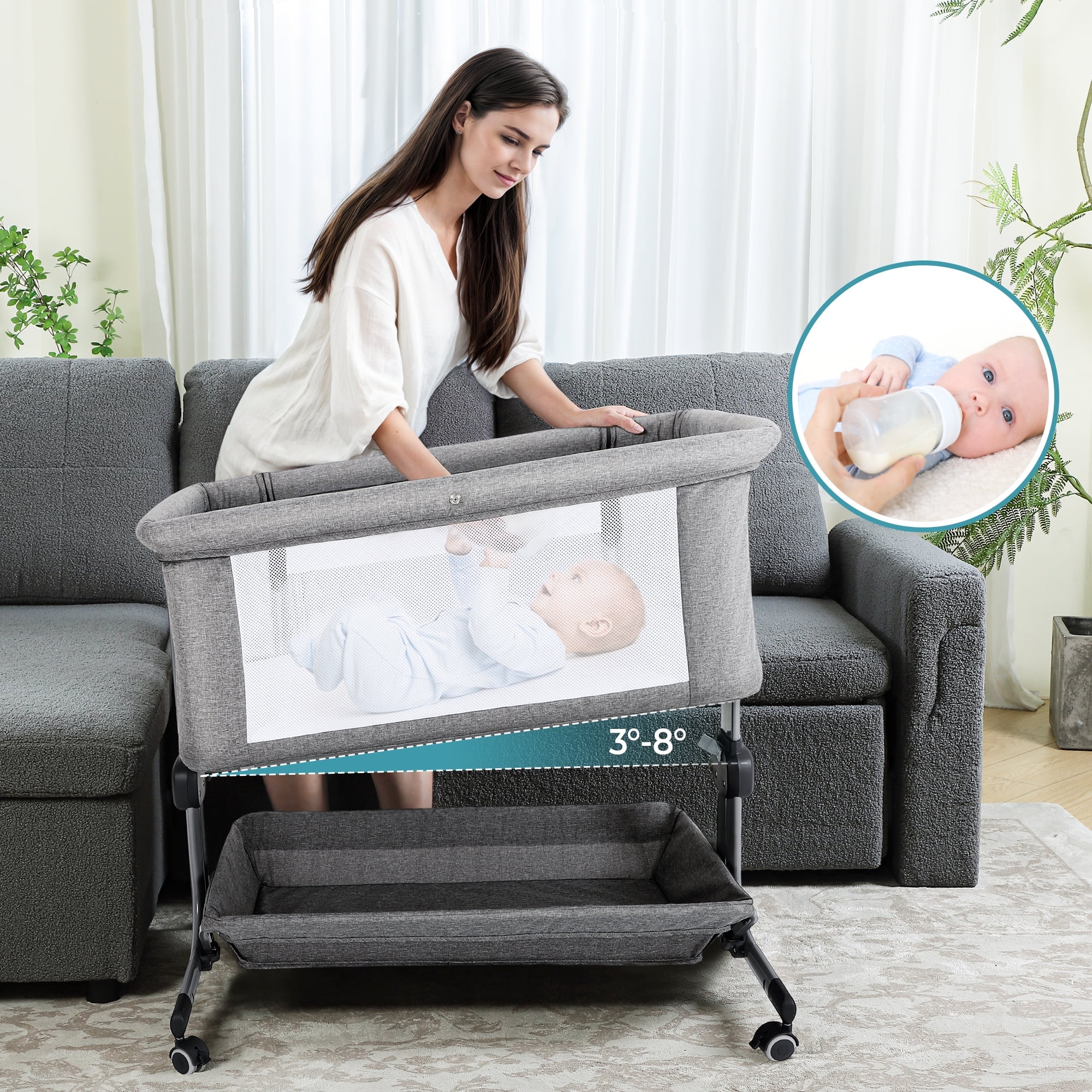
- Check the bassinet angle. Do not add a wedge or raise one end unless the product is specifically designed and approved for that use.
- Check the limits. Stop using the bassinet when your baby reaches the stated weight, age, height, or movement limit.
Signs the setup needs to be corrected
Fix the setup before sleep if you notice:
- A corner of the sheet lifts off
- The mattress moves when pushed
- A gap appears beside the mattress
- The mattress bends or slopes
- The baby sinks into the surface
- The pad shifts under the sheet
- The bassinet rocks or leans unexpectedly
- The mattress cover is torn
- The bassinet has reached its use limit
If a baby has been sleeping on an incorrect or damaged surface, remove the problem item. If you are unsure whether the bassinet is safe, stop using it and ask the manufacturer for model-specific guidance.
Do babies need extra padding for comfort?
No. Babies do not need an adult-style cushioned mattress for safe sleep. A firm surface may feel less cozy to an adult, but it supports the safe-sleep setup recommended for infants.
A baby who seems unsettled may be reacting to hunger, temperature, noise, light, illness, or the normal need for comfort. Adding a soft pad is not a reliable way to solve those problems.
Dress your baby in an appropriate sleep outfit instead of using loose blankets. The AAP advises avoiding overheating and keeping the baby’s sleep area free of soft objects.
Do not use a mattress pad to treat reflux, congestion, or flat-head concerns. Elevating a bassinet or adding a positioner can create a dangerous slope. Ask your pediatrician about medical concerns, and follow the bassinet maker’s instructions for sleep.

What about waterproof bassinet mattress protectors?
A waterproof protector may be useful for cleaning, but only if the bassinet manufacturer permits it and it fits tightly under the sheet.
A safe protector should be thin, flat, and designed for that exact mattress. It should not feel padded or cause the fitted sheet to loosen.
Avoid improvised materials such as:


- Towels
- Plastic bags
- Absorbent pads not made for infant sleep
- Fleece blankets
- Folded blankets
- Crib sheets tied or tucked around the bassinet
- Adult mattress protectors cut to size
These materials can bunch up, create gaps, or add softness. They may also trap heat or interfere with the original mattress.
If your baby has a diaper leak, remove the wet sheet and clean the mattress according to the manual. Do not add multiple layers for quick changes unless the manufacturer specifically says that layered sheets are allowed.
Bassinet mattress pad decision guide
Use this quick guide before buying or adding anything.
| Your situation | Best next step |
|---|---|
| The original mattress is present and fits well | Use it with the correct fitted sheet |
| The mattress feels firm | Keep it firm; do not add a cushion |
| You want easier cleanup | Check the manual for an approved protector |
| The mattress is missing | Contact the manufacturer before use |
| The mattress has a gap | Stop using the bassinet until corrected |
| The sheet is loose | Use the correct sheet or stop using the setup |
| You bought a universal pad | Do not use it unless the manufacturer approves it |
| Your baby seems uncomfortable | Check temperature, feeding, and health; do not add soft bedding |
| The bassinet is tilted | Remove the cause and restore a flat surface |
| Your baby can roll or push up | Follow the product’s transition and use limits |
The key trade-off is simple: a pad may seem more comfortable or easier to clean, but an unapproved layer can reduce fit and firmness. For infant sleep, correct fit matters more than extra cushioning.
Common mistakes to avoid
Buying a “universal” bassinet mattress
Bassinet sizes are not always interchangeable. Even a small difference can leave a gap. Use only an approved part or a replacement confirmed by the manufacturer.
Using a thick waterproof cover
A thick cover can behave like a soft topper. It can also make the fitted sheet loose. Choose only a model-approved protector, if one is allowed.
Adding a blanket under the baby
A folded blanket under a fitted sheet is still an added layer. It can bunch up and soften the surface.
Tilting the mattress for reflux
Inclining the sleep surface can allow a baby to slide into a position that affects breathing. Ask a pediatrician for medical guidance instead of changing the bassinet angle.
Keeping the bassinet in use too long
A bassinet is not safe simply because the mattress still looks good. Follow the limits in the manual. Stop using it when your baby reaches the movement or size limit, even if that happens before a stated maximum age.
Assuming a product claim proves safety
Words such as “orthopedic,” “breathable,” “natural,” and “newborn-friendly” do not replace a proper fit or manufacturer approval. Evaluate the product by its instructions and design, not its marketing label.
Frequently asked questions
Is a bassinet mattress supposed to be hard?
It should be firm and flat, not soft or cushion-like. The surface should not allow your baby’s head or body to sink into it. Use the original mattress or an approved replacement.
Can I put a thin pad under the bassinet sheet?
Only if the bassinet manufacturer allows that exact type of pad. A thin product can still change the sheet fit or create gaps. If the manual is silent, ask the manufacturer before using it.
Can I use a crib mattress pad in a bassinet?
Usually not. A crib mattress pad may have different dimensions, thickness, and intended use. Do not use it unless the bassinet manufacturer confirms that it is approved for your exact model.
What should I do if the bassinet mattress is too hard?
Do not soften it with blankets, towels, toppers, or pillows. A firm surface is expected for infant sleep. If the mattress is damaged or does not fit, request an approved replacement.


Can I use a bassinet without its mattress pad?
No. Do not place a baby directly on the bassinet frame, fabric base, or a makeshift surface. Use the complete manufacturer-approved sleep surface.
Bottom line
You usually do not need a separate mattress pad for a bassinet. Use the original firm, flat mattress with one tight fitted sheet. Add a protector or replacement only when the manufacturer approves it for your exact model and it does not change the fit, firmness, or flatness of the sleep surface.
Before your baby sleeps in the bassinet, check the manual, inspect the mattress, test the fit, and remove all unapproved soft items. If the mattress is missing, damaged, loose, or the wrong size, contact the manufacturer or replace the bassinet rather than improvising.
