
For a bassinet in the United States, the mattress should be no thicker than the amount allowed by the bassinet’s manual—often about 1 to 1.5 inches. The exact limit varies by model.
The safest choice is the original mattress or pad made for that bassinet. Do not add a second mattress, foam topper, blanket, pillow, or extra padding. A bassinet mattress should be firm, flat, snug, and covered only with a fitted sheet made for that model.
Introduction
A thicker mattress may seem softer and more comfortable, but extra padding can create a gap, raise the baby’s sleeping position, or allow the baby’s face to sink into the surface. These risks matter most for newborns, who may not be able to move away from an unsafe position.
U.S. safe-sleep guidance from the American Academy of Pediatrics and the Consumer Product Safety Commission calls for a firm, flat sleep surface with a fitted sheet and no loose items. The mattress thickness alone does not make a bassinet safe.
The fit, firmness, frame, and use of the product all matter.

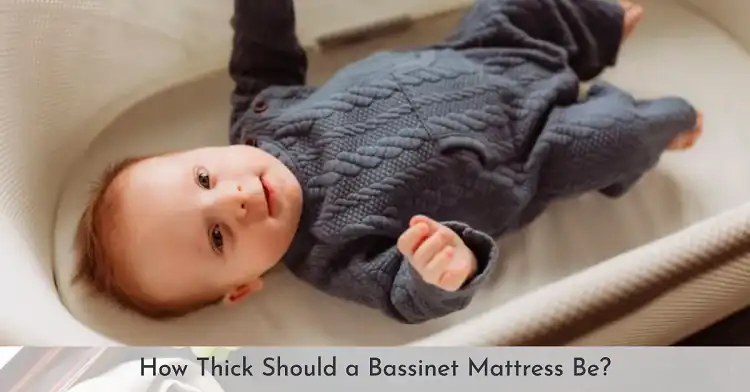
What Is the Standard Bassinet Mattress Thickness?
There is no single thickness that fits every bassinet. Most bassinet mattresses are thin by design, and many are close to 1 inch or 1.5 inches thick. Some models may have a thinner pad or a different built-in sleep surface.
The product manual is the controlling source for your specific bassinet. It should tell you:
- The approved mattress or pad
- The maximum mattress thickness
- The correct fitted sheet
- Whether the pad may be removed
- Whether replacement parts are available
- The age, weight, and developmental limits
- Whether the bassinet must be used with a specific stand or frame
U.S. bassinet and cradle products are subject to federal safety requirements. The CPSC bassinet and cradle rule addresses construction and performance requirements, including mattress-related safety concerns. However, a general thickness number does not replace the instructions for a particular model.
A practical thickness guide
| Bassinet mattress thickness | What it usually means |
|---|---|
| Less than 1 inch | May be correct for some models, but check the manual |
| About 1 to 1.5 inches | Common for many bassinet pads |
| More than 1.5 inches | Do not use unless the manufacturer clearly allows it |
| Any extra pad placed on top | Unsafe unless it is the approved mattress for that model |
| A loose or poorly fitted mattress | Unsafe at any thickness |
The key point is simple: do not choose a mattress by thickness alone. A thin mattress that leaves a gap is not safe. A thicker mattress that was not made for the bassinet may also be unsafe.
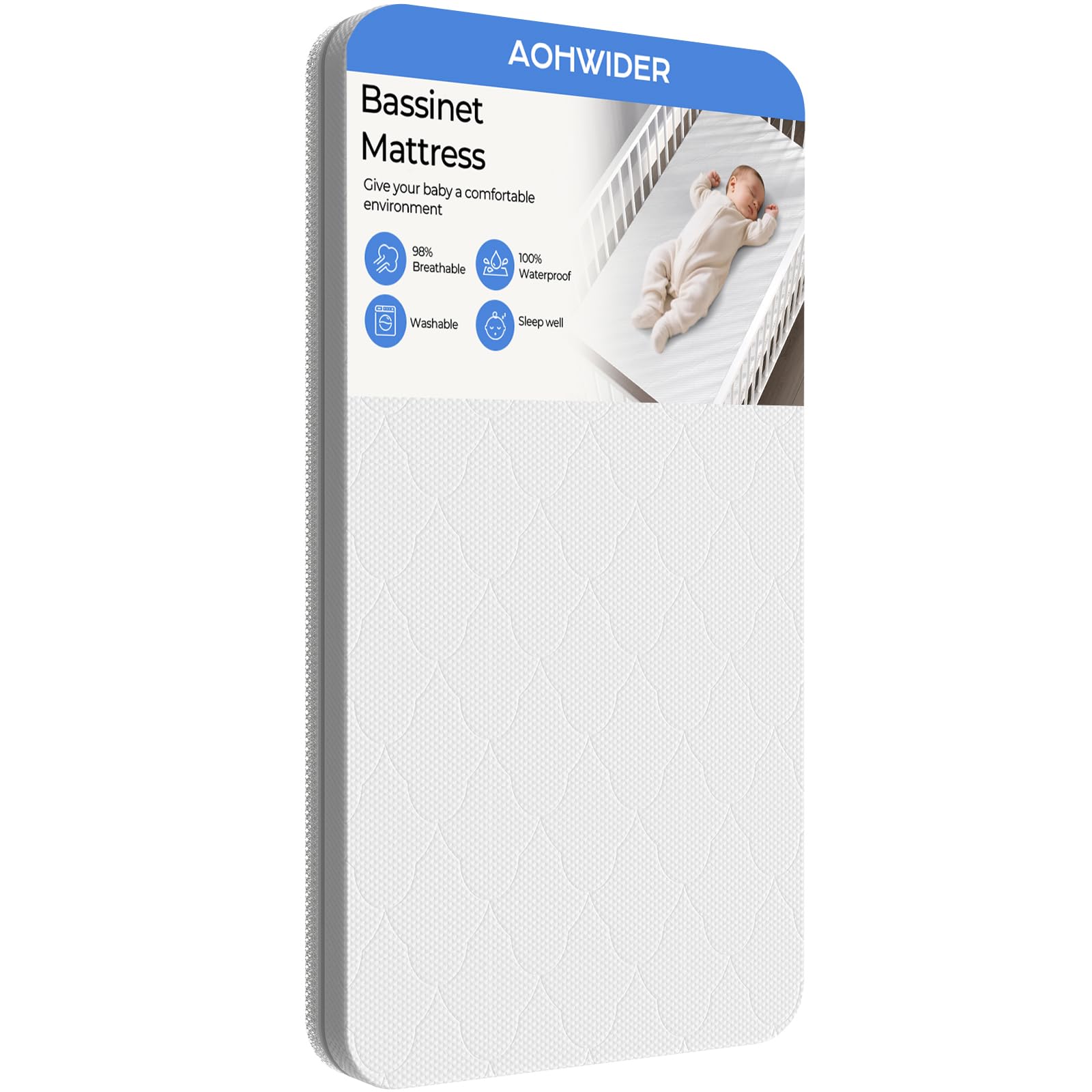
Why Does Bassinet Mattress Thickness Matter?
Mattress thickness affects the height, firmness, and fit of the sleep surface. These factors can change how a baby’s head and body rest inside the bassinet.
A mattress that is too thick may:
- Reduce the depth of the bassinet sides
- Raise the baby closer to the top edge
- Prevent the mattress from sitting fully inside the base
- Leave gaps along the sides
- Make the fitted sheet too tight or too loose
- Add soft material that can press against the baby’s face
A mattress that is too thin can also cause problems. It may not fit the base, may curl at the edges, or may leave hard frame parts exposed. A replacement pad should match the original part in length, width, shape, firmness, and thickness.
Firmness matters more than softness
A safe bassinet mattress should feel firm and should not form a deep dent when you press on it. “Firm” does not mean hard like wood. It means the surface does not allow a baby’s face or body to sink into it.


Do not use memory foam, egg-crate foam, pillow-top pads, quilted toppers, or soft aftermarket inserts. A product marketed as “comfortable,” “plush,” or “breathable” is not automatically safe for infant sleep.
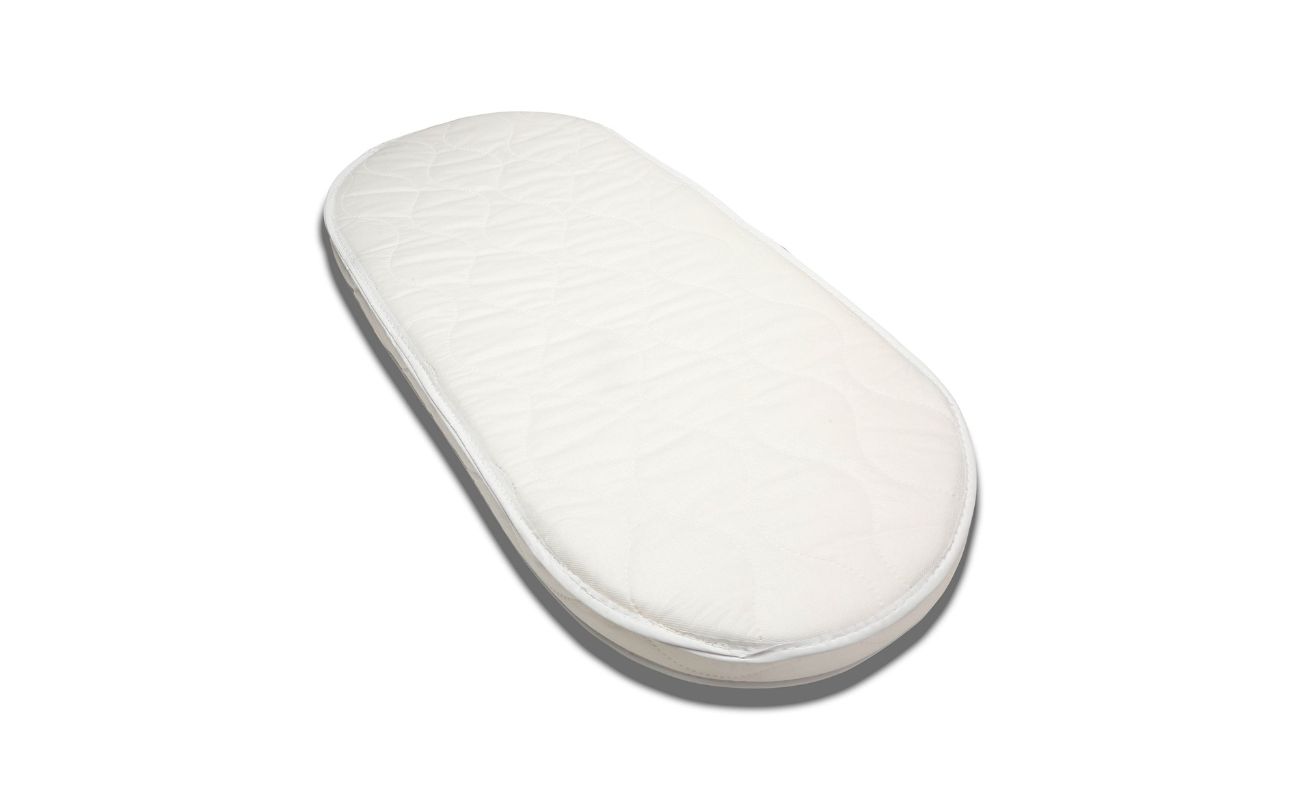
How to Check Whether a Bassinet Mattress Fits
Check the fit before placing the baby in the bassinet. Use this process for the original mattress and any approved replacement.
1. Read the manual first
Find the bassinet’s model number. It may appear on the frame, label, product box, or instruction booklet. Look for the manufacturer’s approved mattress dimensions and thickness.
If the manual is missing, search the manufacturer’s official website or contact the company. Do not rely only on a retailer’s listing or a similar-looking bassinet.
2. Measure the mattress
Measure the mattress while it is lying flat:
- Measure thickness from the bottom surface to the highest point.
- Do not press down on the mattress while measuring.
- Do not include a removable fitted sheet.
- Measure the length and width at the base, not just the cover.
- Check whether the sides taper or have rounded corners.
If the pad is compressed, allow it to return to its normal shape before measuring.
3. Check the mattress base
Place the mattress in the bassinet without a sheet. It should lie flat and remain stable. It should not rock, curl, fold, or slide.
Look around the full edge for gaps. If you can fit two fingers between the mattress and the bassinet wall, the fit may be unsafe. Do not use folded towels, blankets, foam strips, or other items to fill the gap.
4. Test the cover
Use only a fitted sheet made for the bassinet or one that the manufacturer identifies as compatible. The sheet should stay tight at every corner and should not bunch under the baby.
Never use a standard crib sheet if it is too large. A loose sheet can become a suffocation or entanglement hazard.
5. Confirm the full product setup
A safe mattress can still be used in an unsafe setup. Confirm that:
- The bassinet is fully assembled.
- The locking parts are engaged.
- The frame sits on a stable, level surface.
- The bassinet is used only with its approved stand or base.
- The bassinet is not placed on a bed, sofa, table, counter, or other raised surface.
- The baby is placed on their back for every sleep.
- The bassinet has not passed its weight, age, or movement limit.

What Should You Do If You Need a Replacement Mattress?
Use an original replacement part whenever possible. Contact the bassinet manufacturer with the model number and production information. Ask for the approved mattress, pad, cover, and fitted sheet.
Do not buy a replacement based only on these details:


- Similar length and width
- The same advertised thickness
- A high customer rating
- A claim that the pad is “universal”
- A photo showing a similar bassinet
- A foam type that feels comfortable
A mattress can have the right measurements but still be too soft, too flexible, or incompatible with the bassinet frame. The manufacturer may also specify a particular cover or attachment method.
If the original mattress is missing
Do not use the bassinet until you obtain the correct replacement or confirm an approved alternative with the manufacturer. A blanket folded to size is not a mattress. Neither is a changing-pad insert, crib topper, pet pad, yoga mat, or piece of upholstery foam.
If the manufacturer no longer supports the product, check for a current safety notice or recall through the CPSC recall database. A missing replacement part may be a reason to choose a different sleep product rather than modify the old one.
Can You Add a Mattress Topper to a Bassinet?
No. Do not add a mattress topper, cushion, quilt, sheepskin, waterproof pad, or extra foam layer unless it is the approved mattress supplied or specified by the manufacturer.
Adding a layer changes the total thickness and may stop the mattress from fitting correctly. It can also make the surface less firm. Even a thin layer can create a gap or shift during sleep.
For moisture protection, use only a waterproof cover or protector designed for that exact bassinet and approved by the manufacturer. It should fit tightly and should not make the sleep surface soft or uneven.
Can a Baby Sleep on a Thicker Crib Mattress in a Bassinet?
No. A crib mattress is not a safe substitute for a bassinet mattress. Crib mattresses are larger and are made for a different product with different dimensions and side heights.
A crib mattress may:
- Not fit inside the bassinet
- Prevent the bassinet from closing or locking
- Create gaps
- Raise the baby too close to the rim
- Add too much weight
- Change the product’s stability
Use the mattress supplied with the bassinet. When the baby outgrows the bassinet, move the baby to a separate crib, portable crib, or bassinet-style product that meets current U.S. requirements and has its own approved mattress.
How Firm Should a Bassinet Mattress Be?
A bassinet mattress should be firm enough that it keeps its shape under the baby’s weight. It should return to a flat surface rather than forming a deep pocket.
You can perform a basic visual and hand check:
- Place the mattress flat in the bassinet.
- Press down with your hand.
- Look for deep or slow-forming dents.
- Check whether the edges lift or fold.
- Confirm that the cover stays smooth and tight.
This check does not certify a mattress or replace testing by the manufacturer. It only helps identify obvious problems such as excessive softness, damage, or poor fit.
Replace the mattress if it is cracked, torn, wet inside, misshapen, heavily compressed, or no longer lies flat. Do not try to repair a damaged infant sleep pad with tape, extra foam, or a new cover.


Common Bassinet Mattress Mistakes
The most common mistakes involve changing the sleep surface after buying the bassinet.
Using a thicker pad for comfort
A thicker pad is not automatically more comfortable or safer. Babies need a firm, flat surface, not a soft bed.
Using two pads together
Never stack the original pad with another pad. The combined thickness can reduce the bassinet’s side height and create movement or gaps.
Measuring only the center
Some pads are higher in the middle or have raised edges. Measure the whole mattress and check how it sits in the base.
Using a loose sheet
A sheet that fits a full-size crib may be too large for a bassinet. Use the correct fitted sheet for the model.
Filling gaps with fabric
Do not use towels, blankets, receiving blankets, bumpers, or rolled cloth around the mattress. These items can move during sleep.
Continuing use after the baby rolls
Many bassinets are intended only for young infants who cannot push up, roll, or sit. Stop using the bassinet when the manual says to stop or when the baby reaches the product’s movement limit, even if the baby still fits by size.
Bassinet Mattress Thickness: A Simple Decision Guide
Use this guide when deciding whether a mattress or pad is suitable.
| Question | If the answer is yes | Action |
|---|---|---|
| Is it the original mattress? | It was supplied with the bassinet | Check its condition and fit |
| Is it an approved replacement? | The manufacturer lists it for your model | Follow the model instructions |
| Is the thickness within the manual’s limit? | The measurement matches the instructions | Continue with the fit check |
| Does it lie flat and stay firm? | No deep dents, folds, or curling | Continue with the fit check |
| Are there gaps at the sides? | Any visible or finger-sized gap | Do not use it |
| Does the sheet fit tightly? | It stays flat and secure | Use only that approved sheet |
| Is it an added topper or cushion? | It was not part of the approved setup | Remove it |
When any answer raises doubt, pause use and ask the manufacturer for written guidance. A different sleep space may be safer than trying to adapt the bassinet.
Frequently Asked Questions
Is a 2-inch bassinet mattress safe?
Not necessarily. A 2-inch mattress may be too thick for some bassinets. Use it only if the manufacturer expressly approves that thickness for your exact model and the mattress fits firmly and flatly.
Is a thin bassinet pad safe for a newborn?
It can be safe if it is the original or approved pad, remains firm and flat, and fits the bassinet without gaps. Thin does not mean unsafe, and thick does not mean safer.
Can I use a bassinet without its mattress?
No. Do not place a baby directly on a hard frame or base unless the product was designed and approved for that use. Contact the manufacturer for the correct replacement part.
How often should a bassinet mattress be replaced?
Replace it when it is damaged, misshapen, soft, wet inside, or no longer fits correctly. You may also need a replacement after a recall or when the manufacturer issues updated parts. Follow the product’s care and replacement instructions.
Does a waterproof cover change the mattress thickness?
It can. A thick or poorly fitted cover may make the mattress too tight or uneven. Use only a thin, snug cover that the manufacturer approves for the bassinet.
Conclusion
The right bassinet mattress is usually thin—often around 1 to 1.5 inches—but the correct number depends on the model. The manufacturer’s instructions are more important than a general thickness range.


Choose the original or approved replacement mattress. Make sure it is firm, flat, undamaged, and snug against every side. Use only a fitted sheet made for the bassinet, and never add extra padding.
If you are unsure, stop using the bassinet until the manufacturer confirms the correct mattress and setup.
