
Introduction
Yes. A bedside bassinet can be safe for a baby when it is made for infant sleep, meets current U.S. safety rules, and is used exactly as the manufacturer directs. The safest setup is a firm, flat, empty sleep surface next to the adult bed—not a baby sleeping in the adult bed.
In the United States, safe-sleep guidance from the American Academy of Pediatrics (AAP) and Safe to Sleep® recommends placing babies on their backs for every sleep. The bassinet should contain only a firm mattress and a fitted sheet made for that product.
A bedside bassinet may reduce the need to walk across the room for nighttime feeds. It does not remove the risks linked to soft bedding, gaps, tipping, unsafe attachments, or sharing an adult bed.

What Is a Bedside Bassinet?
A bedside bassinet is a small infant sleep space designed to sit beside a parent’s bed. Some models stand independently. Others attach to the adult bed and have a side that lowers or opens for easier access.


The term can describe more than one product:
- A standard bassinet: A separate sleep space that stands near the bed.
- A bedside sleeper: A product designed to attach to, or sit directly beside, an adult bed.
- A co-sleeper: A broad marketing term that may describe a bedside sleeper or an in-bed product.
- An in-bed sleeper: A padded product placed on an adult mattress. This is not the same as a bedside bassinet and should not be treated as a substitute for a separate crib, bassinet, or play yard.
The product name alone does not prove that a sleep space is safe. Check the product’s instructions, required setup, age and weight limits, and U.S. compliance information.
In the U.S., the Consumer Product Safety Commission (CPSC) regulates bassinets and cradles under federal safety requirements. Bedside sleepers also fall under specific federal rules and related voluntary standards. These rules address hazards such as structural failure, sleep-surface problems, entrapment, and stability.
When Is a Bedside Bassinet Safe?
A bedside bassinet is safest when all of these conditions are true:
It is intended for infant sleep.
Do not use a changing station, lounger, nursing pillow, portable nest, or play mat as a sleep space unless the product is specifically designed and approved for infant sleep.It has a firm, flat, level sleep surface.
The mattress should not sag or allow the baby’s head to sink. Avoid inclined sleepers and products with a steep or adjustable sleep angle unless the manufacturer’s instructions clearly allow that position for sleep. The AAP advises against routine sleep on inclined products.The bassinet is empty except for the baby.
Keep out pillows, quilts, comforters, loose blankets, toys, stuffed animals, positioners, wedges, and crib bumpers.The baby lies on their back for every sleep.
This includes naps and nighttime sleep. Once the baby can roll, continue placing the baby on their back, but do not use restraints or swaddling products that limit movement.The product is stable and correctly assembled.
All locks, legs, wheels, fasteners, and support parts must be engaged. If it attaches to the bed, use every required strap and follow the exact attachment method.There is no dangerous gap.
A gap between the bassinet and adult bed can trap a baby’s head, neck, chest, or limbs. If you can see a gap, the product shifts, or the mattress height does not match the instructions, stop using the bedside mode.The product is within its limits.
Stop using it when the baby reaches the listed weight, height, age, or developmental limit. Many bassinets also require a change when a baby can push up, roll, sit, or pull up. The exact limit depends on the model.
A safety label or compliance statement is helpful, but it is not a substitute for correct use. A compliant bassinet can still become unsafe if it is modified, overloaded, placed on an unstable surface, or filled with loose items.

Bedside Bassinet vs. Adult Bed-Sharing
A bedside bassinet is not the same as bed-sharing. In a bedside bassinet, the baby has a separate sleep surface. In bed-sharing, the baby sleeps on the adult mattress, often near pillows, blankets, or another person.
The AAP recommends room sharing without bed-sharing. Keeping the baby’s sleep space in the same room as the parent can make nighttime care easier while avoiding many hazards of an adult bed.
Adult beds are not designed as infant sleep products. A baby may become trapped between the mattress and wall, headboard, or bed frame. Soft bedding can cover the baby’s face. A sleeping adult may also roll toward or onto the baby without knowing it.
The risk can be especially serious when an adult is very tired, has used alcohol, cannabis, sedating medicine, or illegal drugs, or when the baby is placed on a couch or armchair. Couches and recliners are particularly dangerous places for an infant to sleep.


If you bring the baby into bed to feed or comfort them, move the baby back to the bassinet before you fall asleep. If you might fall asleep, clear pillows, blankets, and other soft items away from the baby and return the baby to the separate sleep space as soon as you wake.

How to Set Up a Bedside Bassinet Safely
Use this setup check before the first sleep and after moving or adjusting the product.
1. Read the manual before opening the bedside side
Find the instructions for:
- Mattress height
- Adult-bed height range
- Attachment straps or brackets
- Wheel locks
- Sidewall operation
- Folding and travel use
- Weight and developmental limits
- Approved mattress and sheet types
Do not rely on a product photo or a general online description. The manual for the exact model controls.
2. Inspect the parts
Look for cracked plastic, bent metal, loose stitching, missing fasteners, damaged mesh, broken wheels, and a mattress that does not fit tightly. Do not use a secondhand bassinet if you cannot confirm that it has all parts and has not been recalled.
Check the CPSC recalls database and register the product with the manufacturer when possible. Registration can help you receive recall notices.
3. Place the bassinet on a stable surface
If the bassinet is freestanding, place it on a level floor. Do not put it on a bed, sofa, table, counter, or other raised surface unless the product instructions specifically permit that use.
Keep it away from cords, window blind loops, heaters, fireplaces, and furniture that the baby could reach later.
4. Attach it to the adult bed exactly as directed
For an attached bedside sleeper:
- Set the bassinet at the required height.
- Attach every strap, bracket, or connector.
- Confirm that the adult mattress is within the stated height range.
- Lock wheels or stabilizers as instructed.
- Push and pull the product gently to check for movement.
- Inspect the area between the bassinet and bed from the baby’s level.
Never use improvised rope, bungee cords, tape, furniture straps, or extra padding to close a gap. A homemade fix may create a new entrapment or strangulation hazard.
5. Use only the original sleep surface
Use the mattress and pad supplied or approved by the manufacturer. Do not add a second mattress, memory-foam topper, folded towel, pillow, rolled blanket, or aftermarket insert.
A mattress that seems too hard or thin to an adult may be appropriate for an infant. Softness and padding can allow the baby’s face to press into the surface.
6. Dress the baby lightly
Use clothing suited to the room temperature. A wearable blanket may replace a loose blanket if it fits correctly and does not cover the baby’s head. Avoid weighted swaddles and weighted sleep sacks; the AAP advises against weighted sleep products for infants.


Swaddling should be snug around the chest but allow the hips and legs to move. Stop swaddling when the baby shows signs of trying to roll. Never place a swaddled baby in a position that prevents them from turning their head or body freely.
7. Recheck the setup after every change
Moving the bed, changing the mattress, folding the bassinet, or adjusting its height can change the fit. Repeat the attachment and gap checks each time.
A bedside bassinet is ready for use only when it is stable, level, correctly attached when required, and free of hazards.

What Should Be in the Bassinet?
For routine sleep, the bassinet should contain:
- The baby
- The firm, flat mattress
- One fitted sheet made for that mattress
That is all.
Do not add:
- Loose blankets
- Pillows
- Crib bumpers
- Stuffed animals
- Sleep positioners
- Anti-roll wedges
- Dock-style nests
- Nursing pillows
- Mattress toppers
- Sheepskins or thick pads
- Pacifier clips with cords or straps
A pacifier may be offered at sleep time if the baby accepts it. Do not attach it to clothing with a cord, ribbon, clip, or stuffed toy while the baby sleeps.
Breastfeeding can lower the risk of sudden infant death syndrome (SIDS), and human milk has other health benefits. However, feeding method does not make an unsafe sleep setup safe. Every baby still needs a clear, firm, flat sleep surface.

When Should a Baby Stop Using a Bedside Bassinet?
Stop using the bassinet when the baby reaches any limit in the product manual. This may include a maximum weight, height, age, or developmental milestone.
Development matters because a bassinet has lower sides and less room than a full-size crib. A baby who can roll, push up, sit, or pull up may be able to lean over the side or create a tip-over risk.
Do not wait for the baby to look crowded. If the baby is rolling or trying to move into a new position, read the manual at once. Move the baby to a full-size crib, portable crib, or play yard that meets current U.S. safety requirements.
A transition is also a good time to check whether the next sleep product is assembled correctly. Use a firm mattress made for that product and keep the sleep area empty.
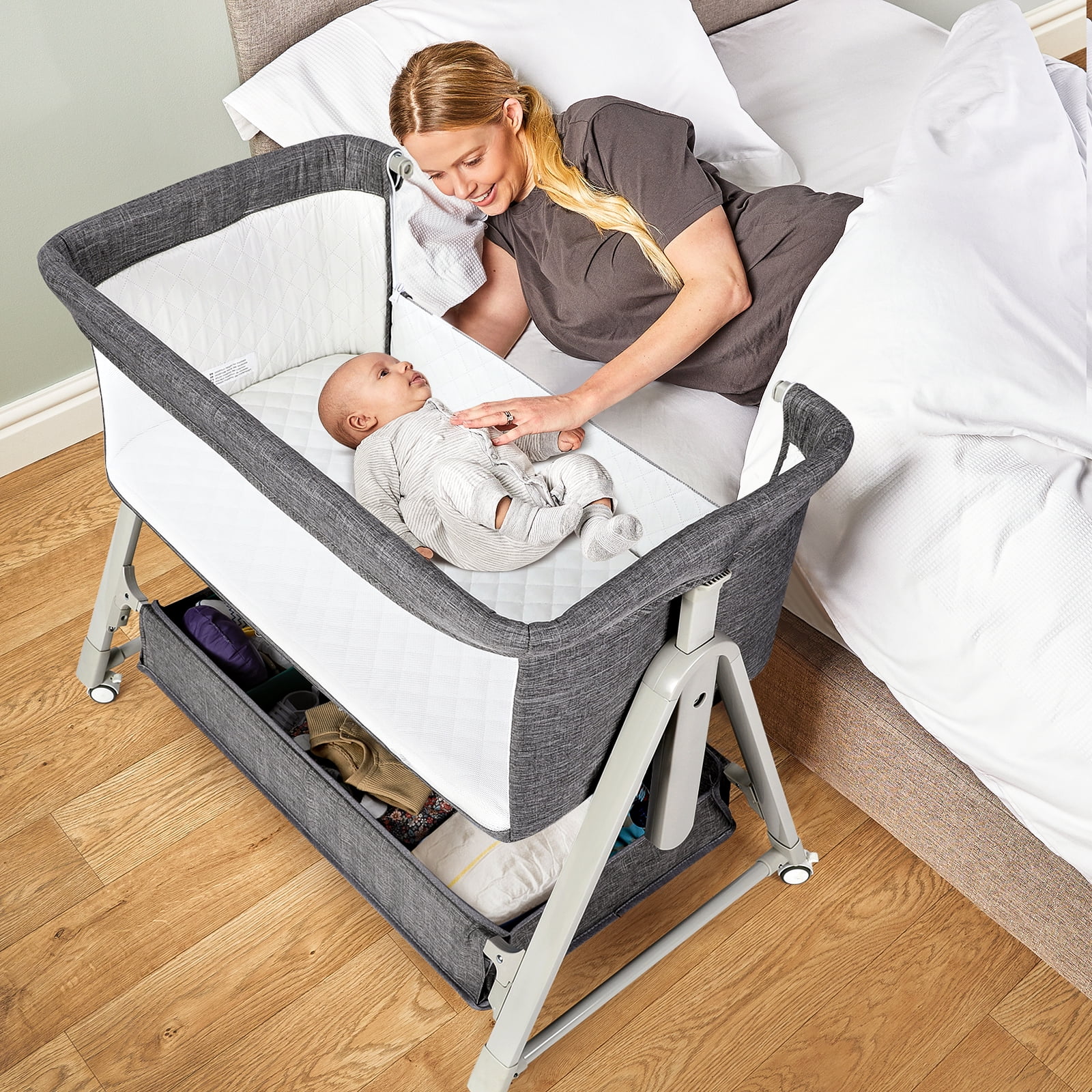
Common Bedside Bassinet Safety Mistakes
The most common problems involve setup, not the basic idea of room sharing.
Treating a bedside sleeper like an open extension of the adult bed
An open side does not make the adult mattress part of the bassinet. The baby should remain on the product’s own sleep surface. Follow the manual on whether and when the side can be lowered.
Using extra padding to make the mattress softer
Extra padding can change the angle, reduce firmness, block airflow, or create a gap. Use only the approved mattress and fitted sheet.


Adding a “breathable” bumper
Mesh does not make a bumper necessary. The safest bassinet is still an empty bassinet. Bumpers, liners, and padded accessories can create entrapment or suffocation hazards.
Assuming a new product cannot be recalled
New products can be recalled. Check the model name, model number, and manufacture date. A used product may also lack a required part or have an outdated design.
Using a product after the baby can move
A bassinet is for a limited stage. If the baby can roll, push up, sit, or pull up, the low side may no longer provide enough protection.
Confusing a lounger with a sleep product
Baby loungers, nests, and padded pods may look comfortable, but appearance is not proof of safe sleep design. Use them only while the baby is awake and supervised if the manufacturer allows that use. Move a sleeping baby to a proper sleep space.
Ignoring damage
Stop using the bassinet if the mesh tears, the frame bends, the side does not lock, a wheel breaks, or the mattress no longer fits. Contact the manufacturer rather than repairing a structural part yourself.

How to Choose a Safe Bedside Bassinet
Use this short checklist before buying:
| Check | What to look for |
|---|---|
| Intended use | The product is made for infant sleep, not lounging or play |
| U.S. compliance | The manufacturer provides applicable safety information for the U.S. model |
| Sleep surface | Firm, flat, level, and free from added padding |
| Bed compatibility | The adult mattress height and bed frame match the manual |
| Attachment | Secure straps or brackets are included when required |
| Limits | Clear weight, age, height, and developmental limits |
| Replacement parts | The company can provide approved sheets or parts |
| Recall support | A model number, date code, and registration process are available |
| Portability | Folding or travel use is explained in the instructions |
| Visibility | The design allows the parent to check the baby without leaning over dangerously |
Avoid choosing based only on a lower price, a large storage basket, a soft appearance, or a claim that the product is “anti-roll” or “breathable.” Those features do not replace a firm, flat sleep surface and correct use.
If you are considering a used bassinet, identify the exact model. Check recalls, confirm every part is present, and inspect the frame, locks, mesh, mattress, and attachment system. When the history is unknown, a new product with clear instructions may be the safer choice.

What to Do If the Bassinet Seems Unsafe
Move the baby to another approved sleep space if:
- The bassinet rocks, tips, or shifts.
- The side will not lock or stay in position.
- There is a visible gap between the bassinet and adult bed.
- The mattress is curved, soft, damaged, or too small.
- A part is missing or broken.
- The bassinet has been recalled.
- The baby has reached a listed limit.
- You cannot confirm how to assemble or attach it.
Do not use towels, pillows, blankets, tape, rope, or homemade parts to correct the problem. Contact the manufacturer for approved parts and instructions. For a recall, follow the remedy listed by the manufacturer or CPSC.
If a baby is trapped, having trouble breathing, unusually limp, or unresponsive, call 911 immediately. For urgent questions about a possible exposure or poisoning, contact Poison Control at 1-800-222-1222.
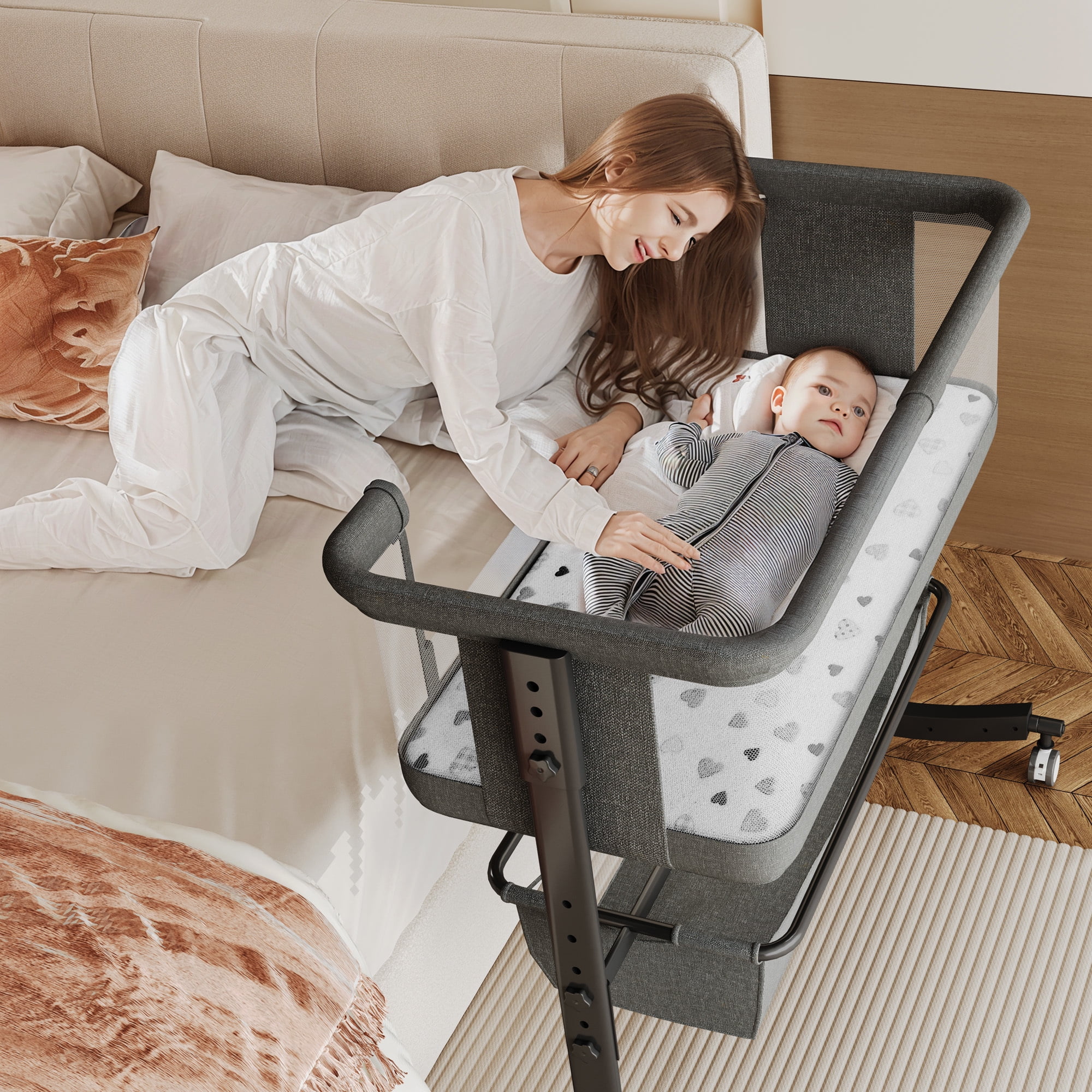
Frequently Asked Questions
Is it safe to use a bedside bassinet all night?
Yes, if the product is designed for overnight infant sleep and is used within its instructions and limits. The baby should sleep on a firm, flat, empty surface, on their back, in the same room as the parent but on a separate sleep surface.
Can a baby sleep in a bedside bassinet with the side down?
Only if the exact product instructions allow it and the bassinet remains stable and safe in that position. Some bedside sleepers have a side that lowers only while the parent is awake and accessing the baby. Never assume that a lowered side is approved for unsupervised sleep.
Is a bedside bassinet safer than a crib?
Both can be safe when they meet U.S. requirements and are used correctly. A bedside bassinet may make room sharing and nighttime care easier, but it is usually used for a shorter period and has lower developmental limits.
A crib, portable crib, or play yard may be more suitable once the baby can roll, push up, or sit.

Can I put a mattress topper in a bedside bassinet?
No. Do not add a topper or any other padding unless the manufacturer specifically supplies and approves it for that model. Extra padding can make the surface less firm or create gaps.
Can my baby sleep in a bedside bassinet if they roll over?
Follow the product manual, but stop using the bassinet when the baby reaches its rolling or movement limit. Always place the baby on their back at the start of sleep. Do not use swaddling or restraints to prevent normal movement.
Bottom Line
A bedside bassinet can be a safe choice for a baby in the United States when it provides a separate, firm, flat, empty sleep surface and is assembled and attached exactly as directed.
The key rules are simple: place the baby on their back, keep the bassinet empty, prevent gaps and movement, check recalls, and stop using it when the baby reaches the product’s limits. Room sharing can support safer sleep, but the baby should not share the adult bed.
Before the next sleep, check the manual, inspect the bassinet, confirm the mattress fit, secure the attachment, and remove every item except the baby and fitted sheet.
