
A jogging stroller is built for controlled running, not just everyday walks. Compared with a standard stroller, it usually has three larger wheels, a more stable frame, stronger suspension, a front wheel that locks straight, and safety features that help a parent stay in control at higher speeds.
Those parts make a jogging stroller better suited to paved paths, tracks, and smooth park trails. They also make it heavier, wider, less compact, and less convenient for stores or crowded sidewalks.

Jogging stroller vs. regular stroller: the main differences
The key difference is stability during motion. A regular stroller is made for walking, turning, folding, and daily errands. A jogging stroller is made to track in a straight line and absorb more movement while the adult moves at a faster pace.
Here is a simple comparison:
| Feature | Jogging stroller | Regular stroller |
|---|---|---|
| Wheel layout | Usually three wheels | Often four wheels or small front wheels |
| Front wheel | Often locks straight | Usually swivels freely |
| Tires | Large, often air-filled or air-like | Smaller, often solid |
| Suspension | Designed for uneven paths | Limited or focused on light bumps |
| Frame | More rigid and stable | Often lighter and more compact |
| Brakes | Hand brake may be included | Usually foot-operated parking brake |
| Best use | Running, brisk walks, smooth trails | Errands, travel, sidewalks, daily use |
| Folded size | Often larger | Usually smaller |
| Weight | Often heavier | Often lighter |
A three-wheel design alone does not make a stroller a jogging stroller. Some everyday strollers have three wheels but lack the wheel control, suspension, tires, or frame strength needed for running.


The most important feature: a lockable front wheel
A jogging stroller often has a front wheel that can swivel for walking and lock in a straight position for jogging. This is one of the clearest differences from a standard stroller.
A locked front wheel helps the stroller move in a predictable line. A freely swiveling wheel can turn quickly when it meets a crack, stone, or change in direction. That sudden turn may pull the stroller off course.
The exact control varies by model. Some strollers use a lever, while others use a knob or pin. Check that the wheel is fully locked before running. A partial lock is not enough.
Larger tires roll over more ground
Jogging stroller tires are usually much larger than regular stroller wheels. Large tires can roll over small cracks, roots, gravel, and uneven pavement with less resistance.
Many jogging strollers use air-filled tires. These can provide a smoother ride, but they need regular pressure checks and can lose air or get punctured. Other models use foam-filled or rubber tires that need less care but may feel different on rough ground.
The tire type is a trade-off:
- Air-filled tires: often smooth and responsive, but they need inflation and repair.
- Foam-filled tires: low maintenance and resistant to punctures, but may have a firmer ride.
- Solid rubber tires: simple and durable, though they may transmit more vibration.
Suspension reduces bumps
Suspension helps separate the stroller body from the motion of the wheels. This can make uneven paths more comfortable for the child and easier for the adult to control.
Suspension does not make every surface safe. A stroller with suspension can still tip, bounce, or become hard to control on steep hills, deep sand, large rocks, or wet roots.
Look at the full system rather than one feature. Tire size, frame design, wheelbase, suspension travel, and the path itself all affect the ride.

Why jogging strollers have a hand brake and wrist strap
A hand brake gives the adult more control on slopes and during changes in speed. It is usually mounted near the handlebar and may work on one or more wheels.
A hand brake is not the same as the parking brake. The parking brake holds the stroller in place when you stop. The hand brake helps manage motion while you are moving.


A wrist strap is another common feature. It connects the stroller to the adult’s wrist so the stroller is less likely to roll away if the handle slips from the hand.
Use the strap when jogging. Keep one hand on the handlebar and avoid tying the strap to a bicycle, scooter, or another moving object.
How to test the brakes
Before using a jogging stroller:
- Check that the parking brake engages fully.
- Press the stroller forward gently while the parking brake is on.
- Test the hand brake at walking speed in a clear area.
- Confirm that the stroller slows in a straight and controlled way.
- Read the manual for brake adjustment instructions.
Do not rely on the hand brake to hold the stroller on a hill while you stand away from it. Use the parking brake and keep hold of the stroller.
Why a fixed wheel can feel harder to turn
A locked front wheel improves straight-line tracking, but it makes tight turns harder. You may need to slow down, lift the front wheel slightly, or unlock the wheel before turning at walking speed.
This is why many jogging strollers have two modes:
- Swivel mode: useful for stores, sidewalks, and tight turns.
- Locked mode: useful for jogging and faster, straighter movement.
Change modes only when the stroller is stopped or moving very slowly, as the manual directs.

How the frame and seat differ from a regular stroller
A jogging stroller usually has a longer wheelbase and a more rigid frame. The longer base can improve stability while moving forward, but it also increases the turning radius and folded size.
The seat often has deeper side support and a five-point harness. Some models offer a near-flat recline, while others keep the seat more upright. A recline can help with comfort, but it does not automatically make the stroller suitable for a young infant during a run.
The harness should sit correctly over the child’s shoulders and hips. It should be snug without pressing into the child. The child should not be able to slide under the straps.
Can you use a jogging stroller with a newborn?
Do not assume that a jogging stroller is safe for a newborn. Many manufacturers set a minimum age or developmental requirement for jogging, often based on head and neck control. The exact rule depends on the stroller and its approved accessories.
The American Academy of Pediatrics advises parents to follow the manufacturer’s age guidance and use care with young infants. Many products allow use as a regular stroller before they allow running, but those are separate uses.
A car seat adapter does not automatically make jogging safe. In many cases, an adapter is approved for walking only. Use an infant car seat during a run only if the stroller manufacturer clearly states that running with that exact setup is allowed.


The safest approach is:
- Read the stroller manual before use.
- Follow the minimum age and weight limits.
- Wait for the developmental milestone the manual requires.
- Use only approved car seats and adapters.
- Do not jog with a child who cannot maintain the required head and neck control.
When the manual is unclear, contact the manufacturer before running.
Can a child sleep in a jogging stroller?
A supervised stroller nap may be allowed in some situations, but a jogging stroller is not a substitute for a safe sleep space. Do not add pillows, loose blankets, positioners, or aftermarket sleep pads unless the manufacturer specifically approves them.
Keep the child secured, maintain supervision, and follow the product’s instructions. For routine sleep, move the child to a safe sleep surface that follows current pediatric guidance.
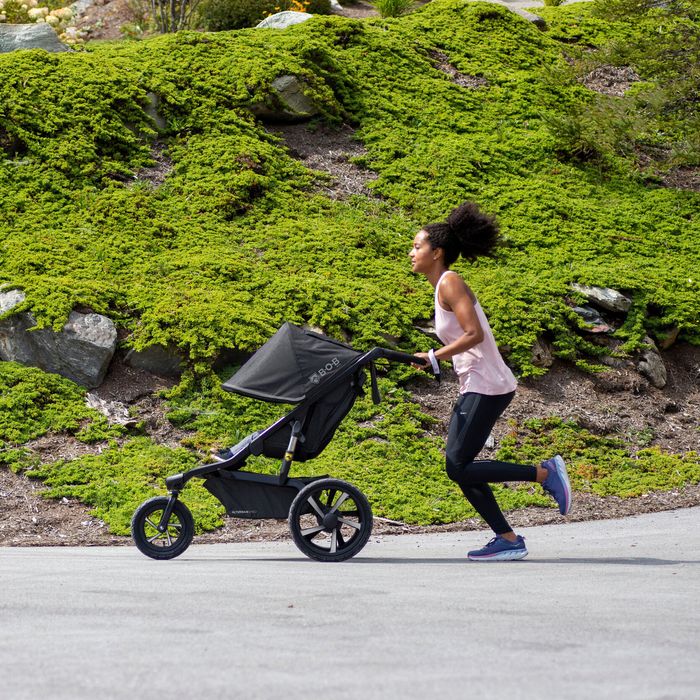
What makes a jogging stroller safer for running?
A jogging stroller can improve control, but it does not remove running risks. Its safety depends on the stroller, the child’s readiness, the route, the weather, and the adult’s handling.
The U.S. Consumer Product Safety Commission regulates stroller safety requirements in the United States. Federal rules include requirements for stroller design, restraints, parking brakes, and other safety features. A stroller that meets a safety standard is not automatically safe for every activity or surface.
Features that support safer use
Look for:
- A front wheel that locks securely.
- A five-point harness.
- A wrist strap.
- A working parking brake.
- A hand brake when running on routes with slopes.
- A stable, rigid frame.
- Tires suited to the surface you plan to use.
- A canopy that protects from sun without blocking your view.
- A storage basket that does not interfere with the wheels or brake.
- Clear instructions for the child’s age, weight, and activity limits.
No single feature proves that a stroller is safe for running. The parts must work together.
Check the route before you run
Start on a flat, smooth surface. Avoid:
- Steep hills
- Deep sand
- Ice and snow
- Wet leaves
- Large rocks
- Broken pavement
- Narrow paths with drop-offs
- Crowded areas
- Roads without a safe separation from traffic
Run at a pace that lets you stop quickly. A stroller adds weight and length, so it takes more space and may need more time to stop.
Keep the stroller balanced
Place heavy items low and near the center of the storage basket. Do not hang heavy bags from the handlebar unless the manual allows it. Extra weight near the handle can affect balance and increase the risk of tipping.
Keep hands, feet, toys, and blankets away from the wheels. Check that the canopy, harness, and accessories cannot reach moving parts.

Jogging stroller limitations and trade-offs
A jogging stroller is not better at everything. Its design solves one problem—controlled movement on faster outdoor trips—but creates other compromises.


It is often heavier
Large wheels, suspension, and a rigid frame add weight. This may be noticeable when lifting the stroller into a car or carrying it up stairs.
Before buying, check:
- Stroller weight
- Folded height and width
- Trunk space
- Carry handles
- One-hand folding claims
- Whether the wheels must be removed for transport
A stroller can be easy to push but hard to lift. Test both if possible.
It may not fit well in small spaces
The longer wheelbase and larger wheels can make a jogging stroller awkward in:
- Small elevators
- Narrow store aisles
- Public transit
- Tight apartment halls
- Crowded sidewalks
- Restaurant spaces
Measure the stroller when folded and unfolded. Compare those measurements with your car trunk, storage area, and front door.
It needs more maintenance
Air-filled tires need pressure checks. Moving parts may need cleaning. Mud, sand, and salt can affect wheel bearings, brakes, and frame joints.
A basic care routine includes:
- Check tire pressure before longer runs.
- Inspect tires for cuts, worn tread, and embedded objects.
- Test the front-wheel lock.
- Test the parking brake and hand brake.
- Check the harness and wrist strap.
- Remove dirt from the wheels and folding joints.
- Follow the manual for lubrication and replacement parts.
Do not use a stroller with a loose wheel, damaged frame, broken brake, torn harness, or faulty front-wheel lock.
It may cost more than a basic stroller
The price often reflects larger tires, suspension, brakes, and frame materials. However, a higher price does not prove that one model is safer or better for every family.
Compare the features that match your use. A parent who only walks on smooth sidewalks may gain little from a high-performance running model. A parent who runs several times each week may value wheel control and suspension more than a compact fold.
How to choose the right jogging stroller
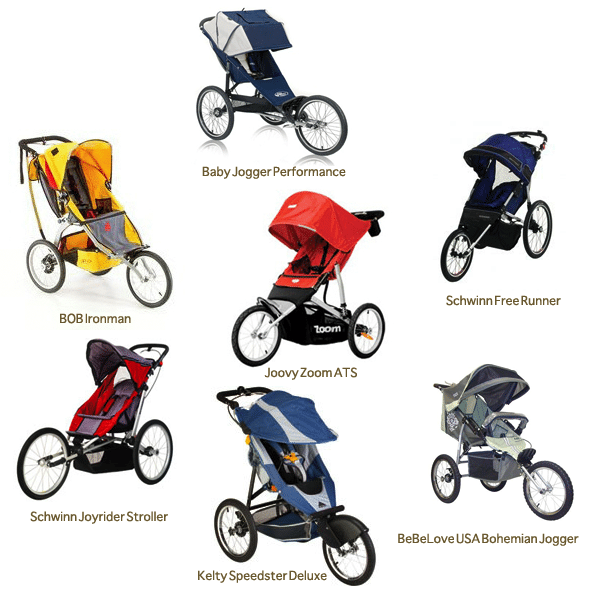
Choose based on where, how often, and with whom you will use it. The best jogging stroller for a flat paved trail may not be the best choice for a small car or a crowded city sidewalk.
Use this decision guide:
| Your main need | Features to prioritize | Possible trade-off |
|---|---|---|
| Regular running | Lockable front wheel, good tracking, wrist strap, hand brake | More weight and bulk |
| Park trails | Larger tires, strong suspension, durable frame | Less compact |
| Flat sidewalks | Stable wheelbase, reliable brake, easy steering | May not need advanced suspension |
| Small car | Compact fold, removable wheels, low folded weight | Smaller tires or less suspension |
| Errands and running | Swivel-to-lock front wheel | More controls to learn |
| Hot, sunny routes | Large canopy, ventilation, adjustable sun shade | Canopy may add bulk |
| One-child daily use | Simple harness and manageable weight | Fewer advanced features may lower cost |
Questions to ask before buying
- Will I run, walk, or do both?
- Are my routes flat, hilly, paved, or rough?
- Can I lock the front wheel securely?
- Does the seat meet my child’s current age and developmental needs?
- Is the car seat adapter approved for my intended activity?
- Can I lift the stroller into my vehicle?
- Will it fit through my doors and storage space?
- Are replacement tubes, wheels, and brake parts available?
- Does the stroller have a current recall?
- Can I test the stroller before buying?
Check the CPSC recalls database and the manufacturer’s support page before purchasing a used stroller. A used model may be missing a wheel lock, harness part, adapter, or recall repair.

Common mistakes when using a jogging stroller
The most common errors come from treating a jogging stroller like a normal stroller or treating it like a sports machine. It is both a child carrier and a moving piece of equipment, so setup and handling matter.


Running with the front wheel unlocked
A swiveling wheel can turn suddenly on uneven ground. Lock the wheel before jogging if the manual requires it.
Using the wrong child age or accessory
A stroller may allow walking with a younger child but prohibit jogging until later. Check the activity-specific instructions, not only the general stroller age range.
Overloading the handlebar
Heavy bags can shift the center of gravity. Use the storage basket within its stated weight limit.
Relying on the brake instead of the strap
The hand brake helps control speed. The wrist strap helps keep the stroller connected to you. Use both as directed.
Running too fast
A jogging stroller does not guarantee stability at any speed. Slow down near turns, people, driveways, slopes, and rough surfaces.
Skipping tire checks
Low tire pressure can change steering and handling. Overinflation can also create problems. Use the pressure range printed on the tire or listed in the manual.
Adding unapproved accessories
Cup holders, boards, organizers, fans, and phone mounts can affect balance or block folding and braking parts. Use only accessories approved for that stroller.
Is a jogging stroller worth it?
A jogging stroller is worth considering if you plan to run regularly with your child and have safe routes where its larger wheels and stable design are useful.
It may not be worth the added cost or bulk if you mainly need a stroller for shopping, travel, indoor spaces, or short sidewalk walks. In that case, a regular stroller may be easier to lift, store, and turn.
Some families use two strollers: a compact everyday stroller and a jogging stroller for outdoor exercise. Others choose one model that supports both walking and running. The right choice depends on whether you are willing to accept the weight and size of a running-focused design every day.
The central trade-off is simple: a jogging stroller improves control and comfort on suitable outdoor routes, but it gives up some convenience in tight spaces.
Frequently asked questions
What is the difference between a jogging stroller and an all-terrain stroller?
A jogging stroller is designed for controlled forward movement at a faster pace. An all-terrain stroller is designed to handle varied walking surfaces. Some models do both, but an all-terrain stroller is not automatically approved for running.
Check for a lockable front wheel, running instructions, a wrist strap, and activity-specific limits.
Can I use a jogging stroller for everyday walking?
Usually, yes, if the manufacturer allows it. Unlocking the front wheel can make everyday turns easier. The main drawbacks are weight, width, and a larger folded size.
Do all jogging strollers have three wheels?
Most traditional jogging strollers have one front wheel and two rear wheels. Some newer designs may use different wheel layouts or dual front wheels. The wheel count matters less than tracking, wheel control, frame stability, and the manufacturer’s running approval.
Are air tires better than foam tires?
Neither is best for every user. Air tires may provide a softer ride but require inflation and repair. Foam or solid tires need less maintenance but may feel firmer. Choose based on your route and willingness to maintain the tires.
Can I run with an infant car seat attached?
Only if the manufacturer clearly approves running with that exact car seat and adapter. Many adapters are intended for walking only. Follow the stroller manual and the car seat instructions.
What should I do if the stroller pulls to one side?
Stop running and inspect the front-wheel lock, tire pressure, wheel alignment, axle, and brake. Uneven tire pressure can affect tracking. If the stroller still pulls, stop using it for running and contact the manufacturer or a qualified repair service.
Final answer
What makes a jogging stroller different is its focus on controlled forward motion. It typically combines a lockable front wheel, large tires, suspension, a stable frame, a wrist strap, and—on many models—a hand brake.
Those features help with running, but they also add weight, size, cost, and maintenance. Before using one, confirm the child’s age and developmental readiness, follow the manufacturer’s running instructions, inspect the brakes and wheels, and start on a flat, clear path.
For most families, the best choice is not the stroller with the most features. It is the one that matches the parent’s route, the child’s stage, the vehicle, and the way the stroller will actually be used.
